

Quadratic Equations: GCSE to A Level Revision Guide
Quadratic equations made clear for GCSE and A Level. Learn factorising, completing the square and the formula with worked examples and mistakes to avoid.
Quadratic equations have a strange talent: they look familiar, then steal your confidence under timed conditions. One minute it’s a neat x2x^2x2 term and a couple of numbers, the next it’s “show that…”, “hence find…”, or a curve-sketching question that suddenly wants exact roots. If that’s you, you’re not behind. You’re just meeting quadratic equations the way exams present them: as a small idea wearing different outfits.
This guide gives you a calm, method-first way to revise quadratic equations for GCSE (foundation and higher) and A Level (Edexcel, AQA, OCR, Eduqas). You’ll see when to factorise, when to use the quadratic formula, when completing the square is the most elegant option, and how to check answers quickly.
Use it alongside YesGenie’s free revision lessons, practice questions, mark schemes, predicted papers and past papers: YesGenie Resources.
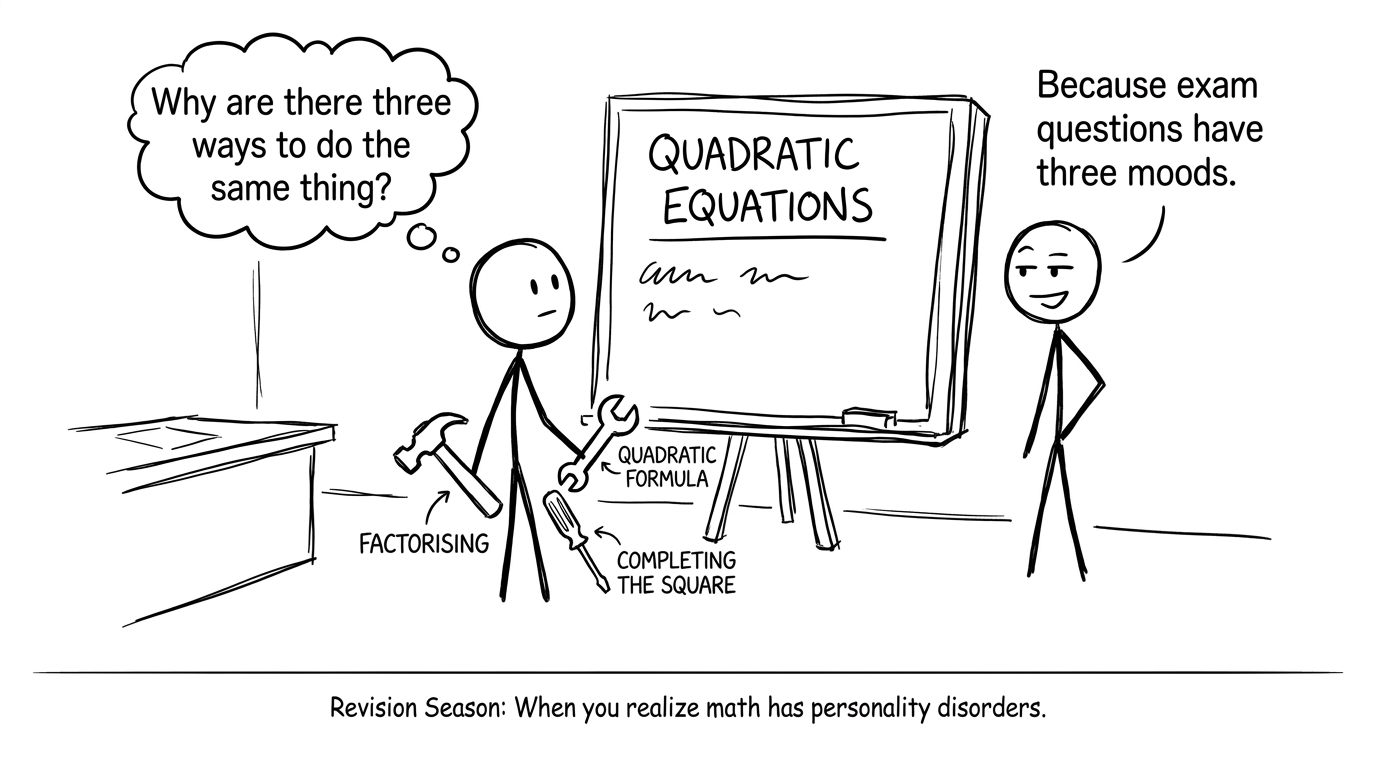 Three methods, three moods
A quick checklist for quadratic equations
When you see quadratic equations, ask these three questions before you write anything:
- Is it in standard form? Aim for ax2+bx+c=0ax^2+bx+c=0ax2+bx+c=0.
- Does it factorise nicely? Look for integer factors of acacac that sum to bbb.
- Do I need exact answers or an approximation? Exact roots often mean factorising, completing the square, or the quadratic formula. Approximations suggest the formula or calculator.
Then choose a method:
- Factorising (fastest when it works)
- Quadratic formula (works for every quadratic)
- Completing the square (best for turning points, transformations, some “show that” questions)
If you’re building your topic list, start from the general revision area and drill down: All revision resources on YesGenie.
What quadratic equations really are (and why exams love them)
A quadratic is any expression of the form ax2+bx+cax^2+bx+cax2+bx+c where a≠0a\neq 0a=0. A quadratic equation sets that expression equal to something, usually 000:
ax2+bx+c=0. ax^2+bx+c=0. ax2+bx+c=0.Solving quadratic equations means finding the xxx-values where the parabola crosses the xxx-axis. That’s why the same skill appears in different GCSE and A Level topics: graphs, algebraic manipulation, simultaneous equations, inequalities, optimisation, kinematics. The “quadratic” part is the thread.
A small but powerful habit: always rewrite into =0 \,=0\,=0 form first. It reduces mistakes and makes method choice obvious.
Solving quadratic equations by factorising
Factorising is the method that feels like a shortcut, but it’s actually a test of structure. If you can express
ax2+bx+c=(px+q)(rx+s), ax^2+bx+c=(px+q)(rx+s), ax2+bx+c=(px+q)(rx+s),then the zero product rule says:
(px+q)(rx+s)=0⇒px+q=0 or rx+s=0. (px+q)(rx+s)=0 \Rightarrow px+q=0 \text{ or } rx+s=0. (px+q)(rx+s)=0⇒px+q=0 or rx+s=0.Worked example (GCSE Higher)
Solve x2−7x+12=0x^2-7x+12=0x2−7x+12=0.
Factorise by finding two numbers that multiply to 121212 and add to −7-7−7: −3-3−3 and −4-4−4.
x2−7x+12=(x−3)(x−4). x^2-7x+12=(x-3)(x-4). x2−7x+12=(x−3)(x−4).Set each bracket to zero:
x−3=0⇒x=3, x-3=0 \Rightarrow x=3, x−3=0⇒x=3, x−4=0⇒x=4. x-4=0 \Rightarrow x=4. x−4=0⇒x=4.So the solutions are x=3x=3x=3 and x=4x=4x=4.
Worked example (GCSE Higher: leading coefficient not 1)
Solve 2x2−5x−3=02x^2-5x-3=02x2−5x−3=0.
Multiply a×c=2×(−3)=−6a\times c=2\times(-3)=-6a×c=2×(−3)=−6. Find two numbers that multiply to −6-6−6 and add to −5-5−5: −6-6−6 and 111.
Split the middle term:
2x2−6x+x−3=0. 2x^2-6x+x-3=0. 2x2−6x+x−3=0.Factor by grouping:
2x(x−3)+1(x−3)=0, 2x(x-3)+1(x-3)=0, 2x(x−3)+1(x−3)=0, (2x+1)(x−3)=0. (2x+1)(x-3)=0. (2x+1)(x−3)=0.So:
2x+1=0⇒x=−12, 2x+1=0 \Rightarrow x=-\frac{1}{2}, 2x+1=0⇒x=−21, x−3=0⇒x=3. x-3=0 \Rightarrow x=3. x−3=0⇒x=3.Factorising is a core GCSE skill, but it also stays relevant at A Level when expressions get rearranged into solvable factors.
Solving quadratic equations with the quadratic formula
The quadratic formula is the method you use when factorising is awkward or impossible over integers.
For ax2+bx+c=0ax^2+bx+c=0ax2+bx+c=0:
x=−b±b2−4ac2a. x=\frac{-b\pm\sqrt{b^2-4ac}}{2a}. x=2a−b±b2−4ac.The discriminant Δ=b2−4ac\Delta=b^2-4acΔ=b2−4ac tells you what kind of solutions you’ll get:
- Δ>0\Delta>0Δ>0: two distinct real roots
- Δ=0\Delta=0Δ=0: one repeated real root
- Δ<0\Delta<0Δ<0: no real roots (complex roots at A Level)
Worked example (GCSE Higher / A Level starter)
Solve 3x2+2x−1=03x^2+2x-1=03x2+2x−1=0.
Here a=3a=3a=3, b=2b=2b=2, c=−1c=-1c=−1.
x=−2±22−4⋅3⋅(−1)2⋅3=−2±4+126=−2±166=−2±46. x=\frac{-2\pm\sqrt{2^2-4\cdot 3\cdot(-1)}}{2\cdot 3} =\frac{-2\pm\sqrt{4+12}}{6} =\frac{-2\pm\sqrt{16}}{6} =\frac{-2\pm 4}{6}. x=2⋅3−2±22−4⋅3⋅(−1)=6−2±4+12=6−2±16=6−2±4.So:
x=−2+46=26=13, x=\frac{-2+4}{6}=\frac{2}{6}=\frac{1}{3}, x=6−2+4=62=31, x=−2−46=−66=−1. x=\frac{-2-4}{6}=\frac{-6}{6}=-1. x=6−2−4=6−6=−1.A quiet exam advantage: if Δ\sqrt{\Delta}Δ is a tidy integer, your final answers often simplify cleanly.
Solving quadratic equations by completing the square
Completing the square is the method that feels slower at first, then suddenly becomes the most useful tool you have. It converts a quadratic into vertex form:
a(x−h)2+k. a(x-h)^2+k. a(x−h)2+k.That helps with:
- solving quadratic equations (especially when factorising is hard)
- finding turning points (GCSE graphs and A Level calculus links)
- solving inequalities and sketching parabolas
Worked example (GCSE Higher)
Solve x2+6x+1=0x^2+6x+1=0x2+6x+1=0 by completing the square.
Start with the x2x^2x2 and xxx terms:
x2+6x+1=(x2+6x+9)−9+1. x^2+6x+1=(x^2+6x+9)-9+1. x2+6x+1=(x2+6x+9)−9+1.Because (62)2=9\left(\frac{6}{2}\right)^2=9(26)2=9.
So:
x2+6x+1=(x+3)2−8. x^2+6x+1=(x+3)^2-8. x2+6x+1=(x+3)2−8.Set equal to zero:
(x+3)2−8=0⇒(x+3)2=8. (x+3)^2-8=0 \Rightarrow (x+3)^2=8. (x+3)2−8=0⇒(x+3)2=8.Take square roots:
x+3=±8=±22. x+3=\pm\sqrt{8}=\pm 2\sqrt{2}. x+3=±8=±22.So:
x=−3±22. x=-3\pm 2\sqrt{2}. x=−3±22.This is a classic example where factorising won’t give nice integers, but the exact surd answers are still straightforward.
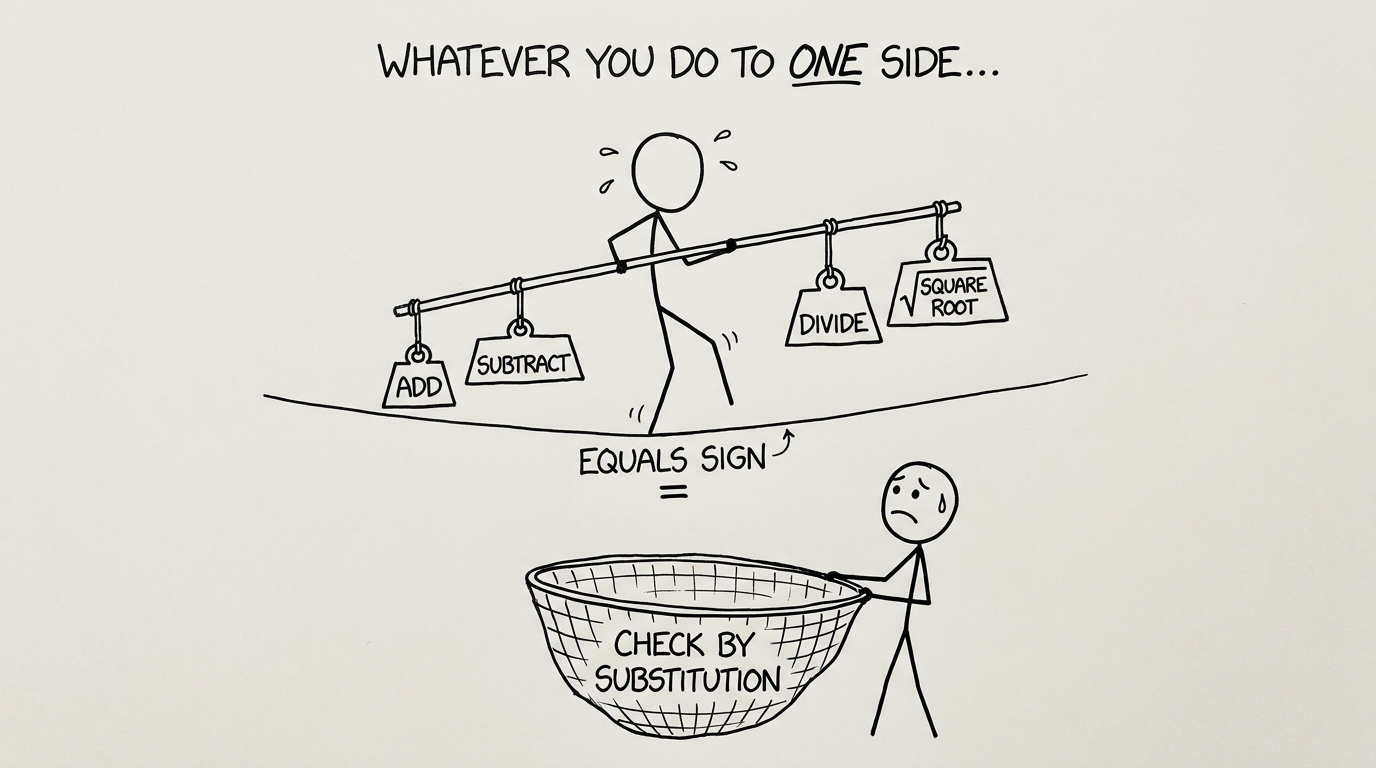 Whatever you do to one side...
Quadratic equations in disguise (rearranging and substituting)
Exams rarely announce themselves with a clean ax2+bx+c=0ax^2+bx+c=0ax2+bx+c=0. Quadratic equations often arrive as:
- fractions
- brackets
- powers like (x+1)2(x+1)^2(x+1)2
- substitution questions in A Level
Worked example (GCSE Higher: rearrange first)
Solve 2x+1=x\frac{2}{x}+1=xx2+1=x.
Multiply both sides by xxx (with the note x≠0x\neq 0x=0):
2+x=x2. 2+x=x^2. 2+x=x2.Rearrange:
x2−x−2=0. x^2-x-2=0. x2−x−2=0.Factorise:
(x−2)(x+1)=0. (x-2)(x+1)=0. (x−2)(x+1)=0.So:
x=2 or x=−1. x=2 \text{ or } x=-1. x=2 or x=−1.Both are valid (neither is 000), so both solutions stand.
Worked example (A Level: substitution creates a quadratic)
Solve x4−5x2+4=0x^4-5x^2+4=0x4−5x2+4=0.
Let u=x2u=x^2u=x2. Then:
u2−5u+4=0. u^2-5u+4=0. u2−5u+4=0.Factorise:
(u−1)(u−4)=0⇒u=1 or u=4. (u-1)(u-4)=0 \Rightarrow u=1 \text{ or } u=4. (u−1)(u−4)=0⇒u=1 or u=4.Now substitute back:
- If x2=1x^2=1x2=1, then x=±1x=\pm 1x=±1.
- If x2=4x^2=4x2=4, then x=±2x=\pm 2x=±2.
So x∈{−2,−1,1,2}x\in\{-2,-1,1,2\}x∈{−2,−1,1,2}.
That pattern -- reduce to a quadratic, solve, then interpret solutions -- is everywhere in A Level maths.
Checking solutions quickly (the habit that saves marks)
A surprising number of lost marks on quadratic equations come from one sign error early on. Checking doesn’t need to be long.
Pick one solution and substitute into the original equation. If you’re short on time, substitute into your rearranged =0 \,=0\,=0 form.
For example, from 3x2+2x−1=03x^2+2x-1=03x2+2x−1=0, check x=−1x=-1x=−1:
3(−1)2+2(−1)−1=3−2−1=0. 3(-1)^2+2(-1)-1=3-2-1=0. 3(−1)2+2(−1)−1=3−2−1=0.It works. Do the same for x=13x=\frac{1}{3}x=31:
3(13)2+2(13)−1=3⋅19+23−1=13+23−1=0. 3\left(\frac{1}{3}\right)^2+2\left(\frac{1}{3}\right)-1=3\cdot\frac{1}{9}+\frac{2}{3}-1=\frac{1}{3}+\frac{2}{3}-1=0. 3(31)2+2(31)−1=3⋅91+32−1=31+32−1=0.That’s 20 seconds to protect several marks.
Common mistakes with quadratic equations
Quadratic equations are consistent. Most errors are too.
- Not rearranging to 000 first. If you solve x2=7x−12x^2=7x-12x2=7x−12 without moving terms carefully, signs go missing. Always write x2−7x+12=0x^2-7x+12=0x2−7x+12=0.
- Dropping the ±\pm± when square rooting. From (x+3)2=8(x+3)^2=8(x+3)2=8, you must write x+3=±8x+3=\pm\sqrt{8}x+3=±8. One root is half the marks gone.
- Incorrect substitution into the quadratic formula. The formula is reliable, but only if aaa, bbb, and ccc match ax2+bx+c=0ax^2+bx+c=0ax2+bx+c=0. A common slip is using bbb as positive when it’s negative in the equation.
- Factorising errors with a≠1a\neq 1a=1. For 2x2−5x−32x^2-5x-32x2−5x−3, students often guess (2x−3)(x+1)(2x-3)(x+1)(2x−3)(x+1) which expands to 2x2−x−32x^2-x-32x2−x−3, not the original. Expand once to confirm.
- Cancelling illegally when x=0x=0x=0 is possible. If you multiply or divide by xxx, state x≠0x\neq 0x=0 and check whether x=0x=0x=0 could have been a solution earlier.
- Forgetting to interpret solutions in context. In geometry or kinematics questions, a negative time or negative length might be rejected. The algebra can be correct but the final answer must make sense.
How to revise quadratic equations effectively on YesGenie
Quadratic equations improve fastest when you rotate methods across mixed questions, not when you do twenty of the same type in a row. A good routine is:
- Learn or refresh the method from a revision lesson
- Practise a small set of questions with mark schemes
- Mix in past paper questions so the topic appears in context
Start with the hub and work down into GCSE and A Level resources: YesGenie Resources. Use it to find practice questions, predicted papers, mini tests and past papers by exam board.
When you’re close to exams, predicted papers can help you practise under realistic constraints: Predicted Papers on YesGenie (open the Predicted Papers section).
If you want shorter bursts, use the mini tests to keep quadratic equations fresh between bigger papers: Mini Tests on YesGenie (open the Mini Tests section).
FAQ about quadratic equations
How do I know which method to use for quadratic equations in an exam?
Start by rewriting the question into ax2+bx+c=0ax^2+bx+c=0ax2+bx+c=0, because method choice becomes clearer once everything is on one side. Then look at the numbers: if a=1a=1a=1 and ccc has small factor pairs that sum to bbb, factorising is often quickest and least error-prone. If the quadratic doesn’t factorise nicely, the quadratic formula is your reliable default because it always works and the mark scheme expects it. Completing the square is usually best when the question mentions a turning point, asks you to “write in the form a(x−h)2+ka(x-h)^2+ka(x−h)2+k”, or when you’re heading towards sketching a graph. In GCSE papers (Edexcel, AQA, OCR, Eduqas), factorising is common early and the formula appears more in higher tier, especially when surds appear. In A Level, you’ll use all three, but completing the square becomes particularly useful because it links algebra to calculus and transformations.
Why do I sometimes get two solutions and other times only one (or none)?
Quadratic equations can have up to two real solutions because a parabola can cross the xxx-axis at up to two points. The discriminant Δ=b2−4ac\Delta=b^2-4acΔ=b2−4ac explains this neatly: if Δ>0\Delta>0Δ>0 you get two distinct real roots, if Δ=0\Delta=0Δ=0 you get one repeated root, and if Δ<0\Delta<0Δ<0 there are no real roots. At GCSE you usually stop at “no real solutions” because the graph never meets the axis. At A Level you go further and learn the complex roots, which still come in a pair. This matters in exam questions because a “show that there are no real solutions” task is often just a discriminant check. It also matters when you’re solving a problem in context, because even if the algebra produces two roots, one might be rejected (for example, a negative time). The key is not to panic when the number of solutions changes -- it’s a feature of the maths, not a sign you’ve done it wrong.
What’s the best way to practise quadratic equations for grades 9-1 and A Level?
Practise quadratic equations in three layers: method, mixture, then exam conditions. First, build fluency with each method individually so you can factorise, complete the square, and use the quadratic formula without hesitation. Second, do mixed questions where you must decide the method yourself, because that’s what GCSE and A Level papers actually test. Third, use past papers and predicted papers so quadratic equations appear alongside other topics like graphs, algebraic fractions, and simultaneous equations. When you practise, mark your work with a mark scheme and write down the exact line where you lost marks, because most improvements come from removing one repeated slip. Keep a short “error log” of common mistakes, such as missing the ±\pm± or miscopying bbb. YesGenie makes this loop simple because you can move from revision lessons to practice questions to mark schemes and then straight into exam-style papers in one place: YesGenie Resources.
Do I need to memorise the quadratic formula for GCSE and A Level?
For GCSE, the formula is typically provided on the formula sheet in England, but you still need to know how to use it accurately and when it’s the right choice. Many students lose marks not because they forgot the formula, but because they substituted aaa, bbb, and ccc incorrectly or made arithmetic errors with negatives. For A Level, you should be able to recall it fluently, because it appears across pure maths topics and you often need it without prompting. Even if you can factorise, the formula is your safety net when coefficients get messy or when the question is designed not to factorise. Memorising it also helps you remember the discriminant and what it means for the graph. The best approach is to practise it enough times that it stops feeling like memory and starts feeling like a tool you reach for.
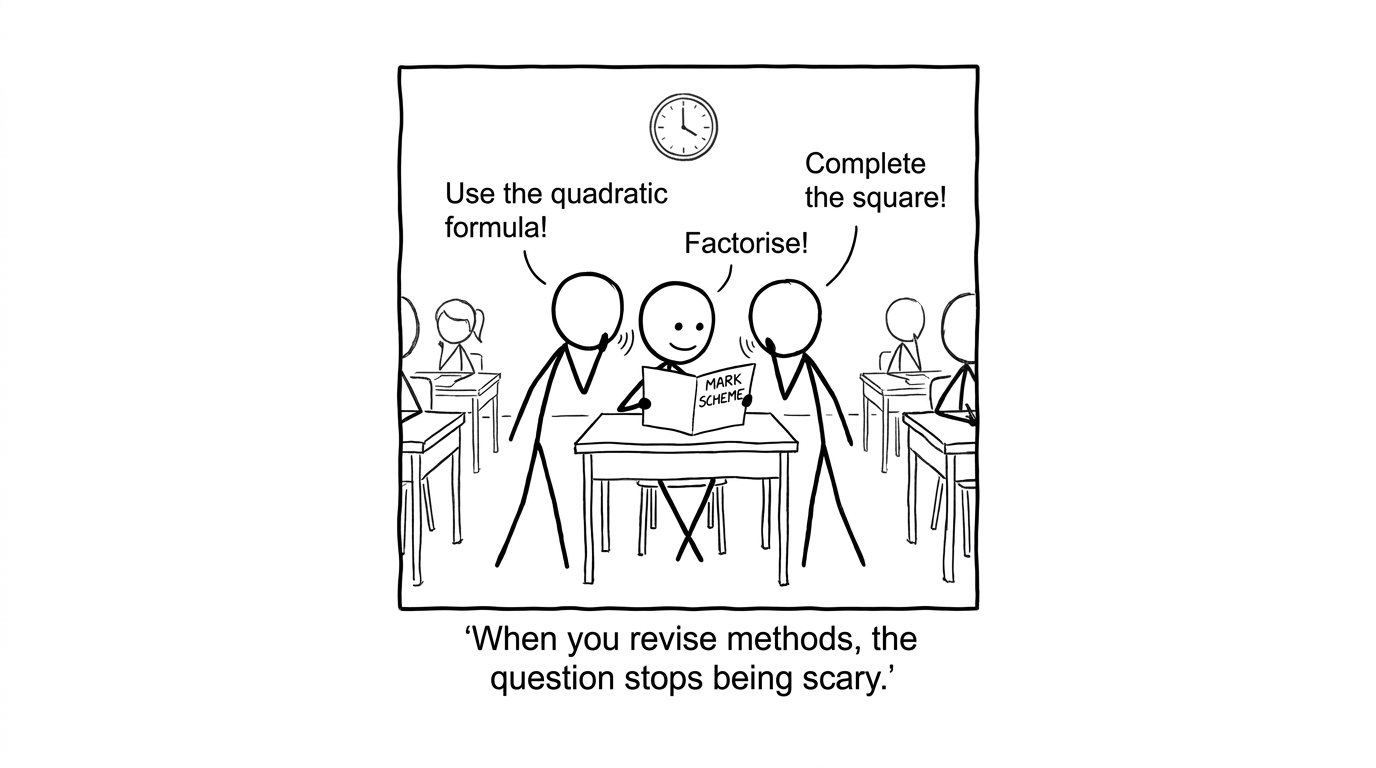 Methods whispering in the exam hall
Closing: make quadratic equations feel predictable
Quadratic equations aren’t hard because they’re complicated. They’re hard because they’re versatile, and exams love versatile ideas. When you can look at a question and calmly choose between factorising, completing the square, and the quadratic formula, quadratic equations stop being a surprise and start being a routine.
Build that routine on YesGenie: use the free revision lessons to lock in each method, then practise with questions and mark schemes, and finally pressure-test your skills with predicted papers and past papers. Start here and work outward: YesGenie Resources. Quadratic equations are a topic where small improvements compound quickly -- and once they click, they keep paying you back across GCSE and A Level maths.