

GCSE Maths Revision: How Parents Can Help Without Nagging
GCSE maths revision without nagging: simple routines, calm accountability, and YesGenie past papers, predicted papers and mini tests to boost grades 9-1.
A lot of GCSE revision arguments don’t start with laziness. They start with fear -- the kind that sits quietly under the surface, then comes out as, “Have you revised?” for the fifth time that evening. If you’re a student, that question can feel like judgement. If you’re a parent, it can feel like the only lever you’ve got.
This post is about finding better levers. Not motivational speeches. Not hovering. Real, practical ways parents can support GCSE maths revision without nagging, while you (the student) still stay in control of your own progress. And because maths is one of the few subjects where improvement is visible, we’ll use a few short worked examples to show what “helpful support” looks like in practice.
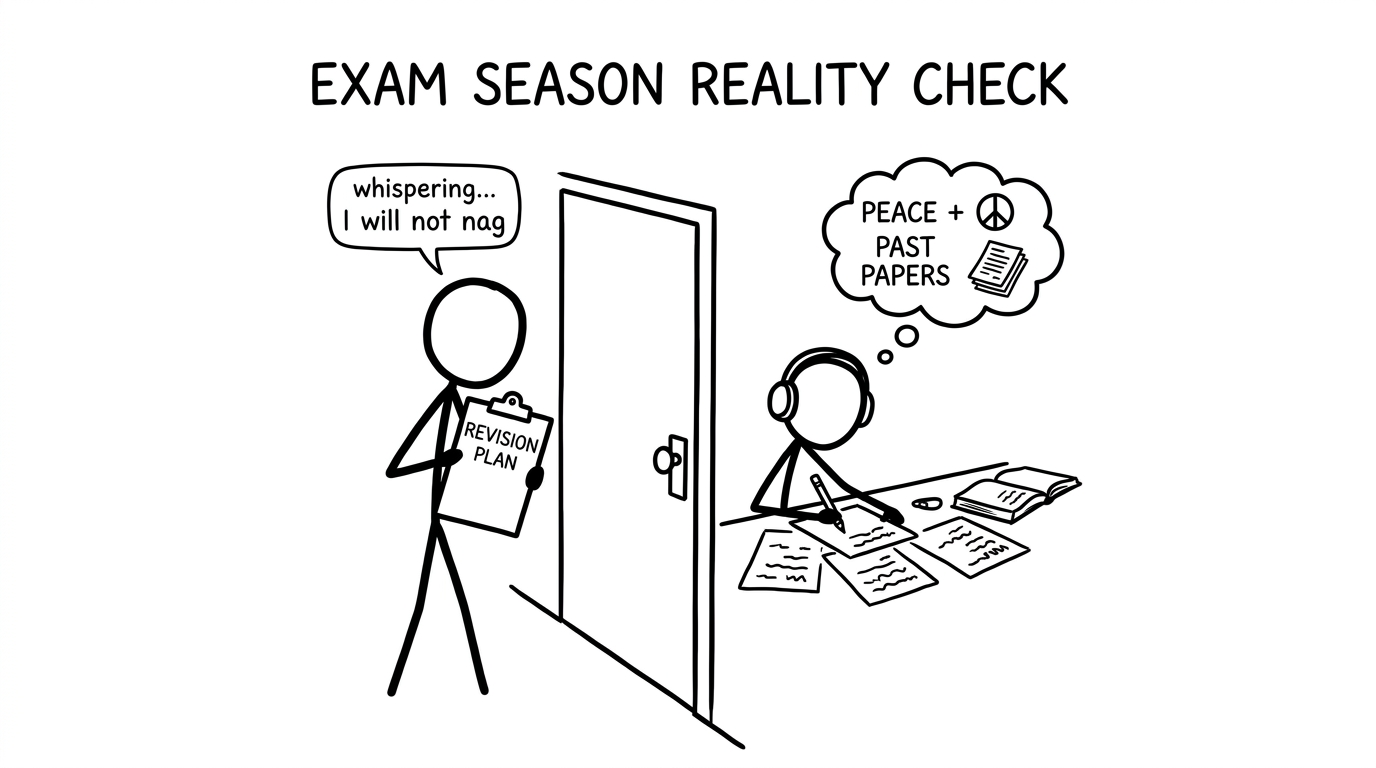 A parent trying not to nag while holding a revision plan
The no-nagging checklist (what actually helps GCSE revision)
Here’s the sweet spot: parents make revision easier to start and easier to stick to; students do the thinking.
- Agree a small, specific revision routine (time, place, duration)
- Replace “Have you revised?” with one calm daily check-in question
- Use evidence-based revision: timed questions, mark schemes, and fixing mistakes
- Practise one topic until it feels boring (that’s usually when it’s sticking)
- Keep resources friction-free: open the right page, print the paper, find the mark scheme
If you want a single hub for that evidence-based loop, build it around YesGenie’s GCSE maths pages such as GCSE Past papers and your exam-board area (for example Edexcel GCSE Maths Revision.
Why nagging backfires (and what to do instead)
Nagging is often “care” wearing an awkward disguise. But for GCSE maths revision, it usually creates three problems.
It turns revision into a power struggle
Maths needs calm concentration. If revision becomes a debate about effort, your brain spends its energy defending your identity rather than learning methods.
Swap this: “You need to do more GCSE revision.”
For this: “What’s the smallest GCSE maths task you can finish in 20 minutes?”
Small tasks reduce resistance. And once you start, you often keep going.
It creates fake certainty
Sometimes a student says “I’ve revised” meaning “I re-read notes”. Parents hear “I can answer questions under time pressure”. Those are not the same.
A better home routine uses proof: a mini test, a past-paper section, or a set of topic questions with the mark scheme.
It makes the parent the ‘manager’
The best GCSE revision is self-owned. Parents can be the environment designer: quiet space, predictable routine, fewer distractions. But the student should remain the decision-maker.
A better script: questions parents can ask that feel supportive
A small change in wording can remove most of the tension.
The daily question (takes 30 seconds)
Ask one of these, once:
- “What did you practise today?”
- “Which topic felt less confusing than last week?”
- “What’s one mistake you fixed?”
These questions point at process. GCSE grades 9-1 are built from tiny method improvements repeated.
The weekly question (takes 5 minutes)
- “Which paper will you do this week -- and when?”
If you’re doing Edexcel, AQA, OCR or Eduqas, anchor that to real resources: Edexcel GCSE Maths Predicted Papers and GCSE Past papers.
The home system that makes GCSE maths revision easier
Most students don’t need more willpower. They need less friction.
Set a ‘default’ revision slot
Agree a slot that’s boring and predictable: same time most days, short enough to feel doable.
A strong pattern is:
- 252525 minutes maths
- 555 minutes break
- Repeat once if you have energy
Parents help most by protecting that slot from interruptions.
Keep the resources open before you start
The easiest GCSE revision session is the one where the tab is already open.
Good “start here” pages on YesGenie:
- GCSE Subjects (fast way to find your course)
- Edexcel GCSE Maths Lessons (bite-sized lessons with practice)
- Resources (mini tests, predicted papers, and more)
Use the loop that improves marks: attempt → mark → repair
A parent doesn’t need to teach maths to support the loop.
They can:
- Print a paper
- Time the attempt
- Sit quietly nearby (optional)
- Ask: “What will you do differently next time?”
And then you (the student) use the mark scheme and solutions to repair your gaps.
Worked examples parents can support (without teaching the whole topic)
Parents often feel they can’t help because they don’t remember the maths. That’s fine. The help is in asking for method clarity.
Example: percentage increase (a classic GCSE marks topic)
A hoodie costs £484848. The price increases by 12.5%12.5\%12.5%. Find the new price.
Method:
Convert the percentage increase into a multiplier:
multiplier=1+0.125=1.125 \text{multiplier} = 1 + 0.125 = 1.125 multiplier=1+0.125=1.125Then multiply:
48×1.125=54 48 \times 1.125 = 54 48×1.125=54So the new price is £545454.
How a parent can help without nagging: ask the student to explain why the multiplier is 1.1251.1251.125 (not just “because that’s what you do”). If they can explain that 12.5%=1812.5\% = \frac{1}{8}12.5%=81 and 48÷8=648 \div 8 = 648÷8=6, so the increase is £666 and £48+6=5448+6=5448+6=54, they’re building real GCSE understanding.
Example: solving a linear equation (foundation and higher tier)
Solve 3x−7=203x - 7 = 203x−7=20.
Add 777 to both sides:
3x=27 3x = 27 3x=27Divide by 333:
x=9 x = 9 x=9How a parent can help: ask for one sentence: “What did you do first, and why?” If the student says, “I got rid of the −7-7−7 first to isolate the xxx term,” they’re thinking like the mark scheme.
Example: circumference of a circle (where students drop marks)
A circle has radius r=6 cmr = 6\text{ cm}r=6 cm. Find the circumference.
C=2πr=2π×6=12π cm C = 2\pi r = 2\pi \times 6 = 12\pi\text{ cm} C=2πr=2π×6=12π cmIf a decimal is required:
12π≈12×3.14159=37.69908≈37.7 cm 12\pi \approx 12 \times 3.14159 = 37.69908 \approx 37.7\text{ cm} 12π≈12×3.14159=37.69908≈37.7 cmHow a parent can help: ask whether the question wants an exact answer or a decimal. That one prompt prevents a surprising number of GCSE mark losses.
Using YesGenie to make GCSE maths revision feel less overwhelming
A big reason GCSE maths revision stalls is that students don’t know what to do next. You open a textbook, see 200200200 pages, and your brain quietly exits the chat.
YesGenie makes the “next step” smaller:
- Use revision lessons for quick method refreshers: Edexcel GCSE Maths Lessons
- Use real papers for exam stamina: GCSE Past papers
- Use predicted papers to focus your final weeks: Edexcel GCSE Maths Predicted Papers
- Use worked solutions when you’re stuck: for example Paper 2 - Worked Solution
Parents can support by helping you choose the right type of resource for the right moment: lesson when you’re confused, question bank when you’re practising, past paper when you’re testing.
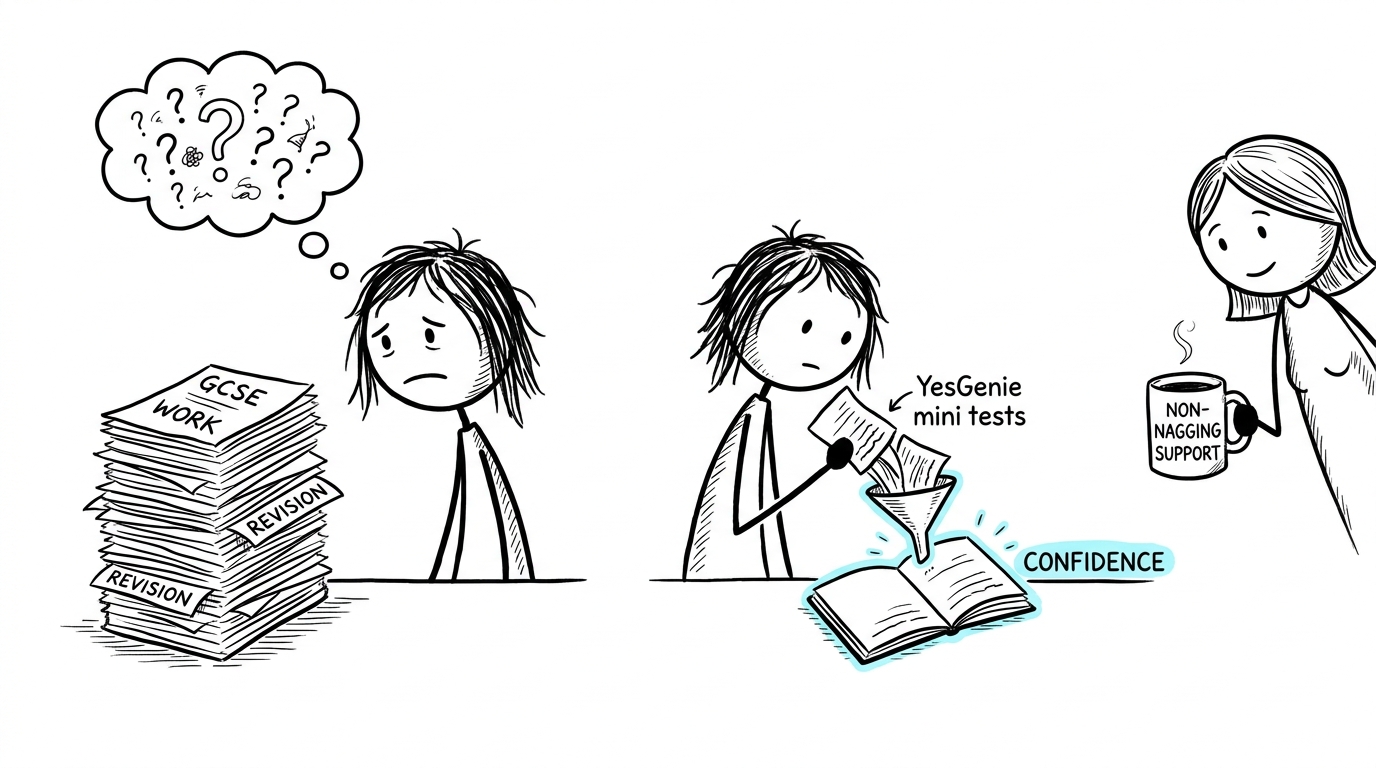 A student turning a huge GCSE pile into confidence with mini tests
Common mistakes (for parents and students) that lead to nagging
Mistake: measuring effort instead of evidence
Saying “I revised for two hours” doesn’t guarantee GCSE progress. Better evidence is: “I did Paper 1 Q1-12, marked it, and redid the questions I missed.”
Mistake: rescuing too quickly
If a parent jumps in with the answer, the student loses the chance to build the habit of un-sticking themselves using lessons, mark schemes, or video solutions.
Mistake: only doing comfortable topics
GCSE maths revision often becomes “I’ll do what I’m already good at because it feels productive.” The marks are usually in the next-hardest topics.
Mistake: letting revision be optional but also stressful
If revision is constantly negotiated, it becomes a daily conflict. Agree the routine once, then make it normal.
Mistake: confusing being calm with not caring
A calm parent is not a passive parent. Calm is a strategy: it keeps revision from becoming a referendum on the student’s character.
FAQ: parents supporting GCSE maths revision without nagging
How can my parent help with GCSE maths revision if they don’t remember the maths?
They can help more than you think, because GCSE maths revision isn’t only about knowing the content. It’s about building a routine, removing friction, and making sure revision includes exam-style questions rather than just reading notes. A parent can time a past paper, print resources, and help you stick to a consistent slot without interrupting you. They can also ask you to explain a method in one or two sentences, which tests understanding without them needing to know the full topic. When you get stuck, the best support is often pointing you back to a worked solution or lesson rather than giving you the answer. For that, pages like GCSE Past papers and topic lessons such as Edexcel GCSE Maths Lessons do the heavy lifting.
What should we do if every GCSE revision conversation turns into an argument?
Start by agreeing that the goal is fewer conversations, not more. Pick one daily check-in question and one weekly planning moment, and make everything else optional. Many arguments come from vague expectations, so make the plan concrete: which paper, which day, how long, and where the mark scheme will come from. Keep the language about behaviours you can see: “attempted questions” and “marked corrections”, not “worked hard” or “tried”. If the student is anxious, it helps to shrink the task so it feels safe to begin, like 202020 minutes of one topic rather than “revise everything for GCSE”. Finally, build trust by using evidence: when a student can show a scored paper and a list of fixed mistakes, the need for nagging naturally drops.
Are predicted papers a good idea for GCSE maths revision, or do they cause false confidence?
Predicted papers are useful when you treat them as practice, not prophecy. They’re best used after you’ve covered a broad range of topics, because then you can diagnose what’s still weak under timed conditions. If you only do predicted papers and ignore your gaps, you can end up with false confidence, especially if you happened to avoid a topic you fear. A healthier approach is: do one predicted paper under exam timing, mark it honestly, then spend the next few sessions repairing the topics you dropped marks on. That is exactly how you convert a score into progress, which is what GCSE maths revision needs. If you’re on Edexcel, you can find them here: Edexcel GCSE Maths Predicted Papers, and you can balance them with GCSE Past papers to stay grounded.
How do I know whether I should be doing foundation or higher tier GCSE maths revision?
This is partly about target grade and partly about consistent performance under exam conditions. Higher tier gives access to grades 444-999, while foundation tier caps at grade 555, so your school’s tier entry matters. The practical test is not what you hope you can do, but what you can regularly score on timed papers with mark schemes. If higher-tier topics like circle theorems, algebraic fractions, or more complex trigonometry are causing repeated low scores, it might be a sign to consolidate core content first. Equally, many students are capable of higher tier but lose marks through weak basics like rearranging, fractions, and accuracy. Use a couple of real papers as evidence, then decide with your teacher. YesGenie’s exam-board areas, such as Edexcel GCSE Maths Revision, make it easier to practise at the right level and track what’s improving.
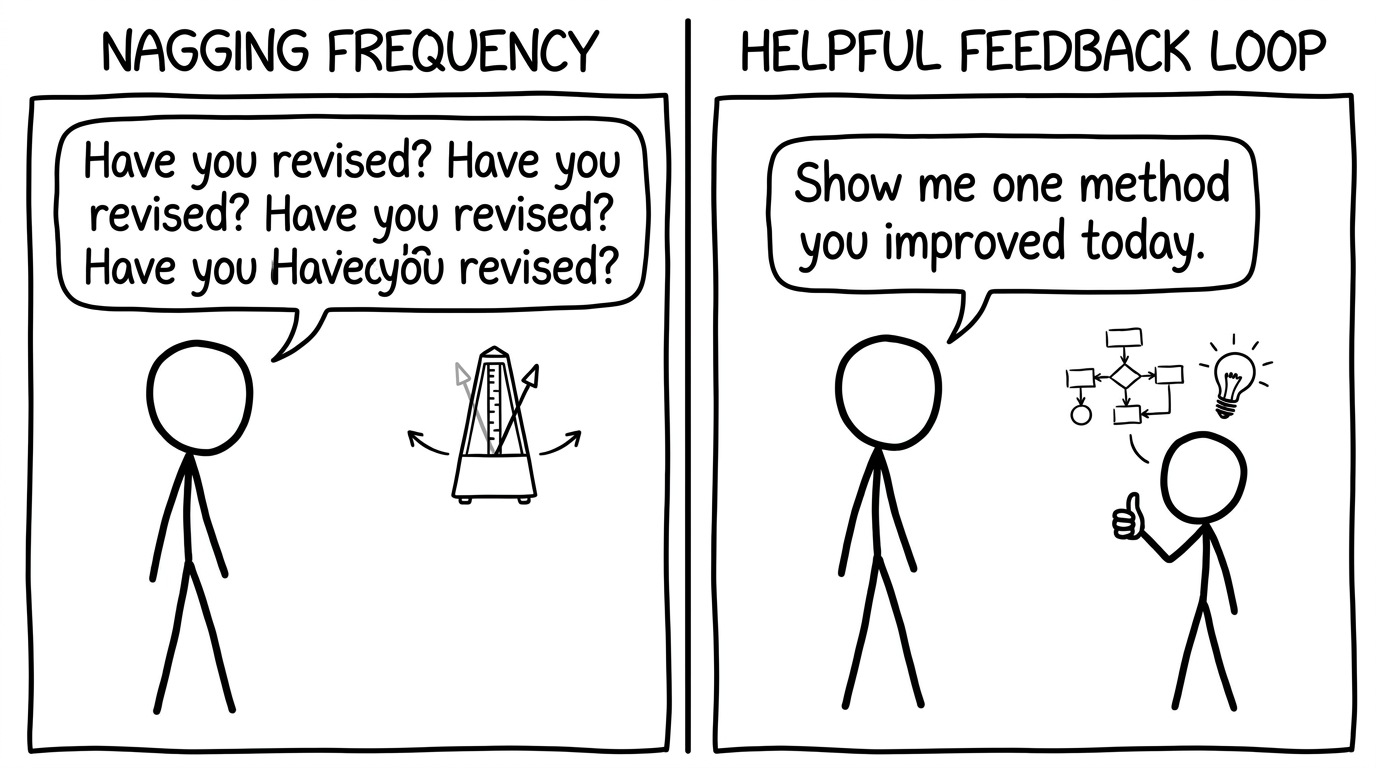 A two-panel comic showing nagging vs a helpful feedback loop
The quiet win: GCSE revision that doesn’t need a soundtrack of reminders
The best GCSE maths revision at home is almost invisible. It looks like a predictable routine, a short check-in, and lots of small proofs of progress: attempted questions, corrected mistakes, and growing confidence on past papers.
Parents don’t have to become maths teachers. They can become the person who makes the right thing easy: the printer works, the workspace is calm, the time is protected, and the conversation stays focused on method and evidence.
If you want that evidence-based loop in one place, build your plan around YesGenie: start with GCSE Subjects, practise through GCSE Past papers, use exam-board revision pages like Edexcel GCSE Maths Revision, and sharpen your final weeks with Edexcel GCSE Maths Predicted Papers. Then use worked solutions such as Paper 2 - Worked Solution when you need to learn from mistakes quickly.
Make it calm. Make it consistent. Make it measurable. That’s how GCSE maths revision improves -- and how nagging becomes unnecessary.