

GCSE Revision for Lazy Students (That Still Works)
GCSE revision for lazy students that still works: a low-effort, high-impact maths plan using YesGenie lessons, mini tests, past papers and mark schemes.
GCSE revision has a reputation for being all-nighters, colour-coded timetables, and guilt. But most students aren’t lazy in the “I don’t care” way. They’re tired in the “I care, but I’m overwhelmed” way. And when you’re overwhelmed, you don’t need more motivation -- you need fewer decisions.
This is the lazy student’s guide to GCSE revision that still works for maths. Not because you’ll magically do less, but because you’ll stop wasting effort on things that don’t move your marks. The goal is simple: turn revision into a small, repeatable routine that you can do even on low-energy days, and then let the maths compound.
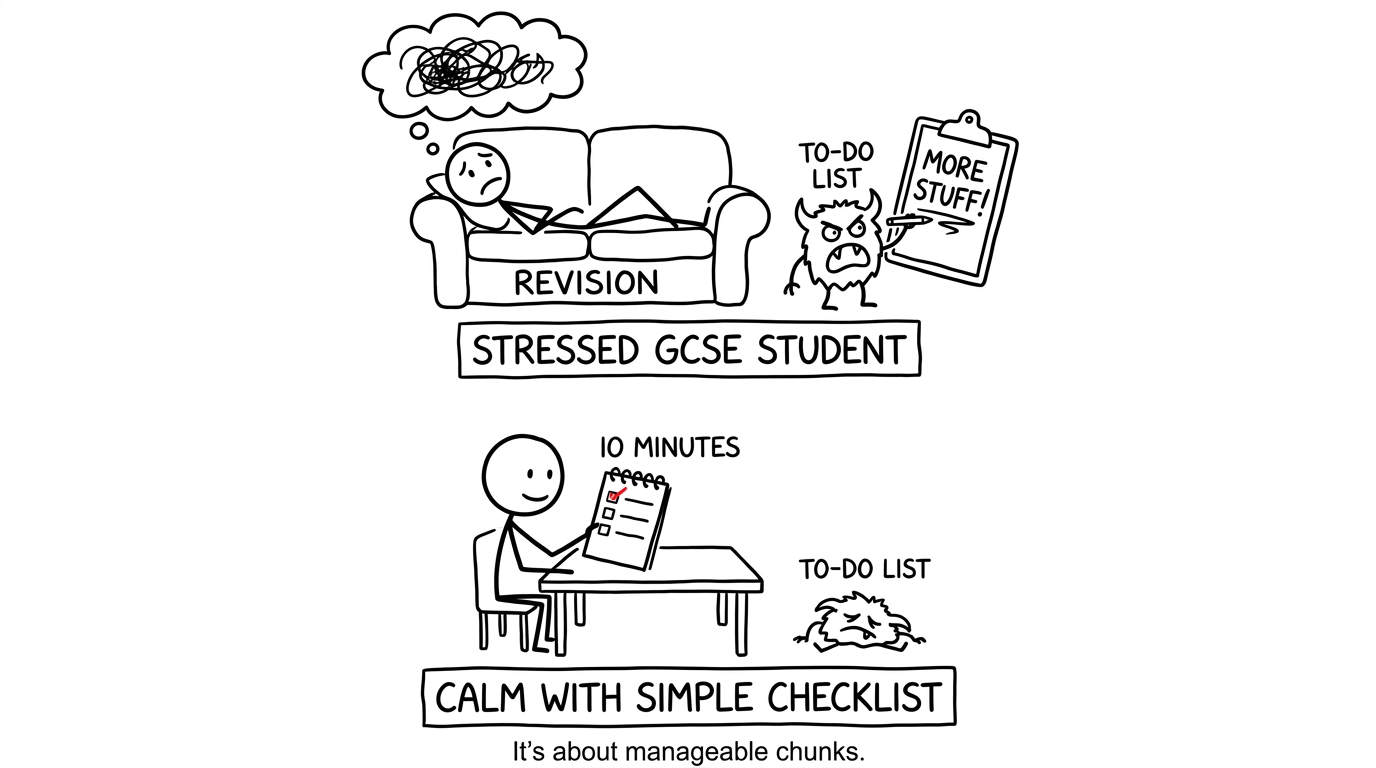 A tired student vs a 10-minute checklist
The lazy student checklist (copy this)
If you only take one thing from this post, take this GCSE revision loop:
- Pick one topic (not “algebra”, a real topic like “solving equations”).
- Learn for 10 minutes (one focused lesson).
- Do 4 questions (topic-specific, exam-style).
- Mark immediately using the mark scheme or video solution.
- Fix one mistake and write a one-line rule.
- Repeat tomorrow.
This is how you revise for GCSE maths without the drama. You trade intensity for consistency.
To make it frictionless, start from your exam board hub and stay there:
Why “lazy” GCSE revision can beat “hard-working” revision
A weird thing happens in maths revision: the students who look like they’re revising the hardest are sometimes just doing the most visible tasks. Highlighting. Rewriting notes. Watching a full video while half-scrolling.
Real GCSE maths marks come from two quiet habits:
- Retrieval: can you produce a method without being shown it?
- Feedback: do you find out what the examiner wanted, quickly?
That’s why past papers and mark schemes are not the “final stage”. They are the engine.
On YesGenie, you can keep this loop tight: lesson to questions to solutions to repeat.
Useful starting points:
- Edexcel GCSE Maths Past Papers
- Edexcel GCSE Maths Predicted Papers
- GCSE revision resources (mini tests and more)
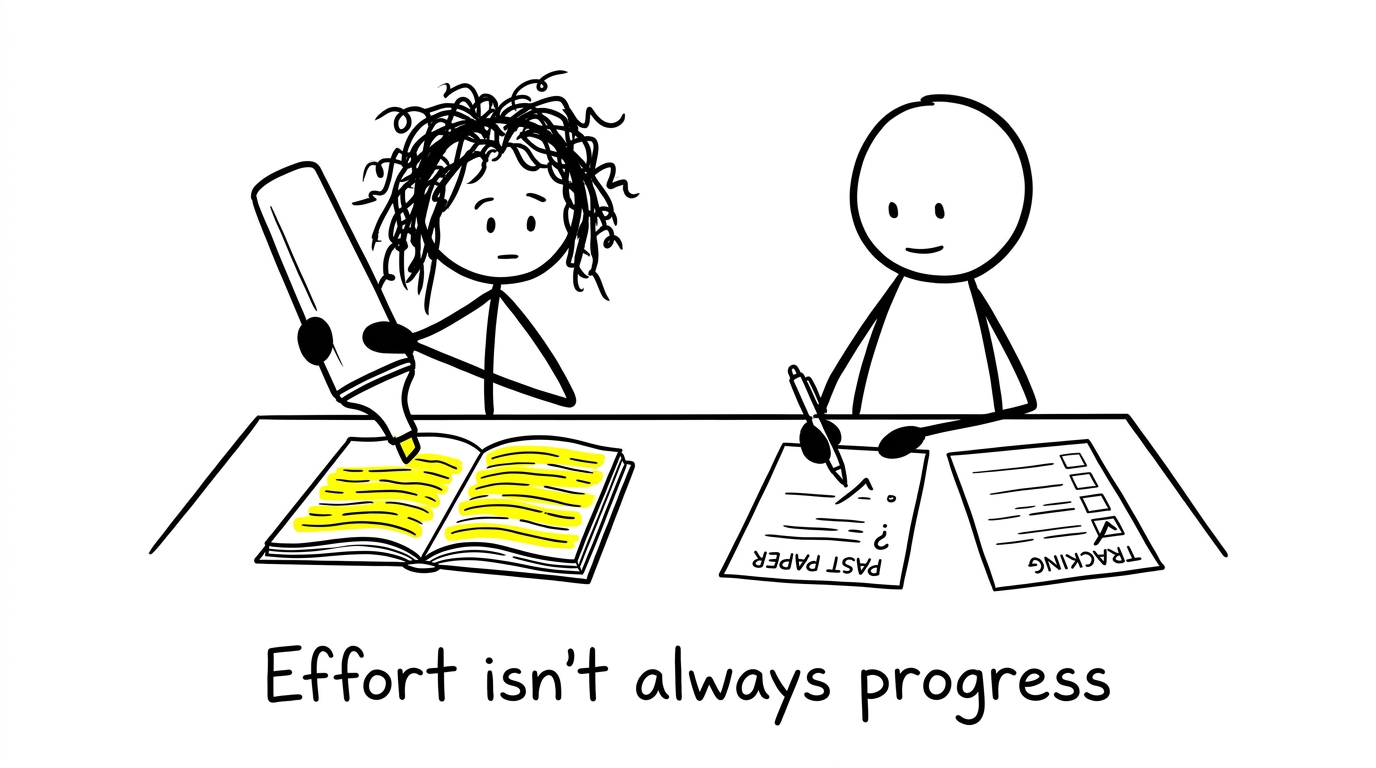 Effort isn’t always progress
The 20-minute GCSE maths routine (the “minimum viable” plan)
This routine is designed for the days when you can’t face “proper revision”, but you still want GCSE progress.
Step 1: 5 minutes to choose the right topic
Don’t choose what you like. Choose what you drop marks on.
A fast way:
- Do one mini test from Resources.
- Circle any question you couldn’t start in 20 seconds.
- That topic becomes today’s revision.
Step 2: 10 minutes of learning (one method only)
Use a focused revision guide for your exam board and grade range. Read it like you’re stealing the method, not admiring it.
Examples of strong “one topic at a time” pages:
- Venn Diagrams (GCSE Revision Guide)
- Bounds (GCSE Revision Guide)
- Best Buy Questions (GCSE Revision Guide)
Step 3: 5 minutes of marking and fixing
Mark immediately. The GCSE mark scheme is basically a map of what matters.
If you want to build this habit fast, use video solutions on a paper question so the feedback is instant:
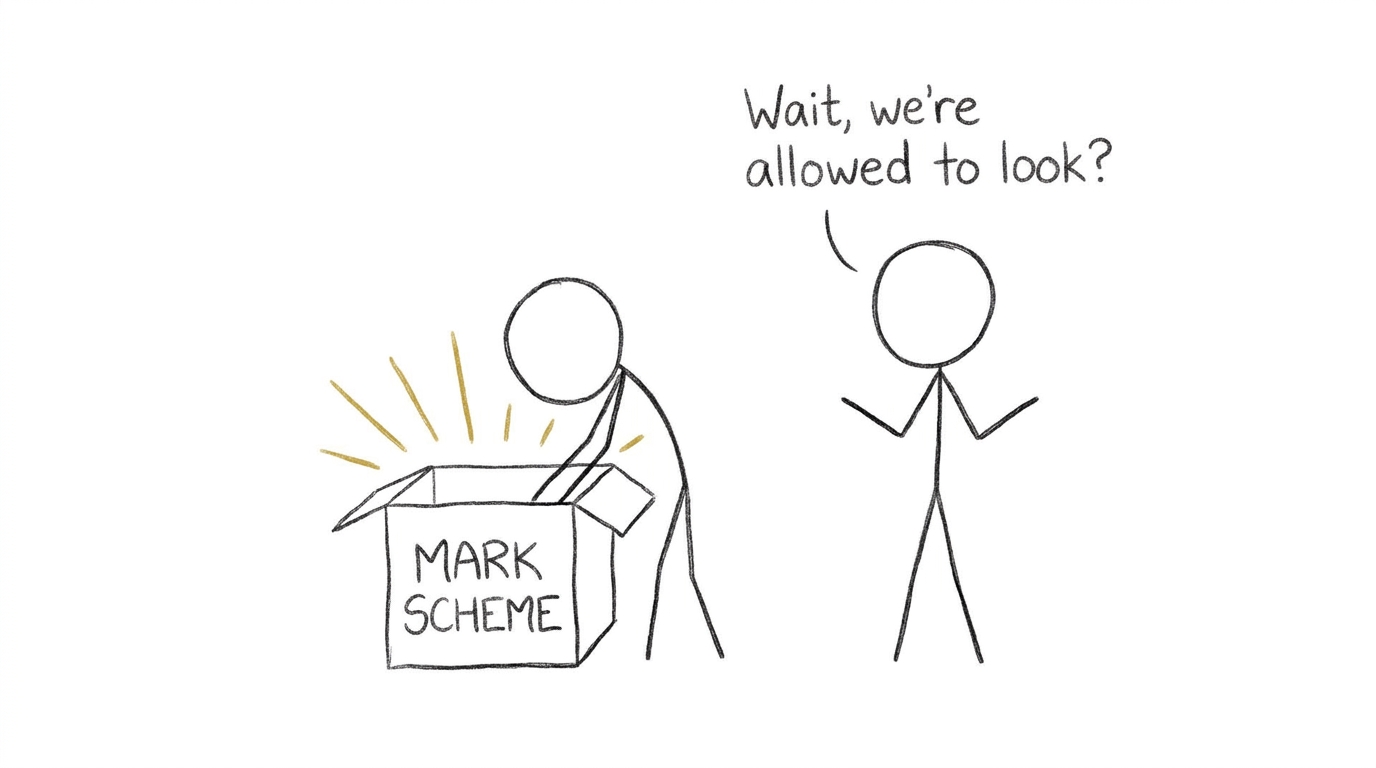 Mark scheme as treasure chest
Worked examples (high-impact GCSE methods)
These examples are here for one reason: lazy GCSE revision works when you master repeatable methods. Not when you “sort of understand” a topic.
Solving a linear equation quickly (GCSE foundation and higher)
Solve 3x−7=203x - 7 = 203x−7=20.
Add 777 to both sides:
3x=27 3x = 27 3x=27Divide both sides by 333:
x=9 x = 9 x=9Lazy revision rule: do one operation at a time, and mirror it on both sides. In GCSE mark schemes, method marks often come from these clean steps.
Best buy (unit cost) without overthinking
A 750 ml bottle costs £2.40. A 1.25 litre bottle costs £3.60. Which is better value?
Convert to the same unit. Use ml:
- 1.251.251.25 litres =1250= 1250=1250 ml.
Unit costs:
Cost per ml for 750 ml=240750=0.32 pence per ml \text{Cost per ml for 750 ml} = \frac{240}{750} = 0.32\text{ pence per ml} Cost per ml for 750 ml=750240=0.32 pence per ml Cost per ml for 1250 ml=3601250=0.288 pence per ml \text{Cost per ml for 1250 ml} = \frac{360}{1250} = 0.288\text{ pence per ml} Cost per ml for 1250 ml=1250360=0.288 pence per mlSince 0.288<0.320.288 < 0.320.288<0.32, the 1.25 litre bottle is better value.
Lazy revision rule: compare unit cost, not total price. If you keep the calculator value until the end, you also avoid rounding errors.
If this topic costs you marks, practise it properly here:
Bounds: the GCSE topic that rewards calm students
A length lll is 282828 cm correct to the nearest cm. Write the bounds for lll.
Nearest cm means the half-gap is 0.50.50.5 cm.
So:
27.5≤l<28.5 27.5 \le l < 28.5 27.5≤l<28.5Lazy revision rule: underline the rounding phrase first, then halve the rounding unit.
For a full method and more exam-style practice:
How to use past papers like a lazy genius (GCSE edition)
Doing full GCSE papers is powerful, but it’s also easy to do it badly: you grind for 90 minutes, feel awful, and learn nothing.
A better approach is “micro-papers”:
The 3-pass method
- Pass 1 (easy marks): do everything you can start immediately.
- Pass 2 (thinking marks): do the questions you can start with a plan.
- Pass 3 (training data): pick one question you can’t do, then learn that exact method.
On YesGenie, that last step is where things click: you can go straight from the paper to solutions, then to topic revision guides.
Start here:
And if you’re doing A Level too, the same technique applies:
Common mistakes that waste GCSE revision time
Lazy GCSE revision only works if you avoid the classic traps:
- “I’ll revise everything” thinking. GCSE maths is too big to revise in one go. Pick one topic, finish it, then move on.
- Copying solutions without diagnosing the mistake. If you got it wrong, write the reason: wrong formula, algebra slip, misread question, calculator error.
- Not using the mark scheme language. GCSE mark schemes reward specific steps (especially for multi-mark questions). Learn what earns method marks.
- Rounding too early. Keep exact values until the end unless the question forces rounding.
- Forgetting calculator habits. A surprising number of GCSE errors are just bracket mistakes, negative signs, or typing π\piπ incorrectly.
FAQ
Is “lazy” GCSE revision actually enough to get a good grade?
Lazy GCSE revision can be enough if “lazy” means low friction and high feedback, not “avoid all effort”. In maths, small daily sessions often beat long weekly sessions because you keep the methods warm in your memory. The key is that your revision must include practice questions and marking, not just reading. GCSE exams reward accurate methods under time pressure, and you only get that by doing exam-style questions repeatedly. If you’re aiming for higher tier grades 777-999, you’ll still need to stretch into harder topics, but the same routine works: one method, practise it, mark it, fix it. YesGenie makes this realistic because lessons, revision guides, questions and solutions sit in one place, so you don’t lose energy just deciding what to do.
How many past papers should I do for GCSE maths?
It’s less about the number of past papers and more about how you use them. One GCSE paper done with careful marking, corrections, and follow-up topic practise can be worth more than three papers done in a blur. If time is tight, focus on one paper per week at first, then increase as the exam approaches. Always keep a “mistake list” so each paper feeds your next revision session. If you keep repeating the same errors, that’s not a motivation problem -- it’s a method problem, and you need to go back to the topic guide. On YesGenie, you can combine Edexcel GCSE Maths Past Papers with targeted revision guides like Bounds or Venn Diagrams to close gaps quickly.
What if I don’t know my exam board for GCSE maths?
First, check your school’s website, your classwork booklet, or ask your teacher -- it’s usually Edexcel, AQA, OCR or Eduqas (WJEC in Wales). The good news is that the GCSE maths content overlaps heavily across boards, especially at foundation and mid-higher level. The difference is often in question style and wording, which is why practising with board-specific papers helps. If you can’t find out immediately, start revising core topics anyway: algebra basics, percentages, ratio, graphs, angles, and probability. Then once you know, move onto the correct hub and focus your past papers there. YesGenie has clear board routes like Edexcel GCSE Maths Revision and OCR GCSE Maths Revision, so you can switch without losing your momentum.
I’m doing GCSE maths now -- how does this help with A Level later?
A Level maths is less forgiving of shaky GCSE habits because the algebra becomes the language of everything else. If your GCSE revision builds a routine of quick retrieval, careful checking, and learning from mark schemes, you are quietly training the exact skills A Level requires. Topics like rearranging, graphs, and proportional reasoning show up everywhere later, just in more sophisticated forms. The difference is that A Level questions are longer, so method and organisation matter even more. If you want a simple bridge, keep using the same loop: learn one method, practise, mark, fix. When you reach A Level, you’ll lean more on full exam questions and papers, which YesGenie supports with resources like Edexcel A Level Maths Past Papers. In other words, lazy GCSE revision done properly isn’t a shortcut -- it’s a foundation.
Closing: make GCSE revision smaller, then make it daily
The real enemy of GCSE revision isn’t laziness. It’s the feeling that you need a perfect plan before you can begin. Maths doesn’t work like that. It rewards the student who shows up often, makes small mistakes, and fixes them quickly.
So keep it simple:
- Use a short YesGenie lesson or revision guide.
- Do a handful of exam-style questions.
- Mark them immediately.
- Repeat.
When you’re ready to level up, move to exam practice:
- Edexcel GCSE Maths Past Papers
- Edexcel GCSE Maths Predicted Papers
- GCSE revision resources (mini tests, predicted papers and more)
GCSE success isn’t built on heroic days. It’s built on ordinary days that you didn’t waste. YesGenie exists for exactly that kind of revision: free lessons, revision guides, practice questions, mark schemes, video solutions, mini tests and predicted papers -- all designed to help you turn small effort into real marks.