

GCSE Physics notes to active recall (with maths help)
GCSE revision: turn GCSE Physics notes into active recall with simple recall prompts, spaced practice and maths methods that win marks in exams.
 Tiny sticky note superhero lifting revision
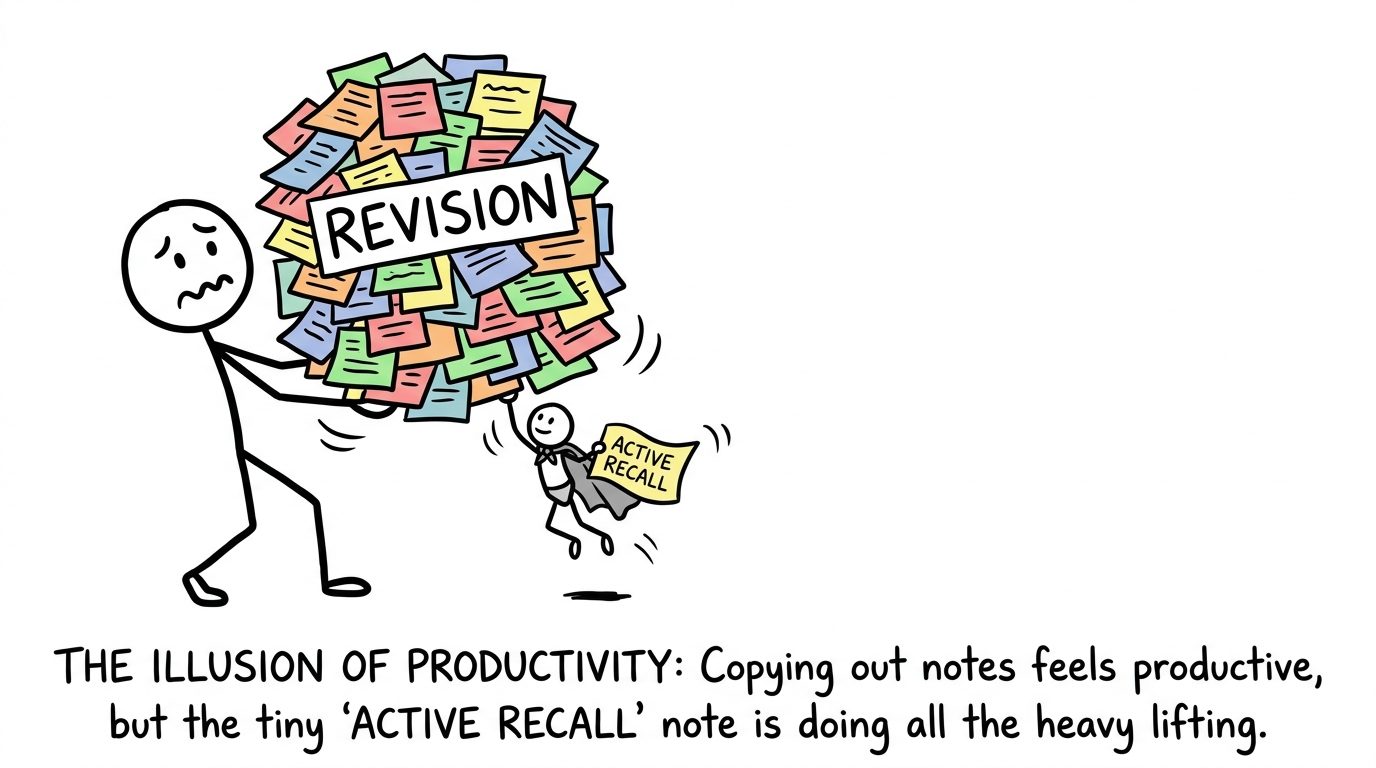
When you’re revising for GCSE exams, it’s easy to mistake effort for progress. You rewrite physics notes, colour-code headings, and the pages look calmer than your brain feels. Then a past paper asks for the one definition you didn’t memorise, or a calculation you can’t set up, and suddenly the neat notes feel like a prop rather than a plan. Turning your GCSE Physics notes into active recall is the moment revision starts behaving like the exam: you practise pulling answers out, not pushing information in.
This matters even more if you’re also doing GCSE or A Level maths. Physics marks often sit on maths foundations: rearranging formulae, substituting, standard form, density, gradients. Active recall becomes your bridge between “I’ve seen this” and “I can do this under time pressure”.
The active recall checklist (turn notes into marks)
Use this as your quick conversion process for any set of GCSE Physics notes:
- Compress: reduce each page to 5-10 “exam prompts” (questions, not statements).
- Cover and recover: answer from memory, then check with your notes.
- Mark like an examiner: compare to a mark scheme and tighten wording.
- Spaced repetition: revisit prompts after 1 day, 3 days, 7 days, then weekly.
- Interleave with maths: pair each physics topic with the maths skill it needs.
- Past paper loop: test with real exam questions early, not at the end.
For the maths side of that loop, YesGenie makes it simple to switch between skills and exam practice: GCSE Past papers, Edexcel GCSE Maths revision guides, and the broader Resources hub when you want mini tests and predicted papers.
 Neon highlighter vs neurons
Why GCSE notes feel productive (but don’t always work)
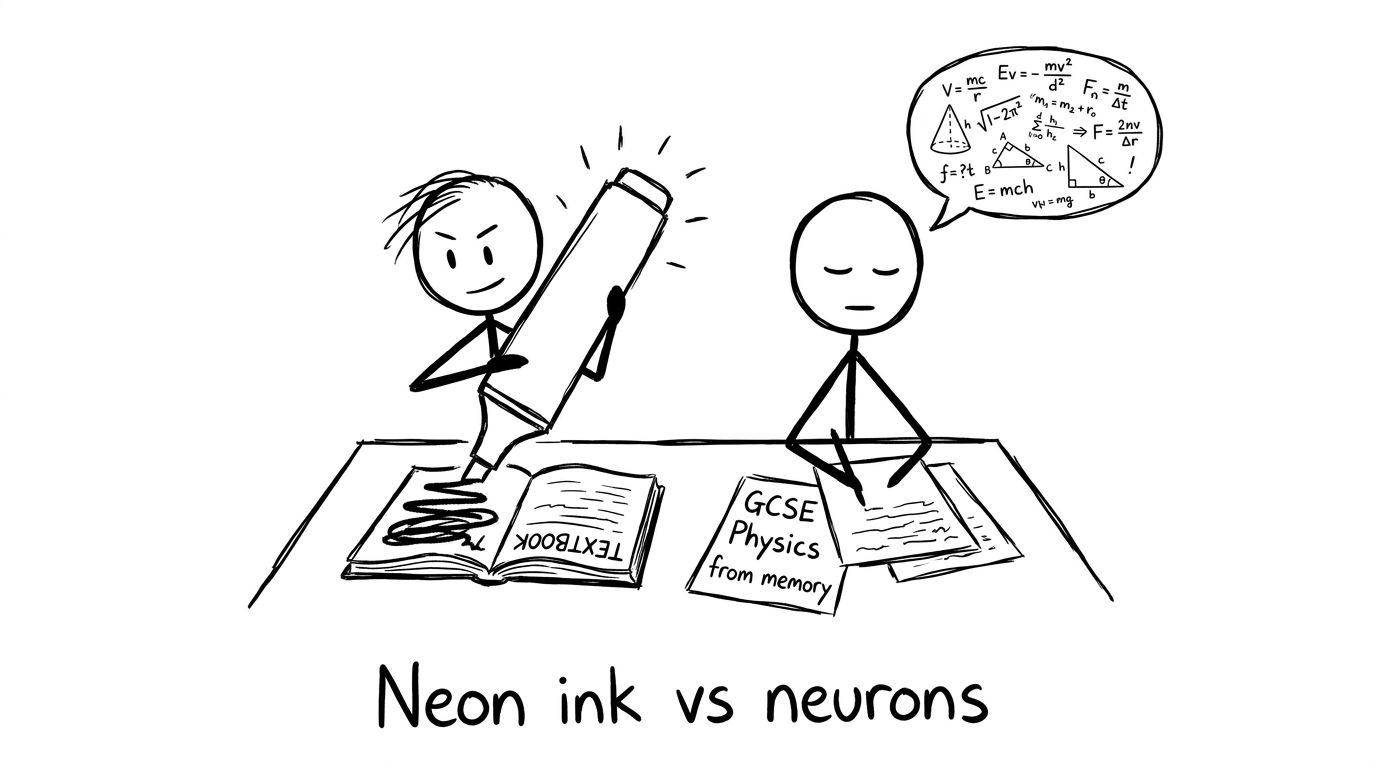
Notes are comforting because they’re controllable. You can always make a page “better”. Exams aren’t like that. In the exam hall, you’re asked to retrieve a definition, a method, a unit, a relationship, and often explain it clearly.
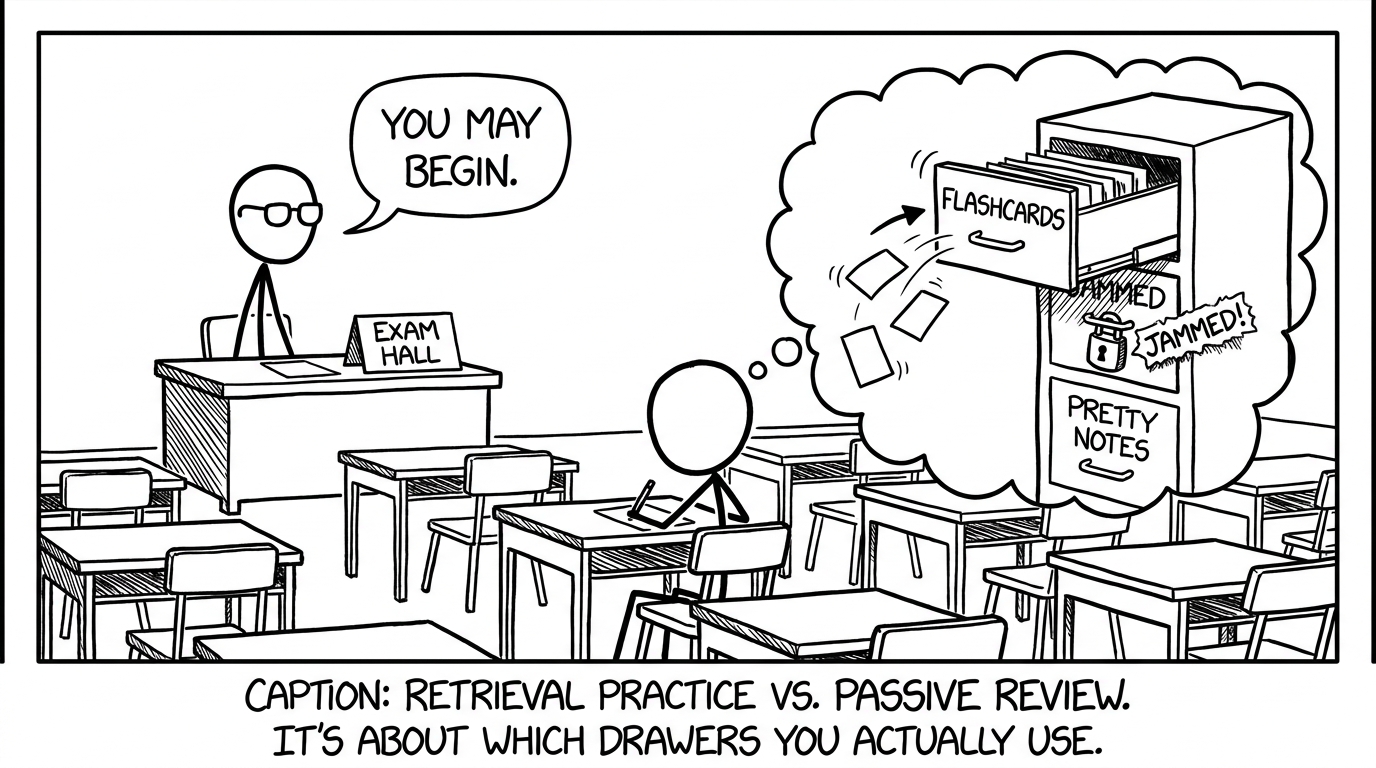
Active recall flips the direction of work. Instead of reading and recognising, you practise producing. Recognition is passive: your brain nods along. Retrieval is active: your brain has to build the answer from scratch. That struggle is not failure -- it’s the training.
A good GCSE student isn’t the one with the prettiest notebook. It’s the one who can consistently do three things:
- state the key idea in exam language,
- apply it to an unfamiliar context,
- and handle the maths without panicking.
Step one: turn each paragraph into a question (proper active recall)
Take a typical GCSE Physics notes paragraph, like:
“When a resultant force acts on a mass, it accelerates. The acceleration is proportional to the resultant force and inversely proportional to the mass.”
Rewrite it into exam prompts:
- “State Newton’s second law in words.”
- “What happens to acceleration if force doubles and mass stays the same?”
- “What happens to acceleration if mass doubles and force stays the same?”
- “Write the equation linking FFF, mmm, and aaa.”
- “What are the units of FFF, mmm, and aaa?”
Those are now flashcard fronts, mini-whiteboard prompts, or a checklist you can brain-dump.
If you want a ready-made system for this style of testing in maths, YesGenie’s structure is already built around recall and checking: revision lessons, topic practice, and mark schemes on GCSE Maths revision guides, plus real exam practice on Edexcel GCSE Maths past papers.
Step two: add “answer constraints” (the examiner’s version of recall)
GCSE Physics answers aren’t just about being vaguely correct. They’re about being correct in the way marks are awarded. So each active recall prompt should include constraints such as:
- Must include: a keyword, unit, or relationship.
- Must avoid: a common confusion (e.g. mass vs weight).
- One-sentence version: so you can write it quickly.
Example prompt:
- “Define density in one sentence. Must include ‘mass per unit volume’ and the equation.”
Your answer becomes:
- “Density is mass per unit volume: ρ=mV\rho = \frac{m}{V}ρ=Vm.”
That’s active recall plus exam precision.
Step three: fuse physics recall with the maths method underneath
A lot of GCSE Physics revision fails at the exact moment you need maths fluency. You remember the story, but you can’t execute the calculation. The fix is to attach a maths method card to each physics equation card.
Worked example: density (rearranging + units)
Suppose a question gives mass m=540 gm = 540\text{ g}m=540 g and volume V=200 cm3V = 200\text{ cm}^3V=200 cm3. Find density.
Convert if needed, but here the units are consistent (both in grams and cubic centimetres), so:
ρ=mV=540200=2.7 \rho = \frac{m}{V} = \frac{540}{200} = 2.7 ρ=Vm=200540=2.7So density is 2.7 g/cm32.7\text{ g/cm}^32.7 g/cm3.
Now practise the inverse direction (this is where active recall gets powerful): if ρ=2.7 g/cm3\rho = 2.7\text{ g/cm}^3ρ=2.7 g/cm3 and V=200 cm3V = 200\text{ cm}^3V=200 cm3, find mmm.
Rearrange:
m=ρV=2.7×200=540 m = \rho V = 2.7 \times 200 = 540 m=ρV=2.7×200=540So m=540 gm = 540\text{ g}m=540 g.
This is exactly the same muscle you build in GCSE maths when you practise rearranging and substitution. If that’s a weak spot, anchor your skills with topic practice and then confirm with exam questions using GCSE Past papers.
Worked example: speed, distance, time (and why your fractions matter)
A car travels 150 km150\text{ km}150 km in 2.5 h2.5\text{ h}2.5 h. Find speed.
speed=distancetime=1502.5 \text{speed} = \frac{\text{distance}}{\text{time}} = \frac{150}{2.5} speed=timedistance=2.5150Convert 2.52.52.5 to a fraction to avoid calculator wobble:
2.5=52 2.5 = \frac{5}{2} 2.5=25So:
1502.5=15052=150×25=60 \frac{150}{2.5} = \frac{150}{\frac{5}{2}} = 150 \times \frac{2}{5} = 60 2.5150=25150=150×52=60Speed is 60 km/h60\text{ km/h}60 km/h.
This is an active recall cue too: when you see 2.52.52.5, your brain should automatically think “52\frac{5}{2}25” as an option. That’s how you reduce silly errors.
Worked example: standard form (physics values without fear)
A charge is 0.0000042 C0.0000042\text{ C}0.0000042 C. Write it in standard form.
Move the decimal 6 places to the right to get 4.24.24.2:
0.0000042=4.2×10⁻⁶ 0.0000042 = 4.2 \times 10^{-6} 0.0000042=4.2×10⁻⁶If you want to keep your GCSE maths standard form sharp (so physics numbers feel normal), use topic lists in Edexcel GCSE Maths revision guides and then pressure-test with Edexcel GCSE Maths past papers.
 Revision planner guides student away from doom-scrolling
Step four: build a 15-minute active recall routine (that you’ll actually do)
The best routine is the one you can repeat on tired days. Try this:
- 2 minutes: pick one GCSE Physics subtopic (e.g. forces, electricity, waves).
- 6 minutes: answer 6-10 recall prompts from memory (no notes).
- 4 minutes: check your answers, correct them, and rewrite the minimum fix.
- 3 minutes: do one maths-style calculation related to that topic.
This is where YesGenie fits naturally into your day. You can do a short burst of skill practice, then a short burst of exam questions, without hunting around. Start with Resources (mini tests, predicted papers), then move to GCSE Past papers when you’re ready to simulate exam conditions.
If you’re balancing GCSEs with A Level ambitions, keep your momentum by occasionally stretching into harder questions. The jump isn’t magic; it’s accumulation. When you want to see what longer-form practice looks like, explore Edexcel A Level Maths past papers.
Step five: make your notes “mark-scheme shaped”
One underrated move: convert your notes into mark scheme language.
- If an answer needs a definition, your recall prompt should demand an exact phrasing.
- If an answer needs a calculation, your recall prompt should demand correct rearranging and units.
- If an answer needs evaluation, your recall prompt should include “because…” and force you to justify.
Even in maths, marks are often split into method and accuracy. So when you revise maths alongside physics, you’re training yourself to show enough working to earn method marks. Past papers on YesGenie come with mark schemes and (for many papers) worked solutions, so you can learn the “what they’ll accept” style: GCSE Past papers and example paper pages like GCSE Maths Paper mark scheme view.
Common mistakes when turning GCSE notes into active recall
- Making prompts too vague: “Revise energy” is not a prompt. “State the equation for kinetic energy and define each symbol” is.
- Checking too quickly: the struggle to retrieve is the point. Give yourself 20-30 seconds of thinking time before looking.
- Only recalling definitions: GCSE Physics marks often come from application. Add prompts like “explain what happens if…” and “compare…”
- Ignoring units: many students lose easy marks by forgetting N\text{N}N, kg\text{kg}kg, m/s\text{m/s}m/s, J\text{J}J, or mixing prefixes.
- Not practising rearranging: if you can only use formula→answer\text{formula} \rightarrow \text{answer}formula→answer in one direction, you’re not exam-ready.
- Doing maths practice in isolation: the skill needs to appear inside physics-style contexts and also inside pure maths questions.
 Filing cabinet brain: flashcards open, pretty notes jammed
FAQ
How many active recall questions should I make from one page of GCSE Physics notes?
Aim for 5-10 prompts per page, but focus on quality over quantity. If you write 30 prompts and never revisit them, you’ve recreated the same problem in a different format. The best prompts are the ones that mirror how GCSE questions are actually asked: definitions, explanations, applications, and calculations. Include at least one prompt that forces you to use units correctly and at least one prompt that forces you to rearrange an equation. If you’re not sure what matters most, use a past paper to guide you: the frequency of topics and the style of wording tell you what to prioritise. Once you’ve built a set, revisit it using spacing so your prompts become reliable memories rather than one-off performances.
I’m good at maths but still drop marks in GCSE Physics calculations -- why?
Often it’s not the arithmetic; it’s the set-up. GCSE Physics questions hide the method inside words, and you have to translate the story into a relationship like ρ=mV\rho = \frac{m}{V}ρ=Vm or v=dtv = \frac{d}{t}v=td. Students also lose marks on units and conversions, because physics expects you to respect what each symbol represents, not just manipulate numbers. Another common issue is rearranging under pressure: you know you’ve seen it, but you can’t isolate the variable cleanly in the moment. Active recall helps because you practise the entire chain: identify the equation, substitute, rearrange, calculate, and state the unit. To sharpen the maths mechanics that underpin this, keep your GCSE skills exam-ready with structured practice and mark schemes on GCSE Past papers and topic refreshers on Edexcel GCSE Maths revision guides.
How do I fit active recall into revision when I have lots of GCSE subjects?
Treat active recall as a short daily habit rather than a rare long session. Fifteen minutes of honest retrieval every day beats two hours of note rewriting once a week, because the brain responds to repeated retrieval over time. Use spacing to reduce workload: today’s prompts, plus a small set from last week, is enough to keep memories alive. Rotate subjects so you always start with something manageable, then do one harder topic while your focus is warm. If you’re doing GCSE maths as well, use it as your anchor subject: it’s objective, it builds confidence fast, and it strengthens physics calculations directly. YesGenie is useful here because you can switch from short practice to exam-style work quickly using the Resources section, then consolidate with GCSE Past papers. Over time, your revision becomes less about “covering content” and more about building a dependable exam response.
Bringing it home: make GCSE revision feel like the exam
If you want your GCSE Physics notes to actually raise your marks, the goal is simple: stop polishing pages and start rehearsing recall. Turn every heading into a question. Force yourself to retrieve. Check against the mark scheme. Repeat with spacing. Then stitch in the maths methods underneath, because that’s where many students quietly leak marks.
When you’re ready to make that process consistent, use YesGenie as your revision base: revision lessons to rebuild weak topics, practice questions to train methods, and real exam practice through GCSE Past papers. Add predicted papers and mini tests from Resources when you need variety and pace. Your notes can still exist -- but now they’re the starting line, not the finish.