

GCSE: Use AQA Physics Past Papers Properly
GCSE revision: learn how to use AQA GCSE Physics past papers properly with a simple loop: attempt, mark, analyse, redo, and improve.
GCSE past papers can feel like a mirror you do not want to look into. You sit down with an AQA GCSE Physics paper, the first question looks familiar, and then suddenly you are three pages in, guessing units, second-guessing equations, and watching the clock bully you into rushing. The frustrating part is this: doing a GCSE paper is not the same as using a GCSE paper properly. One gets you tired. The other gets you marks.
This guide shows you how to use AQA GCSE Physics past papers properly, in a way that also strengthens the maths you need for science exams: rearranging formulae, standard form, gradients, percentages, and interpreting graphs. You will leave with a repeatable method, not just motivation.
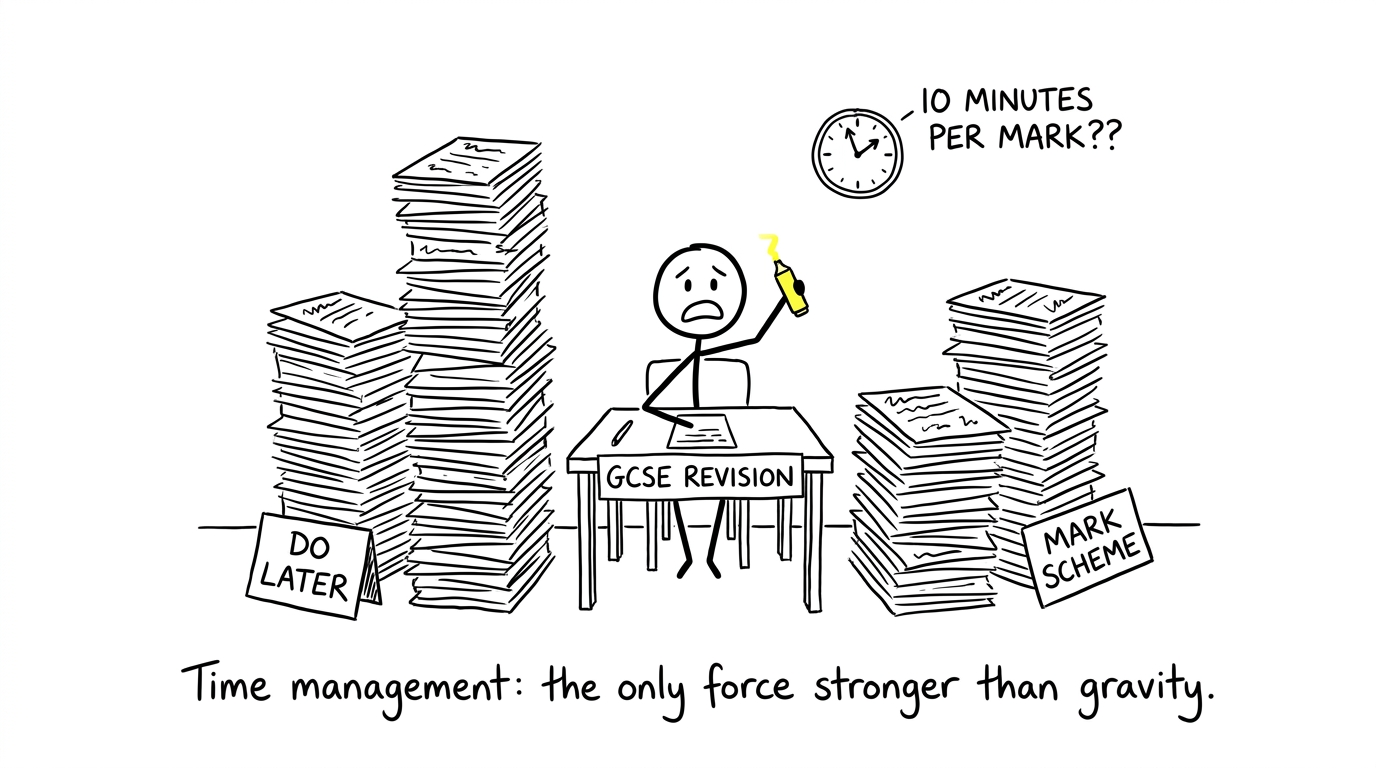 Student vs stacks of past papers
The right mindset: papers are feedback, not judgement
AQA GCSE Physics past papers are not there to “prove” what grade you are today. They are there to show you what to fix next. When students say “I did loads of GCSE papers but my grade did not move”, it is usually because they only did the attempt part. Improvement comes from the loop after the attempt.
There is a quiet skill in learning to enjoy the information a mistake gives you. A mark scheme is not an enemy -- it is a map of how AQA rewards clear thinking.
If you also revise maths alongside science, this is where YesGenie becomes unusually useful: you can instantly switch from a physics calculation you messed up to the exact GCSE maths skill underneath it (like standard form or changing the subject), then come back to the paper stronger.
A quick checklist for using AQA GCSE Physics past papers
Use this as your default routine for every GCSE paper:
- Choose the right paper (AQA Physics or Combined Science Physics, foundation/higher) and set realistic timings.
- Attempt it like the real exam: quiet, no notes, no mark scheme.
- Mark it immediately and be strict but fair.
- Analyse every lost mark and classify the reason.
- Redo the same questions 24-48 hours later without looking.
- Spaced repeat: revisit the same paper sections 1-2 weeks later.
For maths support while you do this, keep these open in separate tabs:
- GCSE Past papers
- AQA GCSE Maths Revision (Question bank, lessons, papers)
- AQA GCSE Maths Revision Guides
- Resources hub (mini tests, predicted papers, mock builder)
Step 1: pick the right AQA paper and use the marks to set time
AQA GCSE Physics papers (and Combined Science Physics papers) are written to a mark budget. The paper tells you how many marks each question is worth, and that is your timing guide.
A simple rule works well:
- If the exam is TTT minutes for MMM marks, then aim for about TM\frac{T}{M}MT minutes per mark.
Example: suppose your paper is 757575 minutes and 707070 marks.
minutes per mark=7570≈1.07 \text{minutes per mark} = \frac{75}{70} \approx 1.07 minutes per mark=7075≈1.07So a 444-mark question should take about:
4×1.07≈4.3 minutes 4 \times 1.07 \approx 4.3 \text{ minutes} 4×1.07≈4.3 minutesThis matters for GCSE because pacing is often the hidden reason students drop from their “homework grade” to their “exam grade”. If you over-invest time early, you end up donating later marks for free.
A practical timing method that keeps you calm
- Write a small target time next to each big question.
- If you hit the time and you are stuck, circle it and move on.
- Come back when you have “easier marks” safely banked.
This is not about being cold. It is about being professional.
Step 2: attempt the paper like an exam (but with one smart tweak)
Do the attempt under exam conditions, but add one tiny habit: underline the maths action.
In physics calculations, the maths action is usually one of these:
- substitute into a formula
- rearrange a formula
- convert units
- use standard form
- compute a gradient or area on a graph
- use percentages/ratio
Underlining forces you to name the move before you make it. That reduces careless errors, and it trains your brain to recognise patterns across different GCSE questions.
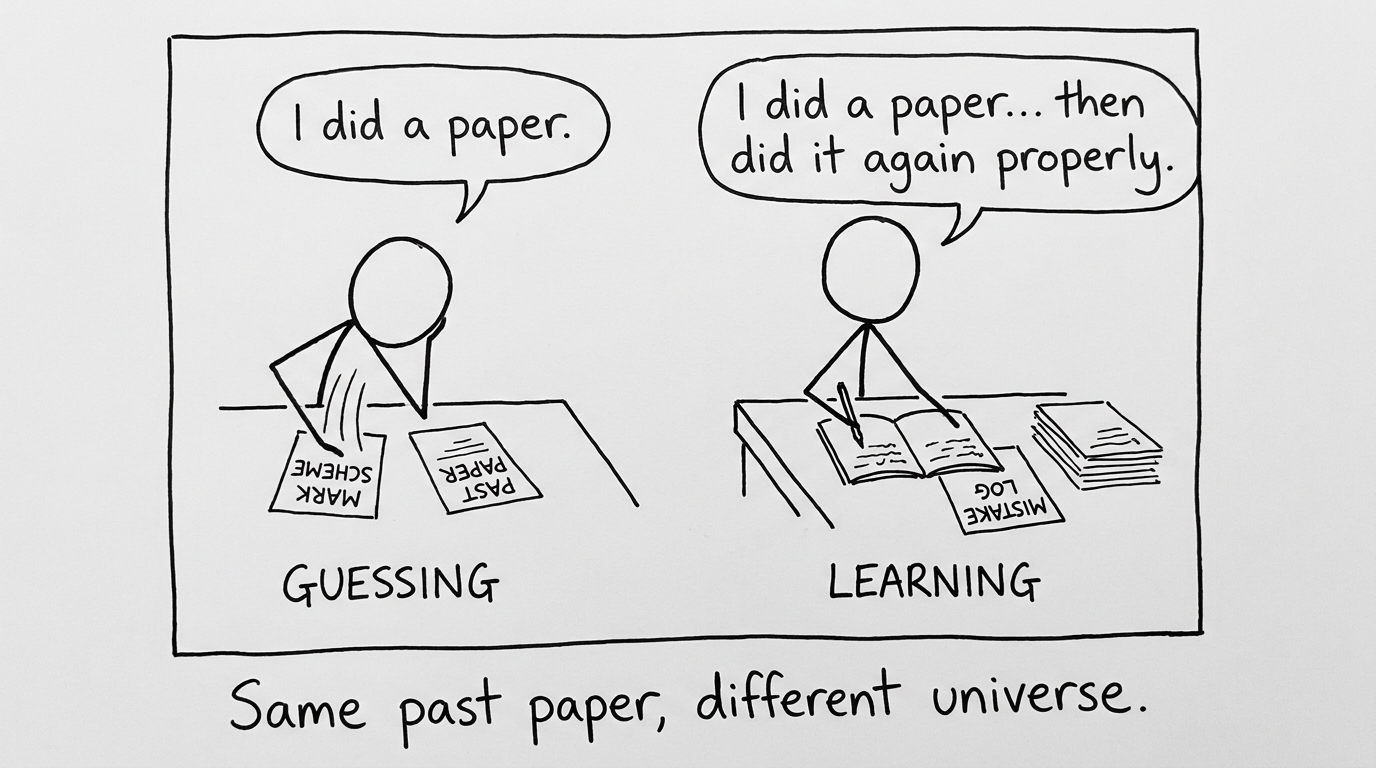 Same past paper, different universe
Step 3: mark it properly (most students do this part too quickly)
Marking is where GCSE papers become useful. Do it the same day if possible.
When you mark, do not just write a score. For every lost mark, write one of these codes:
- K = knowledge gap (you did not know the equation/idea)
- M = maths skill gap (rearranging, standard form, graph skill)
- U = units/conversions
- C = communication (no working, wrong rounding, missing conclusion)
- T = time pressure (you rushed or skipped)
That code turns the mark scheme into a revision plan.
If the issue is maths, jump straight into targeted practise:
- Use the GCSE maths question bank to drill the exact skill.
- Use mini tests for quick, focused checks (even if your board is AQA, the maths skills are the same).
Worked example: rearranging a formula without losing marks
AQA loves formula questions where the physics is straightforward but the algebra trips people.
Suppose you are given:
P=Et P = \frac{E}{t} P=tEand asked to make ttt the subject.
Start with:
P=Et P = \frac{E}{t} P=tEMultiply both sides by ttt:
Pt=E Pt = E Pt=EDivide both sides by PPP:
t=EP t = \frac{E}{P} t=PETwo GCSE habits make this exam-proof:
- Keep the equals sign lined up as you rearrange.
- Only do one operation per line.
If you want extra algebra practice that transfers directly to physics, the “changing the subject” skill appears constantly across GCSE and A Level maths. Build it through YesGenie lessons and revision guides, then bring it back to your AQA papers.
Worked example: standard form and unit conversions in one clean chain
Physics papers often blend two skills: standard form and converting units.
Example: A wire has resistance R=3.0×10³ ΩR = 3.0 \times 10^3\,\OmegaR=3.0×10³Ω. The current is I=2.0×10⁻³ AI = 2.0 \times 10^{-3}\,\text{A}I=2.0×10⁻³A. Find the potential difference using V=IRV = IRV=IR.
Substitute:
V=(2.0×10⁻³)(3.0×10³) V = (2.0 \times 10^{-3})(3.0 \times 10^{3}) V=(2.0×10⁻³)(3.0×10³)Multiply the numbers and add powers:
V=(2.0×3.0)×10−3+3=6.0×100=6.0 V = (2.0 \times 3.0) \times 10^{-3+3} = 6.0 \times 10^{0} = 6.0 V=(2.0×3.0)×10−3+3=6.0×100=6.0So:
V=6.0 V V = 6.0\,\text{V} V=6.0VThis is GCSE maths wearing a physics badge. If you consistently lose marks on powers of ten, use topic practice on YesGenie to tighten that one bolt rather than “doing another whole paper”.
Worked example: gradient from a graph (the method AQA rewards)
When AQA asks for a gradient, it is marking your process as much as your answer.
If two points on your best-fit line are (2,5)(2, 5)(2,5) and (8,17)(8, 17)(8,17), then:
gradient=ΔyΔx=17−58−2=126=2 \text{gradient} = \frac{\Delta y}{\Delta x} = \frac{17-5}{8-2} = \frac{12}{6} = 2 gradient=ΔxΔy=8−217−5=612=2Write the units if the axes have them. Many GCSE students drop a mark not because the gradient is wrong, but because the units are missing.
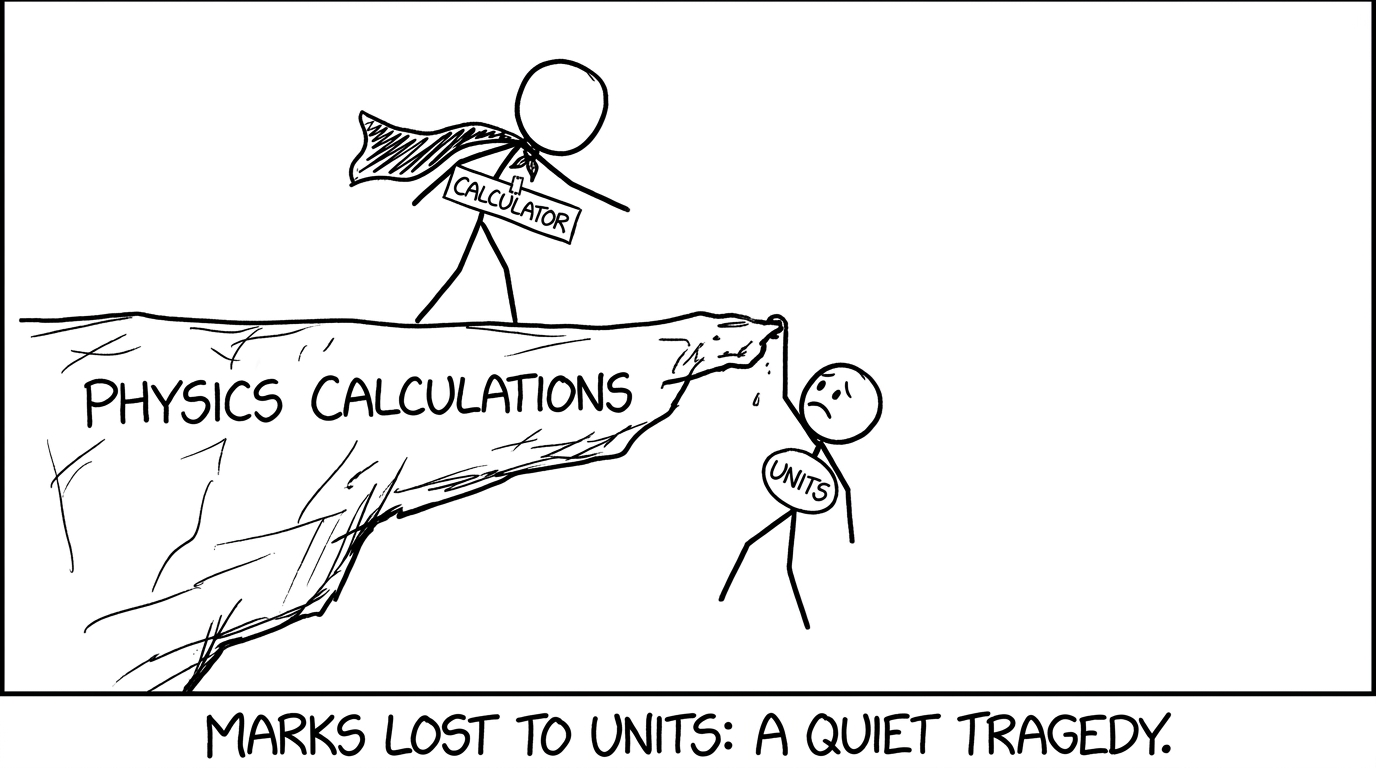 Units superhero
Step 4: redo questions (this is where your grade moves)
After you have marked and analysed, redo the questions you dropped marks on.
Rules for the redo:
- Wait at least 24 hours (so it is not just memory).
- Cover the mark scheme.
- Rewrite the solution fully, including units and final statements.
This feels slower than blasting through more GCSE papers. But it is the difference between activity and progress.
A simple target: each redo should reduce your “same mistake” rate. If you miss the same style again, that is not bad news -- it is clear news.
Step 5: use a “mistake log” that feeds your next session
Your mistake log should be short and specific. For each error, write:
- the topic (e.g. “energy transfers”, “electricity calculations”)
- the maths skill underneath (e.g. “rearranging”, “standard form”, “gradient”)
- the fix (one sentence)
- one similar question to practise next
When the maths skill is the issue, use YesGenie to practise the underlying method through lessons, revision guides, and past-paper-style questions. Start from GCSE Past papers to build confidence with exam wording, then use topic resources to close gaps.
Common mistakes students make with AQA GCSE Physics past papers
- Doing papers open-book and calling it revision. It becomes recognition, not recall.
- Marking with “kindness”. In GCSE exams, marks are awarded for what is on the page.
- Ignoring units. If you do not convert cm\text{cm}cm to m\text{m}m (or forget J\text{J}J vs kJ\text{kJ}kJ), the physics can be perfect and still lose marks.
- Skipping working. Even if the final answer is wrong, correct working can earn method marks.
- Not revisiting the same paper. One attempt is a snapshot; two attempts create learning.
- Treating timing as optional. Timing is part of the specification in practice, even if it is not written as a topic.
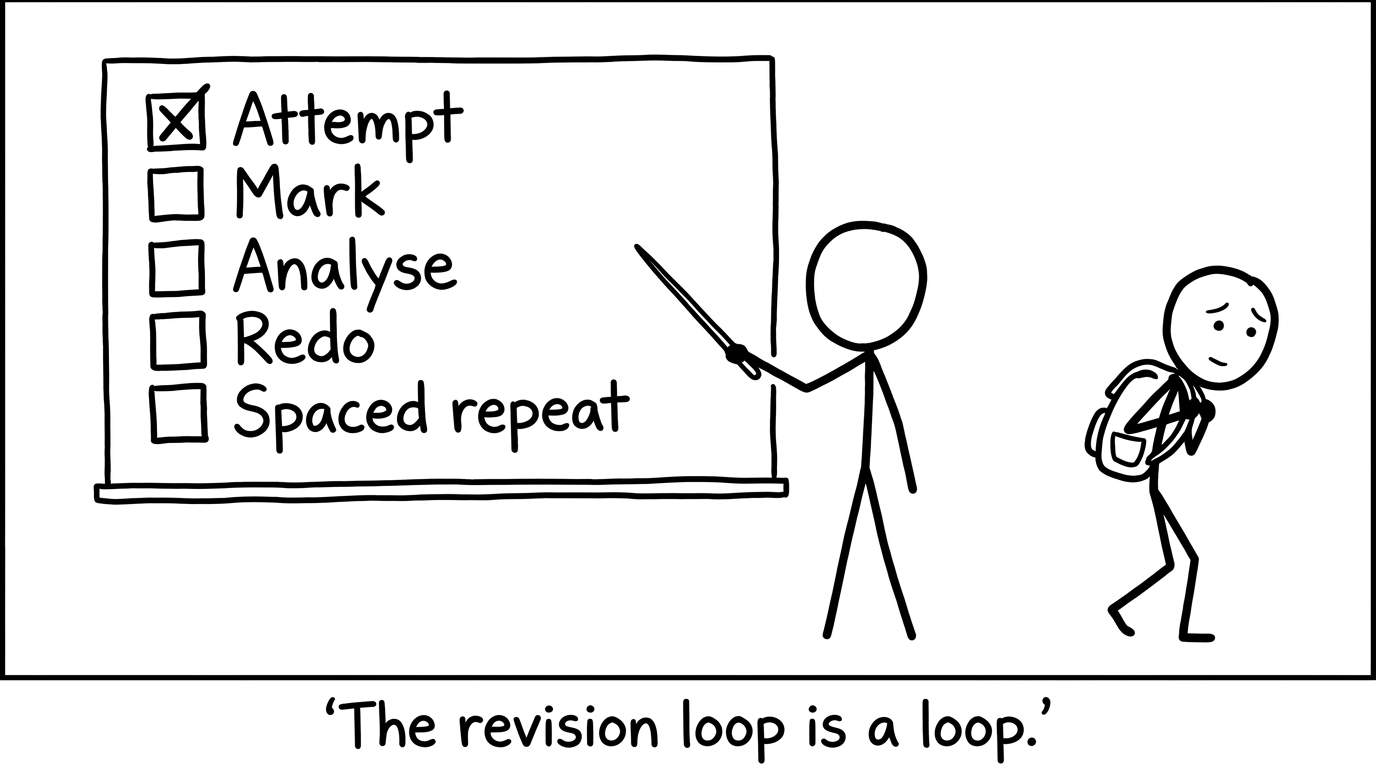 The revision loop is a loop
FAQ
How many AQA GCSE Physics past papers should I do for GCSE revision?
There is no magic number, because GCSE improvement is not linear with the number of papers you attempt. One paper done properly (attempt, mark, analyse, redo, spaced repeat) can teach you more than three papers done quickly. A sensible approach is to start with one full AQA paper per week, then increase as you get closer to exams and your stamina improves. If you are foundation tier, you may benefit from shorter timed sections first, because confidence and accuracy matter more than volume early on. If you are higher tier, the same is true, but you should also practise the longer multi-step questions where marks depend on structured working. Use your scores to decide: if the same topic keeps costing marks, switch to targeted practice rather than endlessly doing new GCSE papers.
What should I do when I do badly on a GCSE paper and feel demotivated?
First, treat the result as data, not identity. AQA GCSE Physics past papers are designed to expose weak spots, and that can feel personal when you are tired, but it is actually helpful. Mark it, code your mistakes (K/M/U/C/T), and pick one category to fix first rather than trying to fix everything at once. If the problem is maths, that is good news because maths is trainable with short, focused practice sessions and clear methods. Do a redo of the same questions after a day, because the emotional impact usually drops once you can see a clean improvement on the second attempt. Finally, remind yourself that GCSE grades move in steps: it is common to plateau, then jump after a few weeks of better-quality feedback.
How do I use GCSE maths revision to improve my AQA GCSE Physics marks?
Physics marks often sit on top of a small set of GCSE maths skills: rearranging formulae, substitution, unit conversion, standard form, gradients, and percentages. When you drop a physics calculation mark, ask: was it really physics, or was it one of those maths moves? Then practise that move in isolation until it feels automatic, because in the exam you need to do it under time pressure. This is where YesGenie helps because you can move from exam practice to topic practice quickly: use maths lessons and revision guides to relearn the method, then return to the same physics-style calculation and redo it. Over time, you build a dependable toolkit, and the physics paper starts to feel less like surprises and more like familiar structures. That is how GCSE maths revision quietly raises GCSE physics outcomes.
Should I use predicted papers as part of GCSE revision too?
Predicted papers can be useful when used as a supplement, not a replacement, for past papers. Past papers teach you the exam board’s habits and mark scheme language, which is irreplaceable for GCSE technique. Predicted papers are best used closer to exams when you want fresh questions that still feel realistic and specification-aligned. The risk is using predicted papers to avoid marking and analysis, because new questions can feel like progress even when the same mistakes repeat. If you use predicted papers, apply the same loop: timed attempt, strict marking, mistake log, and redo. On YesGenie, you can find predicted-paper style resources via the Resources hub and combine them with topic practice and past papers to keep revision balanced.
Closing: make each GCSE paper count twice
Using AQA GCSE Physics past papers properly is less about willpower and more about structure. The structure is simple: attempt, mark, analyse, redo, and spaced repeat. That loop turns every GCSE paper into a lesson tailored to you.
If you want to make the process easier, build your routine around YesGenie: use GCSE Past papers for exam practice, use AQA GCSE Maths Revision and revision guides to fix the maths underneath your physics errors, and use the Resources hub for extra support like mini tests and predicted-paper practice.
Do not just do another GCSE paper tomorrow. Do the same one again -- properly. That is where the marks have been hiding.