

GCSE: How to Stop Forgetting GCSE Physics Content
GCSE students: stop forgetting GCSE Physics content with spaced repetition, active recall and maths practice. Use YesGenie mini tests, papers and mark schemes.
The problem isn’t your brain -- it’s your revision loop
There’s a particular kind of panic that only shows up in GCSE season. You read your GCSE Physics notes, it all seems familiar, and then a past-paper question asks for something tiny -- the difference between mass and weight, the units for power, what happens to current in a series circuit -- and your mind goes quiet. You don’t feel stupid. You feel betrayed by your own memory.
That feeling is common, and it’s fixable. Most students aren’t “bad at Physics” -- they’re trapped in a revision loop that creates recognition, not recall. And because Physics is mathematical in disguise, improving your GCSE Physics memory often starts with a better approach to your maths practice, your formulae, and your exam-style habits.
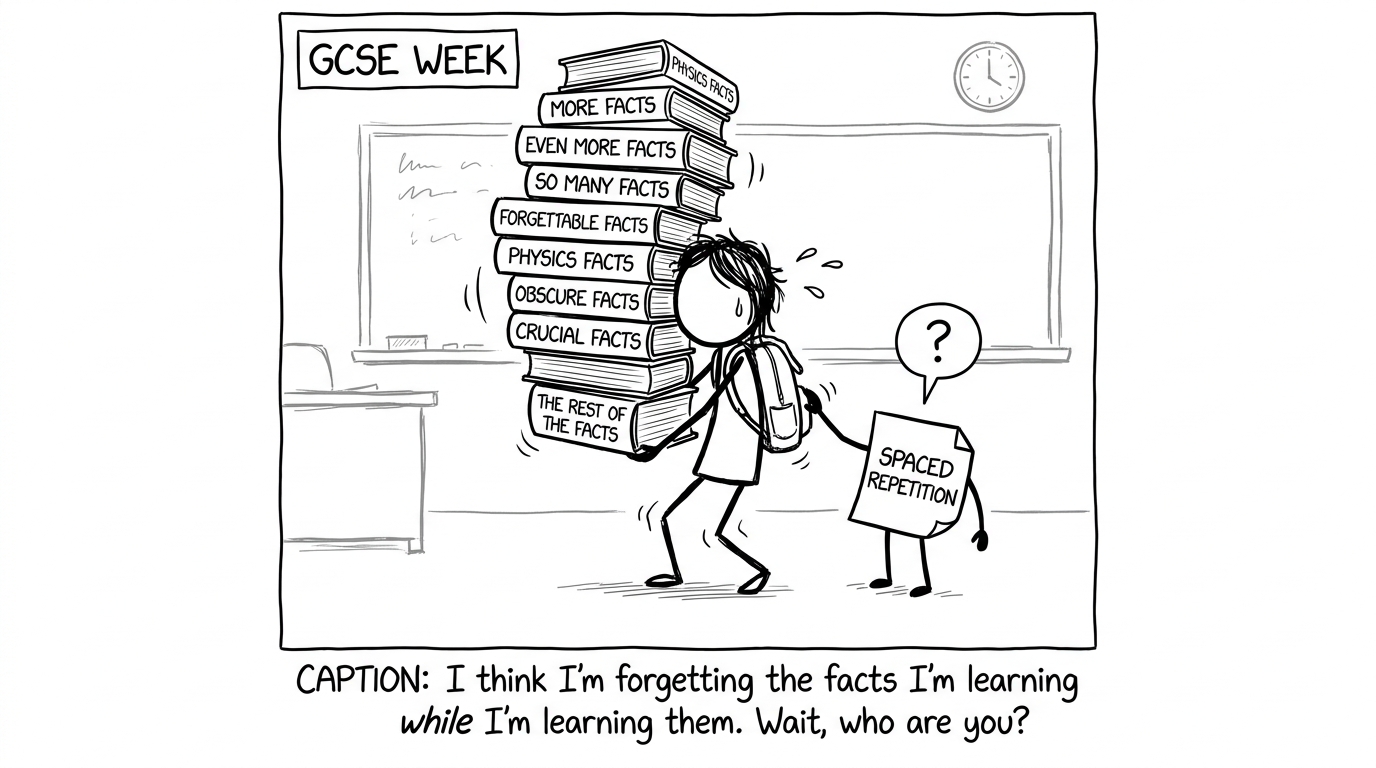 Student carrying physics facts while spaced repetition taps shoulder
A quick checklist for stopping forgetting
If you want to stop forgetting GCSE Physics content, aim to build a system that does four things:
- Forces active recall (you generate answers without looking)
- Uses spaced repetition (you return just before you forget)
- Anchors facts to exam questions (your brain learns what the mark scheme rewards)
- Strengthens the maths underneath (so Physics feels like method, not memory)
YesGenie helps with the last two especially: topic practice, mini tests, past papers, and mark schemes you can learn from.
Useful starting points:
- GCSE Past papers
- Edexcel GCSE Maths Past Papers
- Edexcel GCSE Maths Mini Tests
- Edexcel GCSE Maths Revision Guides
- Edexcel GCSE Maths Lessons
- Resources hub
- Other Resources
Why you forget GCSE Physics (and why it feels random)
Forgetting isn’t a moral failure. It’s what memory does when a piece of knowledge is stored as “I’ve seen this before” rather than “I can produce this under pressure”.
In GCSE Physics, that problem is amplified because:
- You meet lots of similar definitions (accuracy vs precision, scalar vs vector, series vs parallel)
- You use equations with unfamiliar units
- Marks often depend on exact phrasing from the specification (AQA, Edexcel, OCR, Eduqas all reward clarity)
- Questions hide the maths inside words
So rereading can feel productive while achieving almost nothing. Your eyes move; the page looks familiar; your brain relaxes. But exams demand the opposite: effortful retrieval.
The GCSE Physics memory method that actually sticks
Start every topic with “closed book” recall
Before you “revise” a topic, shut the book and write what you remember. Two minutes is enough. What you’re doing is diagnosing the gap honestly.
Try prompts like:
- “Write the equation for power and its units.”
- “List the energy stores and transfers.”
- “Explain why weight changes but mass doesn’t.”
Then open your notes and correct in a different colour. Those corrections are your real revision list.
Use spaced repetition, but keep it simple
Spaced repetition works because it times revision near the edge of forgetting. You don’t need a complicated app to do this.
A simple GCSE spacing pattern:
- Day 0: learn and test
- Day 2: quick recall test
- Day 7: exam questions
- Day 14: mixed questions
- Day 30: full paper section
The key is that each return is a test, not a reread.
Tie every memory to a mark scheme
In Physics, the mark scheme is a map of what counts. You might know the idea, but lose marks for vagueness.
This is where maths-style practice helps: do a question, check the method, adjust, repeat. On YesGenie you can build that habit using GCSE Past papers and, for your maths foundation, the Edexcel GCSE Maths Revision Guides.
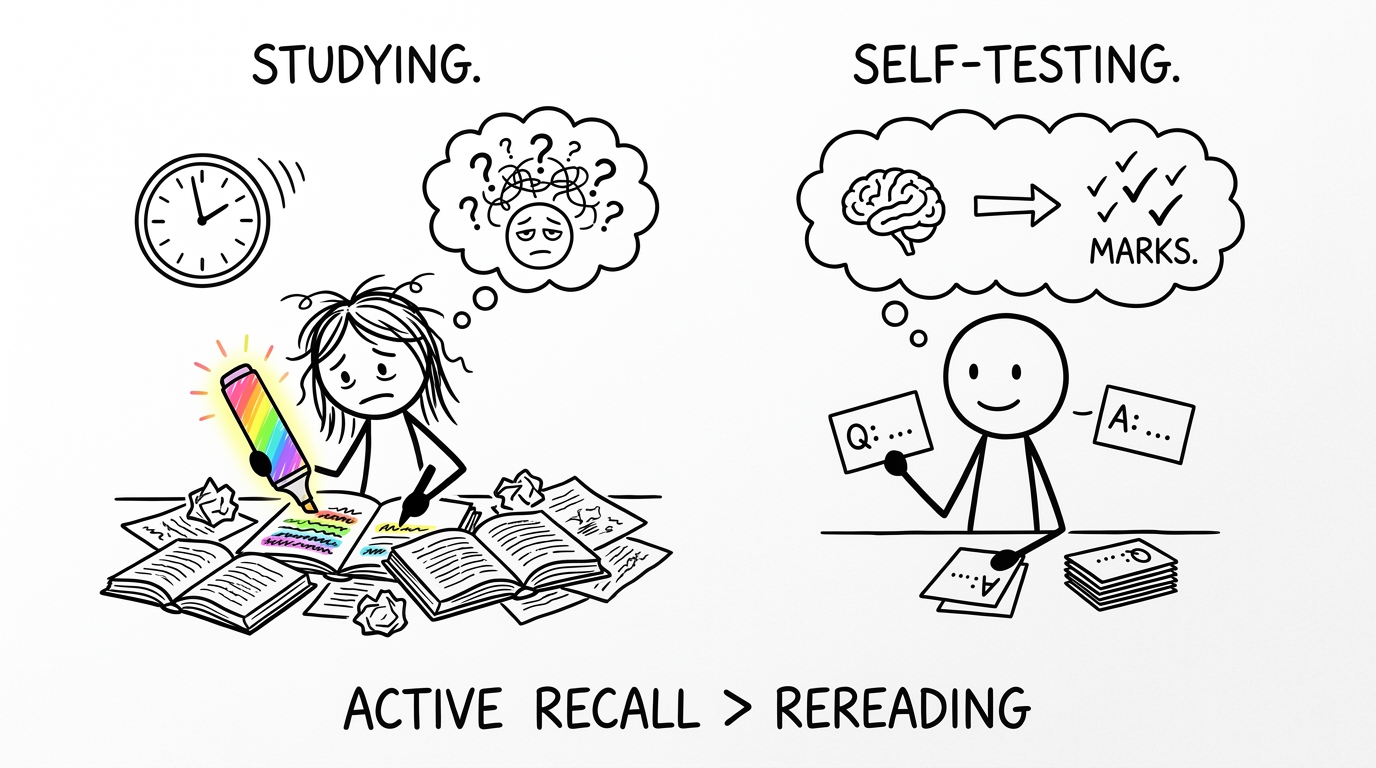 Highlighting vs active recall self-testing
Make GCSE Physics easier by strengthening the maths underneath
A lot of GCSE Physics forgetting is really “I don’t trust the maths, so I panic and guess”. If your algebra and percentages are automatic, your working memory is freed up to think about the science.
Below are three worked examples that show the method you should practise.
Worked example: rearranging equations (the calm way)
A student uses P=IVP = IVP=IV. They know P=24 WP = 24\text{ W}P=24 W and V=12 VV = 12\text{ V}V=12 V. Find III.
Start with:
P=IV P = IV P=IVRearrange for III by dividing both sides by VVV:
I=PV I = \frac{P}{V} I=VPSubstitute values:
I=2412=2 I = \frac{24}{12} = 2 I=1224=2So I=2 AI = 2\text{ A}I=2 A.
If rearranging feels shaky, that’s a maths skill, not a Physics memory issue. Use targeted practice from Edexcel GCSE Maths Lessons, then cement it with Edexcel GCSE Maths Mini Tests.
Worked example: standard form (because Physics loves it)
Convert 0.000450.000450.00045 to standard form.
Move the decimal point to make a number between 111 and 101010:
0.00045=4.5×10⁻⁴ 0.00045 = 4.5 \times 10^{-4} 0.00045=4.5×10⁻⁴Because the decimal moved 444 places to the right, the power is −4-4−4.
Standard form pops up in particle physics, space, electricity, and constants. If your standard form is slow, your Physics feels harder than it is.
Worked example: percentage uncertainty style thinking
A measurement is 50 cm50\text{ cm}50 cm to the nearest 1 cm1\text{ cm}1 cm. The absolute uncertainty is ±0.5 cm\pm 0.5\text{ cm}±0.5 cm. Percentage uncertainty is:
percentage uncertainty=0.550×100=1 \text{percentage uncertainty} = \frac{0.5}{50} \times 100 = 1 percentage uncertainty=500.5×100=1So it is 1%1\%1%.
That same structure appears in GCSE maths topics like percentages and fractions. If you need to rebuild those basics, start with Fractions, Decimals and Percentages (Revision Guide).
Turn forgetting into a predictable routine (the “three layers” plan)
Layer one: facts (flashcards that aren’t fluffy)
Make flashcards for:
- definitions that score marks
- units (and common unit conversions)
- equations you must know
But make them precise. A good card has one idea and one mark-scheme-ready sentence.
Layer two: methods (your equation workflow)
For every equation, practise the same steps:
- Write the equation
- Rearrange first (symbols only)
- Substitute numbers
- Calculate
- Add units
This turns “remembering” into “following a method”. That’s how you reduce panic.
Layer three: exam questions (where memory becomes usable)
Once a week, do exam-style questions under light timing. Not because you love stress, but because your brain stores knowledge differently when it’s retrieved under pressure.
YesGenie is built for this kind of practice loop: do questions, check solutions, repeat. Use the GCSE Past papers and match your maths practice to it with Edexcel GCSE Maths Past Papers.
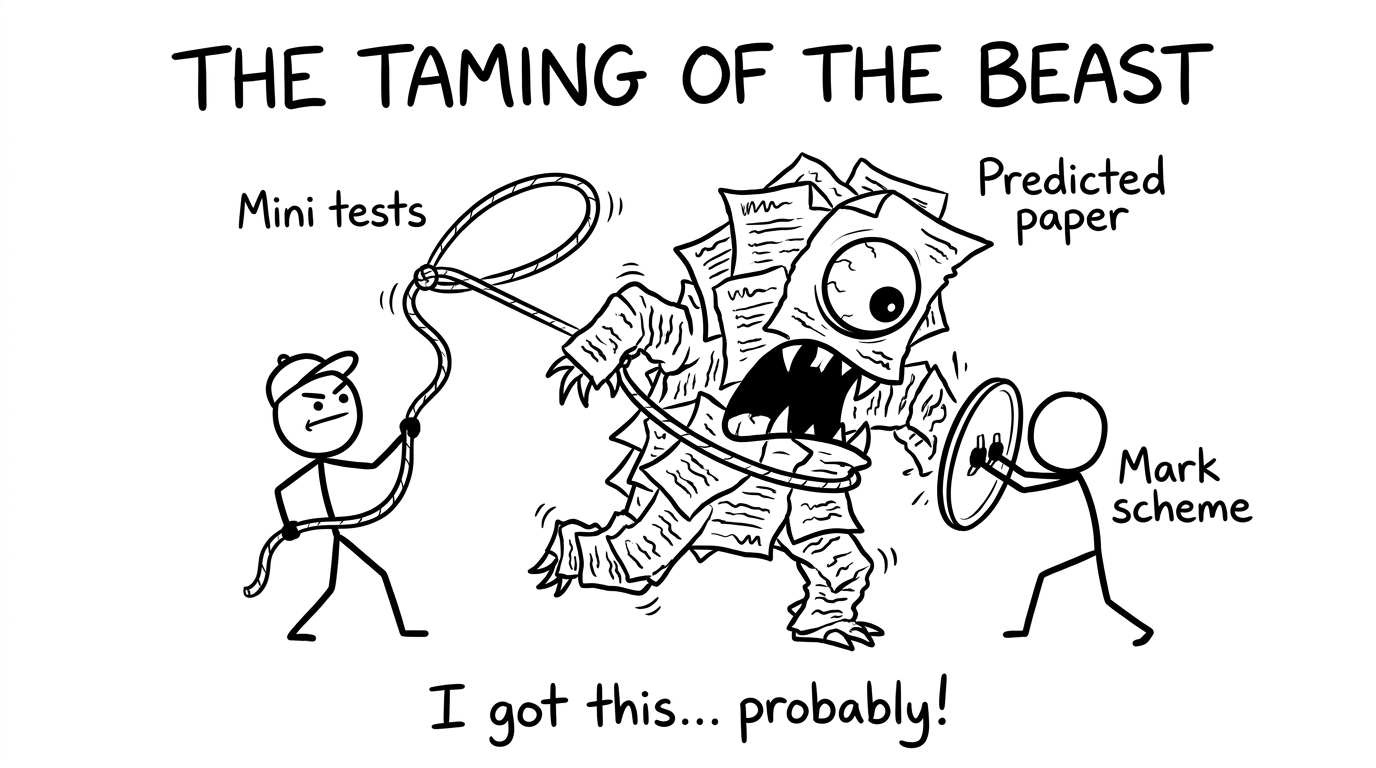 Predicted paper monster tamed by mini tests and mark scheme
Common mistakes that keep GCSE Physics slipping away
- Rereading instead of recalling: familiarity isn’t the same as memory you can use.
- Making huge flashcards: if one card has five facts, you’ll dodge it when you’re tired.
- Not learning units with equations: in GCSE Physics, units are half the meaning.
- Rearranging after substituting numbers: this increases errors and hides algebra weaknesses.
- Practising only “nice” questions: the exam mixes topics and uses unfamiliar contexts.
- Ignoring your maths gaps: if percentages, standard form, and rearranging are shaky, you’ll keep “forgetting” Physics even when you understand it.
FAQ
Why do I keep forgetting GCSE Physics right after I revise it?
Forgetting right after revision usually means you revised by recognition rather than recall. When you reread notes or watch videos passively, your brain can follow along, but it isn’t forced to retrieve the information. Retrieval is what strengthens memory, especially for GCSE definitions and required practicals. Another common reason is that you revised one topic in a long block and didn’t return to it, so the memory trace faded naturally. You can fix this with a simple loop: closed-book recall first, then corrections, then spaced repetition a few days later. Finally, if the topic includes calculations, weak maths skills can feel like forgetting when it’s actually uncertainty about method.
How much maths do I need to remember GCSE Physics content properly?
You don’t need A Level maths to do well in GCSE Physics, but you do need a reliable core: rearranging formulae, standard form, unit conversions, percentages, and interpreting graphs. These skills reduce the load on your working memory so you can focus on the Physics idea rather than the arithmetic. In exams, many mistakes come from skipping steps or mixing units, not from missing the concept entirely. If you make the maths automatic, your Physics revision sticks because it has a procedure to attach to. That’s why it helps to practise maths alongside science revision, using short bursts of exam-style questions. On YesGenie, the combination of lessons, mini tests, and past papers is ideal for turning weak spots into habits.
What’s the best way to use past papers without just copying mark schemes?
Past papers work when you treat them like feedback, not judgement. Start by answering a small section, then mark it immediately and write down the exact phrasing the mark scheme rewards. For GCSE science-style questions, build a “gold sentence” from the mark scheme and turn it into a flashcard, so you can recall it later without the paper. For calculations, compare your working line by line, not just the final answer, and rewrite the solution in your own steps. You should also redo the same question a week later without looking, because that is when you find out what you truly remembered. If you want structure, use YesGenie’s paper practice approach: pick a paper, attempt it, check solutions, then revisit the same skill using topic practice and mini tests.
Does spaced repetition really help for GCSE exams when time is short?
Yes, because spaced repetition is not about doing more -- it’s about timing. Even with limited time, revisiting a topic for five minutes on Day 2 and Day 7 can beat an extra hour of rereading on Day 0. For GCSE Physics, it’s especially powerful for equations, units, and definitions where small wording differences matter. Short, regular recall sessions reduce the “blank page” feeling because you’ve practised retrieving under mild pressure. If you’re close to exams, shrink the intervals: today, in two days, in five days, then in a week. Mix in exam questions so the knowledge becomes usable, not just stored. The goal is not perfect memory, but dependable recall when a question is phrased differently.
Bringing it back to your GCSE week
When students say they’re “forgetting GCSE Physics”, what they often mean is: “I can’t reliably pull it out when I need it.” The fix isn’t more highlighting. It’s a better loop: recall first, space your returns, practise methods, and let mark schemes teach you what earns marks.
If you want that loop to feel simple, build it around YesGenie. Use revision lessons to rebuild shaky maths methods, use mini tests for quick retrieval practice, then step up to past papers and predicted-paper style timing. Start here: Resources hub, then move into GCSE Past papers and your topic practice via Edexcel GCSE Maths Lessons and Edexcel GCSE Maths Mini Tests.
Your memory isn’t broken. It’s just waiting for you to revise the way the exam demands.