

GCSE Revision Mistakes That Secretly Waste Your Time
GCSE revision mistakes can waste hours without improving marks. Learn what to stop doing, what to do instead, and how YesGenie makes maths revision efficient.
GCSE revision can feel like walking for ages and still ending up in the same place. You sit down with good intentions, open a notebook, maybe even colour-code a page… and then the marks don’t move. The frustrating part is that you did work. You were busy. But busy is not the same as getting better at GCSE maths.
This post is about the GCSE revision mistakes that quietly steal your time. Not the obvious ones like “I didn’t revise”. The sneaky ones that feel productive in the moment, but don’t translate into exam marks on Edexcel, AQA, OCR or Eduqas papers.
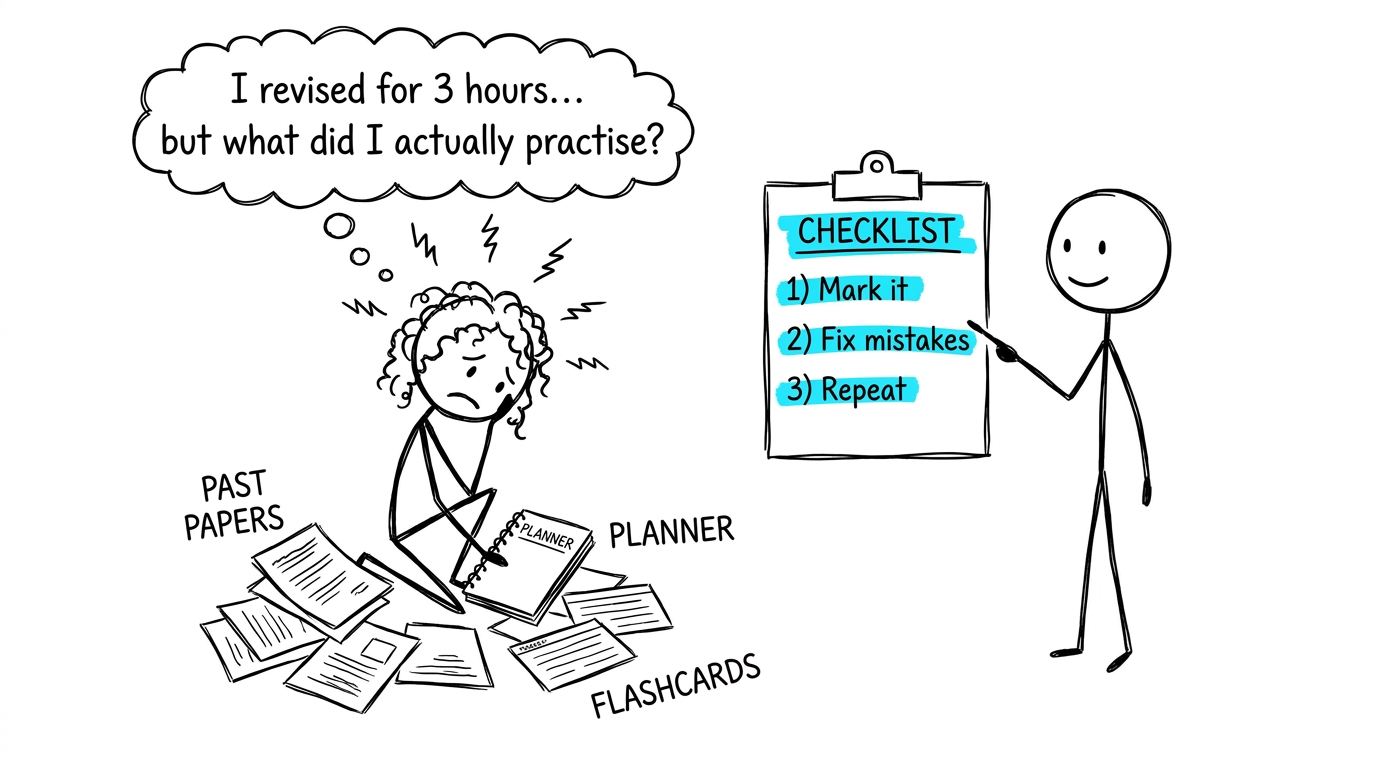 A student realises revision isn't the same as practice
A quick checklist: are you revising or rehearsing?
If you want your GCSE maths revision to actually convert into grades 9-1, aim for revision that does three things:
- Forces recall (you have to produce an answer, not just recognise it)
- Creates feedback (mark scheme, video solution, or a teacher helps you see the gap)
- Repeats intelligently (you return to weak skills until they become automatic)
On YesGenie, that usually means mixing revision lessons, practice questions, mini tests, and past papers. A strong starting point is your exam board hub, for example Edexcel GCSE Maths Revision or the wider GCSE Subjects page if you’re organising everything.
Mistake: doing “comfortable revision” instead of exam thinking
There’s a kind of revision that feels soothing. Re-reading notes. Watching a full video without pausing. Copying worked solutions into a book.
The problem is recognition. In a GCSE exam, you don’t get to recognise the method and feel relieved. You have to retrieve it from memory under time pressure, with a question written in slightly unfamiliar words.
A better swap is simple:
- Read a short explanation (2-5 minutes)
- Then do one exam-style question immediately
- Mark it, fix it, and do another
YesGenie’s topic pathways make this easier because you can move from lesson to questions quickly. If you’re an Edexcel student, the Edexcel GCSE Maths Lessons page is a clean way to pick a topic and start.
Mistake: practising without marking (the “no feedback” trap)
If you practise questions but don’t mark them properly, you’re basically training your brain to repeat its own mistakes. That sounds harsh, but it’s also hopeful: fixing this one mistake often makes revision feel “magically” more effective.
Try this mark-scheme routine:
- Mark with brutal honesty
- Circle the exact line where it went wrong
- Write a one-sentence cause: “I expanded incorrectly” or “I didn’t square the radius”
- Redo the question from scratch the next day
This is why past papers with solutions are gold for GCSE. If you’re on Edexcel, go straight to Edexcel GCSE Maths Past Papers and use the mark schemes and video solutions to create tight feedback loops.
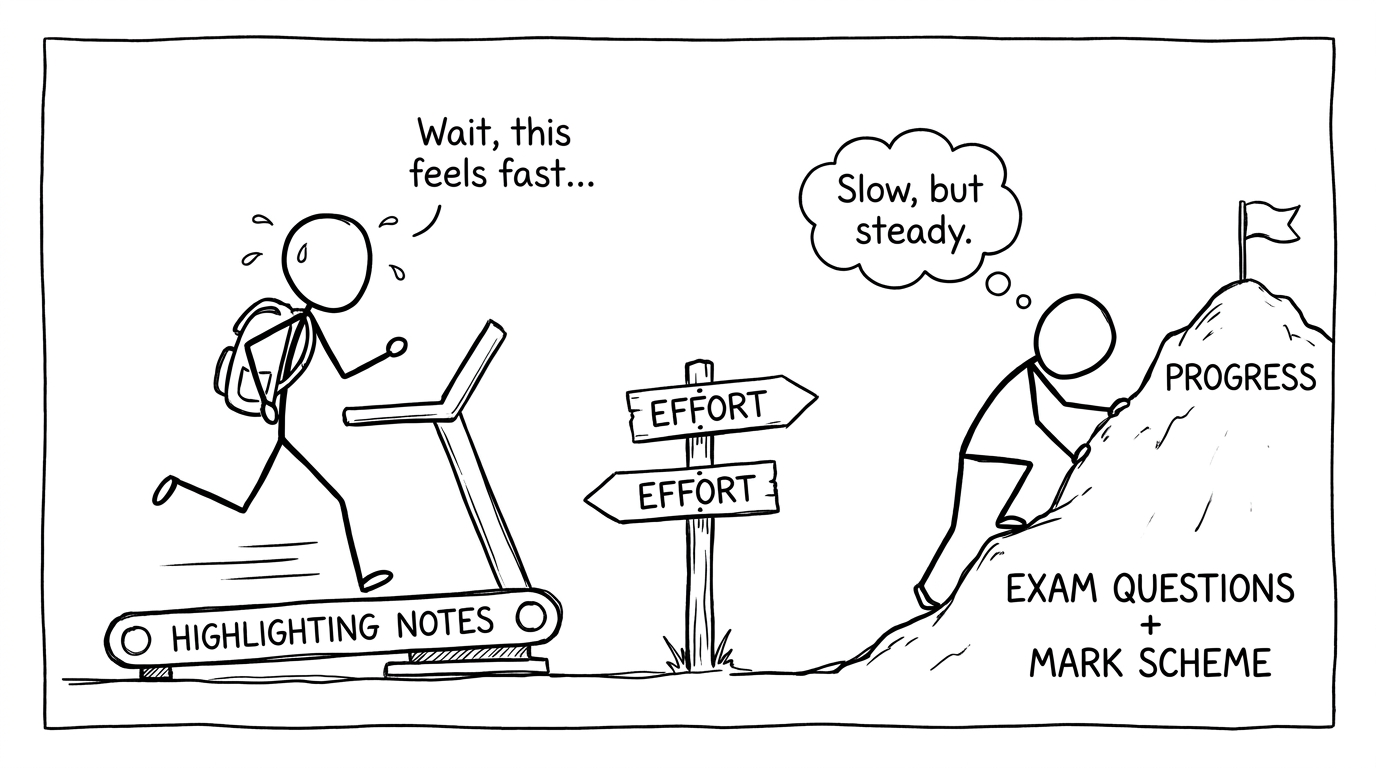 Highlighting vs exam questions treadmill
Worked example: a mistake you only catch by marking
Solve 3(2x−5)=4x+73(2x-5)=4x+73(2x−5)=4x+7.
3(2x−5)=4x+73(2x-5)=4x+73(2x−5)=4x+7Expand:
6x−15=4x+76x-15=4x+76x−15=4x+7Subtract 4x4x4x from both sides:
2x−15=72x-15=72x−15=7Add 151515:
2x=222x=222x=22Divide by 222:
x=11x=11x=11A very common GCSE revision error is to expand to 6x−56x-56x−5 (forgetting the 333 multiplies both terms). If you don’t mark, that wrong habit survives. If you do mark, you spot the exact moment the algebra slips.
Mistake: only doing full papers (or only doing topics)
GCSE revision tends to swing between extremes:
- Only topics: you get good at “chapter tests” but panic when topics mix.
- Only papers: you drown in weaknesses, never repairing any of them.
The efficient approach is a loop:
- Do a paper (or half-paper)
- Diagnose weak topics
- Do targeted topic revision and questions
- Return to another paper
YesGenie makes this loop easier because you can go from exams to topics quickly, and back again. Use Resources to find mini tests and other structured practice, and combine that with your exam board’s past papers.
Where predicted papers fit (without becoming a crutch)
Predicted papers are brilliant when you already have the basics in place. They help you practise GCSE exam style in a focused way near the exam window, especially when you need fresh questions.
For Edexcel students, Edexcel GCSE Maths Predicted Papers can be a smart addition in the final weeks. Treat them like real papers: timed, marked, analysed.
Mistake: ignoring the “1 mark = 1 minute” reality
A painful truth about GCSE maths: you can know the maths and still lose marks through pace.
A rough planning rule is:
- Spend about 111 minute per mark.
So a 444-mark question deserves about 444 minutes. If you’re spending 101010 minutes on every tricky algebra question in revision, you’re not just practising maths -- you’re practising a pace the exam can’t afford.
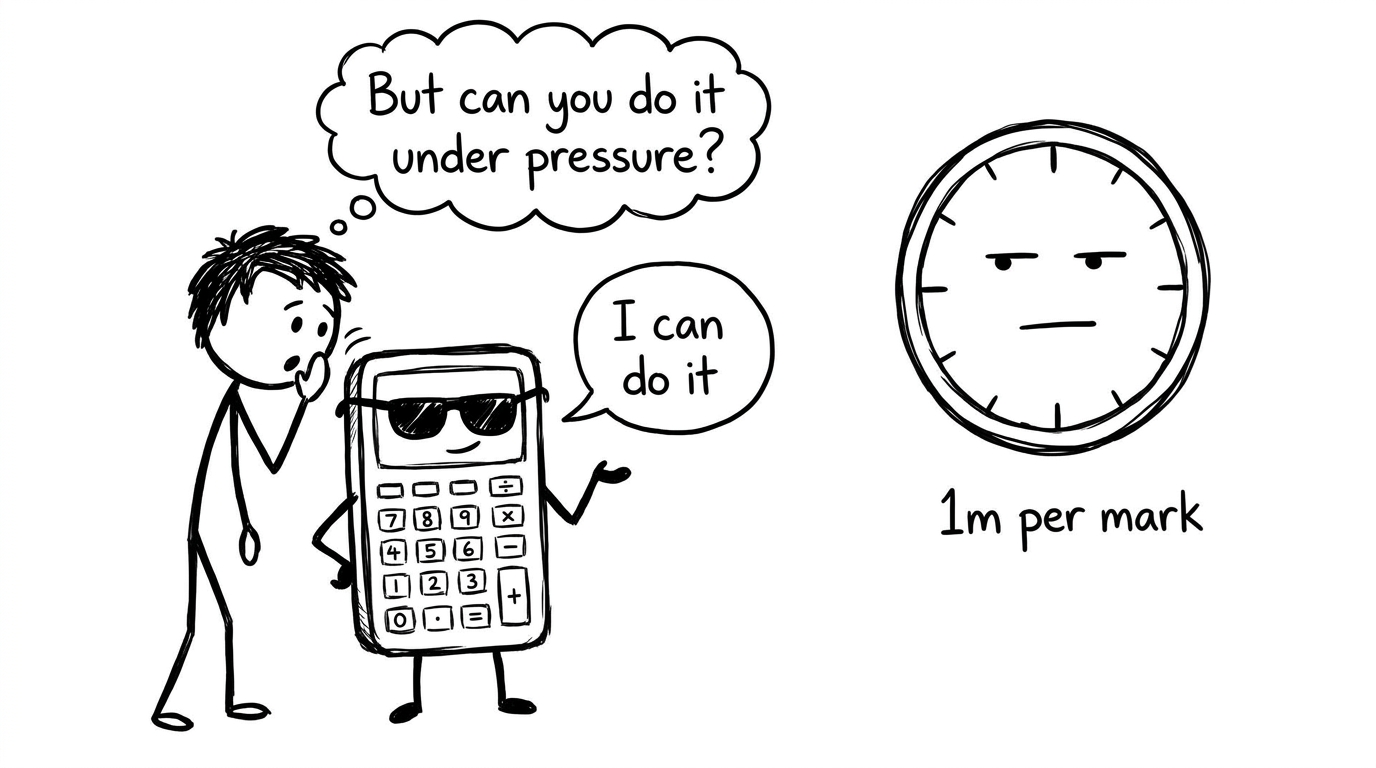 Calculator confidence vs exam pressure
Worked example: building speed with method
Simplify (x+3)(x−5)(x+3)(x-5)(x+3)(x−5).
Use expansion:
(x+3)(x−5)=x(x−5)+3(x−5)(x+3)(x-5)=x(x-5)+3(x-5)(x+3)(x−5)=x(x−5)+3(x−5) =x2−5x+3x−15=x^2-5x+3x-15=x2−5x+3x−15 =x2−2x−15=x^2-2x-15=x2−2x−15The GCSE time-waster here is re-expanding multiple times because you don’t trust your result. In revision, you build trust by marking, spotting patterns, and repeating until it becomes automatic.
Mistake: revising “what you like” instead of “what costs marks”
Most students gravitate towards topics that feel satisfying. The danger is that GCSE papers don’t reward satisfaction; they reward coverage.
A strong habit is to keep a “marks-leak list” with three columns:
- Topic (e.g. ratio, probability, circle theorems)
- What goes wrong (e.g. “I don’t form equations”)
- Fix (e.g. “do 10 ratio questions, mark, redo wrong ones”)
To make this practical, pull questions from revision guides and exam-style sets. For example, if probability is a weak spot, a focused page like Probability -- GCSE Maths Revision helps you go from explanation to practice without wandering.
Mistake: treating grade 8-9 skills as “optional extras”
If you’re aiming for the top grades, your GCSE revision needs some deliberate exposure to grade 8-9 style reasoning: proof, vectors arguments, multi-step problem solving.
This is where students waste time by avoiding discomfort. They keep polishing grade 4-6 skills because it feels like progress, then the higher-tier paper asks for reasoning and the marks disappear.
A good way in is to use structured notes and then do a small set of exam questions. For example, Vectors Proof Questions -- Revision Guides is ideal when you want to practise the written method GCSE mark schemes reward.
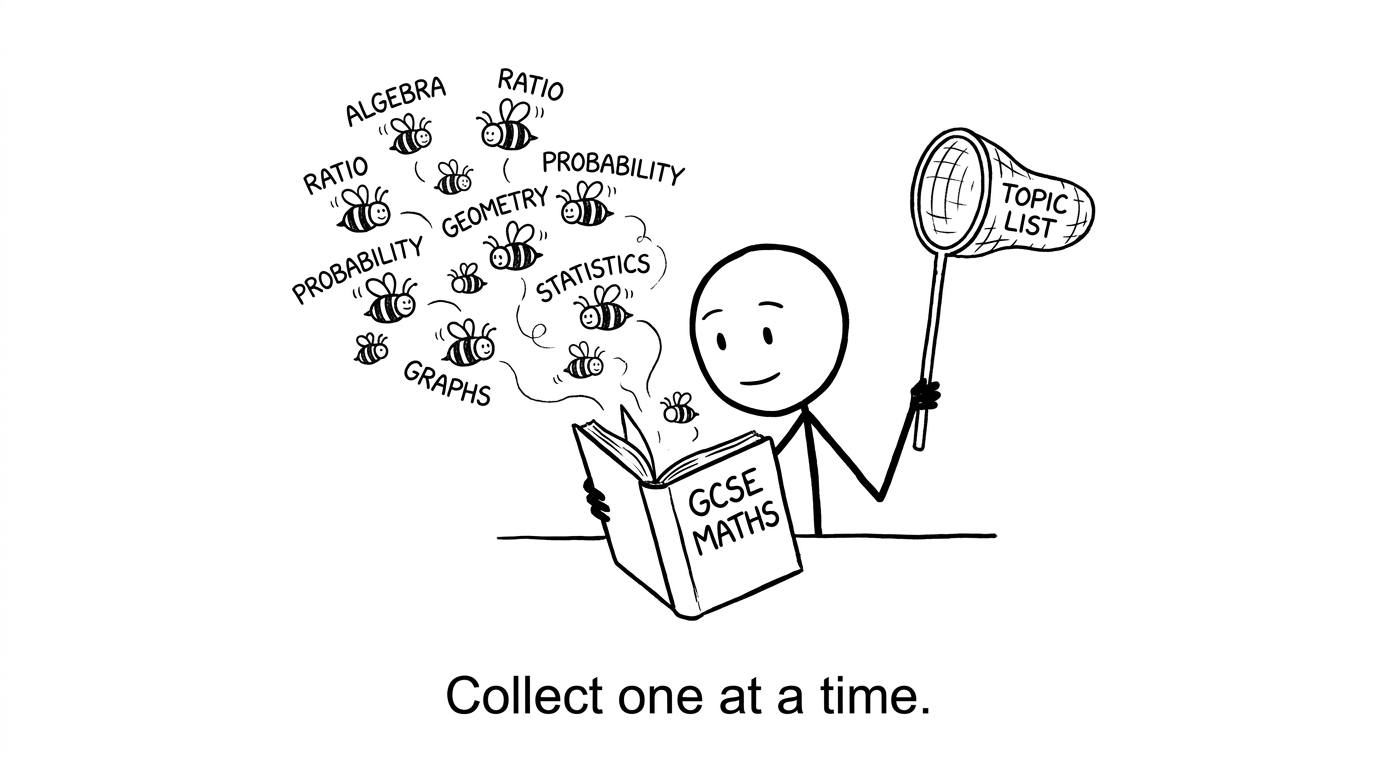 Topics flying out of the book, captured one at a time
Common mistakes that waste time (and the fix)
Here are the most common GCSE revision mistakes, in blunt form:
- You do questions, but don’t redo the wrong ones. Fix: create a “redo list” and revisit within 48 hours.
- You only revise with a calculator. Fix: include non-calculator practice, especially for fractions, BIDMAS and exact values.
- You don’t write enough working. Fix: practise writing the lines that earn marks in mark schemes (especially on higher tier).
- You jump topics every 5 minutes. Fix: do 202020-minute blocks so your brain has time to settle.
- You measure revision by hours, not outcomes. Fix: track “questions marked” and “weak topics reduced”.
If you want your revision to feel more structured, start from Edexcel GCSE Maths Revision Guides (or your board’s equivalent) and attach questions immediately after each note section.
FAQ
How many past papers should I do for GCSE maths revision?
There isn’t a magic number, because the real goal of GCSE past papers is to reveal patterns in your mistakes. One student can do five papers and learn loads because they mark carefully, redo errors, and revisit weak topics. Another student can do fifteen papers and barely improve if they rush, glance at the answers, and move on. A practical target is to do enough papers that your “marks-leak list” starts shrinking rather than growing. If you’re close to exams, aim for at least one timed paper per week, plus targeted topic practice in between. On YesGenie you can build this routine using Edexcel GCSE Maths Past Papers and then switching into lessons and revision guides for the topics that caused lost marks.
Are predicted papers worth doing for GCSE?
Predicted papers are worth doing when they sit on top of solid foundations, not instead of them. They’re useful because they feel like the real exam, help you practise timing, and often focus your attention on common topics and styles that appear. The risk is treating them like a shortcut, where you do a predicted paper, check the score, and repeat without repairing weaknesses. If you use predicted papers properly, you treat them as data: what topics went wrong, and why, and what you will do about it tomorrow. In the final few weeks, predicted papers can be a great way to keep revision fresh and exam-focused. If you’re on Edexcel, use Edexcel GCSE Maths Predicted Papers and commit to marking and redoing, not just attempting.
What should I do if I keep forgetting methods in GCSE maths?
Forgetting is not a character flaw; it’s often a revision design issue. If your GCSE revision is mostly reading or watching, you are training recognition rather than recall, so the method doesn’t stick under exam conditions. The fix is active recall: close the notes, attempt a question, and force yourself to retrieve the steps. Then mark it immediately, because memory strengthens fastest when feedback arrives quickly. After that, do spaced repetition: revisit the same type of question the next day, then a few days later, then a week later. YesGenie helps because you can move from topic explanations to practice questions and solutions quickly, which makes this recall-feedback-repeat cycle easier to maintain. If you want a simple starting structure, go through Edexcel GCSE Maths Lessons and do a small set of questions after each lesson before switching topics.
I’m doing A Level maths as well -- does GCSE revision still matter?
It matters more than you think, because A Level maths quietly assumes fluency with GCSE algebra, indices, surds, graphs, ratio, and probability basics. If those foundations are shaky, A Level topics like differentiation and algebraic manipulation feel much harder than they should. The time-wasting trap is trying to “power through” A Level content while your GCSE skills leak marks and confidence. Even ten minutes a day of targeted GCSE algebra practice can make A Level revision smoother, because you reduce friction in every line of working. The best approach is to treat GCSE skills as your daily warm-up and A Level content as the main session. Use GCSE past-paper questions for speed and accuracy, then return to A Level problem solving with a calmer brain. YesGenie’s structure across exam levels makes it easier to keep both plates spinning without revision chaos.
The ending most students need: revise less, but revise sharper
The aim isn’t to do more GCSE revision. It’s to waste less time. When your revision is built around exam questions, mark schemes, and deliberate repair of mistakes, you don’t need marathon sessions to see progress. You need consistency, feedback, and the courage to practise what feels awkward.
If you want a clear next step, build a simple weekly loop on YesGenie:
- Use Edexcel GCSE Maths Past Papers (or your board hub) for timed practice
- Use Edexcel GCSE Maths Lessons and Edexcel GCSE Maths Revision Guides to fix weak topics
- Add focus and freshness with Edexcel GCSE Maths Predicted Papers near exam season
- Explore extra structured practice via Resources
GCSE maths rewards the student who turns mistakes into a plan. YesGenie gives you the lessons, practice questions, mark schemes, video solutions, past papers, and predicted papers to make that plan real -- for free.