

Eduqas GCSE Exam Week Checklist (Simple Guide)
GCSE exam week checklist for Eduqas Maths: what to revise, what to practise, and how to use YesGenie past papers, lessons and mark schemes fast.
GCSE exam week has a particular feeling: your pencil case suddenly matters, your calculator batteries become a moral issue, and every topic you’ve ever seen in class seems to queue politely at the door of your brain at once.
If you’re on Eduqas, the good news is that you don’t need a magical new technique in the final stretch. You need a simple checklist you can trust, a handful of high-return topics, and a way to practise that turns mistakes into marks. This guide is built for GCSE maths exam week: calm, practical, and focused on what actually moves your grade.
 A student clinging to a calculator while a friend points to a checklist
The Eduqas GCSE exam week checklist (quick version)
Keep this checklist somewhere visible during GCSE exam week (notes app, wall, or the front of your revision folder).
The night before each paper
- Choose one targeted topic to tidy up (not ten). Use a lesson and do a few exam-style questions.
- Do a short paper section under time pressure (or a set of questions) and mark it.
- Prepare your kit: pens, pencil, ruler, protractor, compass, calculator (and spares), water.
- Write a one-line plan for tomorrow: “Start steady, show steps, check units.”
The morning of the exam
- Do 10 minutes of warm-up maths (simple accuracy work).
- Read one page of reminders (formulae, common slips, method patterns).
- Stop revising heavy new content 45 minutes before.
In the exam
- Scan, start with the questions you can bank.
- Show method early and clearly (method marks are real marks).
- If stuck: write something sensible and move on, then return.
- Final 5 minutes: check arithmetic, units, rounding, and that you answered what was asked.
Use YesGenie the Eduqas way (the fastest set-up)
Eduqas GCSE maths papers reward the same thing every board rewards: fluent methods and disciplined checking. So your resources should be organised around those two goals.
These pages are your base for GCSE exam week:
- Eduqas GCSE Maths Revision -- your hub for question bank, lessons, and exam practice.
- Eduqas GCSE Maths Past Papers -- real papers with mark schemes.
- Eduqas GCSE Maths Lessons -- quick topic refreshers when you need a method.
- Eduqas GCSE Maths Exam Booklets -- topic booklets of past-paper questions.
- GCSE Past Papers (all boards) -- useful if you want extra practice on the same topic.
- GCSE Subjects -- if you’re cross-revising other GCSEs.
- Resources and Other Resources -- handy extras for revision routines.
Even if you’re revising for Eduqas, it helps to remember a quiet truth about GCSE exam week: you don’t rise to the occasion, you fall to the level of your systems. YesGenie is the system.
 Past Paper and Mark Scheme shaking hands while Brain photobombs
A simple GCSE exam week plan (without cramming)
Build your “two-loop” revision
In GCSE exam week, you want two loops running at the same time:
- Loop 1: Accuracy loop (short, daily) -- arithmetic, fractions, percentages, calculator skills, rearranging.
- Loop 2: Exam loop (every other day) -- timed paper practice, then mark scheme reflection.
This is why past papers matter: they don’t just test your maths, they test your behaviour under time.
A realistic plan for a week with two papers might look like:
- Day before Paper 1 (non-calculator): 30 minutes accuracy loop + 45 minutes of non-calculator questions + mark.
- Between Paper 1 and Paper 2 (calculator): 30 minutes accuracy loop focused on calculator use + 45 minutes mixed exam questions + mark.
- Day before Paper 2: one topic tidy-up + one timed section + early night.
Use Eduqas GCSE Maths Past Papers as your main practice, and dip into Eduqas GCSE Maths Lessons only when you can name exactly what you’re fixing.
Two worked examples that pay off in GCSE exam week
The best GCSE exam week examples are the ones that appear everywhere in disguise: percentage change and algebraic rearranging. They show up in number, ratio, geometry, and even problem-solving questions.
Percentage change with calm structure
A coat costs £80 and is reduced by 15%15\%15%. What is the sale price?
Write it as “original × multiplier”. A reduction of 15%15\%15% means you keep 85%85\%85%.
Sale price=80×0.85=68 \text{Sale price} = 80 \times 0.85 = 68 Sale price=80×0.85=68So the sale price is £68.
Now the common GCSE twist: the coat later increases by 20%20\%20% from the sale price. New price:
68×1.2=81.6 68 \times 1.2 = 81.6 68×1.2=81.6So the new price is £81.60.
Why this matters in GCSE exam week: when you use multipliers, you avoid the messy halfway method that breaks under stress. It also makes reverse percentages easier, because you can undo a multiplier by dividing.
Rearranging a formula (method marks you can bank)
Make xxx the subject of y=3x−7y = 3x - 7y=3x−7.
Add 777 to both sides:
y+7=3x y + 7 = 3x y+7=3xDivide by 333:
x=y+73 x = \frac{y + 7}{3} x=3y+7That’s it. On GCSE mark schemes, each clean algebra step often earns a method mark. Even if your final line is wrong due to a slip, your steps can still score.
If rearranging regularly costs you marks, spend 20 minutes with targeted practice from Eduqas GCSE Maths Lessons, then immediately apply it using an Eduqas GCSE Maths Exam Booklet so the method sticks to real exam phrasing.
Non-calculator vs calculator: what to prioritise for Eduqas GCSE
Eduqas GCSE papers (like AQA, Edexcel, OCR, Eduqas) split skills across non-calculator and calculator in a way that can change how you revise.
For a non-calculator paper
Prioritise:
- Fraction and percentage fluency: converting, simplifying, finding fractions of amounts.
- Efficient arithmetic: ×\times×, ÷\div÷, and sensible estimation.
- Standard methods: long multiplication/division when needed.
- Exact values and clean algebra.
Your exam-week aim is not to become faster at everything. It’s to remove the slow-down moments where you panic because you can’t remember how to handle, say, 35\frac{3}{5}53 of 120120120.
For a calculator paper
Prioritise:
- Using the calculator correctly (brackets, negative numbers, order of operations).
- Rounding and bounds awareness.
- Interpreting answers (money, units, degree of accuracy).
A calculator doesn’t remove thinking. It just changes where the mistakes happen.
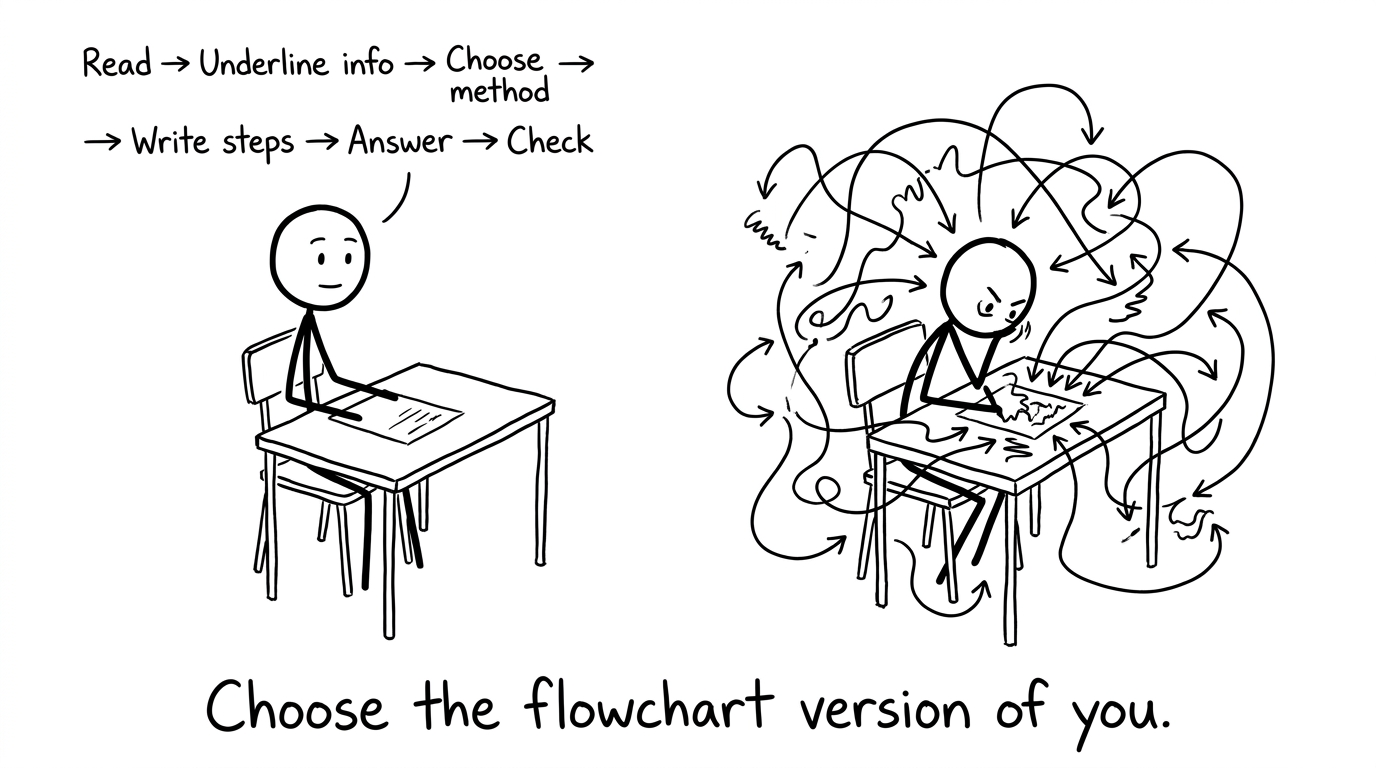 Exam flowchart vs spaghetti panic writing
How to mark like an examiner during GCSE exam week
Marking is where GCSE revision becomes intelligent.
When you finish a paper (or a section), don’t just write “got it wrong”. Instead, label the error:
- Method: you didn’t know what to do.
- Accuracy: you knew what to do but slipped.
- Communication: you had the idea but didn’t show it.
- Reading: you answered a different question.
Then your next 20 minutes is obvious:
- Method error: watch/scan the relevant lesson, then do 3 similar questions.
- Accuracy error: do 5 quick questions of the same type slowly, checking each line.
- Communication error: rewrite your solution with clearer steps.
- Reading error: practise underlining key information and circling what’s being asked.
This is why past papers plus mark schemes are such a powerful GCSE exam week combination: you get immediate feedback on how marks are awarded, not just whether you were right.
Use Eduqas GCSE Maths Past Papers for the papers, and keep the Eduqas GCSE Maths Revision hub open so you can jump straight into lessons or question bank practice for any topic that shows up as a weakness.
Common mistakes (and how to avoid them)
Rounding too early
If a question asks for an answer to 333 significant figures, keep full accuracy until the end. Rounding mid-way can shift your final answer.
Ignoring units
If the question is in cm and you answer in m, your maths may be fine but your answer is wrong. In GCSE exam week, units are an easy mark to protect.
Losing method marks by skipping steps
Even if you can do it mentally, write enough for the examiner to award marks. This matters most on algebra, ratio, and multi-step problem solving.
Misreading “exact” vs “estimate”
“Exact” often means leave answers in terms like π\piπ or surds. “Estimate” means sensible rounding. Train yourself to circle that one word.
Calculator input errors
A common GCSE mistake is typing without brackets. For example, for 35×120\frac{3}{5} \times 12053×120, typing 3÷5×1203 \div 5 \times 1203÷5×120 is fine, but for 35×120\frac{3}{5 \times 120}5×1203 it isn’t. If the structure matters, use brackets.
 A checklist pushing away an 'Exam Panic' gremlin
FAQ (Eduqas GCSE maths exam week)
How many past papers should I do in GCSE exam week?
For GCSE exam week, quality beats quantity. One well-marked paper can do more for your grade than three rushed papers you never review properly. Aim for a realistic rhythm: timed practice plus marking plus a short fix session on the mistakes. If you’re doing higher tier, you may benefit from mixing in a few targeted topic sets as well, because harder questions often combine topics. Use Eduqas GCSE Maths Past Papers for full papers, then use Eduqas GCSE Maths Lessons to repair the methods you missed. The key is to finish each session knowing exactly what you improved, not just what you attempted.
What should I do if I’m foundation tier and aiming for a grade 5?
A grade 5 is built from reliable marks, not heroic questions. In GCSE exam week, prioritise topics that appear frequently and are easiest to secure under pressure: percentages, ratio, basic algebra, angles, area, and interpreting graphs. Make your working clear so you pick up method marks even when arithmetic slips. Try short bursts of practice that feel doable, because confidence matters for performance and speed. Use the Eduqas hub to keep everything organised: Eduqas GCSE Maths Revision and the Eduqas GCSE Maths Exam Booklets are ideal for structured topic practice. If you get stuck, don’t widen your revision -- narrow it, fix one method, and return to exam questions.
I’m also doing A Level maths -- does any of this still help me?
Yes, because exam-week behaviour scales. A Level maths is more complex, but the core habits are the same: show a method, check assumptions, and learn from mark schemes rather than vibes. GCSE-style accuracy work can even be a useful warm-up for A Level students, because it keeps algebra and arithmetic clean. The bigger point is psychological: during exam week, you want fewer decisions and more routine. If you can follow a checklist for GCSE papers, you can follow a checklist for A Level papers too. Use the same structure: timed practice, mark, identify error type, then repair with a targeted lesson and a small set of questions. That loop is the difference between revision that feels busy and revision that changes results.
What if I freeze in the exam even when I know the topic?
Freezing is usually a process problem, not an intelligence problem. In GCSE exam week, practise your “first 60 seconds” routine: read, underline information, circle what is being asked, and write one line of plan. That one line might be “use Pythagoras” or “form an equation” -- it anchors you. If you still can’t see it, write down any relevant fact you do know (a formula, a relationship, a diagram label) because that often unlocks method marks and momentum. Move on quickly and return later, because your brain solves problems in the background when it’s not being stared at. Finally, mimic exam pressure in revision: timed questions marked honestly. The more familiar the feeling is, the less it can hijack you.
Closing: a calmer GCSE exam week starts with a system
There’s a moment in every GCSE exam week when you realise revision isn’t about learning everything. It’s about making fewer avoidable mistakes, collecting method marks, and staying steady when a question is worded differently than you expected.
If you want a simple next step, make YesGenie your home base: start at Eduqas GCSE Maths Revision, work through Eduqas GCSE Maths Lessons for any shaky methods, and then prove it with Eduqas GCSE Maths Past Papers and Eduqas GCSE Maths Exam Booklets. That cycle -- lesson, practice, mark scheme, repeat -- is how GCSE grades move in the final week.
Your checklist doesn’t need to be fancy. It just needs to be followed. And if you follow it, GCSE exam week becomes less about panic and more about progress.