

GCSE CCEA: Night-Before Plan for Chemistry (No Panic)
GCSE CCEA night-before plan for Chemistry that avoids panic. A calm checklist, quick maths refresh, and smart practice using YesGenie resources.
The night before an exam has a special talent: it makes sensible people consider learning an entire specification in one sitting. You open your notes, see a sentence you don’t recognise, and your brain declares an emergency. If you’re sitting CCEA tomorrow, this GCSE night-before plan is designed to do the opposite: reduce noise, protect sleep, and still lift marks.
And because you’re also revising maths (or you’ve got a GCSE maths paper nearby), we’ll use a few high-return maths moves that quietly support Chemistry: rearranging formulae, units, standard form, and graph skills. Not because you need more content -- but because you need fewer surprises.
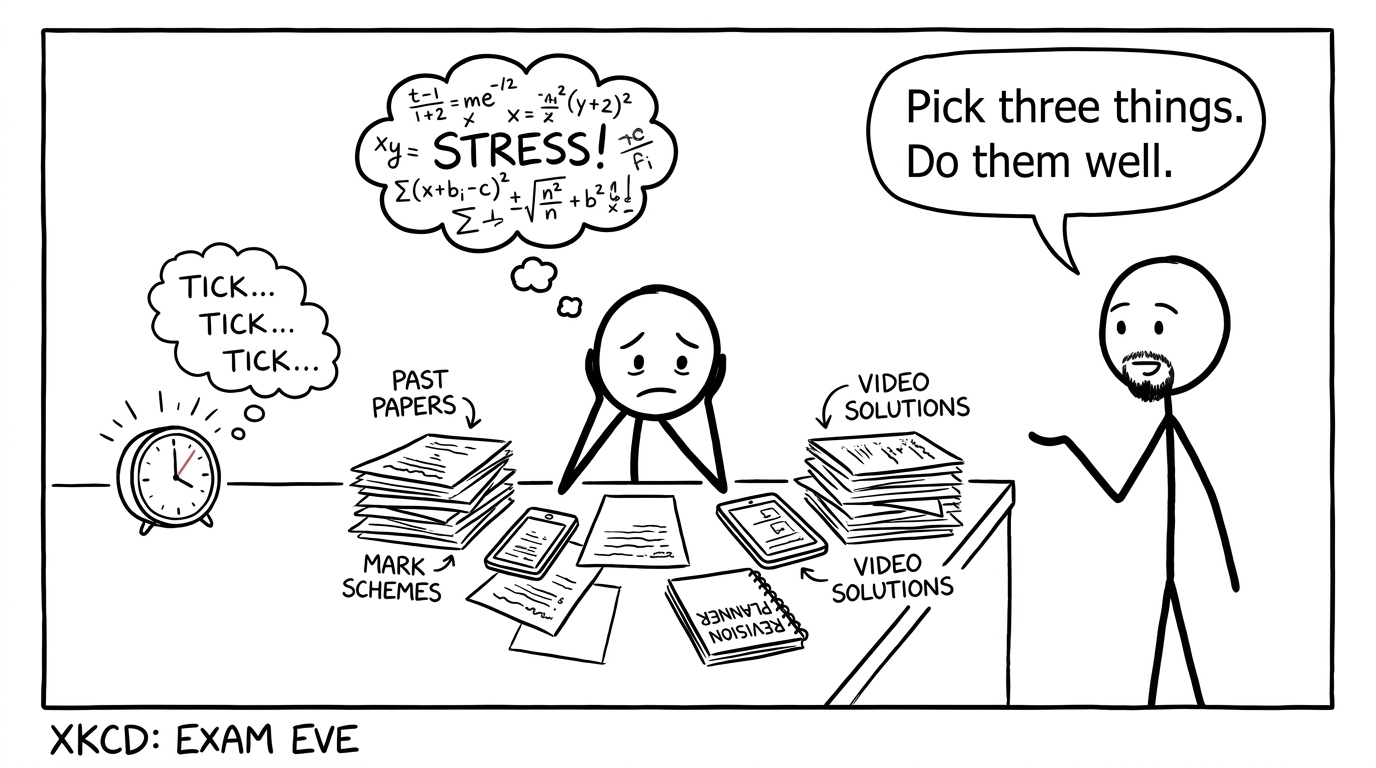 A calm night-before revision moment
The night-before checklist (your whole plan in one page)
Keep it tight. If it doesn’t earn marks tomorrow, it doesn’t belong tonight.
- Set a finish time (ideally 9:30--10:00pm). Protect sleep like it’s revision.
- Choose 3 Chemistry targets: one you’re good at, one you’re average at, one you avoid.
- Do exam-style practice, not rereading. Mark it. Fix one thing.
- Refresh the maths that shows up in Chemistry: formula rearranging, unit conversions, standard form.
- Pack your kit: calculator (if allowed for that paper), ruler, pens, clear bottle.
- Write a 6-line morning plan so you don’t negotiate with your anxiety at 7am.
If you want the maths part in one organised place, start from GCSE Past papers and then narrow to your board resources for timed practice.
Why the night before feels louder than it is
Panic isn’t always fear of the subject. Often it’s fear of uncertainty: “What if the paper asks the one thing I didn’t look at?” The fix is not to look at everything. The fix is to practise the skill that handles unfamiliar questions: reading, selecting a method, and collecting method marks.
That’s where your maths revision habits help. In maths, you learn that a messy-looking question often collapses into a familiar structure: substitute, rearrange, calculate, interpret. Chemistry is similar. The content matters, but the mark scheme rewards process.
So tonight we’ll build a small, repeatable process -- the kind you can carry into any GCSE exam.
Your 90-minute CCEA Chemistry session (calm, exam-first)
Step 1: Pick three targets you can actually finish
Pick:
- One confidence topic (to warm up)
- One mid topic (to stabilise)
- One weak topic (to reduce the chance of a total blank)
Don’t pick ten. Ten is a fantasy version of you. Three is the version who turns up tomorrow.
If you need a timer-friendly structure, borrow the approach from maths: do one short burst, then check answers. YesGenie’s Resources hub is built for this kind of focused practice across formats (past papers, mini tests, predicted papers).
Step 2: Do exam questions immediately (then learn from them)
Do 25--35 minutes of exam-style questions. Mark them. Then spend 20 minutes fixing patterns.
For maths practice alongside, pick a quick paper section from Edexcel GCSE Maths Mini Tests if you want short, contained practice that doesn’t spiral into a two-hour sit-down.
Step 3: Make one “tomorrow sheet” (not a full revision guide)
Your sheet should be small: one side of A4, handwritten. Include:
- common command words (state, describe, explain, calculate)
- 5 key facts you always muddle
- the few equations you regularly forget
- a tiny list of “if you see X, do Y” prompts
You’re not writing notes. You’re writing reminders.
The maths that quietly wins marks in GCSE Chemistry
Even if tomorrow is Chemistry, the arithmetic and algebra still decide whether your understanding becomes marks. These are the moves worth refreshing tonight.
Rearranging formulae (the skill behind half the calculations)
In Chemistry you constantly move symbols around: rates, densities, moles, concentration, energy. The method is always the same.
Example (method focus):
Suppose you use the density relationship ρ=mV\rho = \frac{m}{V}ρ=Vm and you need VVV.
Start with:
ρ=mV \rho = \frac{m}{V} ρ=VmMultiply both sides by VVV:
ρV=m \rho V = m ρV=mDivide both sides by ρ\rhoρ:
V=mρ V = \frac{m}{\rho} V=ρmThat’s it. Slow algebra beats fast guessing.
If rearranging is a weak spot for your GCSE maths, practise it directly using YesGenie revision pages and worked solutions. A good starting point for general skills is GCSE Maths Revision Guides (Edexcel), where methods are laid out step-by-step.
Units and conversions (where silly errors live)
A classic Chemistry loss is correct method, wrong unit. The night before, don’t memorise more facts -- memorise conversion anchors.
- 1 kg=1000 g1\text{ kg} = 1000\text{ g}1 kg=1000 g
- 1 g=1000 mg1\text{ g} = 1000\text{ mg}1 g=1000 mg
- 1 dm3=1000 cm31\text{ dm}^3 = 1000\text{ cm}^31 dm3=1000 cm3
- 1 cm3=1 mL1\text{ cm}^3 = 1\text{ mL}1 cm3=1 mL
Mini worked example:
Convert 0.45 dm30.45\text{ dm}^30.45 dm3 to cm3\text{cm}^3cm3.
Since 1 dm3=1000 cm31\text{ dm}^3 = 1000\text{ cm}^31 dm3=1000 cm3,
0.45×1000=450 0.45\times 1000 = 450 0.45×1000=450So 0.45 dm3=450 cm30.45\text{ dm}^3 = 450\text{ cm}^30.45 dm3=450 cm3.
If calculator confidence is shaky, do a quick refresh using Using a Calculator (GCSE) before you sleep. It’s a small skill that prevents big mistakes.
Standard form (big and small numbers without fear)
Chemistry loves numbers that don’t fit comfortably on one line.
Example:
Write 0.000560.000560.00056 in standard form.
Move the decimal 4 places to the right to get 5.65.65.6, so:
0.00056=5.6×10⁻⁴ 0.00056 = 5.6\times 10^{-4} 0.00056=5.6×10⁻⁴Write 7,200,0007,200,0007,200,000 in standard form.
Move the decimal 6 places left to get 7.27.27.2, so:
7,200,000=7.2×10⁶ 7,200,000 = 7.2\times 10^{6} 7,200,000=7.2×10⁶Standard form is also a confidence trick: it makes calculations feel smaller.
Graphs and gradients (the calm way to handle data)
If you get a graph/data question, your job is not to be clever. Your job is to be neat.
- Choose sensible scales.
- Plot accurately.
- Draw a best-fit line/curve.
- Read values carefully.
If you need a maths refresh for gradient work, it ties closely to straight-line skills like y=mx+cy=mx+cy=mx+c. Even a short read through general GCSE graph methods can help you in other papers too.
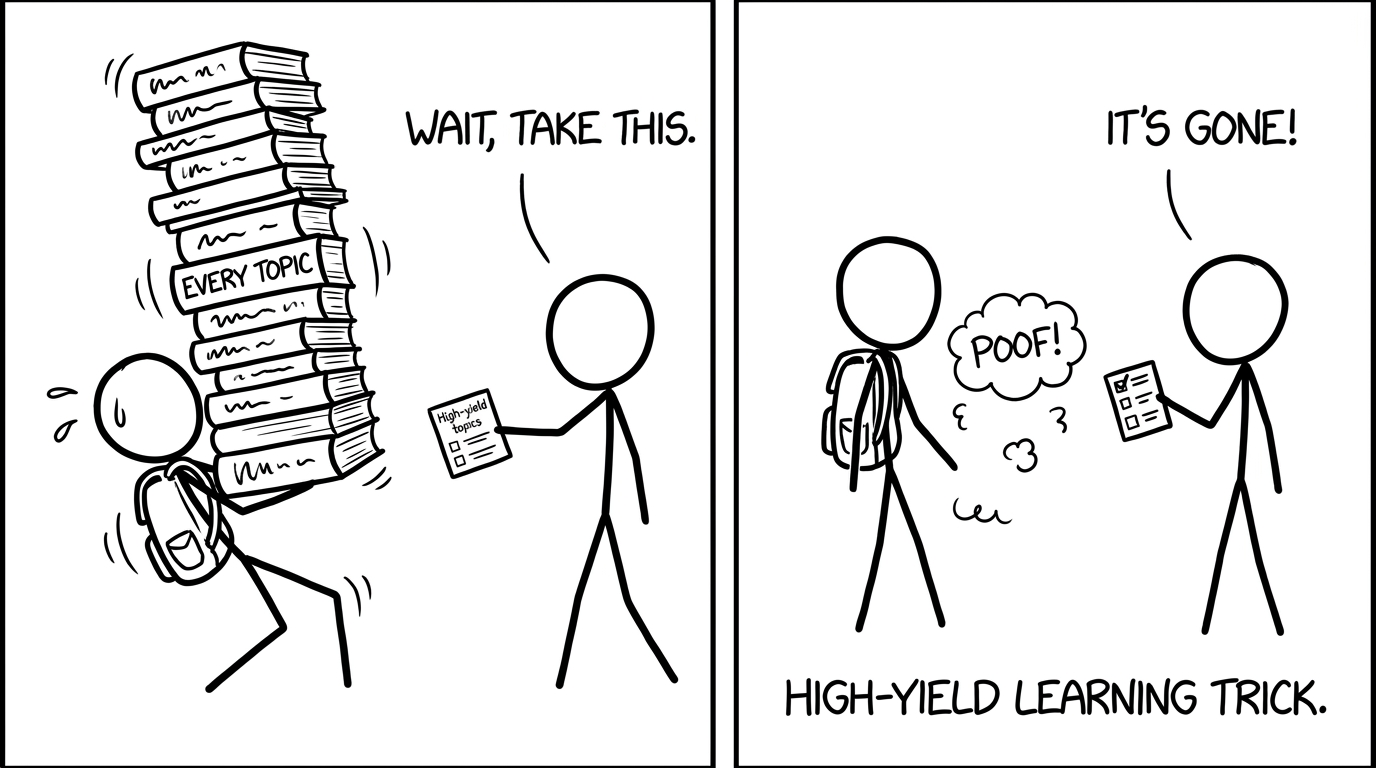 High-yield revision over everything
A realistic hour-by-hour night-before plan (that avoids panic)
Early evening (60 minutes): score quick wins
- 10 minutes: organise desk, water, calculator batteries, clear distractions.
- 25 minutes: Chemistry exam questions on one chosen topic.
- 10 minutes: mark and annotate with the mark scheme.
- 15 minutes: write “tomorrow sheet” prompts from mistakes.
For maths, the equivalent is doing a short timed set, then checking solutions. YesGenie makes that easy with Edexcel GCSE Maths Past Papers and board-specific video solutions (perfect for last-minute clarity).
Later evening (30 minutes): maths refresh for Chemistry calculations
Pick one:
- formula rearranging
- unit conversions
- standard form
Do 6--10 short questions total. Stop while you still feel sharp.
Final wind-down (20 minutes): reduce cognitive load
- Pack your bag.
- Set alarms.
- Put your “tomorrow sheet” somewhere visible.
- Decide your first 15 minutes in the morning.
This is not “wasted time”. It’s removing decisions so your brain can sleep.
Common mistakes students make the night before
- Trying to finish the whole specification. That’s how you end up half-learning everything and remembering none of it.
- Rewriting notes instead of doing questions. Notes feel productive; mark schemes reward application.
- Ignoring maths because it’s a Chemistry exam. Many dropped marks come from arithmetic, unit slips, and rearranging.
- Marking without reflecting. If you don’t write what to do next time, you’ll repeat the same error tomorrow.
- Going to bed “after this one last video”. Sleep is a performance enhancer. Treat it like revision time.
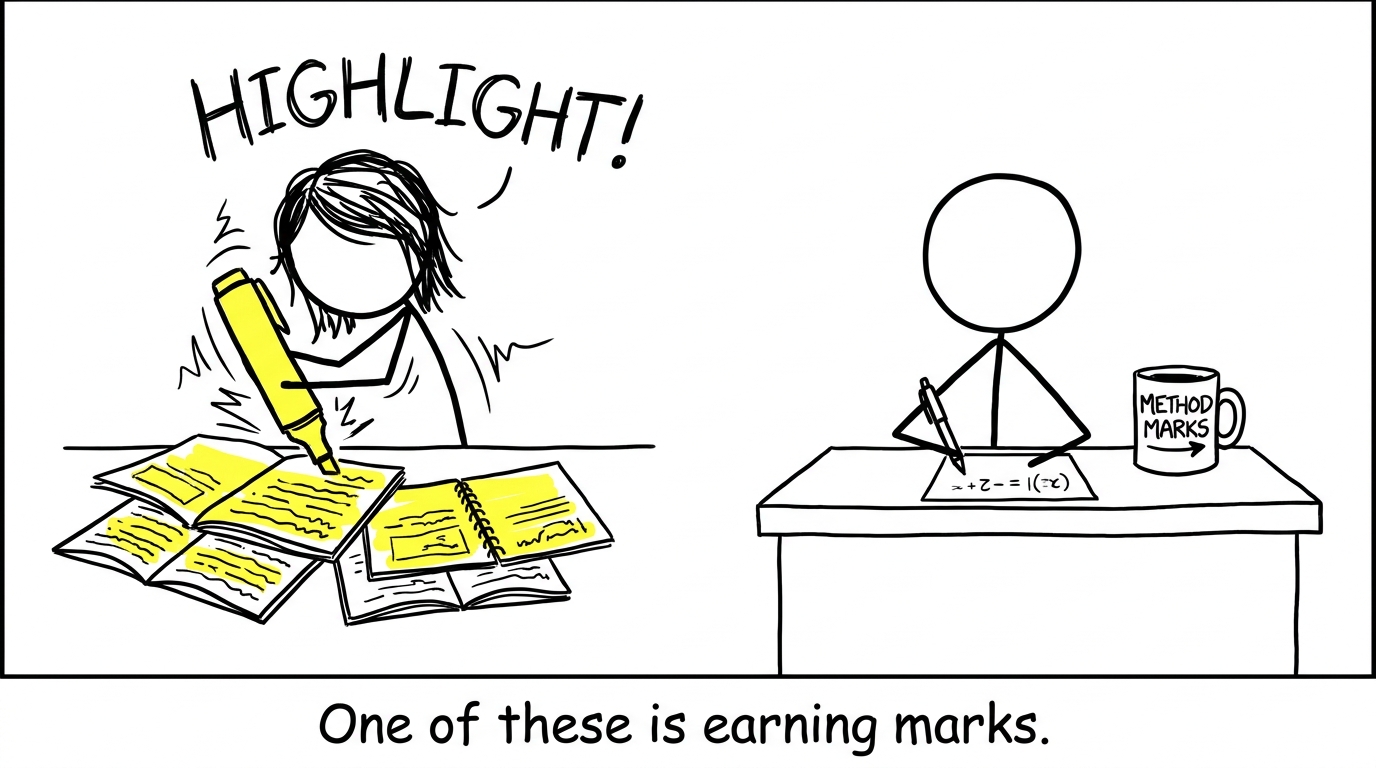 Method marks vs highlight marks
FAQ
What if I’m doing CCEA Chemistry tomorrow but I’m also worried about my GCSE maths grade?
It’s normal for one exam to trigger anxiety about all the others, especially in a GCSE season where everything feels stacked. The night before a Chemistry paper is not the time to overhaul your maths grade, but it is a great time to protect the easy maths marks that show up in science: rearranging, units, standard form, and careful calculator use. That’s why a 30-minute maths refresh can be more valuable than another hour of rereading Chemistry notes. If you want to keep the momentum for later papers, bookmark a clear route: start at GCSE Past papers, then pick your exam board and do one paper under timed conditions when Chemistry is done. After the paper, use mark schemes and video solutions to learn the pattern, not just the answer. Over a week, that routine compounds quickly.
How do I stop panic when I open a question and don’t recognise it?
Panic usually arrives when your brain tries to predict the whole paper from one question. In any GCSE exam, including Chemistry, you’re not required to feel confident to score marks -- you’re required to start a method. Begin by underlining what the question gives you and circling what it wants. Then write down the relationship you think it’s using, even if you’re not sure yet. In calculation questions, symbols are your friend: write the formula with letters before you substitute numbers, because it reduces unit mistakes and shows method marks. If it’s an explanation question, use the command word as your structure: “describe” means what you see, “explain” means why it happens, often linked to particles or energy changes. Finally, remember that unfamiliar contexts often test familiar skills, just dressed up differently.
Should I use predicted papers the night before?
Predicted papers can be useful, but only if you use them in a calm way and don’t treat them as a promise. The best use the night before a GCSE exam is to do a short, timed section to practise exam rhythm and then mark it carefully. If you find yourself chasing every topic that appears, stop -- that’s how predicted papers turn into panic fuel. On YesGenie, predicted papers are best used as targeted practice alongside mark schemes and worked solutions, not as a replacement for the specification. If you’re revising maths around your other subjects, the structured set on Edexcel GCSE Maths Predicted Papers is ideal for building confidence when you’re close to the exam window. Do one, learn from it, then sleep.
What’s the best thing to do in the last 30 minutes before bed?
Your goal is to lower mental noise while keeping one or two key prompts accessible for tomorrow. Choose one small task that makes the morning easier: pack your bag, set out uniform, charge your calculator, write your first-steps plan. If you want a tiny academic action, do it “light”: read your “tomorrow sheet” and close the book while you still feel in control. Avoid anything that invites spiralling, like starting a brand new topic from scratch. In GCSE season, the students who do best aren’t the ones who never feel stress; they’re the ones who can stop feeding it. Sleep is how you cash in the revision you’ve already done.
A final word: your GCSE plan is allowed to be simple
The night before, your job isn’t to become a different student. It’s to show up as yourself, with a clear head and a method you trust. A calm GCSE routine beats a frantic one, even when the content feels big.
When you’re ready to revise without guessing what matters, use YesGenie as your home base: revision lessons, topic-by-topic practice questions, mark schemes, video solutions, mini tests, and predicted papers. Start with Resources to pick the format that fits your time, then use GCSE Past papers for real exam practice. For maths specifically, build consistency with Edexcel GCSE Maths Mini Tests and deepen methods using GCSE Maths Revision Guides (Edexcel).
Tonight: pick three things, do them well, then stop. Tomorrow: collect marks calmly, one method at a time. That’s the whole game -- and it works.