

GCSE Mark Schemes: A CCEA Student’s Revision Shortcut
GCSE revision for CCEA students: learn how to use mark schemes properly, turn mistakes into method marks, and improve exam technique fast.
GCSE season has a particular sound. It’s the quiet click of a calculator, the shuffle of paper, and that sharp inhale when you realise you got the right idea -- but the wrong marks. If you’re a CCEA student revising, mark schemes can feel like a cold list of answers you’re either “in” or “out” of. But used properly, a mark scheme is more like a map of the examiner’s mind. And even if you’re here for maths revision (because YesGenie is built for that), the habit of using mark schemes well will lift every GCSE you sit -- including Biology.
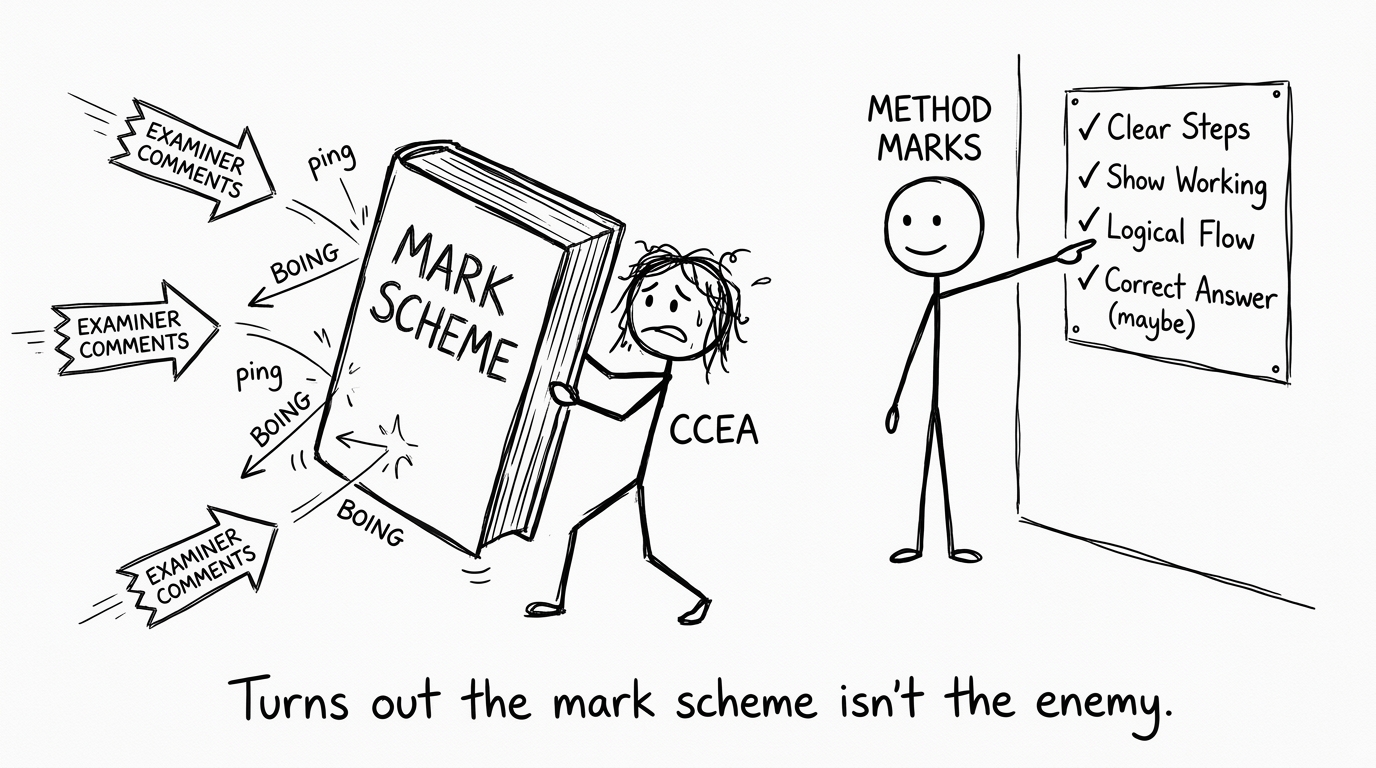 A CCEA student using a mark scheme as a shield
The surprising part is this: mark schemes don’t just tell you what the correct answer is. They show you what counts. That’s why top students don’t merely “check answers” -- they reverse-engineer marks. They practise for method marks, they learn command words, and they train themselves to write the kind of working that an examiner can reward.
Even though YesGenie is a maths-first revision site, the core skill it teaches -- turning exam feedback into better technique -- transfers straight into CCEA GCSE Biology. In this guide, we’ll use mark scheme thinking from GCSE maths to show you how to level up your Biology answers too.
A quick checklist for using mark schemes (CCEA-friendly)
Before we go deeper, here’s the workflow that actually improves grades:
- Attempt the question cold first (no notes, no looking).
- Mark it using the mark scheme, but also underline why marks were given.
- Categorise each lost mark: knowledge, method, communication, or exam technique.
- Rewrite your answer to “match the scheme”, then reattempt a similar question.
- Track patterns weekly (one small table is enough).
If you want a place to build this habit for maths, start with GCSE Past papers and commit to marking properly, not quickly.
Why mark schemes work (and why they feel harsh at first)
A mark scheme is not a model answer. It’s a marking tool designed to be applied consistently across thousands of GCSE scripts. That’s why it can read like shorthand.
In maths, you’ll often see method marks and accuracy marks split clearly. For example, in an algebra question you might get a method mark for setting up an equation, then an accuracy mark for solving it.
In Biology, the same structure exists, just in a different costume. You might lose marks not because your idea is wrong, but because:
- you didn’t use the key term the scheme requires (e.g. “diffusion”, “active transport”, “enzyme-substrate complex”),
- you gave a true statement that doesn’t answer the command word,
- you didn’t link cause to effect (a common “explain” problem),
- you wrote something vague that can’t be credited.
The harshness is actually a gift: it makes the invisible rules visible. GCSE improvement is often just learning the rules.
Think like a maths examiner: method marks are everywhere
Most students treat GCSE answers like a single jump: either you land it or you don’t. Examiners treat answers like ladders: each rung can earn marks.
That’s why YesGenie is built around practising method, not just final answers: AQA GCSE Maths Revision Guides and topic lessons break questions into steps so you learn what examiners reward.
Here’s a simple maths example (because it makes the “ladder” idea obvious).
Worked example: method marks in GCSE maths
Solve 3(x−4)=183(x-4)=183(x−4)=18.
3(x−4)=18 3(x-4)=18 3(x−4)=18Divide both sides by 333:
x−4=6 x-4=6 x−4=6Add 444:
x=10 x=10 x=10Even if a student makes an arithmetic slip at the end, a mark scheme often credits the earlier method. The “set-up” matters.
Now translate that to GCSE Biology. If the question is “Explain how enzymes work”, the mark scheme typically has discrete credit points: correct term, correct idea, correct link. You can earn partial credit by building the explanation in steps.
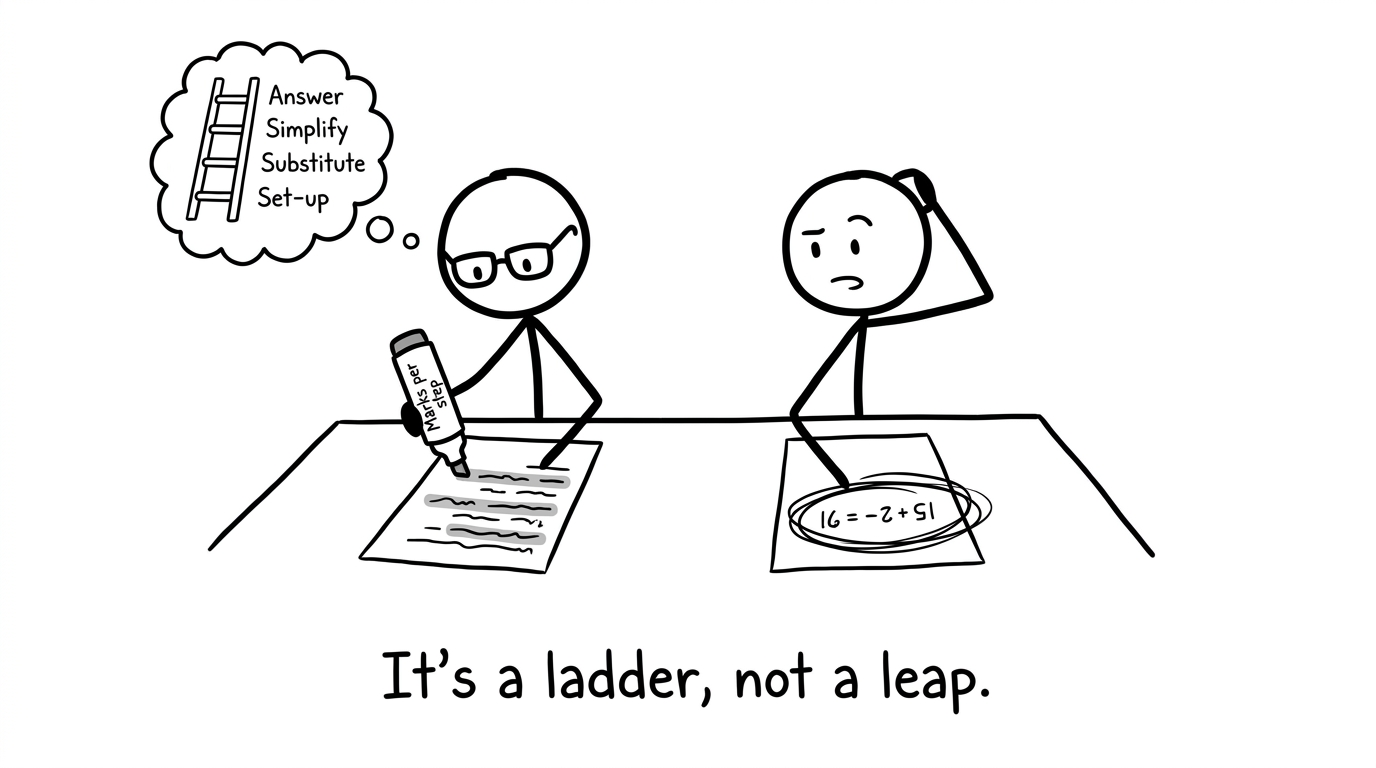 Two students: one uses steps, one only circles answers
How CCEA students can use mark schemes in GCSE Biology (without memorising essays)
CCEA GCSE Biology mark schemes reward specific, creditworthy statements. Your goal is not to write more. It’s to write more credit points per sentence.
Use this four-pass method when you review a Biology mark scheme:
Pass one: highlight “must-have” keywords
Circle the words that appear again and again. In biology, these are usually the scientific nouns and verbs: “diffuse”, “osmosis”, “respiration”, “mitosis”, “antibodies”, “pathogen”, “selectively permeable”.
Your revision job is to make those words feel normal in your own handwriting.
Pass two: spot the “link words” that create explanation
Mark schemes love connections: “therefore”, “so that”, “leading to”, “which means”. When you miss marks, it’s often because you listed facts instead of linking them.
Pass three: identify what the scheme refuses to credit
Some schemes explicitly say things like “do not accept vague answers” or only accept an idea in a specific context.
In maths, this is similar to when a student writes a correct answer but provides no working in a “show that” question.
If you want to see how strict that can be, open any paper and compare your working to the official marking guidance in a Paper mark scheme view.
Pass four: rewrite one answer in “mark scheme style”
Take your own original answer and rewrite it as if you were trying to help an examiner give you marks. Short, precise, credit-point-rich.
This is where grades move.
A maths-style marking table that improves your Biology answers
A small tracking system stops you repeating the same error for months.
After each GCSE practice paper section, create a table like this:
- Topic (e.g. Cells, Infection, Genetics)
- Marks lost
- Reason (knowledge / keywords / link / command word)
- Fix (one sentence)
You can do this for maths too -- and it’s especially powerful when you’re using Eduqas GCSE Maths Question Bank style topic practice, because you’ll see patterns quickly.
Worked examples: using mark schemes to write for marks
Below are two maths worked examples, but the skill is the point: write answers that are easy to mark.
Worked example: earning marks with clear structure (fractions)
Simplify 1824\frac{18}{24}2418.
Prime factorise or divide by the highest common factor.
The highest common factor of 181818 and 242424 is 666.
1824=18÷624÷6=34 \frac{18}{24}=\frac{18\div 6}{24\div 6}=\frac{3}{4} 2418=24÷618÷6=43Why it’s mark-scheme friendly: every step shows intent. In Biology, the equivalent is stating the correct process name then the consequence.
If you need a refresh on number skills that show up everywhere in GCSE science calculations too, practise with Powers and Roots - GCSE Maths Revision Guide.
Worked example: avoiding dropped marks with order of operations
Evaluate 4+3×54+3\times 54+3×5.
Using BIDMAS:
3×5=15 3\times 5=15 3×5=15Then add 444:
4+15=19 4+15=19 4+15=19This matters beyond maths. In Biology calculations, students often lose marks because they do operations in the wrong order or round too early. If your non-calculator confidence is shaky, use BIDMAS - GCSE Maths Revision Guide and practise until the order feels automatic.
How to build a mark-scheme routine with YesGenie (maths first, then transfer)
A reliable routine beats a dramatic one. Here’s a simple week that makes mark schemes normal:
- Two days: topic practice (maths) to build “steps” thinking.
- One day: a timed paper section, then mark it carefully.
- One day: fix day -- redo only the questions you lost marks on, using the scheme.
- One day: a short mixed mini-test style session.
For the paper side, you can rotate across exam boards using GCSE Past papers.
For exam realism, add predicted practice: Edexcel GCSE Maths Predicted Papers (even if you’re not Edexcel, predicted papers are brilliant for training your attention and stamina).
For structure and consistency, use the YesGenie revision planner and keep your mark scheme notes in one place.
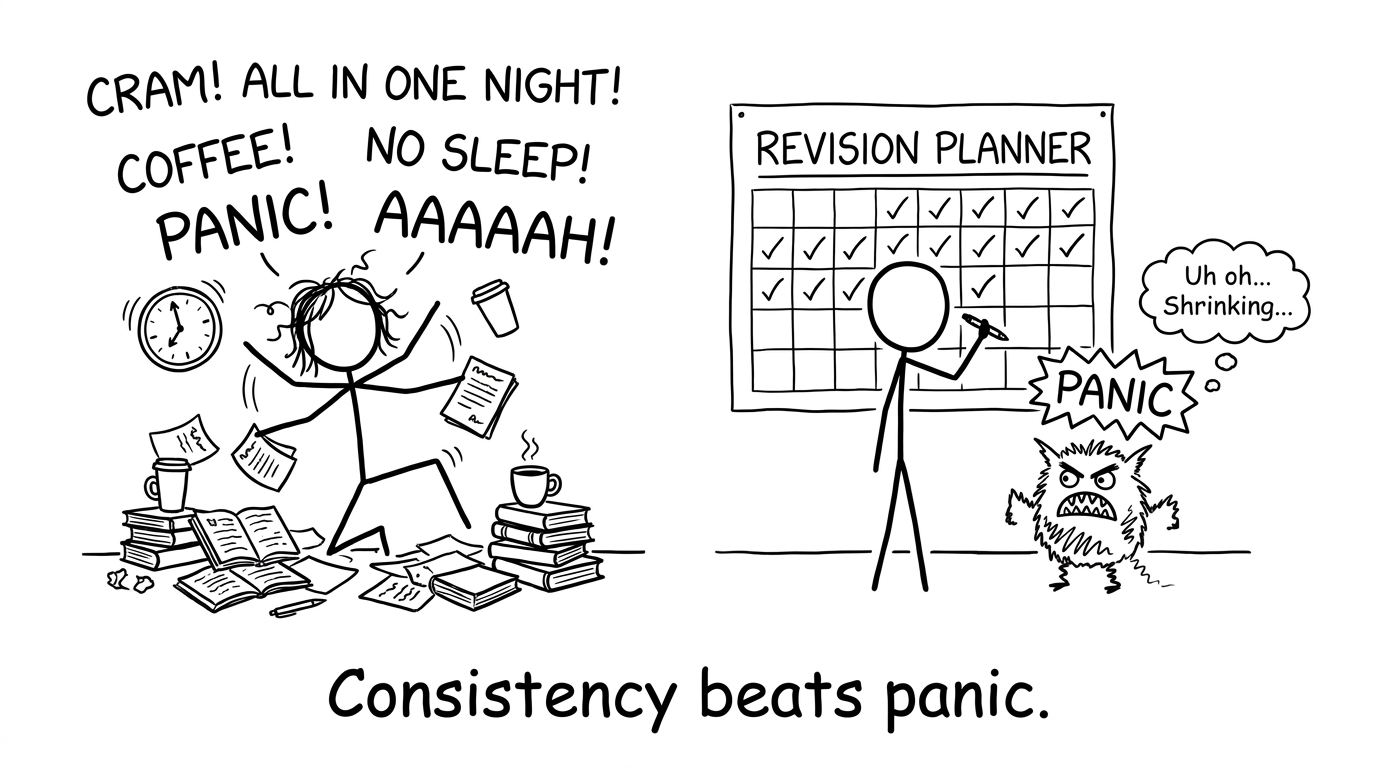 Revision planner shrinking the “Panic” monster
Common mistakes students make with mark schemes
- Marking to feel better, not to get better. If you glance at the scheme, nod, and move on, nothing changes.
- Copying the mark scheme without understanding the mark allocation. The goal is to learn which part earned which mark.
- Ignoring method marks in maths. In many GCSE questions, the final answer is not the main mark.
- Writing Biology answers that are “true” but not creditworthy. Mark schemes reward specific phrasing and specific links.
- Not rewriting corrected answers. Improvement happens when you rewrite in mark-scheme style, not when you merely read it.
- Treating each mistake as random. Most lost marks come from a small set of habits -- track them.
FAQ
Do mark schemes change between exam boards and specifications?
Yes, and it matters more than most students expect. AQA, Edexcel, OCR, Eduqas and CCEA all write papers with slightly different styles, even when the underlying GCSE content overlaps. In maths, the same topic might be tested with different wording or different mark splits across boards. In Biology, the accepted key terms and the way “explain” marks are awarded can vary by specification detail and examiner guidance. That’s why it’s risky to revise only from generic notes, especially close to the exam. The safest approach is to practise with questions written for your board, then learn the mark scheme patterns that repeat. On YesGenie, you can practise board-specific maths papers and mark schemes to build that habit of “specification accuracy” that transfers neatly to science.
Should I memorise mark schemes for GCSE Biology?
Memorising entire mark schemes is usually the wrong target, because it trains you to recall phrases instead of understanding processes. What you should memorise are the recurring credit points: the key terms, the required links, and the command word expectations. Think of it like maths: you don’t memorise every worked solution, you memorise methods like rearranging, substituting, and simplifying. In Biology, that translates to having a reliable structure for explanations: name the process, describe the mechanism, state the consequence. When you use a mark scheme, pull out those reusable building blocks and write them in your own words while keeping the scientific vocabulary. Do that consistently and you’ll sound “mark-scheme correct” without sounding like you’ve learned a script.
How can maths mark scheme practice help my GCSE Biology grade?
It helps because the real skill is not subject-specific -- it’s mark literacy. Maths mark schemes are an unusually clear training ground because you can see method marks, accuracy marks, and working requirements laid out openly. When you practise with a maths mark scheme, you learn to write in steps, to show intent, and to avoid leaving your thinking in your head. Biology rewards the same clarity, just with words instead of algebra. You also improve your confidence with calculations, units, and rearranging, which appear in Biology papers more than students think (rates, percentages, magnification, interpreting graphs). If you build the habit on YesGenie with lessons, question banks, and past papers, you can carry the discipline straight into CCEA GCSE Biology marking. Over time, you stop asking “Is this right?” and start asking “How do I make this easy to give marks to?”
What if I keep losing the same marks even after reading the mark scheme?
That usually means you are reading passively rather than changing your method. The fix is to create a tiny feedback loop: attempt, mark, rewrite, reattempt a similar question within 48 hours. In maths, that might mean doing another question from the same topic in a question bank after you correct your first attempt. In Biology, it might mean rewriting one explanation using the mark scheme bullets, then trying a different past-paper question on the same process. The second attempt is where the brain starts to store the improvement as a skill rather than a comment. Also, check whether your errors are actually about exam technique: command words, missing units, vague phrasing, or skipping steps. Once you label the pattern, it becomes much easier to fix.
Closing: make the mark scheme your coach, not your judge
GCSE revision gets easier when you stop treating mark schemes like verdicts and start treating them like instructions. For CCEA GCSE Biology, that means learning the credit points, writing in linked steps, and training yourself to answer the question the examiner is actually marking. For maths, it means showing method, building tidy working, and understanding where marks come from.
If you want a free, structured way to practise that skill daily, use YesGenie: revision lessons, topic practice, past papers, predicted papers, and mark schemes that make the “rules of marks” visible. Start with GCSE Past papers, add challenge from Edexcel GCSE Maths Predicted Papers, and use revision guides like AQA GCSE Maths Revision Guides to rebuild weak topics properly.
Do that, and the next time you open a mark scheme, you won’t be looking for what you got wrong. You’ll be looking for how to earn the marks next time -- which is the whole game in GCSE.