

GCSE Chemistry CCEA: Get Past the Pass Grade (with Maths)
GCSE Chemistry CCEA revision plan if you’re stuck at a pass grade. Use maths-led methods, past-paper habits, and YesGenie support to improve marks.
A pass grade can feel like a ceiling. You’ve revised, you’ve highlighted, you’ve read the notes twice--and your CCEA GCSE Chemistry marks still land in the same familiar band. If that’s you, the fastest way forward often isn’t “more Chemistry”. It’s smarter GCSE revision: tightening the bits that leak marks, especially the maths, the method marks, and the way you practise past-paper questions.
This matters even if you’re a “maths person” reading this on YesGenie. In CCEA GCSE Chemistry, a surprising number of lost marks are not about knowing the science. They’re about calculating, rearranging, rounding, units, and showing steps clearly. The good news: those are learnable, and they respond quickly to the right kind of practice.
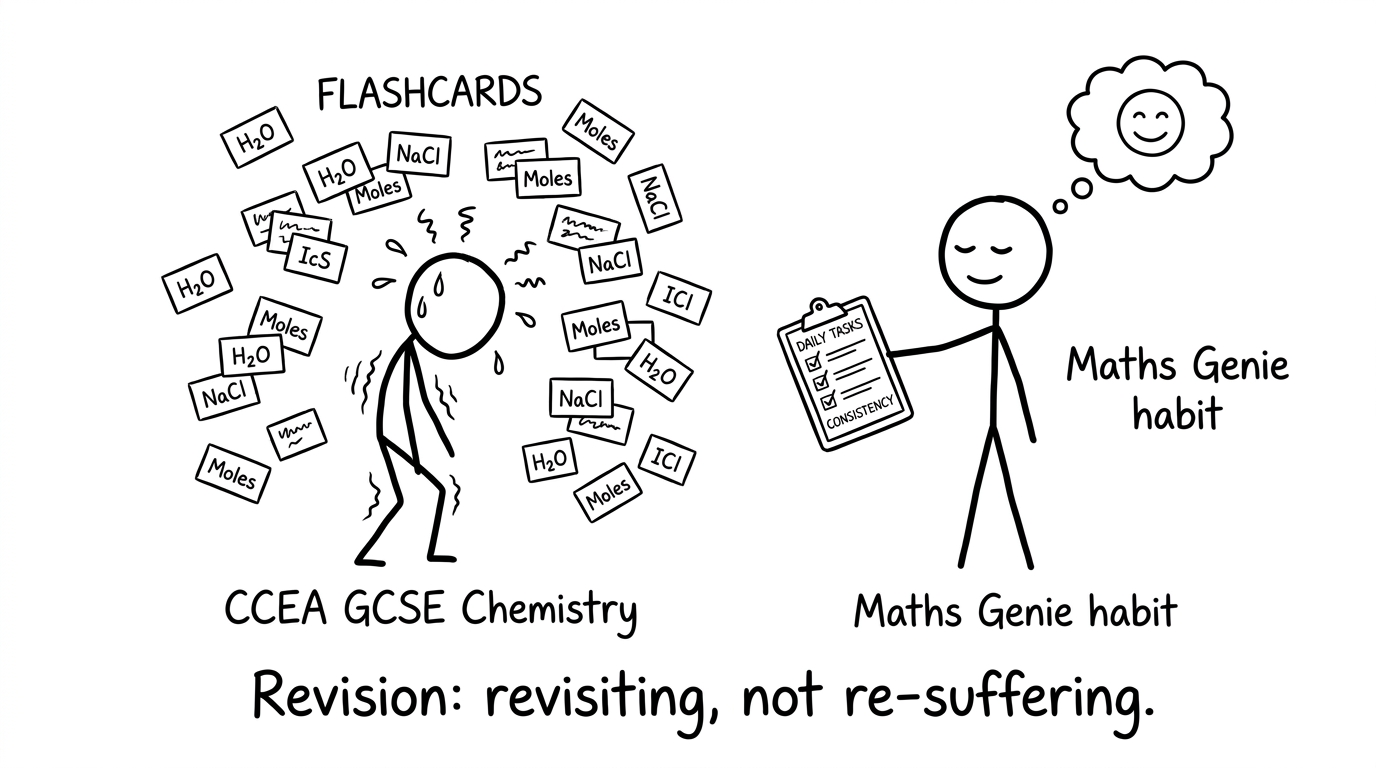 A calm checklist beats panic-revision
The pass-grade trap (and how to climb out)
Being stuck at a pass grade usually means one of three things:
- You know some topics, but your knowledge is patchy, so you drop marks across lots of questions.
- You can do the “nice” questions, but you freeze when the wording changes.
- Your Chemistry understanding is fine, but your GCSE maths skills are costing you method marks.
CCEA papers reward clear working. That’s a gift, because it means you can improve your GCSE performance by improving how you write solutions, not just what you remember.
If you’re revising maths alongside Chemistry, build one routine that serves both. Use YesGenie for the maths foundations that Chemistry quietly demands: fractions, percentages, standard form, and units.
A quick checklist for CCEA GCSE Chemistry revision
Use this as your weekly loop:
- Two short content blocks (20--30 minutes): key definitions, required practicals, and common processes.
- One “maths for Chemistry” block (20--30 minutes): the exact GCSE maths skill you keep using in calculations.
- One past-paper block (40--60 minutes): timed, then marked with a mark scheme.
- One error-log block (10 minutes): write the mistake, the fix, and one similar question.
For your maths blocks, you can use:
Even though those pages are GCSE maths resources, the skill transfer into GCSE Chemistry is immediate.
Why maths is the quickest win for CCEA GCSE Chemistry
At a pass grade, you often lose 1--3 marks at a time. Not because you’re clueless, but because:
- you round too early,
- you drop a unit,
- you misread a scale,
- you forget to convert cm3 \text{cm}^3cm3 to dm3 \text{dm}^3dm3,
- you can’t rearrange a formula under time pressure.
Those are GCSE maths behaviours. Fix them and your Chemistry grade moves.
A simple example: concentration calculations.
Worked example: concentration (mass per volume)
A student dissolves 2.4 g2.4\text{ g}2.4 g of a salt in 200 cm3200\text{ cm}^3200 cm3 of water. Find the concentration in g dm−3\text{g dm}^{-3}g dm−3.
Step 1: Convert volume
200 cm3=0.200 dm3 200\text{ cm}^3 = 0.200\text{ dm}^3 200 cm3=0.200 dm3Step 2: Use concentration=massvolume\text{concentration}=\frac{\text{mass}}{\text{volume}}concentration=volumemass
concentration=2.40.200=12 \text{concentration}=\frac{2.4}{0.200}=12 concentration=0.2002.4=12So the concentration is 12 g dm−312\text{ g dm}^{-3}12 g dm−3.
That question is Chemistry on the surface, but the marks are mostly GCSE: unit conversion and dividing by a decimal.
To rebuild that skill quickly, practise conversions and decimals on:
- Fractions, Decimals and Percentages (revision guide)
- Fractions, Decimals and Percentages (flashcards)
How to use past papers when you’re stuck at a pass grade
Many students “do a paper” like it’s a fitness test: you sit it, you score it, you feel bad, you move on. That’s not GCSE revision. That’s just measurement.
A better approach is slower and kinder:
- Do half a paper timed.
- Mark it with the mark scheme.
- For every lost mark, ask: Was it knowledge, interpretation, or maths?
If it’s maths, it’s fixable fast.
Use the structure YesGenie builds for GCSE maths practice:
- GCSE Past papers
- Edexcel GCSE Maths Past Papers (useful even if your exam board is CCEA, because GCSE maths skills are transferable)
- Edexcel GCSE Maths Predicted Papers (great for timed practice habits)
You’re not using these to “learn Chemistry”. You’re using them to learn the GCSE skill of performing under exam conditions.
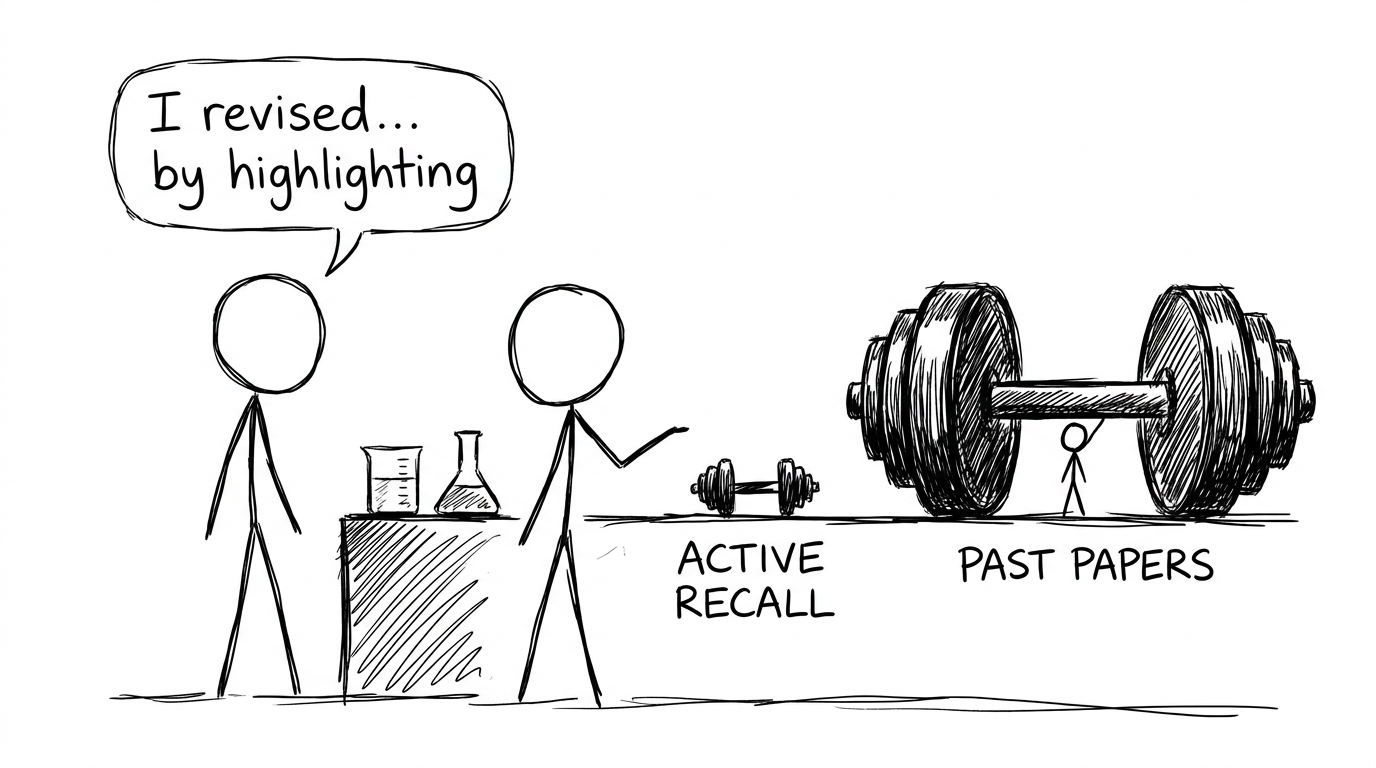 Highlighting vs doing the work
The maths skills that quietly decide GCSE Chemistry grades
Below are the repeat offenders. If you’re stuck at a pass grade, pick just two per week and drill them.
Percentages and percentage change
Chemistry loves “percentage yield” and “percentage purity” style thinking, even when the exact context changes.
Worked example: percentage change A reaction produces 7.5 g7.5\text{ g}7.5 g of product, but the expected mass was 10 g10\text{ g}10 g. What is the percentage decrease?
Decrease =10−7.5=2.5=10-7.5=2.5=10−7.5=2.5.
percentage decrease=2.510×100=25% \text{percentage decrease}=\frac{2.5}{10}\times 100 = 25\% percentage decrease=102.5×100=25%That’s a GCSE percentage method. If it feels shaky, rebuild it using:
Standard form
In Chemistry you’ll see tiny and huge numbers (particles, concentrations, constants). Standard form stops you panicking.
Worked example: standard form multiplication Calculate (3.0×10⁴)(2.0×10⁻³)(3.0\times 10^4)(2.0\times 10^{-3})(3.0×10⁴)(2.0×10⁻³).
Multiply numbers: 3.0×2.0=6.03.0\times 2.0=6.03.0×2.0=6.0.
Add powers: 104×10−3=104+(−3)=10110^4\times 10^{-3}=10^{4+(-3)}=10^1104×10−3=104+(−3)=101.
So:
(3.0×10⁴)(2.0×10⁻³)=6.0×101 (3.0\times 10^4)(2.0\times 10^{-3})=6.0\times 10^1 (3.0×10⁴)(2.0×10⁻³)=6.0×101That is 606060.
Rearranging formulae
This is where confident Chemistry students lose cheap marks.
Worked example: rearranging If m=cVm=cVm=cV, make VVV the subject.
Divide both sides by ccc:
V=mc V=\frac{m}{c} V=cmIf you want structured practice on rearranging, YesGenie’s maths topics build the habit of keeping algebra tidy.
Units and conversions
In CCEA GCSE Chemistry, a correct method with the wrong unit can still lose you the last mark. Treat units as part of the answer, not decoration.
You can strengthen the “units reflex” through GCSE maths practice on measures and conversion-style questions via the CCEA maths hub:
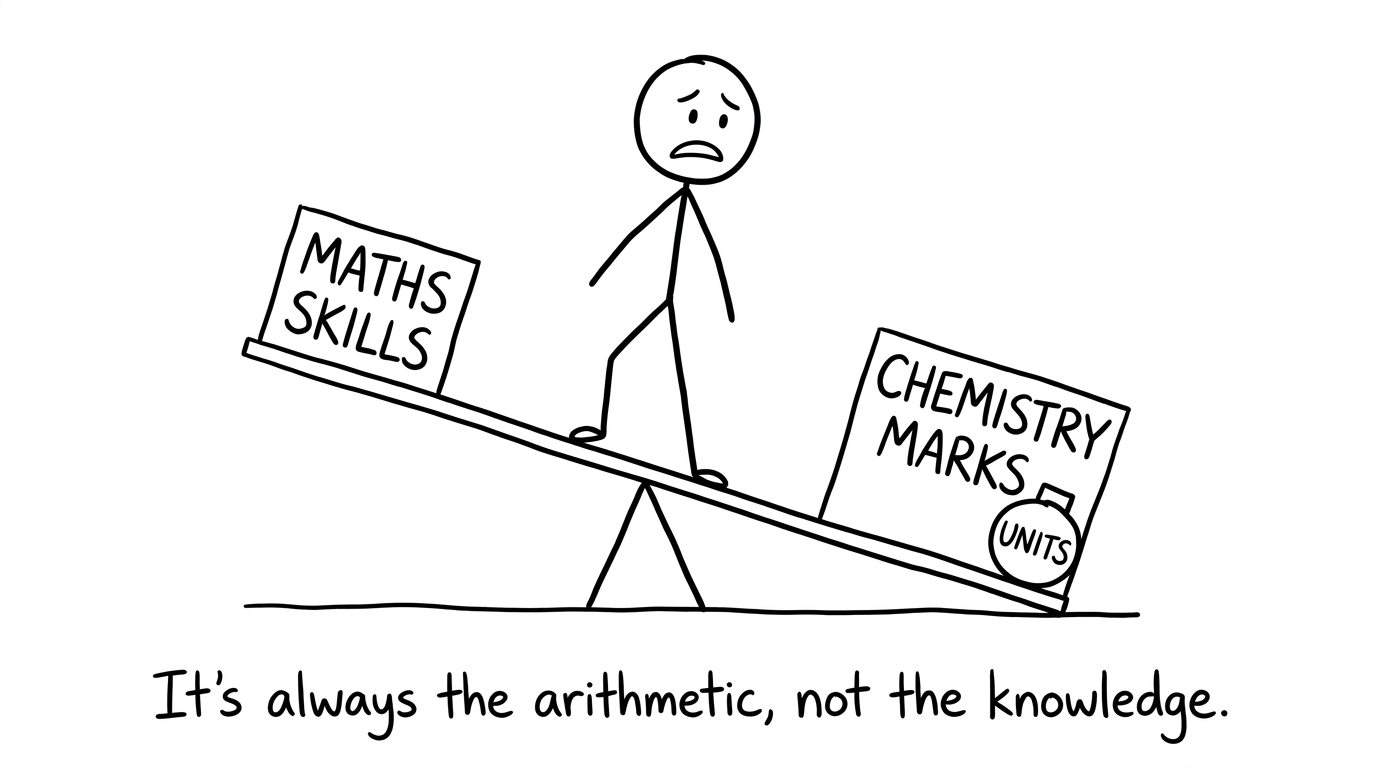 Losing marks to arithmetic, not knowledge
A realistic 14-day plan (when you’re close to a pass)
If your exam is soon, aim for stability, not perfection.
Days 1--4: stop the leaks
- Make an error log from your last two assessments.
- Identify the top 5 mark-leaks (units, rounding, missing steps, misreading command words).
- Do 30 minutes daily of GCSE maths foundations (percentages, conversions, standard form).
Days 5--10: practise like the exam
- Do 3 timed past-paper sections.
- Mark with a mark scheme and rewrite full-mark solutions.
- Spend one block using YesGenie lessons to rebuild any shaky skill.
Days 11--14: calm repetition
- Re-do your error-log questions.
- Do one final timed paper section.
- Keep revision short, focused, and sleep-protecting.
This is how GCSE revision becomes sustainable: fewer promises, more repeats.
Common mistakes CCEA GCSE Chemistry students make (when stuck at a pass)
- Rounding too early: keep full calculator values, then round at the end.
- Forgetting conversions: especially cm3 \text{cm}^3cm3 to dm3 \text{dm}^3dm3 and minutes to seconds.
- Writing no working: even if you can do it in your head, GCSE mark schemes often reward method.
- Confusing “increase” and “decrease” in percentage change.
- Answering the wrong command word: “describe” vs “explain” vs “calculate”.
- Unit-free answers: treat the unit as the final line of your solution.
A small habit that helps: after every calculation, write “Does the unit make sense?” before you move on.
FAQ
How do I move from a pass grade to a strong pass in GCSE Chemistry quickly?
Start by accepting that quick improvement rarely comes from learning brand-new content first. It usually comes from reducing avoidable errors that happen repeatedly under time pressure. For CCEA GCSE Chemistry, those errors are often GCSE maths errors: conversions, rearranging, and rounding. Use past-paper sections to find your personal pattern, not to judge yourself. Then practise the exact micro-skill that caused the mistake, and repeat one similar question straight away. Over two weeks, that cycle can raise your marks more reliably than trying to “cover everything”.
What if I’m good at Chemistry but my maths is weak?
That is more common than people admit, and it is not a character flaw. It just means you need a parallel GCSE maths routine that specifically targets Chemistry-style calculations. Focus on decimals, fractions, percentages, standard form, and units because these show up constantly. Use short, frequent sessions rather than long ones, because fluency is built through repeated retrieval. On YesGenie, you can use revision guides and flashcards to build automaticity, then apply it immediately in your Chemistry questions. When your maths becomes calmer, your Chemistry answers become clearer too.
How many past papers should I do for CCEA GCSE Chemistry if I’m stuck at a pass?
Do fewer papers, but use them better. Two or three carefully marked sections per week can be enough if you genuinely fix what went wrong. Every paper you do should produce an error log you revisit, otherwise you are just collecting scores. Time your attempts so you learn pacing, but don’t time everything at the beginning because it can hide what you actually don’t understand. If you’re also revising GCSE maths, use YesGenie past-paper practice to build exam stamina and method-mark habits, because those habits transfer. The goal is not “more papers”; it’s fewer repeated mistakes.
Is it worth using Maths Genie (YesGenie) if I’m revising Chemistry, not maths?
Yes, because your GCSE outcomes are often limited by your weakest supporting skill, not your strongest subject knowledge. In CCEA GCSE Chemistry, maths is a supporting skill that affects a meaningful chunk of marks. YesGenie is built for targeted, topic-by-topic practice: you can isolate the exact skill you need (like percentages or standard form) and practise it until it feels automatic. You also get mark-scheme-aligned methods, which trains you to show the kind of working examiners reward. Once that foundation is stable, your Chemistry revision becomes more efficient because you’re not re-learning the same calculation every time. In other words, YesGenie helps you stop leaking marks.
A final thought (and your next step on YesGenie)
When you’re stuck at a pass grade, it’s tempting to assume you’ve found your limit. But GCSE limits are often just routines you haven’t built yet. For CCEA GCSE Chemistry, the routine that changes everything is simple: practise past-paper questions, track your mistakes, and strengthen the GCSE maths that sits underneath the calculations.
Use YesGenie to make that routine easy to repeat: revision lessons when you need clarity, practice questions when you need fluency, and past papers and predicted papers when you need exam confidence. Start with the CCEA GCSE Maths hub, then build stamina using GCSE Past papers and the Resources page. Do it for two weeks, and you’ll feel the difference--not because you worked harder, but because your GCSE revision finally started working for you.