

GCSE Biology Revision Without Wasting Time (For Maths Minds)
GCSE Biology revision without wasting time: a simple plan that works. Use maths-style practice, mark schemes and past papers to improve quickly.
GCSE season has a particular kind of noise. Your brain knows you should revise, but your hands keep reaching for the safest activity in the room: re-reading notes, highlighting, making the third “perfect” set of flashcards. It feels productive. It rarely moves your grade.
If you revise GCSE Biology like you revise GCSE maths -- with practice, feedback, and a calm loop of improvement -- you stop wasting time. And because you are a maths student, you already have the best mindset for it: you understand that marks come from methods, not vibes.
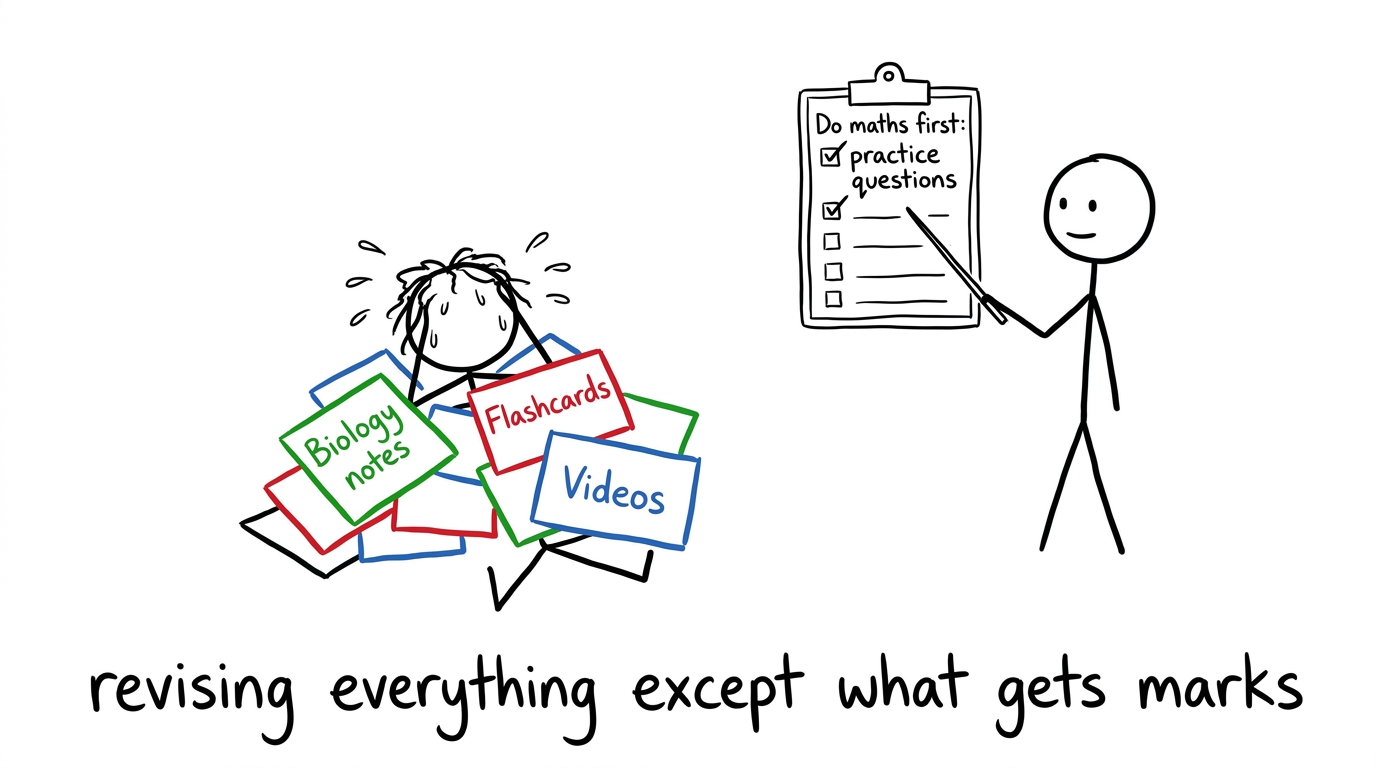 A student revising everything except what gets marks
The no-waste GCSE Biology revision checklist
Use this as your default, then personalise it.
- Start with questions, not content. Your gaps reveal themselves faster than any “topic list”.
- Mark the work the same day. Feedback delayed is feedback diluted.
- Fix one thing at a time. One misconception properly corrected is worth an hour of vague revision.
- Cycle past papers. Questions repeat by style if not by wording.
- Use maths to manage time. Track minutes spent vs marks gained.
For the “questions and marking” engine, YesGenie is built for this style of revision. Even if you are mainly here for maths, the habits transfer perfectly: practise, mark, improve, repeat.
Useful hubs to keep open in a tab:
Why most GCSE Biology revision wastes time (and why maths students notice it)
A lot of Biology revision is “input heavy”. You watch a video. You rewrite notes. You summarise a summary of a summary. The problem is not that information is useless -- it is that the exam rewards retrieval and application.
Maths students have an advantage because you are used to this:
- You don’t become good at algebra by watching someone else factorise x2+5x+6x^2+5x+6x2+5x+6.
- You become good by attempting it, checking, seeing where your method slips, and trying again.
GCSE Biology is the same, just with different “methods”: required practicals, command words, data interpretation, and structured explanations. You need to practise answers and learn what examiners accept.
To keep your revision grounded in marks, borrow the workflow you already use on YesGenie for maths:
A maths-style system to revise GCSE Biology efficiently
Here is the system that stops the drift.
Step one: pick your exam board and build a “question map”
GCSE Biology differs slightly across AQA, Edexcel, OCR, Eduqas (especially required practicals and wording). If you are unsure, check what your school enters you for.
Then do this:
- Choose one topic (for example, infection and response).
- Attempt exam-style questions without notes.
- Mark them immediately.
- Write a short “fix list” of what lost you marks.
YesGenie makes this rhythm easy because you can switch between practice and mark schemes quickly using its paper pages and topic resources.
Start from:
Step two: use a tight loop -- attempt, mark, fix, repeat
Think of each revision session as a loop, not a lecture.
- Attempt (15--25 mins): realistic timing, no notes.
- Mark (10 mins): be strict; if it is not in the mark scheme, it is not a mark.
- Fix (15 mins): rewrite the one missing idea, then do one more question on it.
This loop is exactly why maths practice works. It is also why reading your notes feels comforting but underperforms.
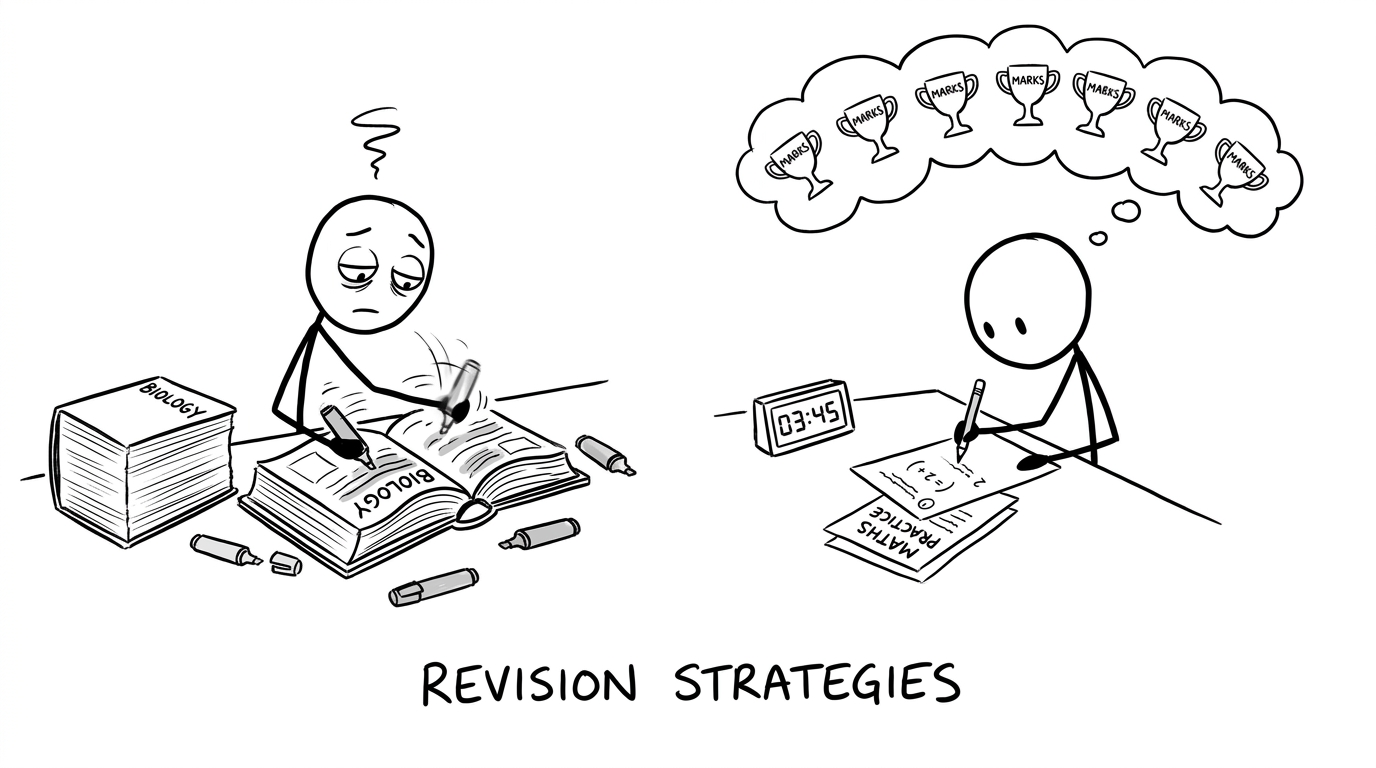 Two students: highlighting vs doing timed practice
Step three: measure efficiency like a statistician
Maths students often revise better as soon as they quantify.
Create a simple efficiency score:
- Let mmm be marks gained since last attempt.
- Let ttt be minutes spent.
- Efficiency E=mtE=\frac{m}{t}E=tm marks per minute.
Example: you spend 404040 minutes and improve from 222222 to 303030 on a section. Then m=8m=8m=8, t=40t=40t=40:
E=840=0.2 marks per minute. E=\frac{8}{40}=0.2 \text{ marks per minute}. E=408=0.2 marks per minute.Now compare revision methods honestly. If re-reading notes for 404040 minutes improves you by 111 mark, that is E=140=0.025E=\frac{1}{40}=0.025E=401=0.025. Your time is not “free”. GCSE revision is an allocation problem.
If you want quick maths practice alongside this, use:
Worked examples: applying maths habits to GCSE Biology questions
You do not need Biology content here as much as you need the exam habit. These worked examples show how to convert “I sort of know it” into marks.
Worked example: timing a 6-mark explanation
A common GCSE Biology trap is writing a long answer that does not hit marking points.
Assume you have 505050 minutes for a paper worth 100100100 marks. Your average pace should be:
minutes per mark=50100=0.5. \text{minutes per mark}=\frac{50}{100}=0.5. minutes per mark=10050=0.5.So a 666-mark question should take about:
6×0.5=3 minutes. 6 \times 0.5 = 3 \text{ minutes}. 6×0.5=3 minutes.Method:
- Spend 202020--303030 seconds planning: list 666 bullet points.
- Write one clear sentence per bullet.
- Stop when you have covered the points.
This is exactly like showing steps in maths: you are making your marks visible.
Worked example: using ratios to prioritise topics
Suppose your last three topic scores (out of 202020) are:
- Topic A: 888
- Topic B: 141414
- Topic C: 161616
Your “gap marks” are 121212, 666, and 444.
If you have 909090 minutes, allocate time proportional to gaps.
Total gap =12+6+4=22=12+6+4=22=12+6+4=22.
Time for Topic A:
90×1222≈49.09 minutes. 90\times \frac{12}{22} \approx 49.09 \text{ minutes}. 90×2212≈49.09 minutes.Time for Topic B:
90×622≈24.55 minutes. 90\times \frac{6}{22} \approx 24.55 \text{ minutes}. 90×226≈24.55 minutes.Time for Topic C:
90×422≈16.36 minutes. 90\times \frac{4}{22} \approx 16.36 \text{ minutes}. 90×224≈16.36 minutes.Round sensibly: 505050, 252525, 151515. Now your GCSE Biology revision is driven by evidence, not mood.
For building short, evidence-led practice blocks, YesGenie mini tests are a great model:
How to combine GCSE Biology revision with GCSE maths (without burning out)
Most students do not waste time because they are lazy. They waste time because they are tired, and tired brains choose low-friction tasks.
Try a two-subject session that plays to your strengths:
- 25 minutes GCSE maths questions (high focus, clear marking).
- 5 minutes break.
- 25 minutes GCSE Biology questions (same intensity, same marking discipline).
- 10 minutes mark and fix.
The trick is that maths “wakes up” your attention. Then Biology gets done with the same seriousness.
If you need a starting point for structured maths revision, use:
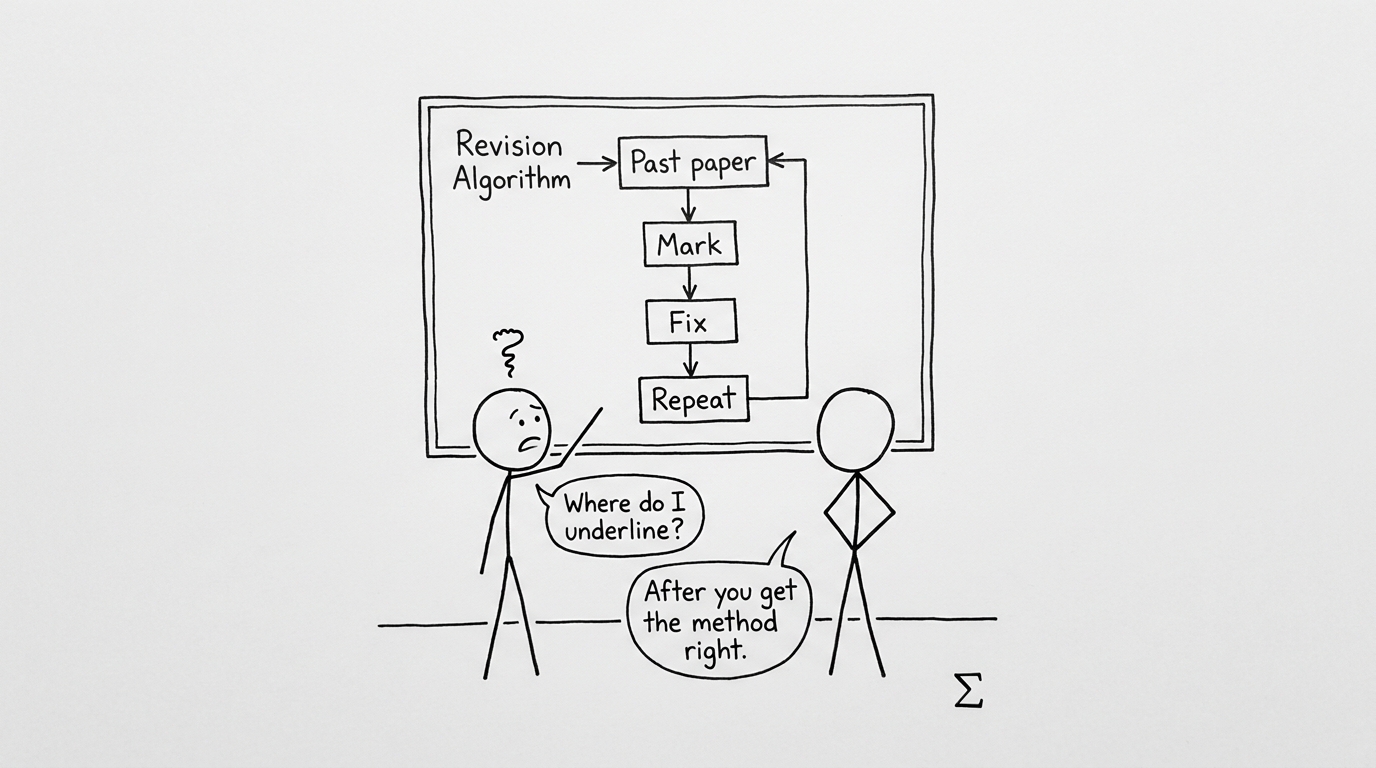 A revision flowchart that refuses to include highlighting
Common mistakes that waste time in GCSE Biology revision
- Doing “pretty” revision instead of marked revision. If it cannot be marked against a mark scheme, it is rarely efficient.
- Not learning the language of marks. GCSE Biology mark schemes reward key phrases and precise cause-effect links.
- Ignoring command words. “Describe”, “explain”, “evaluate” are different tasks with different structures.
- Leaving required practicals vague. You need variables, controls, and improvements, not a story.
- Cramming content without retrieval. Recognition (it looks familiar) is not recall (you can produce it under pressure).
- Never revisiting mistakes. The same error repeated across three papers is a system problem, not bad luck.
FAQ: revising GCSE Biology without wasting time
How many past papers should I do for GCSE Biology?
Past papers are the fastest way to stop wasting time because they show you what the GCSE exam actually rewards. Start with one paper (or half a paper) to diagnose weaknesses, then use topic questions to fix the biggest gaps. After that, return to another paper and see if your score moves in the areas you targeted. If your marks are not improving, the issue is usually that you are attempting papers without doing the “fix” step properly. Quality beats quantity, but most students benefit from repeating the cycle until the common question styles feel routine. Even for maths, this is why students improve quickly when they use GCSE Past papers with strict marking.
Is it better to revise GCSE Biology with flashcards or exam questions?
Flashcards can be useful, but only when they are used for active recall and then tested under exam conditions. The problem is that many students create flashcards as a procrastination activity, which feels organised but does not translate into marks. Exam questions force you to retrieve and apply knowledge, which is closer to what GCSE Biology actually demands. A good compromise is to use flashcards for definitions and core processes, then immediately do questions that require those ideas in context. If you find yourself “knowing” a card but still losing marks, it means you need practice with wording and structure, not more cards. The maths equivalent is knowing a formula but not being able to use it in a multi-step question.
How do I revise GCSE Biology if I am mostly focused on GCSE maths?
Use your maths strength as a tool rather than a distraction. Put your most demanding maths practice first, then do Biology in the same timed, mark-scheme-led way. Keep sessions short and repeatable so you do not rely on motivation: for example, 252525 minutes of questions, then mark and fix. Track your results like you would in maths: identify the topic that loses the most marks, allocate time to it, and re-test within a few days. This prevents the common problem where Biology becomes “the subject I read about” rather than “the subject I can score in”. If you already trust YesGenie for maths practice, build the same habit using Resources on YesGenie and the GCSE Past papers hub for consistent exam-style work.
What should I do the night before a GCSE Biology exam to avoid wasting time?
The night before is for confidence and accuracy, not for learning an entire topic from scratch. Choose a small set of high-yield tasks: review your mistake list, practise a few short questions, and check required practicals in a structured way (variables, method, improvements). Avoid anything that creates panic without feedback, such as watching hours of videos at 1.5×1.5\times1.5× speed. If you do use notes, do it as a prompt for retrieval: cover the page and recite, then check what you missed. Set a stopping time so you protect sleep, because memory and focus are part of performance in any GCSE exam. Your goal is to walk in feeling that you know how to answer questions, not that you have “looked at everything”.
A final word: make GCSE revision look like marks
When you are under pressure, your brain will try to conserve energy. It will suggest the easiest form of GCSE revision -- reading, highlighting, reorganising. You do not need more effort. You need a better loop.
Revise GCSE Biology the way you already know how to revise GCSE maths: practise questions, mark them properly, fix the exact errors, then repeat. Use YesGenie as the home base for that method: revision lessons when you need clarity, practice questions when you need skill, and past papers and predicted papers when you need exam confidence.
Open Resources on YesGenie, pick a paper from GCSE Past papers, and run the loop today. One focused cycle is worth a week of vague revision.