

GCSE CCEA night-before plan for Biology (no panic)
GCSE CCEA night-before plan for Biology: a calm timetable, maths-based self-testing, and quick wins using YesGenie past papers and mini tests.
If you’re staring at the clock the night before a GCSE exam, you already know the feeling: your brain wants certainty, but your notes are a pile of maybes. The twist is that the night-before isn’t really for learning everything. It’s for building calm, protecting marks, and walking into the hall with a plan you can actually execute. This GCSE CCEA guide is written for students who revise maths as well as science -- because the best night-before habits are strangely mathematical: prioritise, timebox, measure what you can control, then stop.
Even though tomorrow might be Biology, the engine of exam confidence is the same across subjects: short bursts of recall, quick feedback, and a simple routine you can repeat. YesGenie is built for that kind of revision.
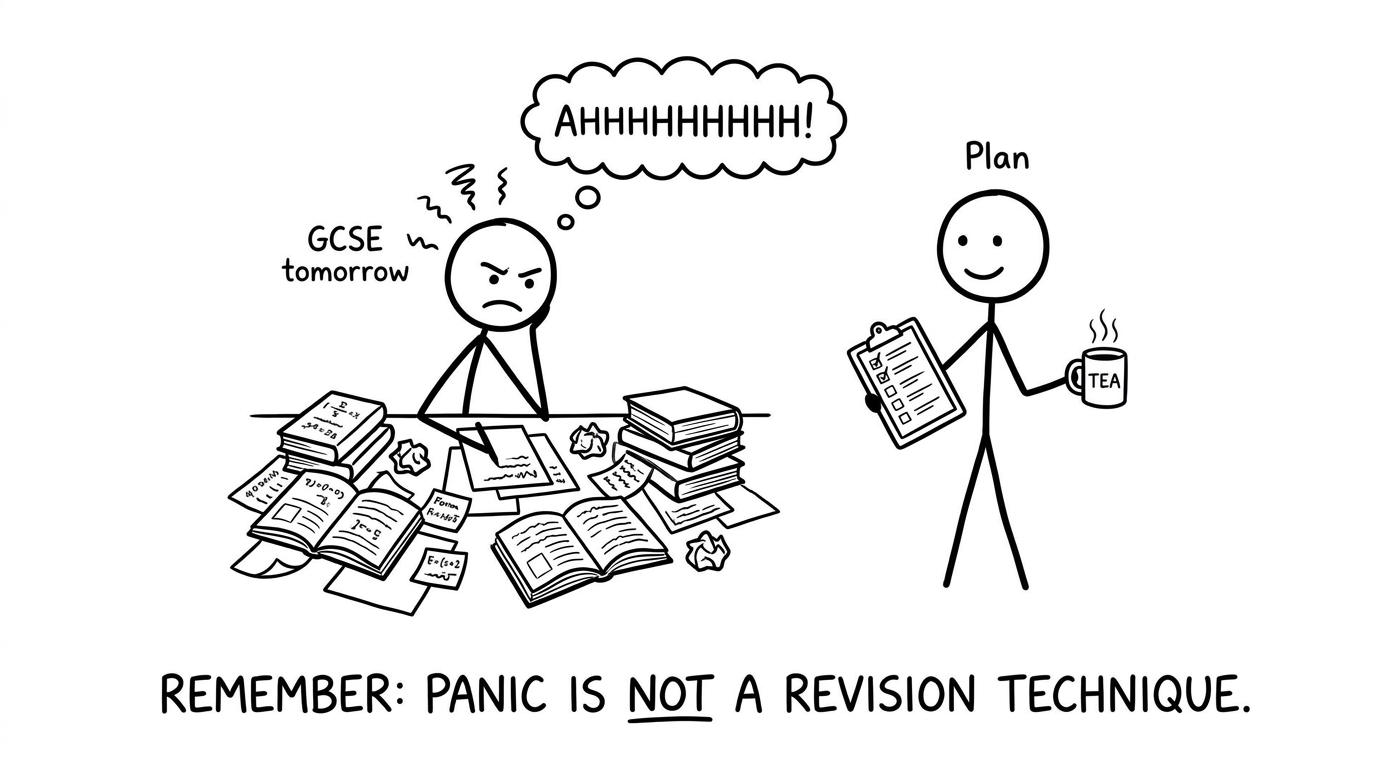 A calm plan beats panic the night before
The night-before checklist (CCEA-friendly, panic-proof)
Keep this tight. The goal is to finish the night feeling “ready enough”, not “empty”.
- Decide your stop time (a real time) and protect sleep.
- Do two short active-recall blocks, not a five-hour reread.
- Mark something using mark-scheme thinking (even if it’s maths, the skill transfers).
- Pack your kit: pens, calculator (for other exams), water, snacks, layers.
- Write a micro-plan for the morning.
- End with an easy confidence pass -- something you can get right.
When you need structured short practice, use GCSE Past Papers and the Resources hub so you’re not hunting random worksheets at midnight.
A CCEA-style night-before timetable that actually works
You can shift the times, but keep the structure. Think in blocks: you’re trying to maximise marks per minute, not minutes per night.
Two hours before your stop time: the “reduce the unknowns” block
- Choose three topics, not ten. In Biology, that might be cells, enzymes, and ecology. Your job is to turn “I sort of know it” into “I can say it under pressure”.
- Active recall only: close notes, speak answers, write from memory, then check.
- Use a mark scheme mindset: what exact phrases, definitions, and steps earn marks?
Maths students often forget they already have the perfect training ground for this. When you do a maths question, you don’t just “understand” it -- you produce a sequence that earns marks. That is exactly the habit Biology rewards too.
To practise that habit tonight, do one short maths set that forces clear method. Use Edexcel GCSE Maths Mini Tests or pick a focused topic from Edexcel GCSE Maths Revision Guides. It’s not about switching subjects -- it’s about switching your brain into “marks mode”.
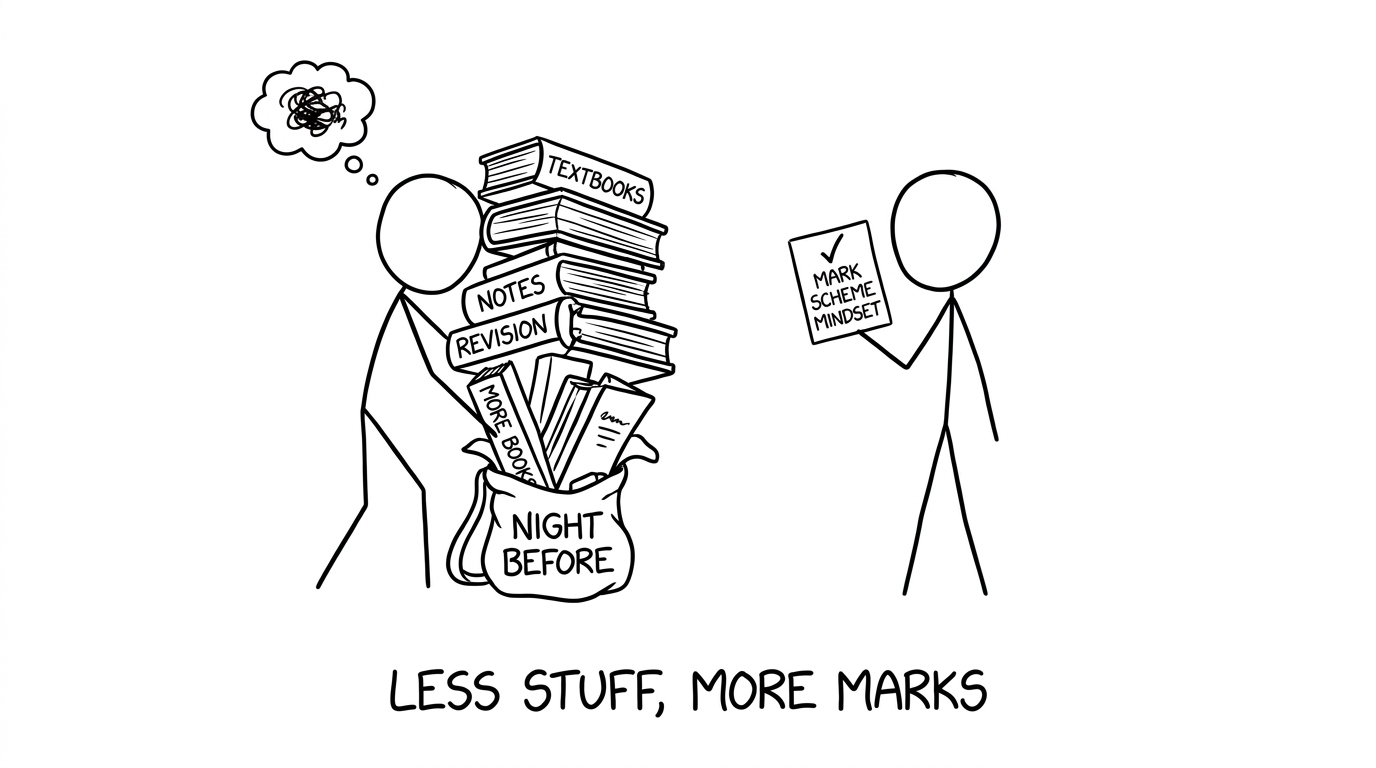 Cramming vs mark-scheme mindset
90 minutes before stop time: the “short paper” block
Do one of these, not all:
- A short section of a past paper (any subject) with marking.
- A mini test on a high-impact maths topic.
- A handful of exam-style questions from a question bank.
On YesGenie, you can build this quickly using the question bank, worksheets, and solutions available on the CCEA maths area: GCSE Maths CCEA. The point is speed-to-feedback. You’re training the loop:
- attempt, 2) check, 3) correct, 4) repeat once.
One hour before stop time: pack, reset, and make tomorrow easy
- Pack everything now.
- Put your alarm across the room.
- Decide your breakfast.
- Decide your first 10 minutes of morning revision (keep it tiny).
If you like structure, bookmark the Other Resources page for formula lists and self-assessment sheets. The night before is not the time to build a new system; it’s the time to use a simple one.
Final 30 minutes: confidence pass + calm
End on something that feels clean and finishable. For maths students, a short topic you can secure quickly works well.
Try this higher-tier style example because it rewards calm method.
Worked example (maths method that reduces exam panic)
You’re revising tonight, and your brain is loud. So you choose one question where the steps are certain.
Example: percentage change (a reliable marks topic)
A lab culture increases from 250250250 to 315315315.
- Find the percentage increase.
So the culture increased by 26%26\%26%.
- If it then decreases by 20%20\%20%, what is the new amount?
A 20%20\%20% decrease means multiply by 0.80.80.8:
315×0.8=252 315 \times 0.8 = 252 315×0.8=252New amount is 252252252.
Why this helps your Biology night-before: it reinforces a truth you can carry into any GCSE exam -- you don’t need to feel confident to do confident steps. You need a method, a line, a check.
For more quick-win practice, use Edexcel GCSE Maths Past Papers and mark one question properly. That single act often calms the whole evening.
How to revise Biology the night before (without pretending you’ll relearn the spec)
This is a CCEA guide, but the night-before principles hold across AQA, Edexcel, OCR, and Eduqas.
Use “definition anchors”
Pick 10 definitions you could be asked to state. In Biology these might be words like diffusion, osmosis, enzyme, homeostasis. Don’t reread them. Cover them and write a one-sentence definition each, then check and correct.
Convert content into “if asked, I will say…”
A strong GCSE answer often sounds like it’s following a script. That’s not fake; it’s exam technique. For each big topic, write:
- If asked “describe”, I will include a sequence.
- If asked “explain”, I will include a cause and effect.
- If asked “evaluate”, I will include a limitation.
Maths students already do this with command words (show, prove, hence). You’re just borrowing your own strength.
Practise one six-mark style response
Choose one longer question and plan it as bullet points. You’re rehearsing structure, not memorising paragraphs.
The maths-based anti-panic trick: estimate your time and protect your sleep
Panic is often a time error. You think you have “loads to do” because you haven’t measured it.
Do this:
- List your tasks (e.g. 10 definitions, 1 long plan, 1 short paper section).
- Assign honest times.
- Add a buffer.
Example:
10 definitions×2 min=20 min 10 \text{ definitions} \times 2 \text{ min} = 20 \text{ min} 10 definitions×2 min=20 min 1 long question plan=15 min 1 \text{ long question plan} = 15 \text{ min} 1 long question plan=15 min 1 short paper section=35 min 1 \text{ short paper section} = 35 \text{ min} 1 short paper section=35 minTotal planned work =70= 70=70 minutes. Add a 202020 minute buffer: 909090 minutes.
Now your evening has edges. And when revision has edges, your brain relaxes.
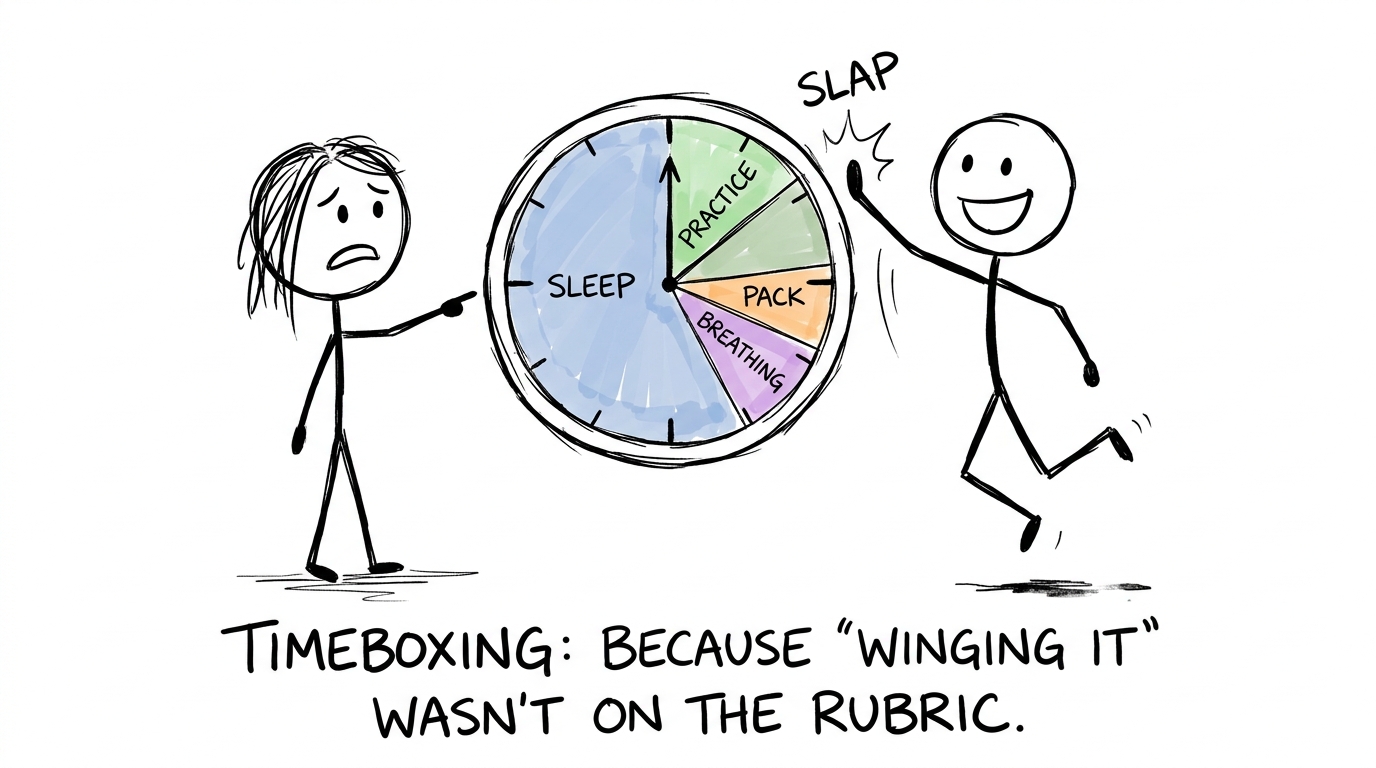 Timeboxing makes revision feel possible
Common mistakes the night before (and what to do instead)
- Mistake: rereading notes for hours. You feel busy but you don’t get feedback. Instead, write from memory for 3 minutes, then check.
- Mistake: “I’ll sleep after I finish everything.” That deal never ends. Instead, choose a stop time and treat sleep as revision.
- Mistake: doing only the hardest topics. That’s emotionally loud and often low return. Instead, secure a few reliable marks topics.
- Mistake: marking loosely. In any GCSE subject, vague marking creates false confidence. Instead, mark strictly, then redo one question correctly.
- Mistake: changing your whole system tonight. New flashcards, new apps, new plans. Instead, use one platform you trust (YesGenie) and keep it simple.
FAQ: night-before GCSE strategy (CCEA focus, maths mindset)
Should I revise the night before a GCSE exam?
Yes, but only if “revise” means active recall and quick feedback, not marathon reading. The night before a GCSE exam is best used to reduce uncertainty, because uncertainty fuels panic more than difficulty does. If you do two short blocks of recall, mark something properly, and end with a confidence pass, you will usually feel calmer the next morning. The key is to stop at a sensible time, because sleep improves memory and attention in a way no last-minute notes can replace. If you keep going until you’re exhausted, you often damage your performance on questions you actually could have answered. A short, strict plan is more powerful than a long, emotional one.
What if my exam tomorrow is Biology, but I’m mainly revising maths right now?
That’s more normal than you think, especially in the middle of a full GCSE timetable. The best transfer from maths to Biology is method: clear steps, checking, and mark-scheme thinking. Tonight, you can do a small amount of Biology recall, but you can also use a short maths mini test to get your brain into “perform under pressure” mode. Maths forces you to turn fog into working, and that habit helps with Biology explanations too. Keep the maths section short so you don’t avoid Biology completely, but don’t feel guilty for using what you’re good at to stabilise your mindset. If you need quick structured maths practice, start at GCSE Maths CCEA and pick a tight topic.
How do I avoid blanking in the exam hall?
Blanking is often an adrenaline problem, not an intelligence problem, and it hits smart students hard in GCSE season. Your job is to create a routine you can trigger even when your mind feels noisy. In the first minute, breathe slowly and read the first question twice, looking for command words and data you can use immediately. If you freeze on a question, switch to one you can start, because starting restores momentum and reduces panic. In maths, writing something like let x=\text{let } x=let x= or drawing a quick diagram can restart thinking; in Biology, writing a few key terms you remember can do the same. Most importantly, practise this tonight by doing one short timed section and marking it, so your brain remembers what “starting” feels like.
Is it worth doing past papers the night before?
Yes, but only in a controlled way, because full papers can inflate stress if you try to do too much. A night-before GCSE past paper should be a small, chosen slice with strict marking, so you get rapid feedback and a clear next step. On YesGenie you can use GCSE Past Papers to find the right board and then focus on one section, not the entire paper. The big win is not the score; it’s the correction. Do one question, check the mark scheme, then redo it correctly so the method is fresh for tomorrow. If you finish the slice and feel calmer, stop -- that’s the signal you’ve done enough.
Closing: your GCSE night-before plan, simplified
The night before a GCSE exam isn’t a referendum on how hard you worked this year. It’s a small decision-making window: choose what matters, practise it briefly, mark it honestly, then sleep. If you’re doing CCEA Biology tomorrow, use short recall and a mark-scheme mindset. If you’re a maths student at heart, lean on your strength: timeboxing, method, and feedback.
Tonight, keep everything in one place. Use YesGenie for GCSE Maths CCEA topic practice, quick confidence builders via Edexcel GCSE Maths Mini Tests, and proper exam conditioning with Edexcel GCSE Maths Past Papers and the wider GCSE Past Papers library. If you want a broader set of tools for the rest of the exam season, keep the Resources page open for predicted papers, mini tests, and structured revision materials.
Set your stop time. Do the next small step. Then let sleep do its share of the revision. Your GCSE marks tomorrow will thank you.