

GCSE Memory: Stop Forgetting WJEC Chemistry Content
GCSE revision for WJEC Chemistry: stop forgetting content using spaced retrieval, exam-style practice and mark schemes. Plus maths methods to remember.
If you’re a WJEC student, the most frustrating part of GCSE Chemistry revision isn’t learning it the first time -- it’s watching it evaporate a week later. You make neat notes, highlight definitions, even rewrite the page… then a six-mark question appears and your mind goes blank.
Here’s the twist: forgetting isn’t proof you’re bad at Chemistry. It’s proof you revised in a way your brain can’t easily retrieve under pressure. And because you’re also a maths student, you already have an advantage: maths revision (done properly) is built around methods, retrieval, and mark schemes. We can borrow that structure and use it to make your WJEC Chemistry content stick.
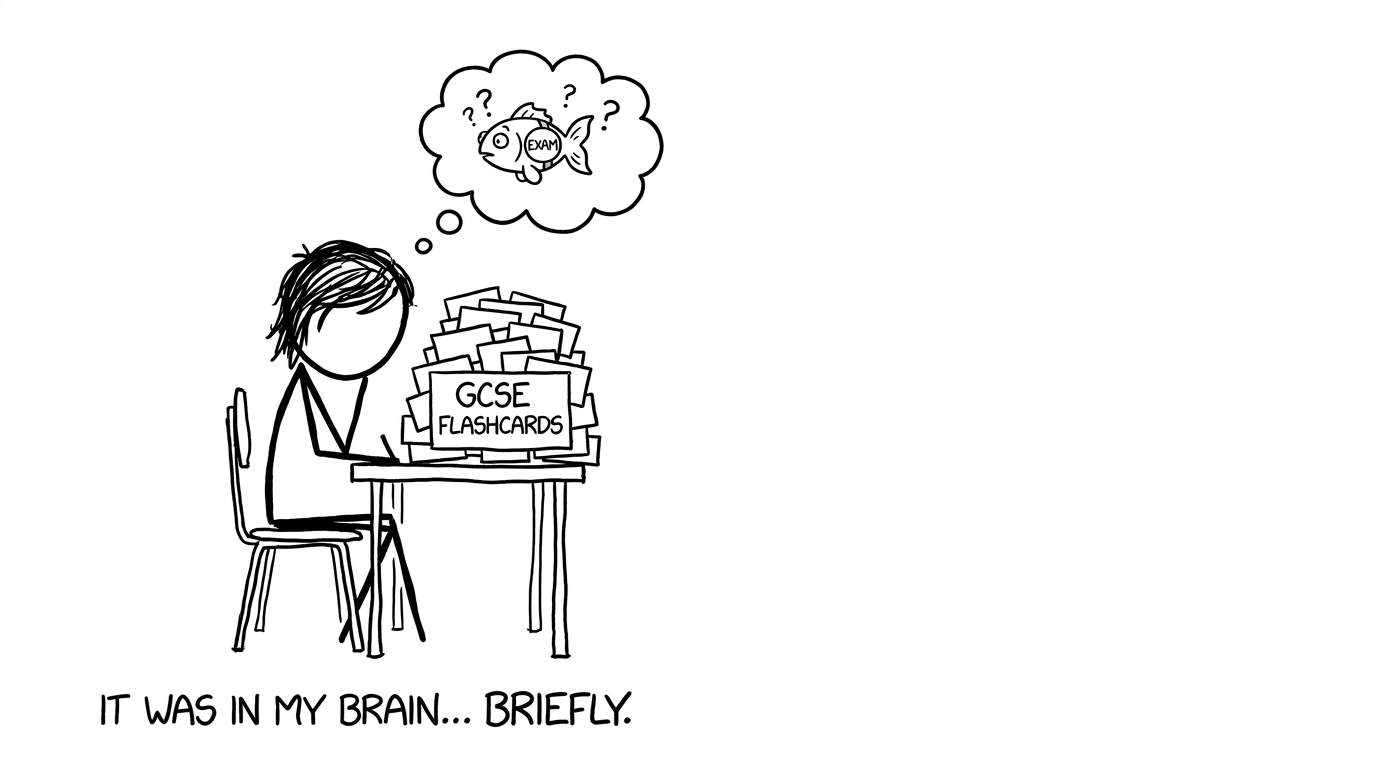 A student revising with a goldfish brain
A quick GCSE checklist for not forgetting
Use this as your simple GCSE routine for WJEC Chemistry (and honestly, most subjects):
- Short, frequent recall beats long rereads.
- Spaced practice: revisit topics after 111 day, 333 days, 777 days, then weekly.
- Interleaving: mix topics (rates, bonding, moles) so your brain practises choosing the right idea.
- Mark-scheme thinking: practise writing what earns marks, not what sounds right.
- Maths-first confidence: secure the calculations so you don’t lose “easy” marks.
To support the maths side while you’re doing this, keep YesGenie open for quick method refreshers, mini tests, and exam practice: GCSE Past Papers, GCSE Mini Tests, and the Resources hub.
Why WJEC GCSE Chemistry content slips away
Most forgetting happens for three predictable reasons:
Rereading feels like revision, but it isn’t retrieval
Rereading creates familiarity. In an exam, you need recall. Familiarity is passive; recall is active. If you want GCSE Chemistry knowledge on demand, you need to practise pulling it out without the page in front of you.
Your brain stores “stories”, not lists
Your notes often read like a list of facts: definitions, conditions, examples. But memory works better when information is connected. The trick is to build small “cause and effect” chains (like you do in maths proofs or multi-step methods).
Exams reward specific phrasing and steps
WJEC mark schemes (like all boards) reward precise statements. You can understand something and still drop marks if you miss the required keywords, units, or steps. This is where GCSE maths habits help: show working, label units, and write what the mark scheme expects.
Turn GCSE Chemistry into a maths-style method
If Chemistry feels like “too much content”, convert it into repeatable routines.
Use the “definition, example, non-example” pattern
For each tricky term (e.g. “exothermic”, “oxidation”, “rate of reaction”), write:
- Definition (one sentence)
- Example (real reaction or context)
- Non-example (what it is not)
It’s the same reason a maths definition sticks when you pair it with a worked example and a common pitfall.
Build mini mark-scheme answers
Take a six-mark question and rewrite a perfect answer as bullet points, each bullet being “one mark’s worth”. That’s exactly how maths students learn to hit method marks and accuracy marks.
For your maths practice alongside this, use an exam-board pathway like GCSE Maths (OCR) or topic notes like Edexcel GCSE Maths Revision Guides -- not because you’re sitting Edexcel, but because the skill of writing mark-scheme-ready steps transfers.
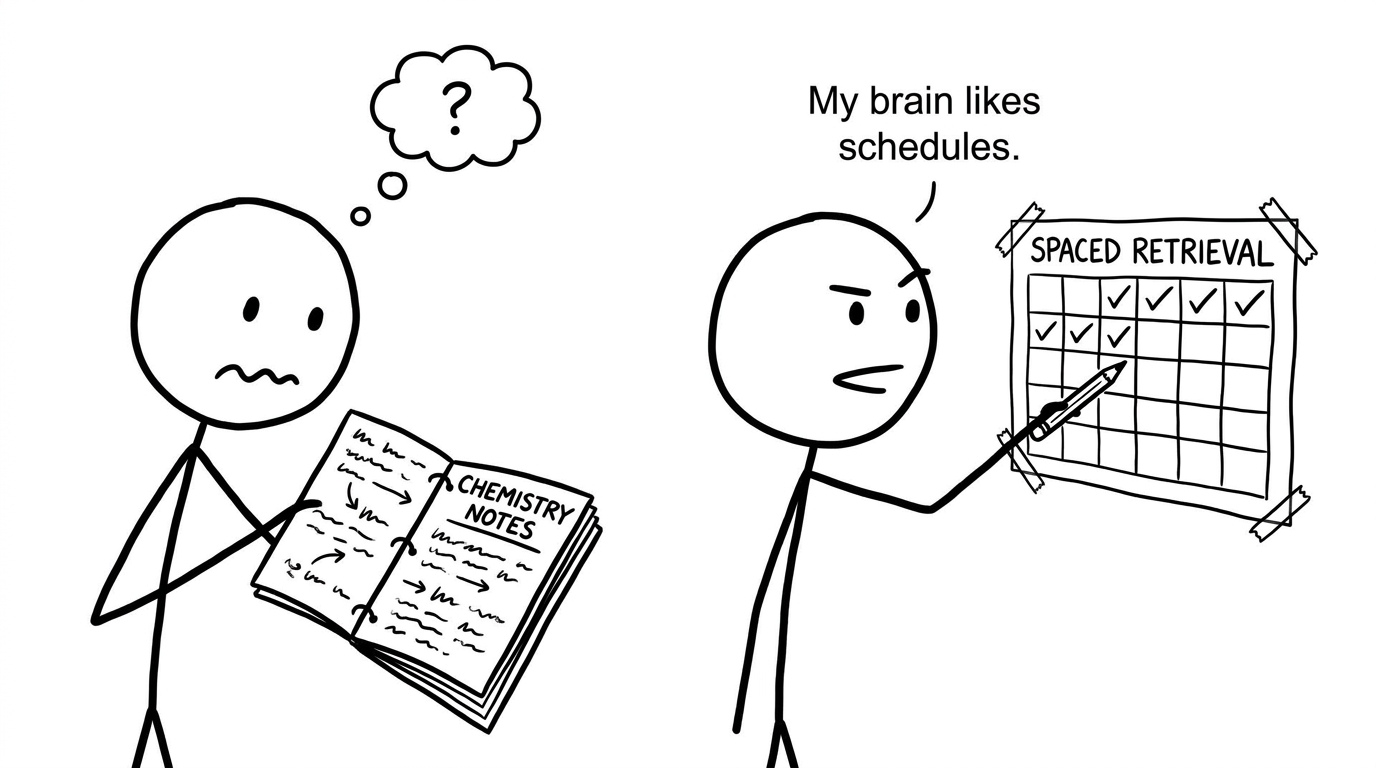 Two students: rereading vs spaced retrieval
Spaced retrieval: the GCSE forgetting problem, solved quietly
Spaced retrieval means you test yourself before you feel ready, then revisit later. That discomfort is the point -- it’s your brain strengthening the path.
A simple schedule:
- Day 111: Learn + short self-test (no notes)
- Day 333: Self-test again
- Day 777: Mixed-topic self-test
- Weekly: Exam-style questions
To make this painless, use short maths-style checks. For example, do a quick GCSE mini test for momentum, then swap to a Chemistry recall set, then back to maths. YesGenie’s short-format resources are perfect for this rhythm: Edexcel GCSE Maths Mini Tests and the broader Resources page.
Worked examples: the maths you must not lose in WJEC GCSE Chemistry
Even if your blog topic is Chemistry memory, you’re a maths student. The fastest way to feel calmer in GCSE Science papers is to lock in the calculations. These are also the easiest marks to protect with method.
Worked example: percentage yield
A reaction produces 8.4 g8.4\text{ g}8.4 g of product. The theoretical yield is 12.0 g12.0\text{ g}12.0 g. Find the percentage yield.
Percentage yield=actual yieldtheoretical yield×100 \text{Percentage yield} = \frac{\text{actual yield}}{\text{theoretical yield}}\times 100 Percentage yield=theoretical yieldactual yield×100Substitute:
Percentage yield=8.412.0×100 \text{Percentage yield} = \frac{8.4}{12.0}\times 100 Percentage yield=12.08.4×100Calculate:
8.412.0=0.7⇒0.7×100=70 \frac{8.4}{12.0}=0.7 \quad\Rightarrow\quad 0.7\times 100 = 70 12.08.4=0.7⇒0.7×100=70So the percentage yield is 70%70\%70%.
What to memorise isn’t the number -- it’s the structure: fraction then multiply by 100100100.
Worked example: mean rate of reaction
A gas syringe shows volume increases from 10 cm310\text{ cm}^310 cm3 to 58 cm358\text{ cm}^358 cm3 in 444 minutes. Find the mean rate in cm3 min−1\text{cm}^3\,\text{min}^{-1}cm3min−1.
Change in volume:
ΔV=58−10=48 cm3 \Delta V = 58-10 = 48\text{ cm}^3 ΔV=58−10=48 cm3Mean rate:
rate=ΔVΔt=484=12 cm3 min−1 \text{rate} = \frac{\Delta V}{\Delta t} = \frac{48}{4} = 12\text{ cm}^3\,\text{min}^{-1} rate=ΔtΔV=448=12 cm3min−1Again, it’s method-first. The mark scheme loves clearly shown substitutions.
Worked example: rearranging for density (the quiet GCSE winner)
If ρ\rhoρ is density, mmm is mass, and VVV is volume:
ρ=mV \rho = \frac{m}{V} ρ=VmIf m=45 gm=45\text{ g}m=45 g and ρ=3 g cm−3\rho=3\text{ g cm}^{-3}ρ=3 g cm−3, find VVV.
Rearrange:
V=mρ V = \frac{m}{\rho} V=ρmSubstitute:
V=453=15 cm3 V = \frac{45}{3} = 15\text{ cm}^3 V=345=15 cm3Rearranging confidently is a maths skill. Keep it sharp with topic practice like Changing the Subject of a Formula (the page title is maths-specific, but the skill is universal across GCSE sciences).
Revise like the mark scheme is watching
A lot of GCSE forgetting is really “I remembered it, but I didn’t write it the right way.” Try these habits:
- Write units every time: g\text{g}g, cm3\text{cm}^3cm3, min−1\text{min}^{-1}min−1.
- When you state a reason, include the cause and effect (e.g. “more frequent collisions, so reaction rate increases”).
- Practise under time pressure so retrieval becomes automatic.
This is why maths past paper practice works so well: you learn how questions are phrased, what steps are rewarded, and how marks are allocated. Build that same reflex with GCSE Past Papers on the maths side, and bring the mindset into WJEC Chemistry.
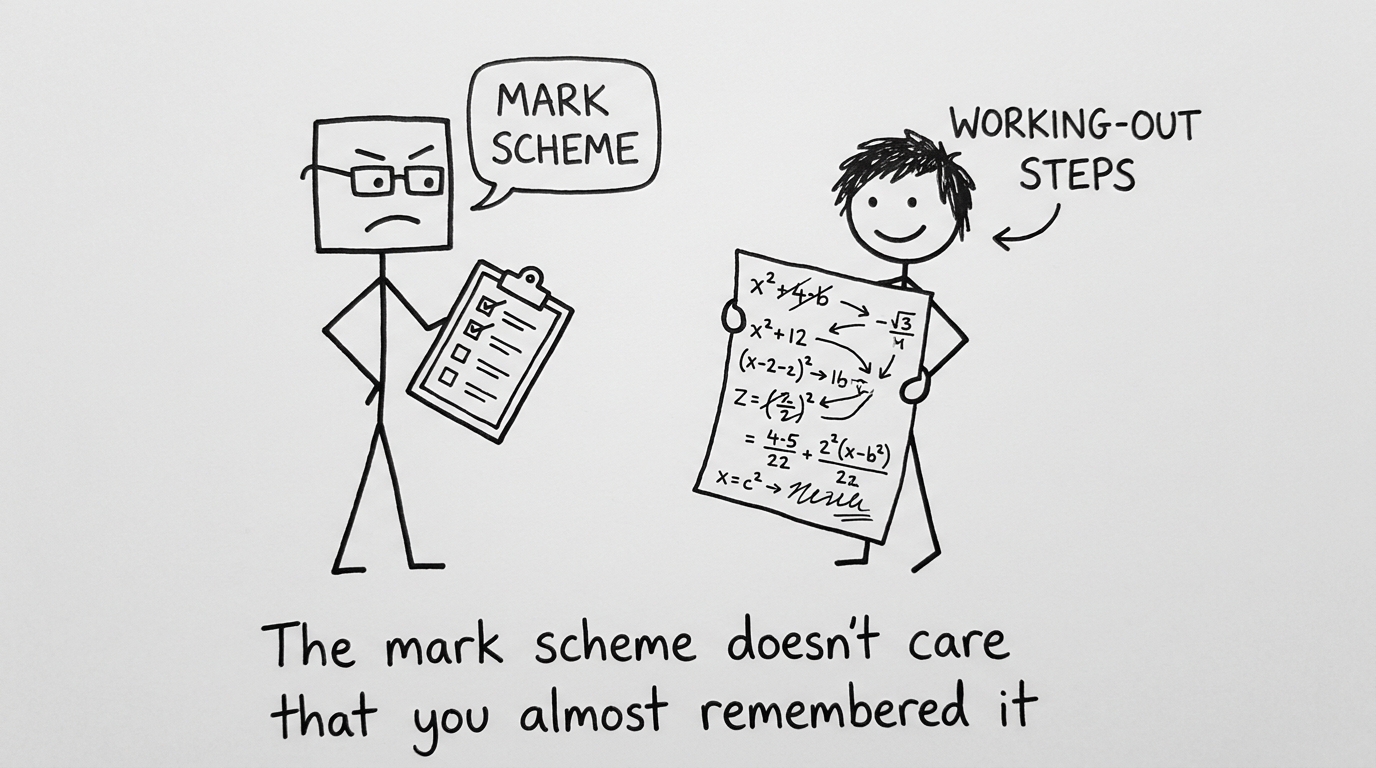 A stern mark scheme character
Common mistakes that cause GCSE Chemistry forgetting
- Rereading instead of recall: you recognise the page, but can’t produce the answer.
- Leaving gaps too long: a topic revised once in March won’t be reliable in May.
- Only revising what you like: your brain starts to fear the weak topics, so you avoid them, then forget faster.
- Not linking words to maths: you can describe “rate” but don’t practise rate=ΔamountΔt\text{rate}=\frac{\Delta\text{amount}}{\Delta t}rate=ΔtΔamount.
- Forgetting required keywords: “because it reacts more” won’t score like “more frequent successful collisions”.
- Dropping units or rounding badly: losing marks that you could have protected with careful method.
If you want a quick way to expose weak areas in maths (so they stop stealing time from Science), use short resources like Starters and GCSE Mini Tests.
A GCSE revision routine that fits maths and WJEC Chemistry together
You don’t need a perfect timetable. You need a repeatable one.
A simple weekly structure
- 3×3\times3× per week: 252525 minutes Chemistry retrieval (flashcards or blurting) + 101010 minutes correcting with notes.
- 3×3\times3× per week: 303030 minutes maths topic practice (methods and exam questions).
- 1×1\times1× per week: a mixed session where you do a maths mini test then a Chemistry six-mark plan.
Keep the maths side grounded in exam-style questions and mark schemes: Edexcel GCSE Maths Past Papers is a reliable bank for practising the exam discipline that lifts marks across GCSE subjects.
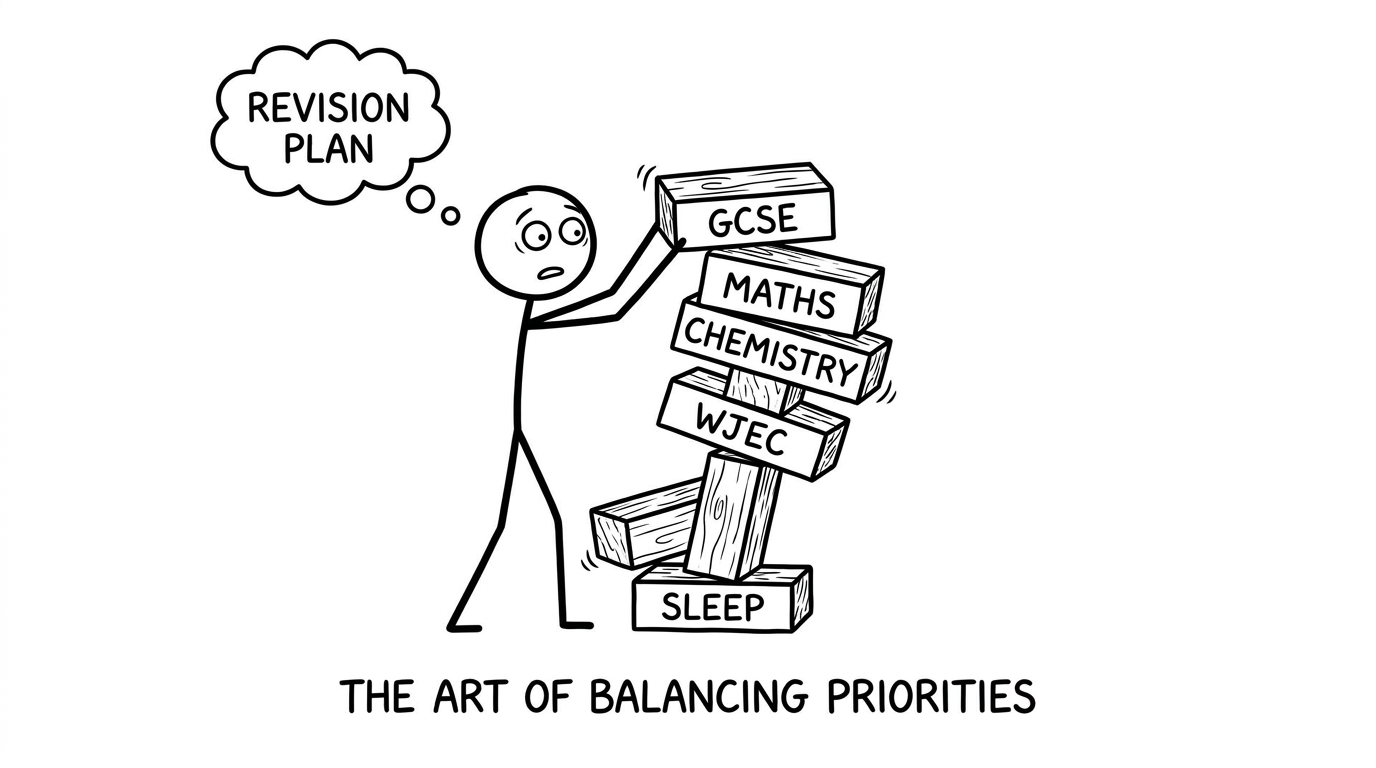 A revision plan built like Jenga
FAQ
How can I stop forgetting GCSE Chemistry definitions for WJEC?
Stop treating definitions like lines to memorise and start treating them like answers you must retrieve. Write the definition once, then close your notes and try to say it out loud or write it from memory. If you miss a key word, correct it immediately, but keep the correction short so you don’t drift into rereading. Space the same definition over multiple days so your brain gets repeated retrieval practice rather than one long session. Also, attach each definition to an example you genuinely understand, because meaning is a memory anchor. Finally, practise turning definitions into mark-scheme bullets, because GCSE papers reward precision, not just general understanding.
Does doing GCSE maths revision really help my Chemistry memory?
Yes, because good maths revision trains the exact habits Chemistry needs: step-by-step methods, careful substitution, and checking units. When you practise maths topics, you’re repeatedly strengthening recall under mild pressure, which is closer to exam conditions than rereading a textbook. It also makes you comfortable with mark schemes, where marks are awarded for specific steps, not vibes. In Chemistry, that translates to writing structured explanations and showing clear working in calculations. If you’re steady on rearranging formulae, ratios, and proportional reasoning, you remove a whole category of panic from Science papers. Using YesGenie resources like GCSE Mini Tests and Revision Guides keeps those fundamentals secure across your GCSE subjects.
What if I’m revising for WJEC Chemistry but YesGenie is a maths site?
Use YesGenie as the engine for the skills that quietly add marks everywhere: algebra, rearranging formulae, proportional reasoning, and exam technique. WJEC Chemistry has plenty of calculation marks, and those are often the most reliable marks to improve quickly. When you practise maths properly, you’re also practising how to learn: retrieval, spacing, interleaving, and fixing mistakes using solutions. That learning process is exactly what stops forgetting in content-heavy subjects. You can then apply the same structure to WJEC Chemistry recall sessions: short, spaced, and mark-scheme focused. So even though YesGenie isn’t a Chemistry specification site, it can still be the backbone of your GCSE revision system through lessons, practice questions, mini tests, and past papers.
Closing: make GCSE memory a system, not a mood
Forgetting WJEC GCSE Chemistry content isn’t a character flaw. It’s what happens when revision is built on recognition instead of retrieval, and on effort instead of structure. The good news is that you already have the blueprint in your maths revision: methods, practice, mark schemes, and spaced return visits.
Use YesGenie to keep that blueprint strong: practise key skills with GCSE Maths Revision Guides, pressure-test yourself with GCSE Mini Tests, and build exam confidence through GCSE Past Papers. Then take the same habits into WJEC Chemistry: recall little and often, correct using mark-scheme language, and revisit before you’ve forgotten.
Your GCSE grades won’t come from one heroic weekend. They come from a calm system you can repeat.