

GCSE Revision for CCEA: From Pass Grade to Stronger
GCSE revision for CCEA students stuck at a pass grade: a calm plan, maths-style methods, worked examples, and how YesGenie helps you rise.
If you are a CCEA student stuck hovering around a pass grade, you do not need a personality transplant or a brand-new brain -- you need a better system. The odd part is that your most reliable system might come from your GCSE maths habits: short practice, tight feedback, and learning the mark scheme language. Biology feels like “so much content”, but exam marks are usually earned in a smaller place: what the question is really asking, what counts as a point, and how you show it clearly.
This post is written for UK GCSE and A Level maths students who want to get unstuck. It uses maths-style revision methods to help CCEA Biology revision feel less foggy, while keeping your maths sharp at the same time.
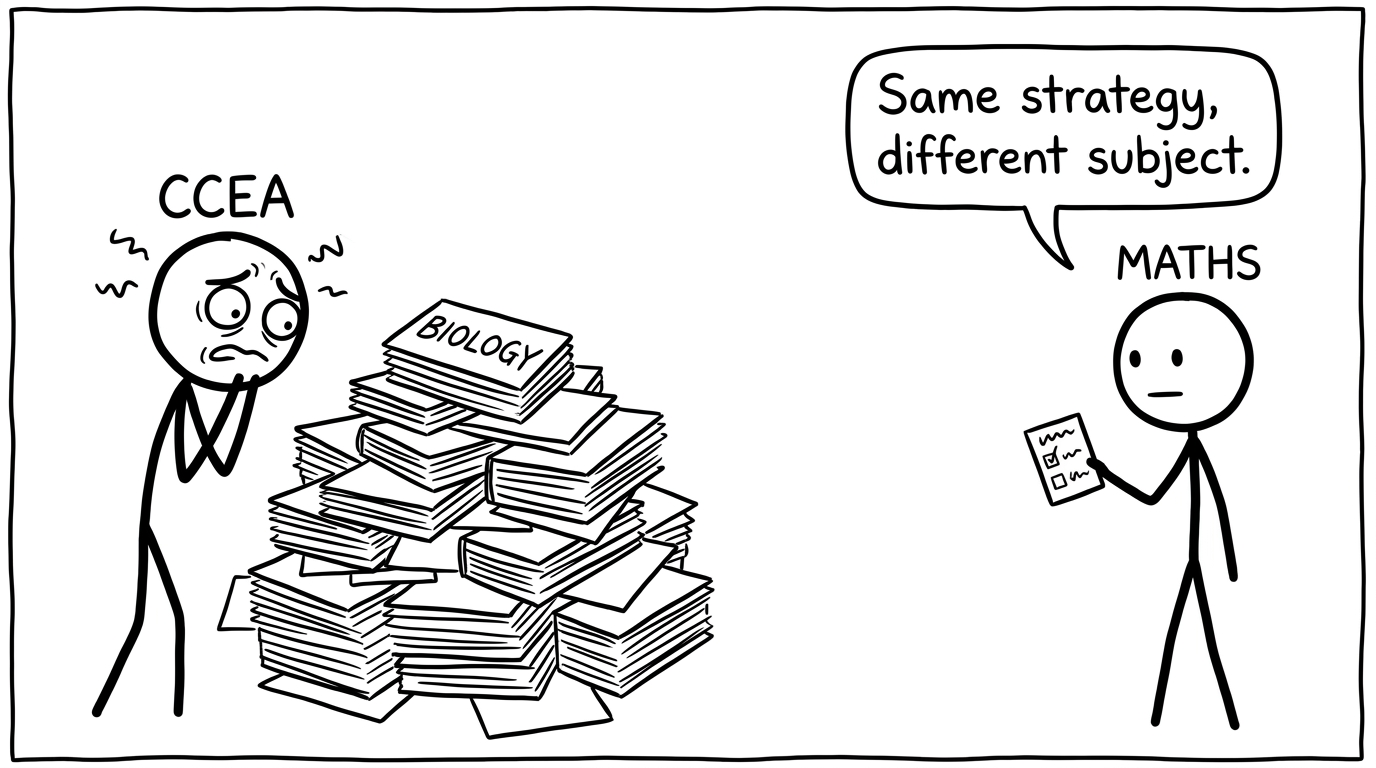 A student juggling Biology and Maths revision
The quick checklist to move beyond a pass grade
If you only do one thing this week, do this:
- Choose one Biology topic and one maths topic per day (keep the brain in “practice mode”).
- Do timed questions first, notes second (so you learn what you actually forget).
- Mark brutally using a mark scheme mindset: points, not paragraphs.
- Turn mistakes into mini flashcards: prompt on one side, mark scheme wording on the other.
- Repeat the same topic 48 hours later to lock it in.
For maths support while you do this, keep YesGenie open in a tab and rotate between lessons, topic practice, and papers:
Why “stuck at a pass grade” happens (and why it is fixable)
A pass grade often means you can recognise ideas, but you cannot consistently retrieve them under time pressure. In maths, this is the moment you stop “understanding” and start practising: you learn the method, then you do it until the steps come out in the right order.
CCEA GCSE Biology rewards the same skill. Your knowledge has to be organised into “exam answers”: short, accurate, and directly tied to the command word. When you are stuck, it is rarely because you know nothing. It is because:
- you revise by re-reading (comforting, low impact),
- you answer in vague language (true, but not mark-scheme true),
- you do not diagnose patterns in mistakes.
That is exactly what a good GCSE maths routine fixes.
Borrow a GCSE maths method: start with the marks
In maths, you quickly learn that:
- 333 marks usually means 222--333 clear steps,
- method marks matter even if the final answer is wrong,
- showing working is not “extra” -- it is how you get rescued.
In Biology, method marks turn into “point marks”. Your job is to build answers out of distinct points, each one worthy of a tick.
Worked example: turning messy Biology into “point marks”
Imagine a question like: “Explain how enzymes work and why temperature affects enzyme activity.” A pass-grade answer often looks like a paragraph with lots of nearly-right science.
A higher-mark answer is more like a maths solution: small steps.
- Enzymes are biological catalysts -- they increase reaction rate.
- They have an active site with a specific shape.
- Substrate binds to active site (lock-and-key or induced fit).
- Enzyme-substrate complex forms and reaction happens.
- At higher temperature, particles have more kinetic energy, so collision frequency increases.
- Above the optimum temperature, bonds in the enzyme break, active site changes shape -- enzyme denatures.
- Substrate no longer fits, so rate decreases.
That structure is “show your working” for Biology.
Keep your maths strong while revising CCEA Biology
Most students revising CCEA Biology also need to protect their GCSE maths grade. The risk is that Biology eats time and maths quietly slips.
YesGenie helps because you can revise maths in small, controlled blocks:
- If you are aiming to secure the basics (especially Foundation), start with mini tests and topic-by-topic lessons.
- If you are pushing higher, use mixed papers and mark scheme style.
Useful starting points:
- Edexcel GCSE Maths Revision
- OCR GCSE Maths Revision
- Edexcel GCSE Maths Past Papers
- Edexcel GCSE Maths 45-Min Tests
Even if your school is not Edexcel, the practice style still builds GCSE maths fluency.
A two-week “pass to progress” plan (CCEA Biology + GCSE maths)
This plan is simple on purpose. Being stuck often comes from doing too much and measuring too little.
Week one: diagnose and build the basics
Daily (60--90 minutes Biology):
- 252525 minutes: timed past-paper questions on one topic.
- 151515 minutes: mark and rewrite answers into bullet points.
- 202020 minutes: targeted notes only on what you missed.
Daily (20--30 minutes maths):
- 101010 minutes: a YesGenie lesson or revision guide section.
- 101010--202020 minutes: a short set of exam-style questions.
Week two: mix topics and train exam stamina
Biology:
- Alternate between single-topic focus and mixed questions.
- Practise command words: describe, explain, compare, calculate, evaluate.
Maths:
- Do one longer session every 333 days: a half paper or a mini test.
If you want an easy hub to keep this organised, start at the YesGenie Sitemap and pin the pages you use most.
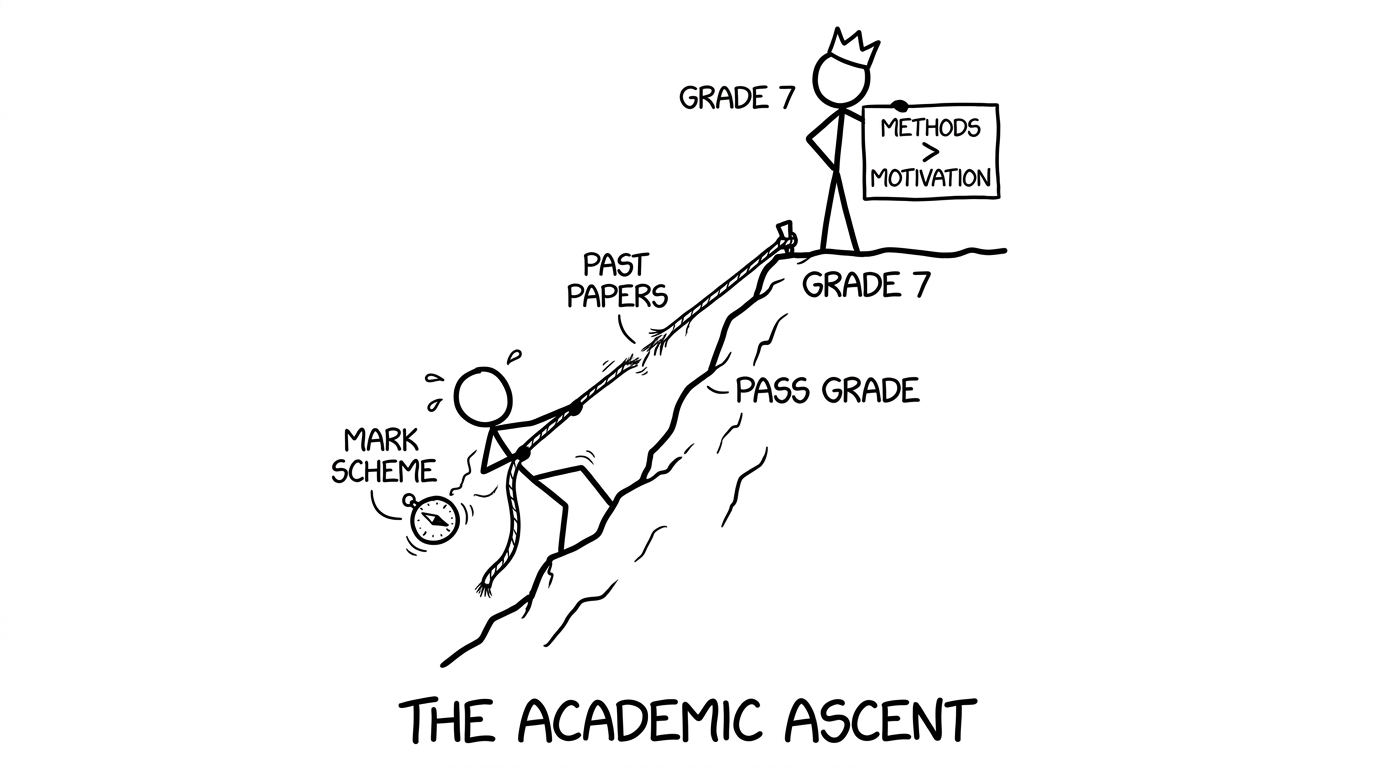 Climbing from pass grade using past papers and mark schemes
Use maths to get better at Biology calculations
CCEA GCSE Biology includes calculations (for example, magnification, percentages, rates). If you are stuck at a pass grade, calculations can be a fast way to gain marks because they are less subjective.
Worked example: percentage change (maths method, Biology context)
Suppose a question says: “The number of bacteria increases from 250250250 to 400400400. Calculate the percentage increase.”
Increase:
400−250=150 400-250=150 400−250=150Percentage increase:
150250×100=60% \frac{150}{250}\times 100=60\% 250150×100=60%Notice the structure: difference, then divide by original, then ×100 \times 100×100. In GCSE terms, this is a repeatable method, not a one-off trick.
Worked example: magnification
If image size is 36 mm36\text{ mm}36 mm and actual size is 9 mm9\text{ mm}9 mm:
magnification=369=4 \text{magnification}=\frac{36}{9}=4 magnification=936=4Rearranging is where students drop marks. Treat it like changing the subject in maths:
If M=IAM=\frac{I}{A}M=AI then A=IMA=\frac{I}{M}A=MI and I=MAI=MAI=MA.
That one set of relationships can rescue multiple GCSE Biology marks.
If rearranging is a weak point, build that skill directly in maths revision too (YesGenie has topic-by-topic practice and worked solutions across specs).
Common mistakes that keep CCEA students at a pass grade
- Re-reading instead of retrieving. If you are not forcing your brain to pull information out (from memory), it will feel familiar but disappear in the exam.
- Writing essays for 3-mark questions. Marks are usually points. If you hide points inside waffle, the examiner cannot award them.
- Ignoring command words. “Describe” is observations; “explain” is causes; “evaluate” is pros/cons with judgement.
- Not learning the “GCSE language”. Biology mark schemes like precise words (for example “denatured”, “diffusion”, “active site”). Close-but-not-quite vocabulary loses marks.
- In maths: not showing steps. Even when you can do it mentally, write the method. Treat it as collecting method marks.
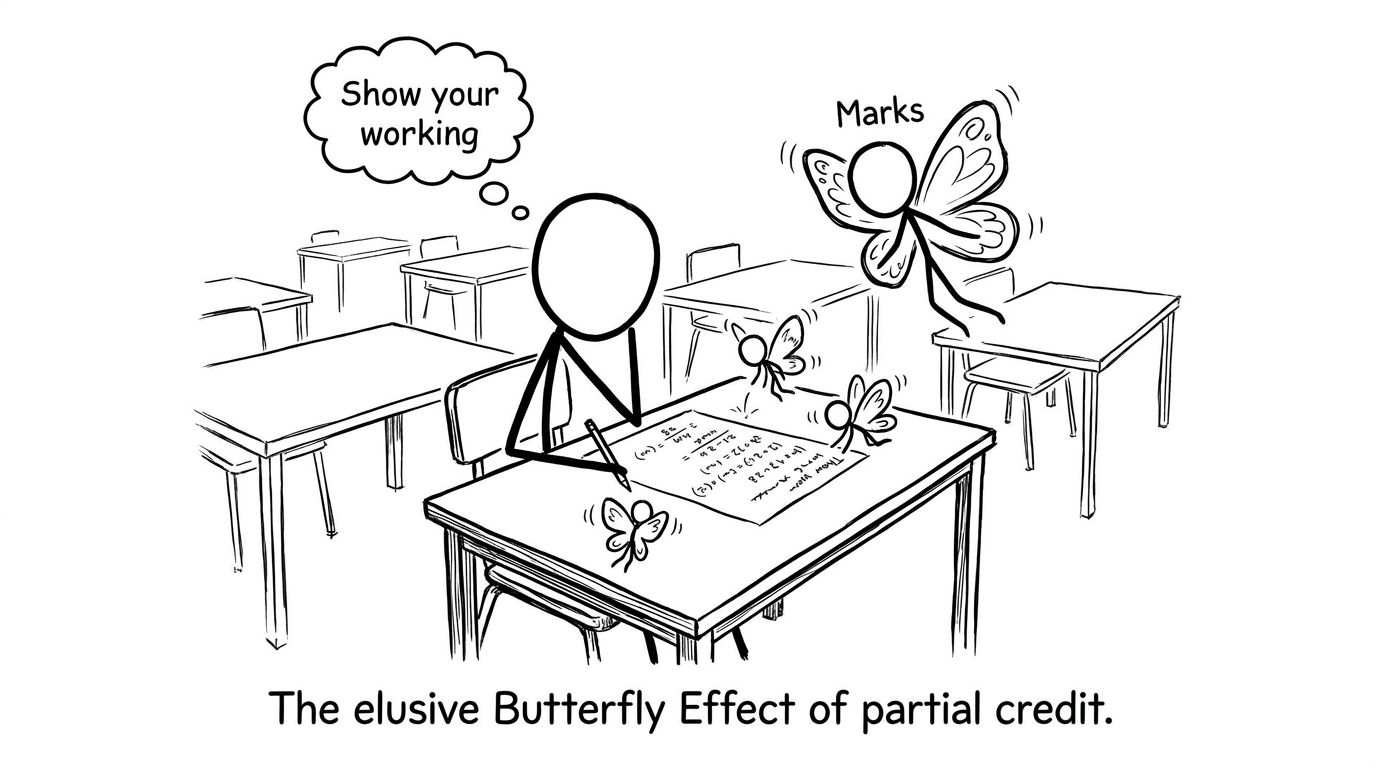 Marks only land when you show your working
FAQ
How many hours of GCSE revision do I need if I am stuck at a pass grade?
Hours are a weak measure because two students can spend the same time and get totally different results. If you are stuck at a pass grade, the bigger issue is usually revision quality: are you doing timed questions, marking them, and fixing the specific gaps that appear? A strong starting point is 606060--909090 minutes per day per subject in the final stretch, but with clear feedback loops. That means at least half your time should be answering questions, not taking notes. In GCSE maths, it also means regularly doing mixed questions so you practise choosing the method, not just performing it. If you use YesGenie, you can keep sessions short and focused by switching between lessons, question banks, and past papers depending on what your mistakes show.
I do well in class but my GCSE exam answers drop marks -- why?
Classwork often rewards participation and partial understanding, but GCSE exams reward precision under time pressure. In Biology, that means writing points the mark scheme can recognise, not just showing that you “get the idea”. In maths, it means writing enough working to earn method marks even if you slip later. Many students lose marks because they answer the question they wish they were asked, not the one on the page, especially when command words are involved. The fix is to practise exam questions early, then mark them honestly, then rewrite answers in a tighter form. Over time, your brain starts to see questions as templates, the same way it learns that quadratic questions usually want a known set of steps. YesGenie is useful here because you can practise exam-style maths questions with worked solutions and video support, which helps you build that “template recognition” skill across subjects.
What is the best way to balance CCEA Biology with GCSE maths revision?
Treat GCSE maths as your “daily maintenance” subject and Biology as your “deep work” subject. Maths improves quickly with frequent, smaller sessions because methods need repetition and spaced practice. Biology needs more focus time, but it still benefits from active recall, so you should spend a large chunk of time doing questions and turning mark scheme points into flashcards. A practical balance is 202020--303030 minutes of maths most days, plus 606060--909090 minutes Biology, then one longer maths session every few days using a mini test or paper. When your timetable gets tight, protect maths by using short YesGenie resources like mini tests or topic practice, then use past papers at the weekend. That way you stop one subject swallowing the other, and you keep both moving forward towards stronger GCSE grades.
Closing: get unstuck by revising like a mathematician
Being stuck at a pass grade can feel like pushing against a door that is locked. But most of the time it is not locked -- it is just stiff, and it opens when you push in the right place. For CCEA Biology, the “right place” is mark-scheme points, timed practice, and short cycles of feedback. For GCSE maths, it is the same idea: methods, working, and honest marking.
Make your next week simple: practise, mark, fix, repeat. Then use YesGenie to keep the process frictionless: revision lessons when you are learning, practice questions when you are building skill, and GCSE past papers when you are training for the real exam. If you want to push further, add predicted papers and timed mini tests from the YesGenie Resources Hub and build a routine you can actually stick to.
The goal is not to “revise harder”. The goal is to revise with a method -- and let your GCSE results follow.