

GCSE Chemistry Exam Week Checklist (for Maths Students)
GCSE chemistry exam week checklist for calm, efficient revision. Use maths-style planning, mark schemes and timed practice to protect your grades 9-1.
The moment GCSE exam week stops being “revision” and becomes logistics
GCSE exam week has a way of shrinking time. You open your bag, you see two pens, a calculator you might not even need for Chemistry, and a timetable that suddenly looks like a weather forecast: unavoidable, and slightly threatening. If you’re a maths student, you already know something important -- pressure is rarely beaten by motivation. It’s beaten by a simple system you can follow when your brain is tired.
This checklist is for GCSE Chemistry exam week, but it’s written for students who revise maths too (or feel more confident when there’s a method). You’ll use the same habits that raise marks in algebra and graphs: small daily targets, timed practice, and honest feedback from mark schemes.
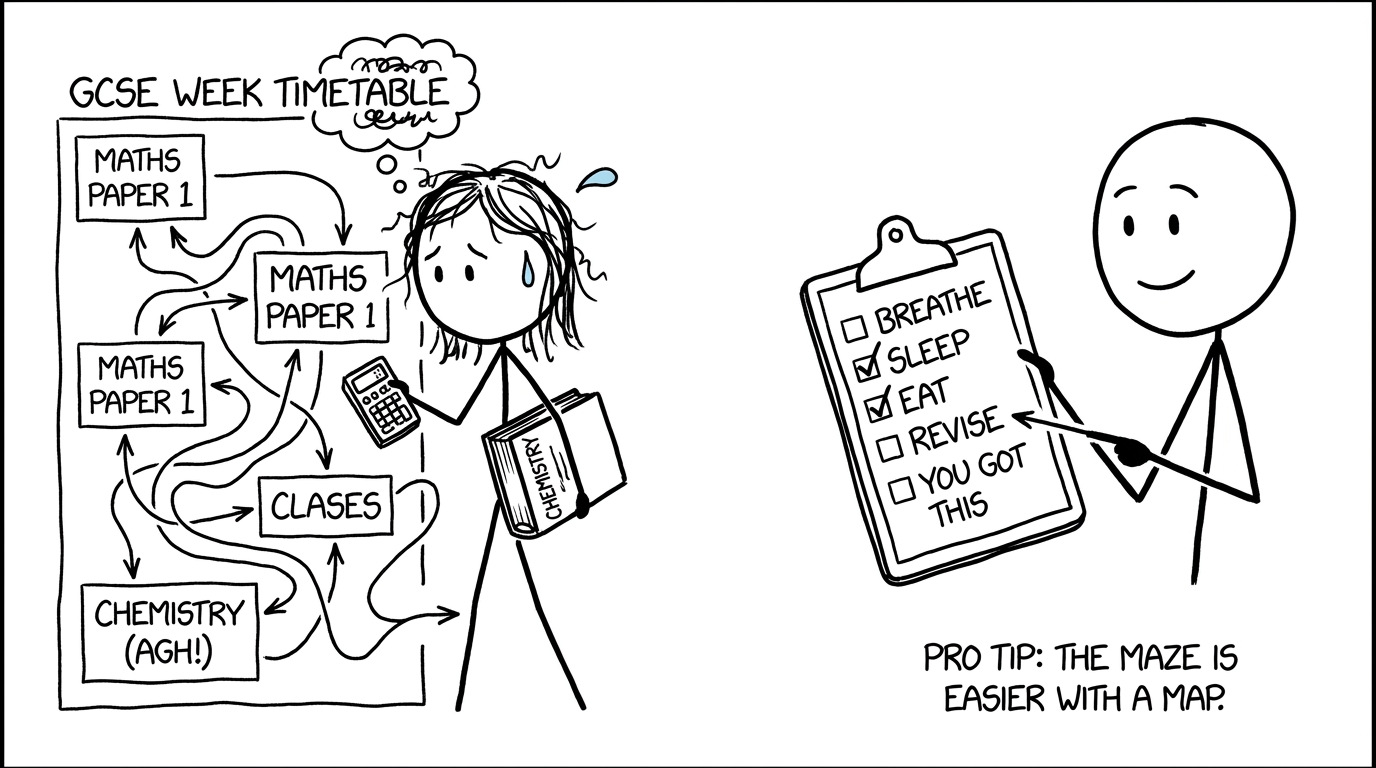 A stressed student in a GCSE timetable maze
GCSE Chemistry exam week checklist (quick version)
Keep this short list somewhere you’ll actually see it during GCSE week:
- Confirm your exam board and tier (AQA, Edexcel, OCR, Eduqas; Combined or Separate).
- Pack the night before: pens, ruler, calculator (still useful), water, clear pencil case.
- Do one timed Chemistry paper section per day (not endless notes).
- Mark using the mark scheme, then write a “fix list” of weak topics.
- Use maths-style error checking: units, sig figs, rearranging formulas, proportional reasoning.
- Sleep as if it counts for marks (because it does).
- On exam morning, do light recall only: definitions, required practicals, key equations.
When you need maths practice in the same week, keep it efficient and exam-shaped: GCSE Past papers, Edexcel GCSE Maths Past Papers, and Edexcel GCSE Maths Predicted Papers.
The night-before routine that protects GCSE marks
The night before a GCSE Chemistry exam isn’t for learning brand-new content. It’s for reducing friction. The smaller your morning decisions are, the more mental space you keep for the paper.
Pack like you’re eliminating future mistakes
Use the same mindset you use before a maths paper: you’re not trying to be brilliant -- you’re trying to be unflustered.
- Two black pens, a pencil, rubber, ruler.
- Calculator fully working (even if Chemistry is mostly non-calculator, you still need arithmetic and rearranging).
- Water bottle and a small snack for after.
- Your candidate number and centre details if your school requires it.
Make a “two-page” plan
Choose exactly two pages of notes to glance at. Think of it like a maths formula sheet you built yourself.
Page 1 ideas:
- Required practical method summaries (variables, control, safety)
- Common definitions (isotope, ion, oxidation, reduction)
Page 2 ideas:
- Equation patterns (combustion, neutralisation, precipitation)
- Key chemistry calculations (moles, concentration, gas volume)
Then stop. GCSE week rewards restraint.
GCSE exam week scheduling for students who also have maths
Exam week often stacks subjects in a way that feels unfair. Your best response is to revise in blocks that match how exams behave.
Use “one timed task + one fix” each day
A simple daily structure:
- Timed task (30-60 mins): one Chemistry section (or one full past paper if you’re close to exam day).
- Fix (20-30 mins): mark it, then redo the worst questions with the mark scheme beside you.
For maths on the same day, keep it similarly exam-shaped:
- Use Resources to choose a short paper or mini test.
- Use the Edexcel GCSE Maths Predicted Papers if you’re close to your maths paper.
- If you need topic practice instead, use a question bank like Eduqas GCSE Maths Question Bank.
This works because you’re practising decisions, not just remembering facts.
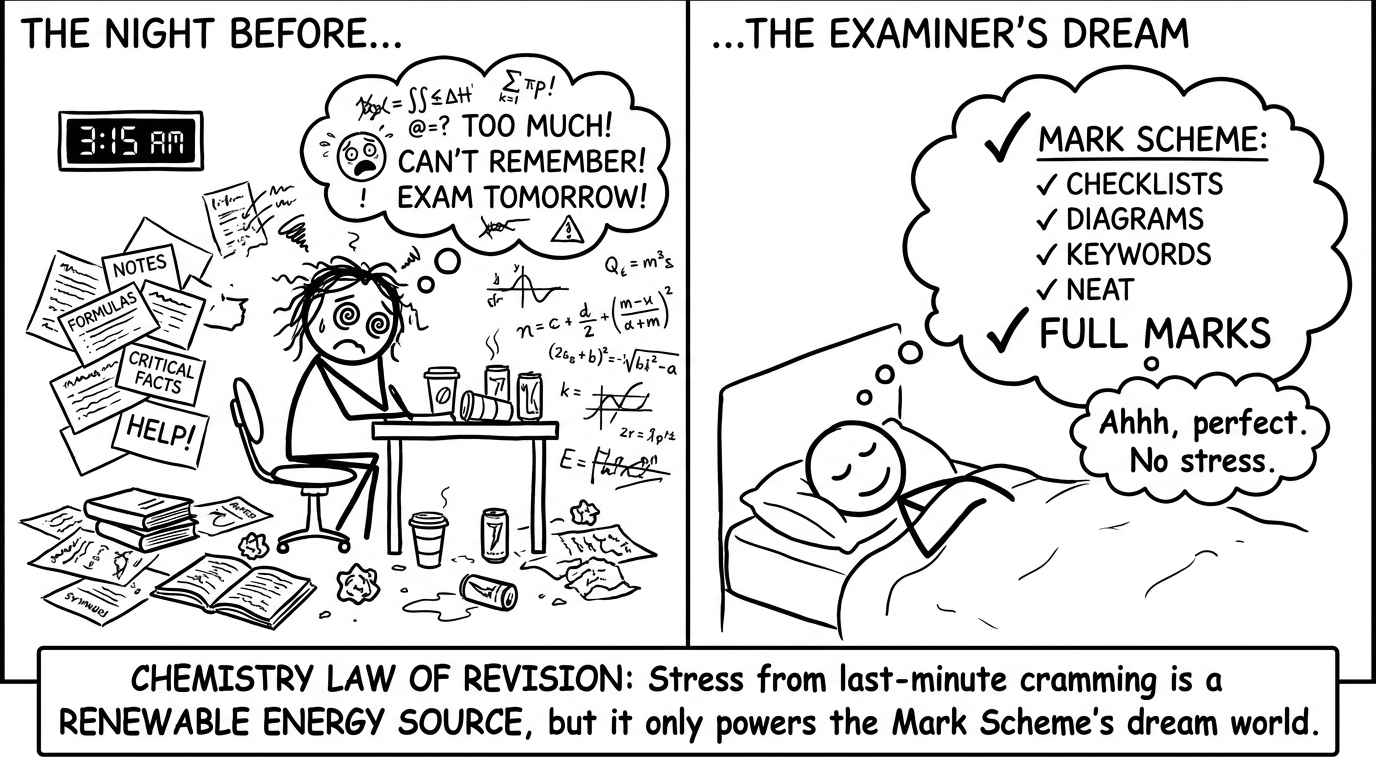 Two students: cramming vs sleeping with a mark scheme tick list
The maths inside GCSE Chemistry: three quick worked methods
If you revise maths, you can gain easy Chemistry marks by treating calculations as familiar processes: substitute, rearrange, check units. Below are three methods that come up again and again across AQA, Edexcel, OCR and Eduqas GCSE Chemistry papers.
Moles from mass
Method:
- Write the formula. 2) Find MrM_rMr. 3) Use n=mMrn = \frac{m}{M_r}n=Mrm.
Example: You have 5.00 g5.00\text{ g}5.00 g of sodium hydroxide, NaOH\text{NaOH}NaOH. Find moles.
Relative formula mass:
Mr=23+16+1=40 M_r = 23 + 16 + 1 = 40 Mr=23+16+1=40Moles:
n=mMr=5.0040=0.125 mol n = \frac{m}{M_r} = \frac{5.00}{40} = 0.125\text{ mol} n=Mrm=405.00=0.125 molMaths-style check: the answer is less than 520=0.25\frac{5}{20}=0.25205=0.25, which makes sense because MrM_rMr is 404040.
Concentration calculations
A common GCSE form is:
c=nV c = \frac{n}{V} c=Vnwhere ccc is concentration in mol dm−3\text{mol dm}^{-3}mol dm−3 and VVV is volume in dm3\text{dm}^3dm3.
Example: 0.200 mol0.200\text{ mol}0.200 mol is dissolved to make 500 cm3500\text{ cm}^3500 cm3 of solution. Find ccc.
Convert volume:
500 cm3=0.500 dm3 500\text{ cm}^3 = 0.500\text{ dm}^3 500 cm3=0.500 dm3Now substitute:
c=0.2000.500=0.400 mol dm−3 c = \frac{0.200}{0.500} = 0.400\text{ mol dm}^{-3} c=0.5000.200=0.400 mol dm−3Maths-style check: dividing by 0.50.50.5 doubles, so 0.20.20.2 becomes 0.40.40.4.
Percentage yield (the “percentages” question in disguise)
Formula:
percentage yield=actual yieldtheoretical yield×100 \text{percentage yield} = \frac{\text{actual yield}}{\text{theoretical yield}} \times 100 percentage yield=theoretical yieldactual yield×100Example: The theoretical yield is 12.0 g12.0\text{ g}12.0 g, actual yield is 9.6 g9.6\text{ g}9.6 g. Find percentage yield.
9.612.0=0.8 \frac{9.6}{12.0} = 0.8 12.09.6=0.8 0.8×100=80% 0.8 \times 100 = 80\% 0.8×100=80%Maths-style check: 9.69.69.6 is four-fifths of 121212, so 80%80\%80% is right.
These questions are where GCSE Chemistry and GCSE maths quietly overlap. During GCSE week, that overlap is your advantage.
How to use mark schemes without losing confidence
A mark scheme can feel blunt. It’s not saying “you’re wrong”. It’s saying “this is what earns marks”. That’s a gift in GCSE exam week because it reduces uncertainty.
Here’s a simple approach:
- First pass: mark strictly. Circle every lost mark.
- Second pass: rewrite the model phrasing for the worst answers (especially 4-6 markers).
- Third pass: make a short “fix list” of topics. No more than five.
Then, when you switch to maths, do the same thing. YesGenie makes this straightforward because you can combine practice with feedback: GCSE Past papers, Edexcel GCSE Maths Past Papers, and timed options via Resources.
Common mistakes in GCSE Chemistry exam week (and how maths students avoid them)
- Forgetting unit conversions: cm3\text{cm}^3cm3 to dm3\text{dm}^3dm3, or g\text{g}g to kg\text{kg}kg. Treat it like a scale factor question.
- Rearranging formulas incorrectly: do it like algebra. If c=nVc=\frac{n}{V}c=Vn, then n=cVn=cVn=cV.
- Rounding too early: keep values until the end, then round appropriately.
- Writing vague practical answers: you need named variables, repeats, control variables, and a clear method.
- Missing command words: “describe” vs “explain” vs “evaluate” matters for marks.
- Cramming the wrong thing: in GCSE exam week, timed questions beat rereading notes.
GCSE exam morning micro-checklist
Your goal is calm accuracy.
- Eat something predictable.
- Arrive early enough that you’re not rushing.
- Do 10 minutes of light recall only (definitions, equations, practical steps).
- If you panic, breathe and write something you know. Momentum matters.
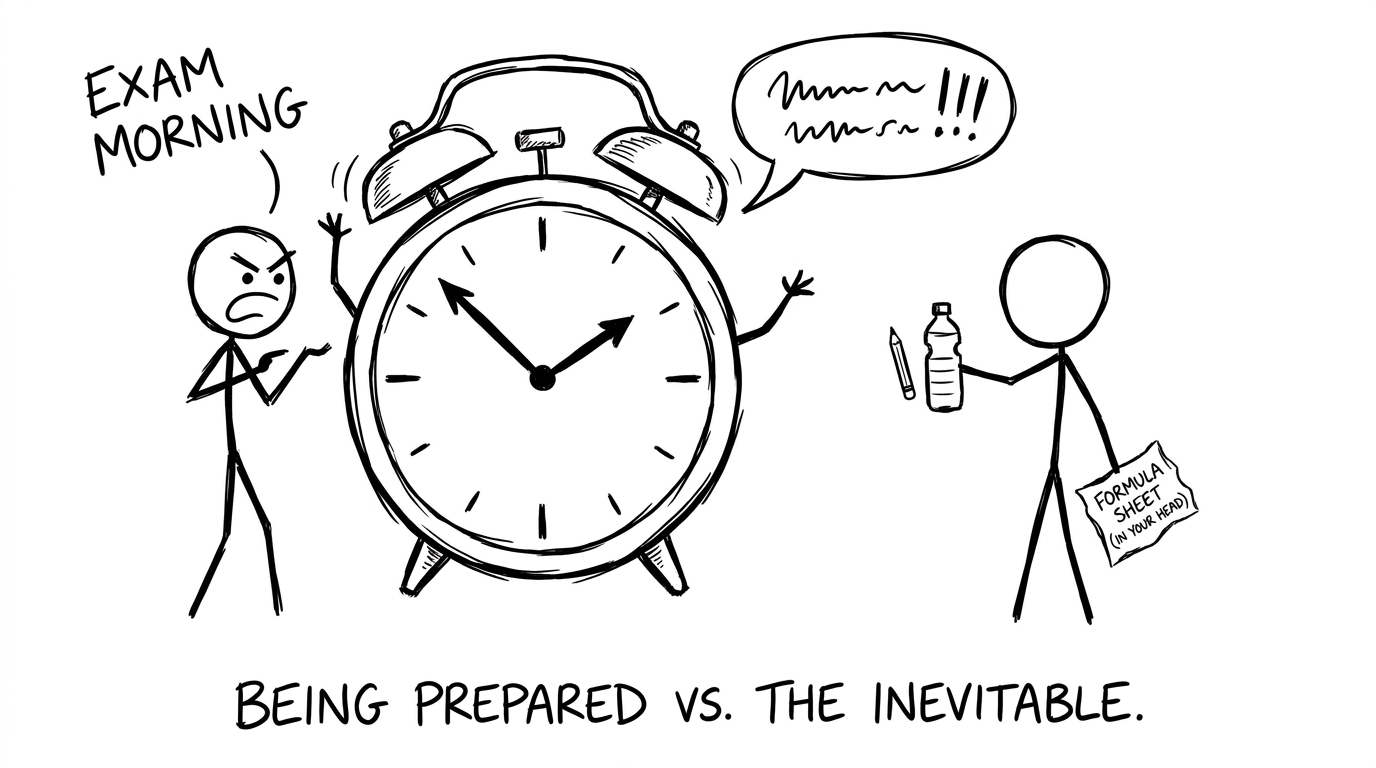 Stick figures arguing with an alarm clock while packing essentials
FAQ
How should I split GCSE Chemistry and GCSE maths revision in the same week?
Split by energy, not by guilt. GCSE exam week is mentally expensive, so you want revision that gives you feedback fast: timed questions, then marking, then a short fix. Chemistry often benefits from short bursts of recall plus exam questions, while maths often benefits from targeted practice on weak topics and then a full paper. If you have both exams close together, alternate: a Chemistry timed section one day and a maths timed section the next, with small maintenance sessions for the other subject. Keep the sessions short enough that you can still sleep, because tired revision tends to create false confidence. For maths practice that fits into a busy week, use Edexcel GCSE Maths Predicted Papers or broader GCSE Past papers so your time matches exam conditions.
What if I don’t know which GCSE Chemistry topics will come up?
That uncertainty is built into GCSE exams, so your strategy should be designed for it. Focus on high-frequency skills that travel across topics: interpreting graphs, balancing equations, moles and concentration, required practical write-ups, and clear explanations using scientific keywords. Use past papers to see the style of questions your exam board prefers, because AQA, Edexcel, OCR and Eduqas can phrase similar content differently. When you mark your work, don’t just note the topic -- note the mistake type (units, wording, missing steps, incorrect rearrangement). Over a few papers, patterns appear, and you can fix them quickly. This mirrors how you improve in maths: you don’t “revise everything”, you remove the mistakes that keep recurring. If you need a reliable maths routine alongside Chemistry, YesGenie’s Resources make it easy to choose short, exam-shaped tasks.
Is it worth doing predicted papers during GCSE exam week?
Predicted papers can be useful if you treat them as exam practice, not as a promise of what will be on the paper. In GCSE exam week, their main value is that they force you to attempt a balanced set of questions under time pressure, which is exactly what the real exam demands. They also give you a structured way to identify gaps when you’re too tired to plan revision from scratch. The risk is over-trusting them and ignoring the specification, so keep your mindset healthy: use them for method practice and timing, then correct using mark schemes. For maths, predicted papers are especially helpful for building confidence with the layout and pacing of the exam. If you’re sitting Edexcel, you can use Edexcel GCSE Maths Predicted Papers alongside Edexcel GCSE Maths Past Papers to balance familiarity with realism.
I’m aiming for grades 8-9 -- what should I do differently in GCSE exam week?
At the top end, most gains come from precision. You’re not only learning content -- you’re learning how to communicate it in the way mark schemes reward. In Chemistry, that means exact key terms, clear chains of reasoning, and answers that match the command word. In maths, it means clear method marks, correct algebraic steps, and checking your final answers for reasonableness. During GCSE exam week, prioritise the questions that are most likely to separate grades: longer explanations in Chemistry and multi-step problem-solving in maths. Do timed practice, but spend extra time analysing lost marks and rewriting solutions so the improvements stick. YesGenie helps here because you can quickly move from practice to feedback, using past papers and predicted papers, then repeat with purpose.
A calm finish: use GCSE week like a systems test
GCSE exam week isn’t a character test. It’s a systems test. When you rely on a checklist, you don’t need to feel ready to act ready. You just follow the next step: one timed section, one mark scheme review, one fix list.
And if you’re revising maths at the same time, let YesGenie carry the structure. Use the free revision lessons and topic practice when you’re patching gaps, then switch to exam conditions with GCSE Past papers, Edexcel GCSE Maths Past Papers, and Edexcel GCSE Maths Predicted Papers. GCSE success is rarely about doing more -- it’s about doing the right things when time is tight.