

GCSE Chemistry OCR Revision: Stop Wasting Time
GCSE Chemistry OCR revision without wasted time: use maths-style methods, exam questions, and mark schemes to boost marks efficiently and calmly.
GCSE revision can feel like walking into the exam hall carrying a bin bag full of notes you never opened. You’ve highlighted everything, re-read everything, and still don’t feel ready. If you’re an OCR student revising GCSE Chemistry, that panic often comes from one simple problem: your revision isn’t producing marks. The good news is that you already have a proven system for marks sitting right next to your Chemistry folder -- the way you revise maths.
Maths revision works because it’s measurable. You do questions, you check a mark scheme, you fix the method, and you repeat. This post shows how to revise OCR GCSE Chemistry with that same disciplined rhythm, so you stop spending hours “being busy” and start building reliable exam performance.
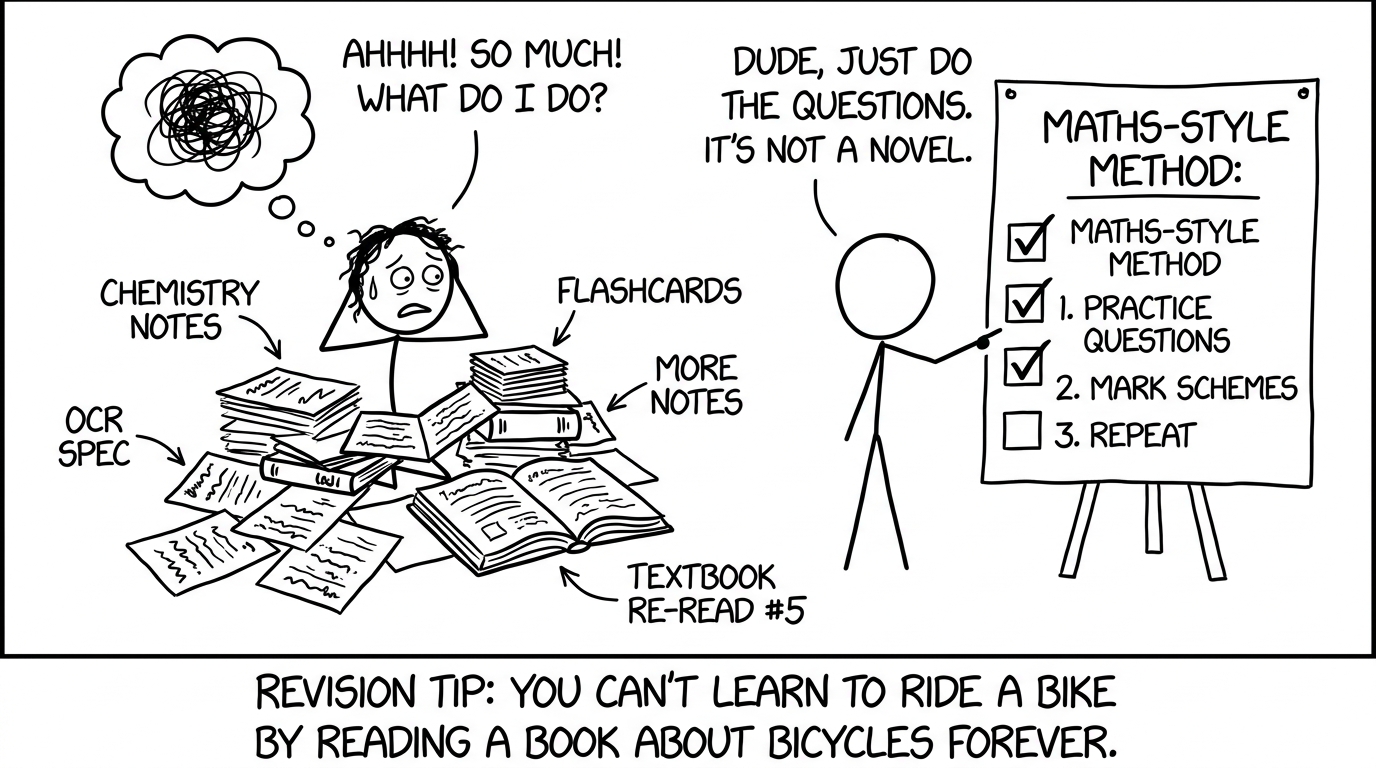 A stressed student finds a calm checklist
The no-waste OCR GCSE Chemistry checklist
Use this as your weekly loop. It is intentionally boring -- because boring is what works in a GCSE exam.
- Clarify the OCR spec topics you’re currently weakest on (not the ones you like).
- Learn the minimum notes needed to answer questions (definitions, key equations, required practicals).
- Do exam-style questions under light time pressure.
- Mark with a mark scheme and correct in a “mistake log”.
- Retest after 48 hours using short, mixed questions.
For the maths side of your timetable, keep your momentum going with YesGenie’s topic resources, then mirror the same structure in Chemistry:
- GCSE Past papers
- Edexcel GCSE Maths Mini Tests
- Edexcel GCSE Maths Predicted Papers
- Resources hub (mini tests, predicted papers and more)
- GCSE Maths Starters (quick warm-ups)
Even if those pages are maths-specific, the underlying method is what you’re borrowing for OCR GCSE Chemistry.
Why OCR GCSE Chemistry revision wastes time (and how maths fixes it)
Most wasted GCSE revision time comes from activities that feel productive but don’t create exam-ready recall:
- Re-reading notes until they feel familiar.
- Copying the OCR specification into prettier language.
- Watching videos without stopping to answer anything.
- Making flashcards you never properly test.
Maths revision rarely falls into that trap because you can’t “feel” your way to an answer. You either get the marks or you don’t. That same clarity is available in OCR GCSE Chemistry if you treat each topic as a method.
A useful mindset shift is this:
- In maths, you don’t revise “algebra”. You revise solving equations, factorising, rearranging formulae.
- In OCR GCSE Chemistry, don’t revise “bonding”. Revise explaining ionic bonding, drawing dot-and-cross diagrams, linking structure to properties.
The more you turn broad topics into small, mark-winning moves, the less time you waste.
Build an OCR GCSE Chemistry plan the way you build a GCSE maths plan
A calm plan is not a long plan. For GCSE, your plan should be short enough to follow on a tired Wednesday night.
Step one: choose the “highest-return” topics
In maths, your grade often moves when you fix a handful of topics you keep dropping marks on. Chemistry is the same. OCR papers repeatedly reward:
- Required practicals (method, variables, accuracy, safety)
- Calculations (moles, concentration, gas volumes, energy changes)
- Core explanations (particle model, bonding, rates, equilibrium)
So when you plan, don’t ask “What haven’t I revised?” Ask “Where am I currently losing the easiest marks?”
Step two: timebox the revision
A timebox is a promise: “I will do 25 minutes of questions, then stop.” It prevents you from spending 2 hours perfecting notes.
A simple GCSE weekly pattern:
- 3 short Chemistry sessions: learn a micro-topic + do questions
- 1 longer session: timed practice + mark scheme + fix mistakes
Keep your maths ticking over with one focused resource at a time (a mini test, a topic booklet, or a predicted paper). The YesGenie Resources hub is designed for exactly that kind of structured practice.
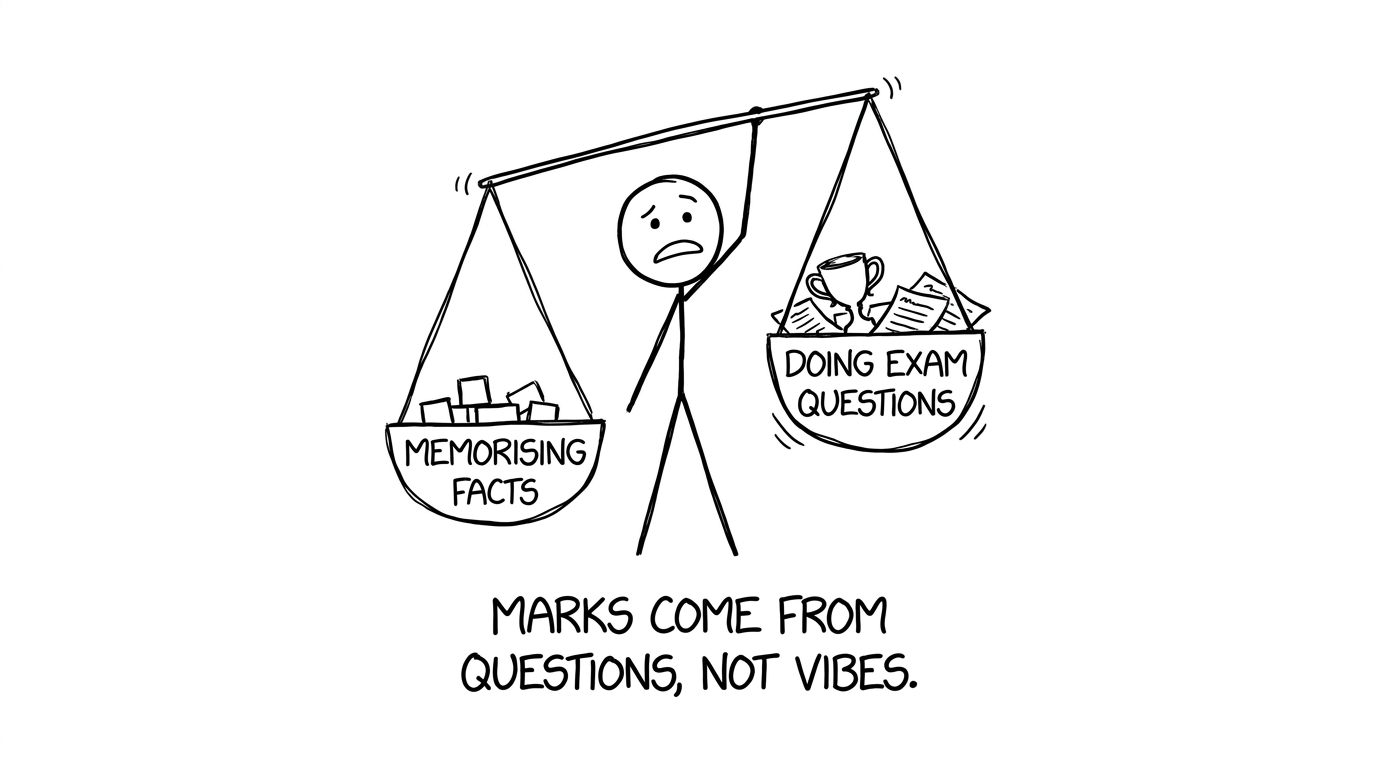 Scales tip towards exam questions
Use maths as your secret weapon in OCR GCSE Chemistry calculations
OCR GCSE Chemistry contains a surprising amount of GCSE maths. Students often lose marks not because they don’t “know Chemistry”, but because the calculation method isn’t automatic.
Below are a few worked examples written like a maths solution -- clear steps, correct units, no leaps.
Worked example: moles from mass
Question: Calculate the amount of substance in moles when 5.00 g5.00\text{ g}5.00 g of sodium hydroxide (NaOH\text{NaOH}NaOH) is used. Ar(Na)=23A_r(\text{Na})=23Ar(Na)=23, Ar(O)=16A_r(\text{O})=16Ar(O)=16, Ar(H)=1A_r(\text{H})=1Ar(H)=1.
Method: n=mMrn = \frac{m}{M_r}n=Mrm.
First find relative formula mass:
Mr(NaOH)=23+16+1=40. M_r(\text{NaOH}) = 23 + 16 + 1 = 40. Mr(NaOH)=23+16+1=40.Now calculate moles:
n=5.0040=0.125 mol. n = \frac{5.00}{40} = 0.125\text{ mol}. n=405.00=0.125 mol.Exam habits that win marks: state the equation, show MrM_rMr, include units.
Worked example: concentration
Question: 0.20 mol0.20\text{ mol}0.20 mol of solute is dissolved to make 250 cm3250\text{ cm}^3250 cm3 of solution. Find the concentration in mol dm−3\text{mol dm}^{-3}mol dm−3.
Convert volume:
250 cm3=0.250 dm3. 250\text{ cm}^3 = 0.250\text{ dm}^3. 250 cm3=0.250 dm3.Use c=nVc = \frac{n}{V}c=Vn:
c=0.200.250=0.80 mol dm−3. c = \frac{0.20}{0.250} = 0.80\text{ mol dm}^{-3}. c=0.2500.20=0.80 mol dm−3.Worked example: percentage yield
Question: The theoretical yield is 12.0 g12.0\text{ g}12.0 g. The actual yield is 9.0 g9.0\text{ g}9.0 g. Calculate the percentage yield.
Percentage yield=actualtheoretical×100 \text{Percentage yield} = \frac{\text{actual}}{\text{theoretical}} \times 100 Percentage yield=theoreticalactual×100 =9.012.0×100=75%. = \frac{9.0}{12.0} \times 100 = 75\%. =12.09.0×100=75%.This is GCSE maths: fractions, conversion, tidy working. You don’t need flair -- you need consistency.
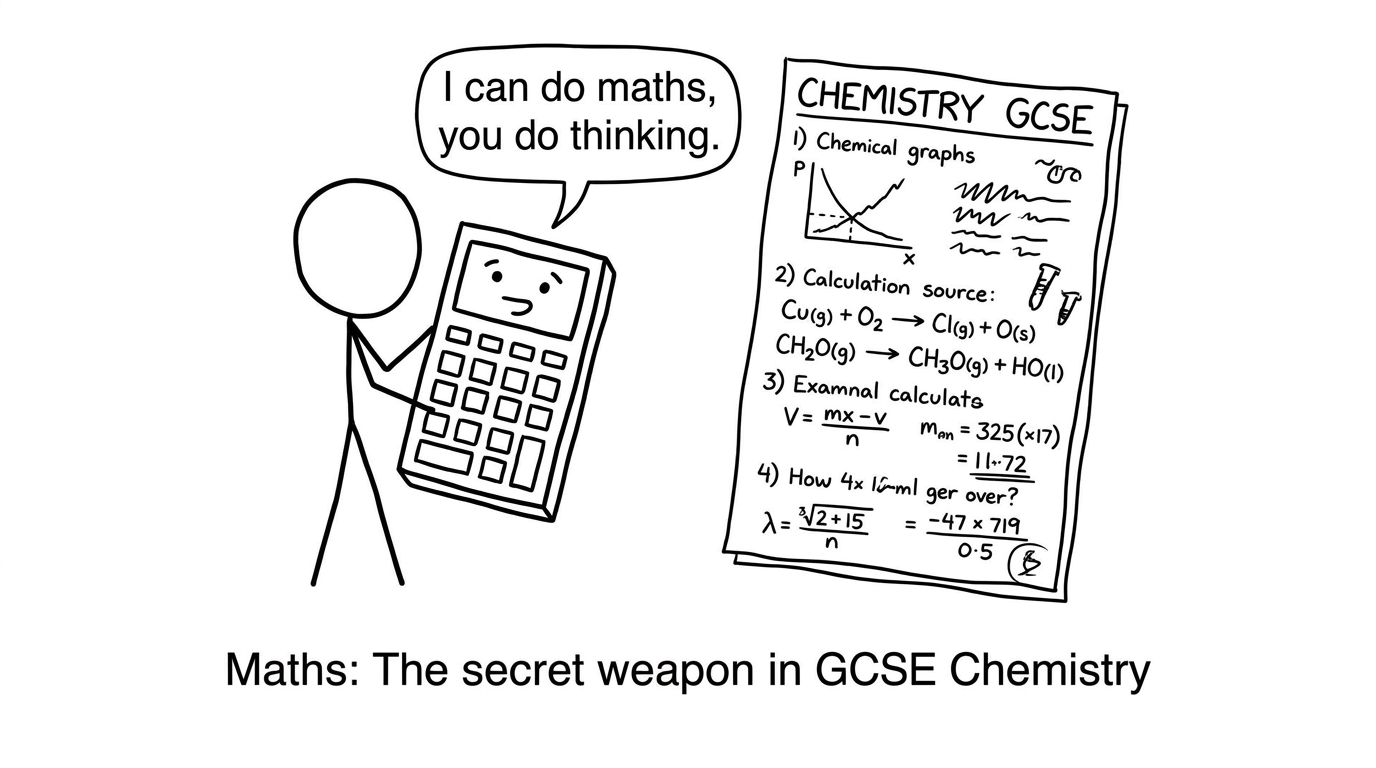 Calculator reminds you to think
How to do OCR GCSE Chemistry required practicals without memorising essays
Required practicals are where students waste time writing paragraphs that never match the mark scheme. Instead, revise practicals in “mark blocks”, like you would revise a maths method.
For each practical, you should be able to answer these quickly:
- Aim (one sentence)
- Independent variable, dependent variable, and control variables
- Apparatus (only what matters)
- Method (bullet points, not story time)
- How to improve accuracy/reliability (repeat, average, control temperature, use more precise apparatus)
- Safety (hazards linked to chemicals/equipment)
A strong technique is to write a 6-line “model answer skeleton” for each required practical, then practise rebuilding it from memory. This is identical to remembering the steps for iteration or rearranging formulae in GCSE maths.
If you’re already used to learning methods from worked examples on YesGenie, that skill transfers. For instance, maths topics like iteration reward a fixed routine you can repeat under pressure -- see the structure on Iteration (GCSE Maths OCR).
The best way to use exam questions for OCR GCSE Chemistry
If you only remember one line, make it this:
Your OCR GCSE Chemistry revision should be built out of exam questions, not built up to them.
A practical weekly system:
Do “closed book” questions first
Read the question and attempt it without notes. Even if you get it wrong, you learn faster because your brain is forced to search.
Mark like a mathematician
In maths, you mark by method: you compare each step. Do the same in Chemistry:
- Did you use the correct key term (e.g. “electrostatic attraction”)?
- Did you link cause to effect (structure →\to→ property)?
- Did you include units?
- Did you answer exactly what was asked (compare, explain, calculate)?
Fix one thing at a time
After marking, write one “next time” sentence. Example:
- “Next time I will state that ionic compounds conduct when molten because ions are free to move.”
That sentence is your method. Your next set of questions is where you apply it.
To keep your maths exam technique sharp alongside Chemistry, use structured paper practice like:
The point isn’t the exam board -- it’s the habit: timed work, mark scheme feedback, repeat.
Common mistakes OCR GCSE Chemistry students make (that waste GCSE revision time)
- Revising what you enjoy, not what loses marks. Your confidence grows, but your grade doesn’t.
- Learning definitions without practising application. OCR questions often disguise familiar content in unfamiliar contexts.
- Ignoring command words. “Explain” needs linked reasoning, “describe” needs clear steps, and “compare” needs similarities and differences.
- Dropping units or significant figures in calculations. This is an easy GCSE mark giveaway.
- Writing practical methods as narratives. Mark schemes reward specific variables, controls, and improvements.
- Not reviewing mistakes. If you don’t keep a mistake log, you’re paying for the same lesson repeatedly.
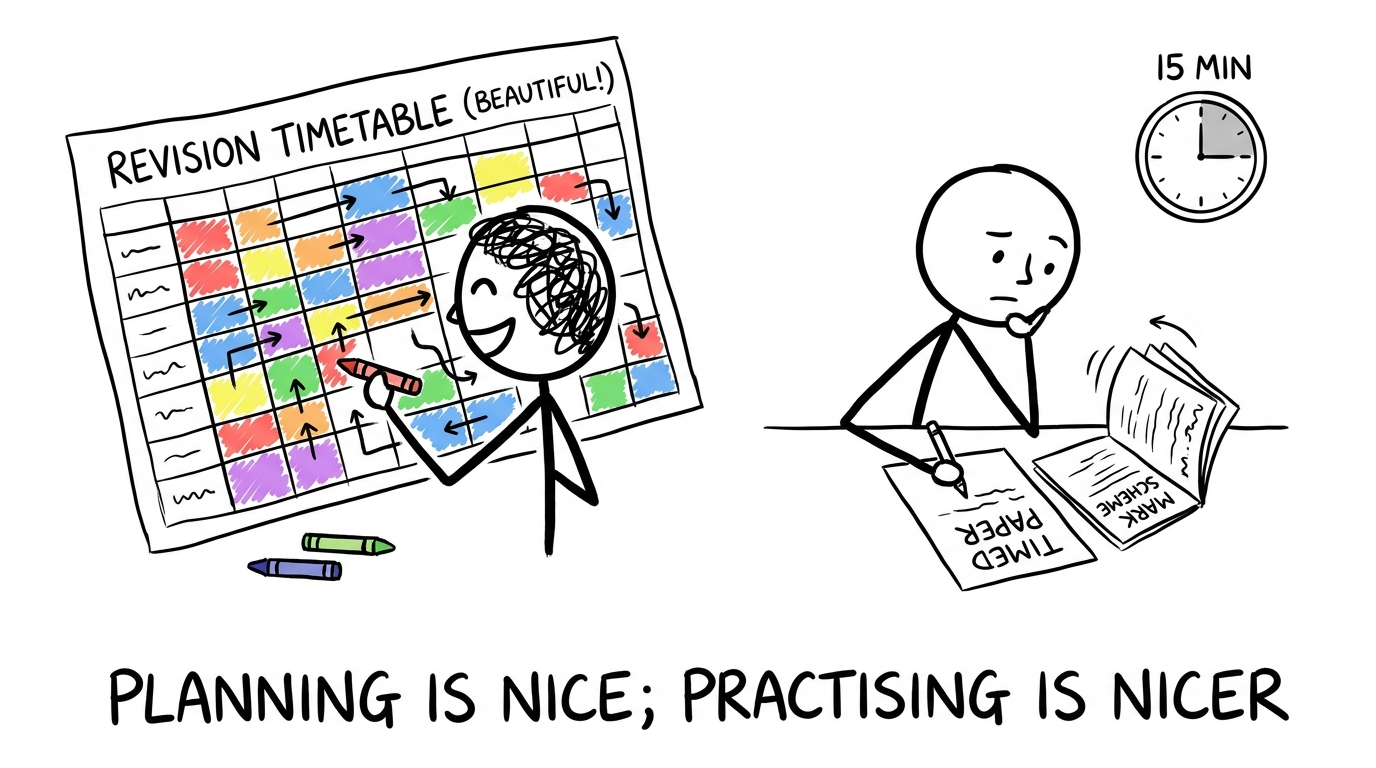 Planning vs practising
FAQ: OCR GCSE Chemistry revision without wasted time
How many hours of GCSE Chemistry revision do I need for OCR?
Hours matter less than feedback. Two students can both do 10 hours of GCSE revision, but the one who marks properly and fixes mistakes will improve far faster. For OCR GCSE Chemistry, aim for three to five short sessions a week rather than one long weekend grind, because memory strengthens through spacing. Each session should include a small piece of learning and then exam-style questions, so you can see if the learning actually works. If you’re close to exams, swap some note-based time for timed question practice, because that’s where marks come from. Keep a record of what you got wrong and revisit it, otherwise you’ll keep revising the same content without improving. If you want a model for structured practice, look at how you improve in GCSE maths using short tests and papers on YesGenie, like the Edexcel GCSE Maths Mini Tests.
What’s the fastest way to revise OCR GCSE Chemistry without forgetting it?
The fastest way is active recall plus spaced repetition, but in an exam format rather than a pretty-notes format. Start by trying to answer a question or explain a process from memory, then check what the mark scheme actually rewards. When you correct it, write a short “method line” you can reuse, such as “rate increases because particles have more kinetic energy so there are more successful collisions per second”. Return to that same idea 48 hours later with a different question so you’re not just memorising the wording. This is the same logic as GCSE maths: you don’t just read about rearranging formulae, you practise it across multiple questions until it sticks. The key is that forgetting a little in between sessions is not failure -- it’s the point, because it forces stronger retrieval next time. Done well, this approach reduces total hours because your revision becomes more efficient.
I’m good at GCSE maths but Chemistry feels wordy -- how do I use my strengths?
Treat Chemistry explanations like proofs: short, structured, and logically linked. Most OCR GCSE Chemistry “wordy” marks are for specific scientific terms and clear cause-and-effect, not for long paragraphs. Build a template for common explanation types: bonding and properties, particle model, rates, equilibrium, and required practical evaluation. Then practise applying the template to different questions, just like you apply the same maths method to different numbers. Your maths strength also helps with proportional reasoning, graphs, gradients, and unit conversions, which often separate grades 6-9 from the middle. If you’re used to checking methods with mark schemes in maths, bring that same discipline to Chemistry: compare your answer to the mark scheme and identify the missing key phrase or link. Keep your overall GCSE momentum by continuing regular maths practice with resources like GCSE Past papers and timed options from the Resources hub.
Bringing it together: an OCR GCSE Chemistry revision routine that actually earns marks
There’s a quiet relief that comes when revision stops being a moral test and becomes a system. You don’t have to be the kind of person who “loves Chemistry” to do well in OCR GCSE Chemistry. You just have to stop wasting time on activities that don’t produce marks, and start doing the work that does: short learning, lots of questions, ruthless marking, and targeted re-attempts.
If you’re a UK student already revising GCSE maths (or moving into A Level maths), you’ve seen this process succeed. YesGenie exists to make that process easier: clear revision lessons, practice questions, mark schemes, video solutions, mini tests, past papers, and predicted papers -- all organised so you can practise efficiently.
Keep your timetable simple this week: choose one OCR Chemistry topic, do questions, mark them, fix the method, and repeat. Then do the same tomorrow. For your maths sessions alongside Chemistry, start with GCSE Past papers, build confidence with mini tests, and sharpen exam readiness with predicted papers. That’s GCSE revision without the wasted time -- and it’s how marks quietly build.