

GCSE revision without nagging: an Eduqas parent guide
GCSE parent guide for Eduqas: support maths revision without nagging. Use routines, past papers, mini tests and calm check-ins to boost grades.
Parents usually start nagging for a good reason: they can see the GCSE clock ticking, and they know maths isn’t a subject you can cram in one heroic weekend. Students feel the same pressure, but from the inside. It’s not laziness so much as overwhelm -- a pile of topics, a fear of getting it wrong, and a quiet question: where do I even begin? This guide is for Eduqas families who want progress without conflict. You’ll see how to turn GCSE maths revision into something practical, calm, and measurable, using YesGenie resources that make the next step obvious.
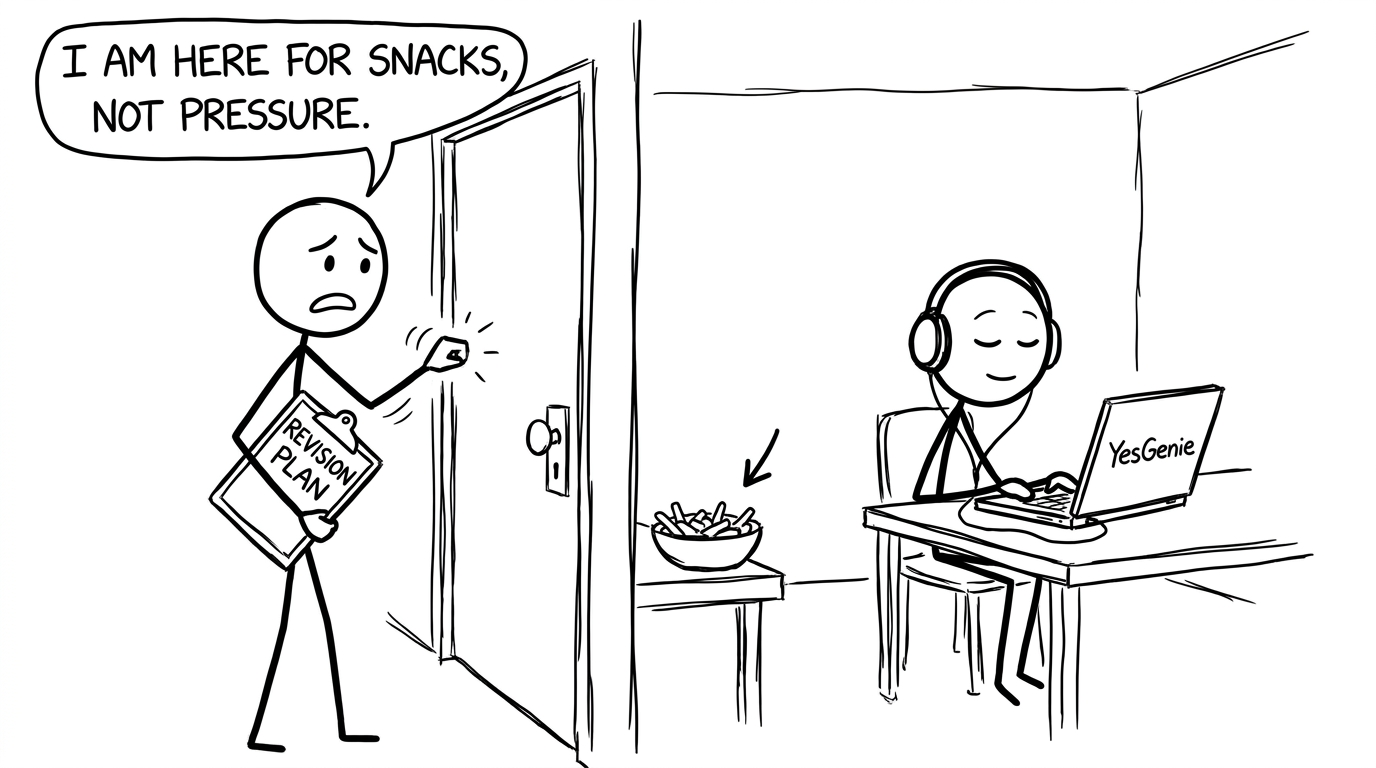 Parent outside the door with snacks, not pressure
The no-nag checklist (what actually helps GCSE maths revision)
If you remember nothing else, remember this: the job isn’t to create motivation from scratch. The job is to reduce friction.
- Agree a small routine that happens even on “bad” days (consistency beats intensity for GCSE maths).
- Make the next task tiny and specific (one topic, one method, one paper section).
- Use external structure: topic lists, mini tests, mark schemes, and worked solutions.
- Review marks like a coach, not a judge: “what will we do differently next time?”
- Keep revision visible but not invasive: a shared plan, not a running commentary.
For Eduqas, start with the right hub so you’re not hunting around: Eduqas GCSE Maths Revision.
Why nagging fails (and what to do instead)
Nagging is a strange kind of optimism. It assumes the problem is a lack of reminders. But most GCSE students already have reminders everywhere: school, homework apps, teachers, friends, mock grades, and their own conscience at 11:37pm.
What they often lack is clarity. If your child sits down and thinks “I’m bad at algebra”, that’s not a plan. A plan is: “Tonight I’ll practise solving linear equations, mark it, then redo the two question types I missed.”
A parent’s best role is to help shrink the problem into something that can be completed in 202020 to 303030 minutes. The moment revision becomes finishable, it becomes repeatable.
The ‘one calm question’ rule
Instead of “Have you revised?”, try one calm, specific question:
- “What’s the one topic you’re focusing on today for GCSE maths?”
- “Do you want questions or a past paper section?”
- “What did you lose marks on last time?”
This shifts revision from mood to method.
Eduqas GCSE revision that feels structured (without controlling everything)
Eduqas GCSE Maths is assessed over papers that reward method marks as much as final answers. That’s good news: students can improve quickly by writing clearer working, choosing the right method, and avoiding predictable errors.
Your goal as a parent is not to teach the entire specification. Your goal is to provide:
- a place to start,
- a way to practise,
- a way to mark,
- a way to improve.
YesGenie does that in one place:
- Start with targeted practice: Eduqas GCSE Maths Question Bank
- Move to exam practice: Eduqas GCSE Maths Past Papers
- If you need a general directory for GCSE resources (useful if friends are on other boards): GCSE Past Papers (all boards)
A simple weekly routine parents can support (GCSE friendly)
A routine works when it’s boring. Boring means it happens.
Two weekday sessions (short and predictable)
- 252525 minutes: one topic lesson or revision guide
- 151515 minutes: topic questions
- 555 minutes: write “next time I will…”
You don’t need to supervise. You can simply protect the time (quiet house, phone away, snack ready, no surprise chores).
One weekend session (exam-style)
- One past paper section (or a full paper later in the year)
- Mark it using the mark scheme
- Choose 333 “fix questions” to redo carefully
A strong weekend habit can carry an entire GCSE grade improvement.
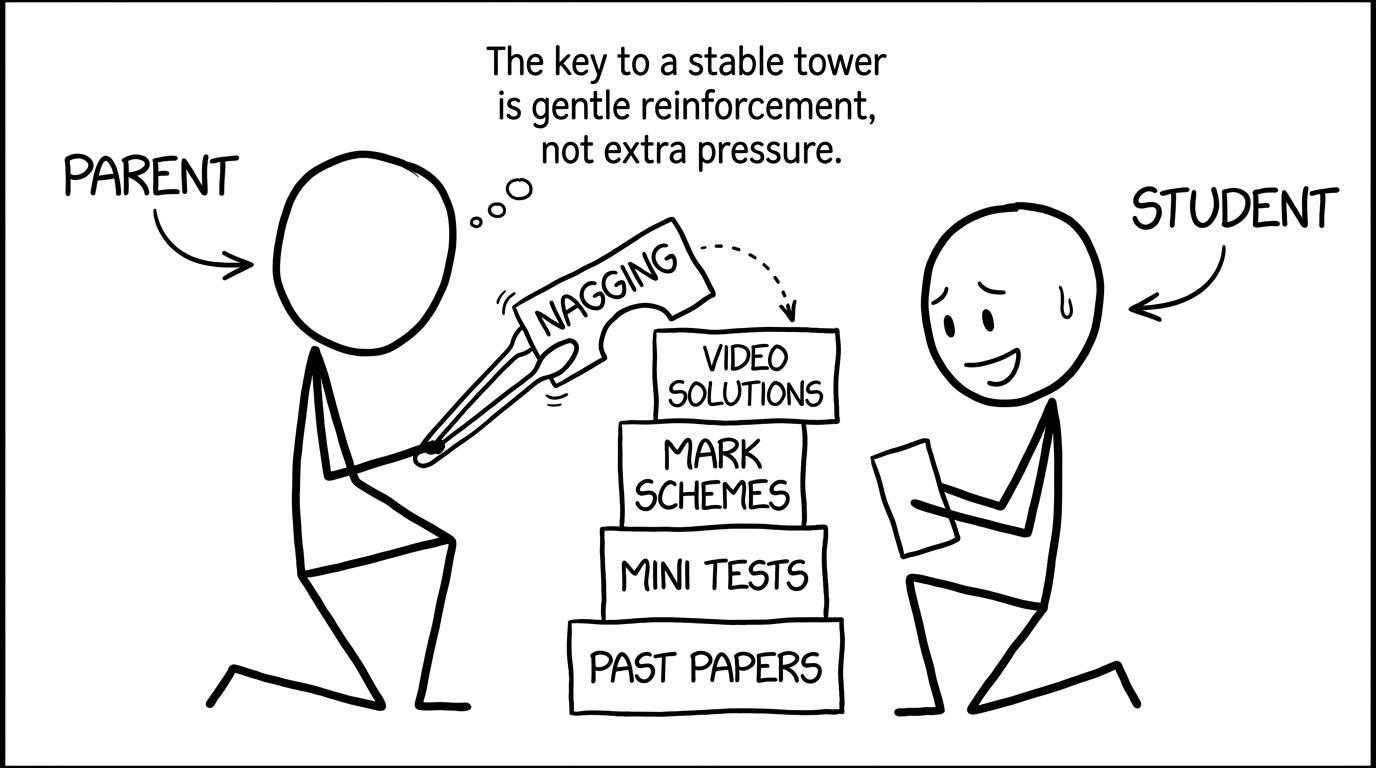 Building a revision tower while removing “nagging”
Worked examples you can use to support without teaching
You don’t need to be a maths expert to help with GCSE maths revision. You just need a shared language: method, marks, checking.
Below are three common GCSE methods. As a parent, your job is to ask: “Which step is this?” and “How will you check it?”
Linear equations (method marks matter)
Solve 3x−7=203x - 7 = 203x−7=20.
3x−7=203x - 7 = 203x−7=20Add 777 to both sides:
3x=273x = 273x=27Divide both sides by 333:
x=9x = 9x=9Check by substitution:
3(9)−7=27−7=203(9) - 7 = 27 - 7 = 203(9)−7=27−7=20Parent support prompt: “Show me the line where you did the same thing to both sides.” That’s how GCSE examiners award method marks.
Percentage change (the ‘multiplier’ approach)
A calculator is allowed on many papers, but the method still matters. Increase £240240240 by 12%12\%12%.
Multiplier for an increase of 12%12\%12% is 1.121.121.12.
240×1.12=268.8240 \times 1.12 = 268.8240×1.12=268.8So the new amount is £268.80268.80268.80.
Parent support prompt: “Did you choose 1.121.121.12 (increase) or 0.880.880.88 (decrease)?” This catches a huge number of GCSE errors.
Angles on a straight line and in triangles
If angles on a straight line add to 180∘180^\circ180∘, and one angle is 47∘47^\circ47∘, then the other is:
180∘−47∘=133∘180^\circ - 47^\circ = 133^\circ180∘−47∘=133∘If a triangle has angles 58∘58^\circ58∘ and 73∘73^\circ73∘, the third angle is:
180∘−(58∘+73∘)=180∘−131∘=49∘180^\circ - (58^\circ + 73^\circ) = 180^\circ - 131^\circ = 49^\circ180∘−(58∘+73∘)=180∘−131∘=49∘Parent support prompt: “What total are you aiming for: 180∘180^\circ180∘ or 360∘360^\circ360∘?” That single question prevents a lot of GCSE slips.
Using past papers without turning your home into an exam hall
Past papers are the fastest way to make GCSE revision feel real. But they also trigger panic if students treat every paper like a final judgement.
Here’s a calmer approach:
Paper as data, not identity
When you mark a paper, separate these:
- Content gap: they didn’t know the topic.
- Process gap: they knew it, but didn’t set it out clearly.
- Careless slip: arithmetic, copying, sign errors.
Then only fix one type at a time. That’s how real improvement works.
If you need a place to start, open an Eduqas paper from Eduqas GCSE Maths Past Papers and agree this family rule: we’re looking for patterns, not perfection.
Mini tests and short sessions (the anti-procrastination tool)
Some days, your child won’t have the energy for a full paper. That’s not the day to force an argument. It’s the day to use a short win.
YesGenie mini tests are designed for exactly this kind of GCSE moment: quick recall, small time commitment, immediate feedback.
- Browse: GCSE Mini Tests
- If your child is with Edexcel (common in England) but you want the same idea: Edexcel GCSE Maths Mini Tests
You can also use a starter task as a five-minute warm-up before a longer session: GCSE Starter Tasks.
Common mistakes that cause GCSE marks to leak away
These are the moments where parents can help most, because they’re not “hard topics” -- they’re habits.
- Not showing working: even if the final answer is wrong, clear steps can earn method marks in GCSE maths.
- Cancelling terms instead of factors: students try to simplify x+3x\frac{x+3}{x}xx+3 by “cancelling the xxx”, which is invalid because x+3x+3x+3 is a sum, not a factor.
- Forgetting brackets with negatives: substituting x=−2x=-2x=−2 into x2x^2x2 and writing −22=−4-2^2=-4−22=−4 (instead of (−2)2=4(-2)^2=4(−2)2=4).
- Rounding too early: rounding intermediate steps and drifting away from the correct answer.
- Calculator trust: typing mistakes and accepting the first number without estimation.
- Not reading the command word: “show that”, “estimate”, “give your answer to 333 significant figures” are mark instructions, not decoration.
A calm parent sentence that helps: “Let’s look at the mark scheme together and see what it rewards.”
What to say instead of nagging (phrases that keep GCSE revision moving)
- “Do you want me to time 252525 minutes so you can focus?”
- “Which topic is most likely to come up again?”
- “After you mark it, pick two questions to redo slowly.”
- “Let’s make tomorrow easier -- what’s the first task you’ll do?”
These sentences do something subtle: they assume revision is happening, and they only negotiate how.
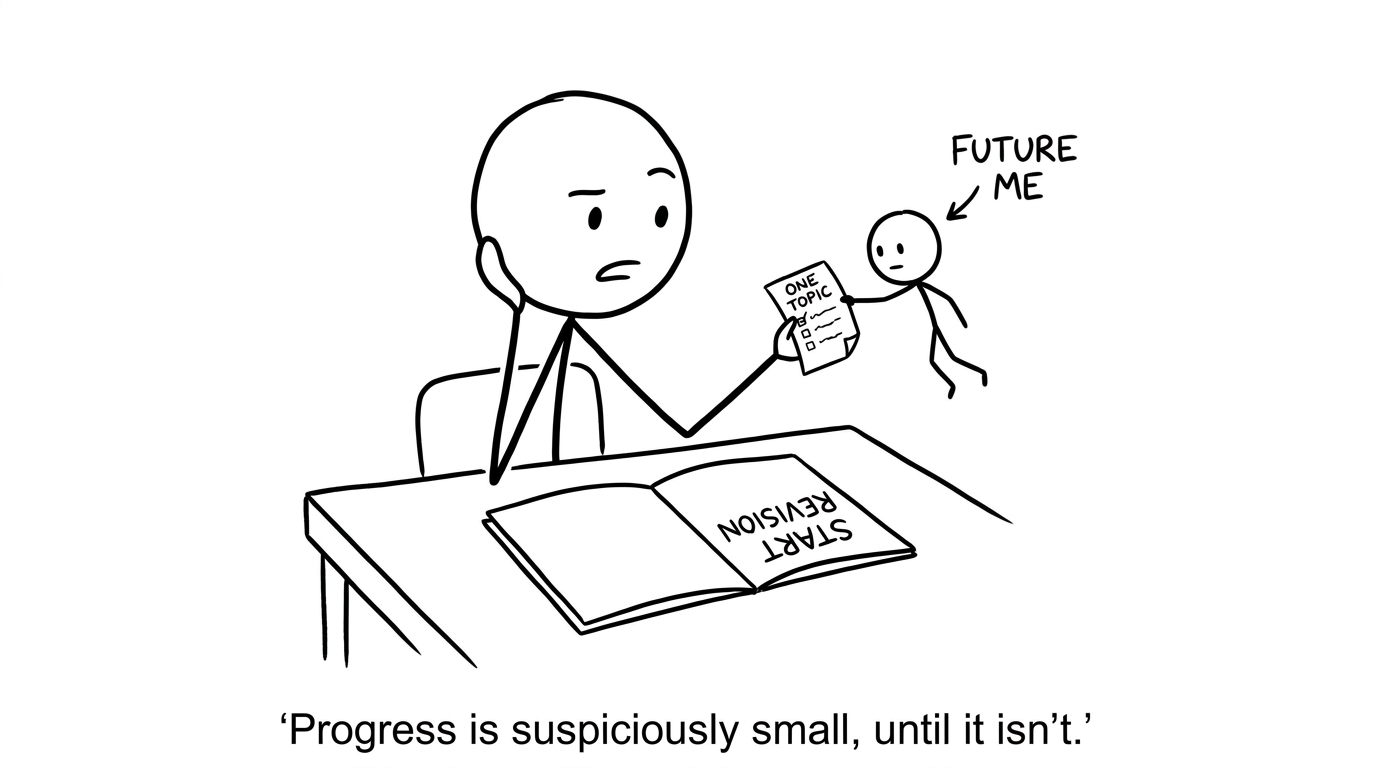 Future Me offers a tiny checklist titled “One Topic”
FAQ (Eduqas and GCSE revision support)
How can I support GCSE maths revision if I’m not confident at maths?
You don’t need to be able to solve every GCSE question to be useful. Your value is in structure: helping your child choose a topic, practise it, and then review what went wrong. You can sit beside them with the mark scheme and ask them to explain each step in plain English, because explanation is a form of checking. If they get stuck, you can point them to a worked solution or a revision guide rather than trying to invent a method on the spot. On YesGenie, students can practise with exam-style questions and then compare their approach to the solutions, which removes the pressure on you to be the expert. Over time, your child learns that revision is a process they can repeat, not a performance they have to perfect.
How much GCSE revision should my child do each week for Eduqas maths?
There isn’t a single magic number, because what matters is whether revision is deliberate and marked. A common sweet spot is 333 to 555 focused sessions per week, with one longer session for exam practice when you can manage it. For Eduqas, make sure your child practises both non-calculator thinking and calculator fluency, because GCSE papers often test method alongside computation. If your child is on foundation tier, consistency on core number, algebra, and geometry topics can quickly lift their grade. If they are on higher tier, the same routine works but with more time spent on multi-step problem solving and accuracy under time pressure. Using Eduqas GCSE Maths Question Bank during the week and Eduqas GCSE Maths Past Papers at weekends creates a natural loop of learn -- practise -- assess.
What should we do after a bad GCSE mock result without making things worse?
Start by treating the mock like a diagnostic, not a verdict. A bad result usually means one of three things: missing topics, weak exam technique, or poor recall under pressure, and the fix depends on which one it is. Sit down together for 202020 minutes and categorise lost marks into those three buckets, because that turns panic into a plan. Then choose one small priority for the next two weeks, such as “linear graphs and equations” or “percentages and ratio”, and practise it consistently. Use a short routine: one revision guide or lesson, then topic questions, then mark and redo the same style until it feels familiar. When your child sees marks improve on the same question type, confidence returns, and GCSE revision becomes less emotional.
A calm ending: GCSE progress is built, not chased
The best GCSE maths revision rarely looks dramatic. It looks like 252525 minutes on a Tuesday, a few corrected mistakes, a past paper on Sunday, and a growing sense that the exam is knowable. Parents don’t need to nag to create that. They need to help the plan stay simple, the feedback stay kind, and the practice stay consistent.
If you want a clear next step today, open the Eduqas GCSE Maths Revision hub on YesGenie, choose one topic from the question bank, and finish with a marked set of exam-style questions. Then, at the weekend, try one paper from Eduqas GCSE Maths Past Papers and use the mark scheme to spot patterns. GCSE improvement is not about being told off more often. It’s about practising the right things, with the right feedback, often enough that the marks have no choice but to rise.