

GCSE: Turn English Lit Notes into Active Recall
GCSE students: learn how to turn English Literature notes into active recall using maths-style practice, retrieval routines and spaced revision in YesGenie.
A familiar GCSE problem: you’ve got notes, but not marks
Most GCSE revision starts with good intentions and ends with a highlighter. You read your English Literature notes again, you nod along, and you tell yourself you “know it”. Then you open a question and the quotes vanish like they were never yours. If that sounds familiar, you don’t need more notes -- you need active recall.
Here’s the twist: the best way to build active recall for English Literature is to borrow the habits that work in GCSE maths. Maths revision works because it’s built on retrieval (doing questions), feedback (mark schemes), and spacing (coming back again). In this post, you’ll learn how to turn GCSE English Literature notes into active recall without rewriting your folder, and without pretending re-reading is revision.
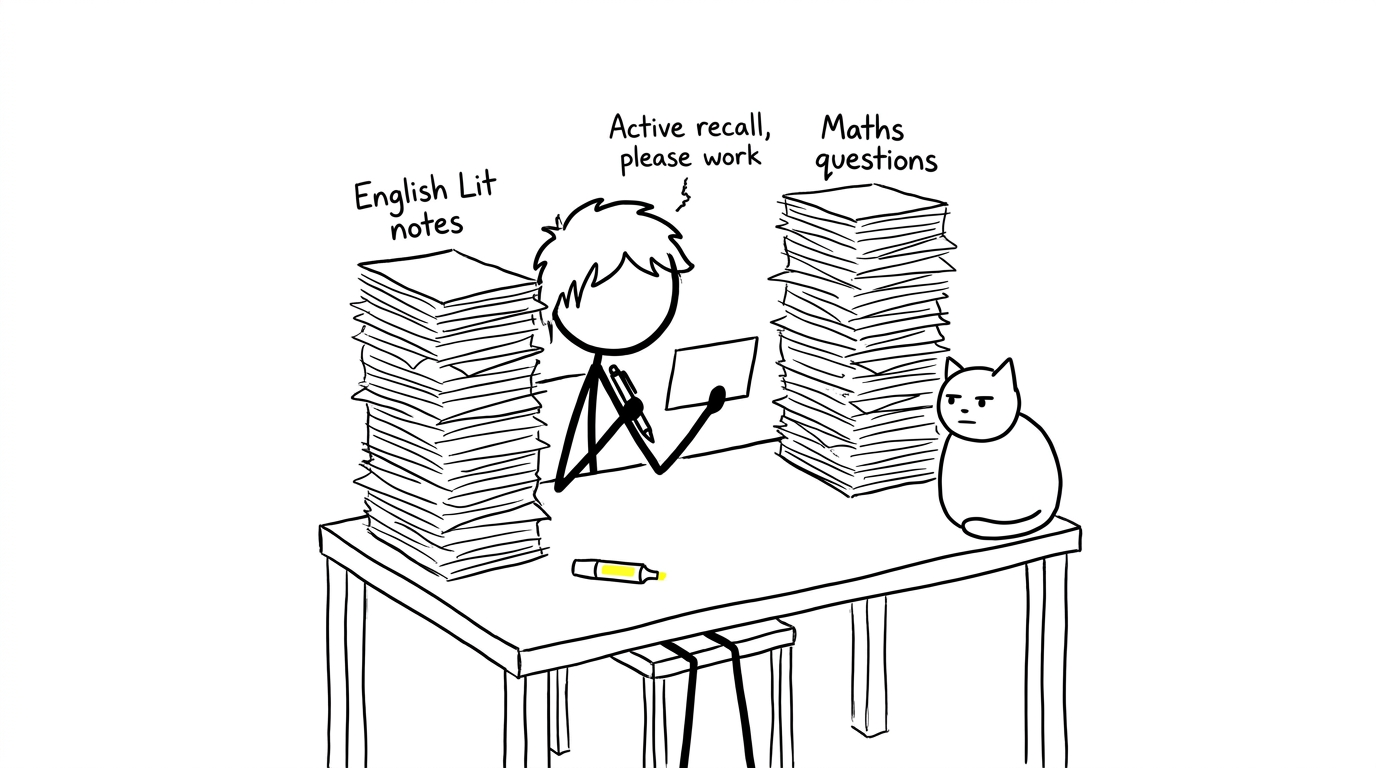 A student with two towering piles of notes and questions, trying active recall
The active recall checklist (steal this from maths)
If you only remember one thing, make it this: notes are storage, not training. Active recall is training.
Use this simple checklist to convert any page of notes into recall practice:
- Reduce each page to a set of prompts (questions you can answer without looking).
- Retrieve from memory first, then check your notes.
- Mark your attempt with something objective (a mini mark scheme).
- Repeat after gaps of time (spaced revision).
- Mix topics (interleaving) so your brain has to choose the right idea.
This is exactly how you’d use GCSE Past papers in maths: attempt, mark, fix, repeat.
Why active recall feels harder in English than maths (and why it isn’t)
English Literature revision often becomes passive because notes look complete. Maths is less forgiving: you either get x=3x=3x=3 or you don’t. In English, you can read an analysis paragraph and think, “Yes, I understand that.” But understanding is not the same as retrieving under pressure.
So we create English versions of maths behaviours:
- A maths question becomes an English prompt.
- A maths method becomes an English paragraph plan.
- A maths mark scheme becomes an English success criteria list.
The goal isn’t to turn English into maths. It’s to turn your English notes into something you can practise.
Turn notes into questions: the “prompt ladder”
A good prompt is one you can answer without peeking. A great prompt has levels so you can scale difficulty.
Take a typical English Literature notes section (theme + quotes + analysis). Convert it into a ladder like this:
Level 1 prompts (facts)
- “Write two quotes about ambition from Macbeth.”
- “Name one method used in the quote.”
Level 2 prompts (meaning)
- “What does the quote suggest about Macbeth’s state of mind?”
- “How does Shakespeare present power in Act 1?”
Level 3 prompts (exam writing)
- “Write a 333-sentence mini paragraph: point, evidence, explain.”
- “Plan a full response in 666 bullet points, including context.”
That ladder is your active recall engine. It’s the English equivalent of moving from a simple substitution question to a harder multi-step problem.
If you want the maths version of this approach, see how topics are broken down into structured practice on Edexcel GCSE Maths Revision Guides.
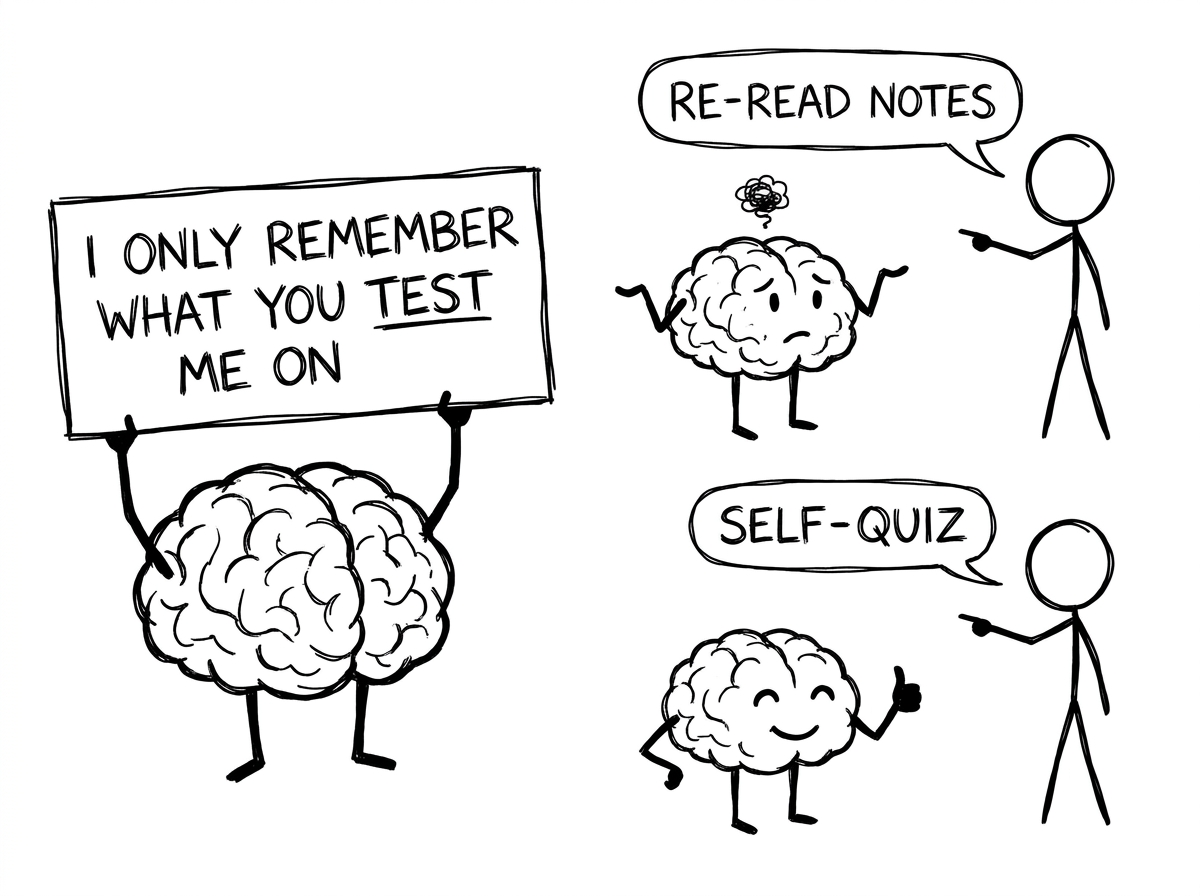 A brain character holding a sign: remember what you test
Build “English mark schemes” so recall becomes measurable
Students often avoid active recall in English because they can’t tell if they’ve done it “right”. In maths, feedback is built in. In English, you have to manufacture it.
For each key theme/character/poem, create a tiny mark scheme you can use to self-assess:
- Did I make a clear argument?
- Did I use a relevant quote?
- Did I analyse a method (e.g. metaphor, semantic field, structure)?
- Did I link to the question focus?
- Did I add context that actually supports the point?
Then you mark your recall attempt: not with vague feelings, but with ticks. You’re training exam behaviour.
This is the same logic as using a mark scheme after a maths paper on GCSE Past papers: you don’t just “check answers”, you learn what examiners reward.
A worked example: convert one page of notes into a 10-minute recall routine
Let’s say your notes page is: Macbeth -- Lady Macbeth -- guilt.
Step 1: compress the notes into five prompts
Write prompts that force retrieval:
- “Write one quote showing Lady Macbeth’s confidence early on.”
- “Write one quote showing guilt later.”
- “Name two methods in either quote.”
- “Explain how Shakespeare changes her across the play in 444 sentences.”
- “Plan a 555-point response to: ‘How is guilt presented?’”
Step 2: add a timer and a mark scheme
Set a 101010 minute timer:
- 333 minutes: quotes + methods
- 444 minutes: mini explanation
- 333 minutes: plan
Now mark using your success criteria. Score it out of 555.
Step 3: space it like a maths topic
Repeat the same prompts after 111 day, then 333 days, then 777 days. Each time, make one prompt slightly harder (e.g. add: “Include a structural point”).
That’s active recall: small, repeatable, and measurable.
How to use a maths-style revision cycle (even when revising English)
GCSE maths revision works best when you rotate between learning, practice, and exam simulation. You can mirror that for English Literature, and it will also improve your maths because you’re building consistency.
Learn (short)
Skim the notes for 555 minutes only. Your aim is to create prompts, not to “finish reading”.
On the maths side, YesGenie does this cleanly with GCSE Maths lessons and topic pages that feed straight into practice.
Practise (long)
Do active recall prompts. Write from memory. Then check.
For maths, you’d use a topic set from the GCSE Maths question bank. For English, your “question bank” is your own prompt ladder.
Simulate (occasionally)
Do one timed exam-style response, then self-mark using a checklist.
For maths, you can raise the stakes with Edexcel GCSE Maths Predicted Papers or build a paper using the mock exam builder via Resources.
Spaced repetition without fancy apps
You don’t need a complicated system. You need a simple schedule you can actually keep.
Try this:
- Today: create prompts from notes (active recall begins)
- Tomorrow: attempt prompts again (no notes)
- Weekend: do one harder prompt (a paragraph plan)
- Next week: one timed response
In maths, spacing is natural because you return to topics repeatedly across mixed papers. If you want a structured way to spot weak areas, use Other Resources to support self-assessment habits.
Interleaving: stop revising one text in a block
Block revision feels productive because it’s smooth. Interleaving feels harder because you have to choose the right idea. That difficulty is the point.
Mix your prompts like this:
- One Macbeth prompt
- One unseen poetry skills prompt
- One comparison prompt
- Then back to Macbeth
Do the same in maths: mix algebra, geometry, and ratio. YesGenie makes this easier by letting you switch between topics and exam practice quickly through GCSE Subjects.
Common mistakes (and what to do instead)
Re-reading notes as your main GCSE revision method
Re-reading makes you feel fluent because the words are there. In the exam, they won’t be. Replace the second read with a prompt attempt from memory.
Making flashcards that are still passive
If the front says “Ambition quotes” and the back is a full paragraph, you’ll read it and feel clever. Make the front a specific question and force yourself to produce an answer.
Only testing quotes, not analysis
Quotes matter, but marks come from explanation. Add prompts that require a method + effect + link to question.
Never marking your own work
If you don’t check against criteria, you’ll repeat the same weak habits. Build mini mark schemes and tick them every time.
Leaving timing until the last week
Timing is a skill, not a mood. Train it early with 101010-minute recalls and occasional full timed answers.
 Exam hall: revision planner vs tangled notes
FAQ
How do I do active recall for English Literature if I don’t know what to ask myself?
Start by turning headings into questions, because most notes are organised around themes, characters, and key scenes. If your notes say “Power and control”, your prompt becomes “How is power shown in Act 1, and what changes by Act 5?” Then add quote prompts: “Write two quotes that support your argument.” After that, add method prompts: “Identify one language method and explain its effect.” Finally, add an exam prompt: “Plan a response in 666 bullet points.” If you do this for just one page per day, you’ll build a bank of prompts that grows naturally. The key is that every prompt must be answerable without looking, otherwise it’s not active recall.
I’m revising GCSE maths and English at the same time -- how do I fit this in?
Use the same revision rhythm for both subjects so your brain doesn’t have to switch systems. For example, do 252525 minutes of maths questions, then 101010 minutes of English recall prompts, then a short break. Maths naturally suits retrieval, so anchor your session with something like the GCSE Maths question bank or a targeted revision guide page such as Edexcel GCSE Maths Revision Guides. Then treat English like “skills practice” rather than “reading”, using your prompt ladder. Over a week, the spacing happens automatically because you keep returning to the prompts. This approach also reduces procrastination because you always know what “good work” looks like: attempt, check, improve.
Does active recall actually improve GCSE grades, or is it just a trend?
Active recall improves grades because exams reward retrieval under pressure, not familiarity in a calm bedroom. When you practise pulling information out of memory, you strengthen the pathways you need in the exam hall. It also shows you what you don’t know, which makes revision more efficient and less emotional. The process mirrors what successful GCSE maths students already do with practice papers and mark schemes, especially when they use resources like GCSE Past papers and Edexcel GCSE Maths Predicted Papers. In English, active recall turns vague “I’ve revised this” into evidence: you either produced a quote and analysis, or you didn’t. Over time, that honesty compounds into confidence, because you’ve trained the exact skill the exam demands.
Bringing it back to YesGenie (and your next GCSE session)
If your GCSE English Literature notes feel heavy, it’s not because you’re lazy. It’s because notes aren’t the same thing as practice. Turn each page into prompts. Retrieve first. Mark it. Space it. Mix it.
And when you switch back to maths, keep the same active recall mindset. Use YesGenie to make retrieval unavoidable: work through GCSE Past papers, sharpen weak topics with the GCSE Maths question bank, and build exam readiness with Edexcel GCSE Maths Predicted Papers and the tools in Resources. Your revision shouldn’t just store knowledge -- it should train recall.
Choose one notes page tonight. Convert it into five prompts. Then test yourself. That’s how GCSE revision starts turning into GCSE marks.