

GCSE: Find Your Weakest Topics in English Literature
GCSE students: learn how to find your weakest English Literature topics using data, mark schemes and a simple method you can apply across subjects.
GCSE revision has a strange habit of turning sensible people into optimists. You tell yourself you’ll “do poetry later”, because it’s uncomfortable, and because the last essay felt like wading through fog. But the exam doesn’t reward optimism -- it rewards accuracy, practice, and knowing exactly where you’re losing marks. This post shows you how to find your weakest topics in GCSE English Literature in a way that feels calm, measurable, and surprisingly similar to how strong students improve in GCSE maths.
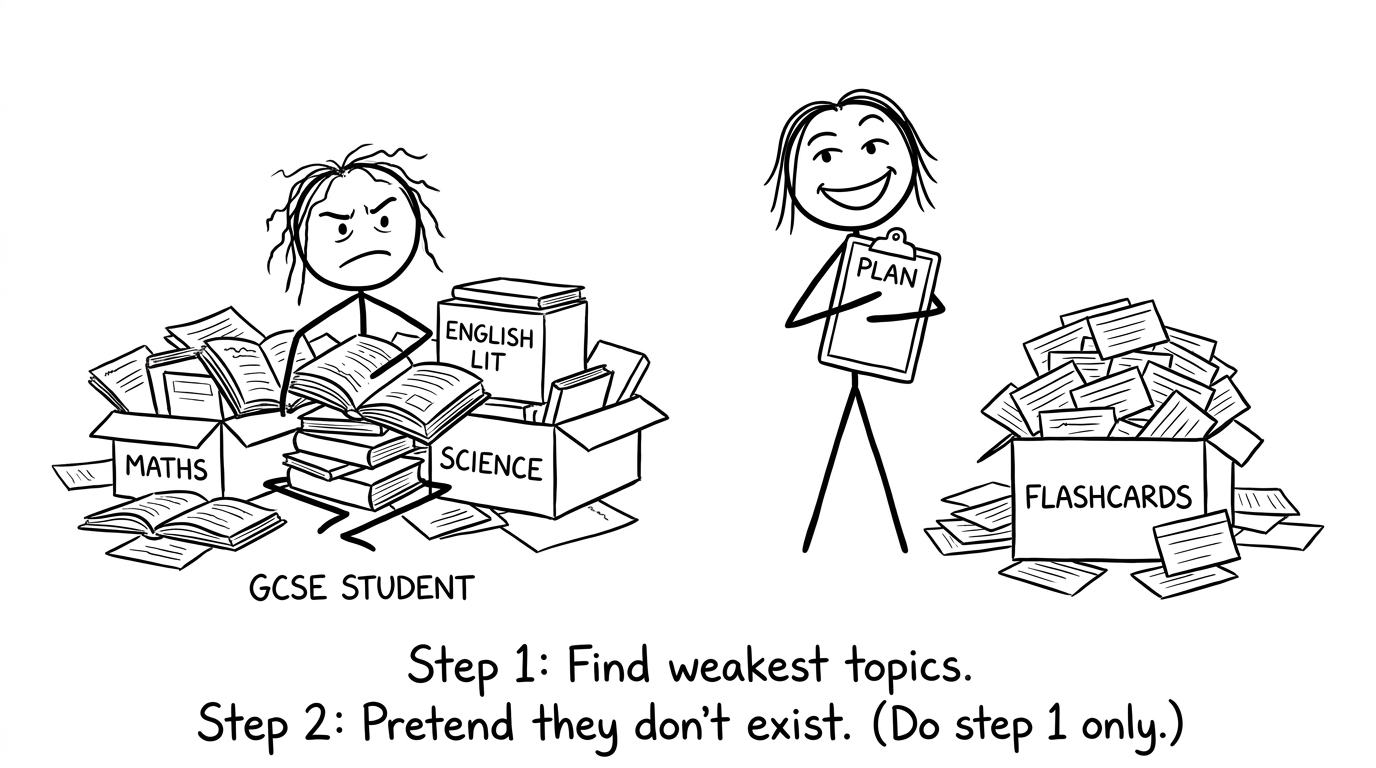 A stressed student with a plan clipboard
The big idea is simple: stop guessing. Use a small amount of evidence (past papers, mark schemes, and a trackable error log) to locate the few English Literature areas that are quietly dragging your GCSE grade down. And because you’re a maths student too, we’ll treat this like a data problem: collect results, categorise errors, and prioritise the highest-return fixes.
A quick checklist to find weak GCSE English Literature topics
Use this as your overview, then we’ll work through each step.
- Choose the right exam board and paper style (AQA, Edexcel, OCR, Eduqas).
- Do one timed question (not a full paper) to generate honest evidence.
- Mark it using the mark scheme and examiner-style criteria.
- Convert weaknesses into categories (knowledge, analysis, structure, methods, timing).
- Create a “weak topic list” with the next action for each item.
- Re-test the same skill a week later and compare.
When you do this properly, your weakest topics stop being a vague feeling and become a shortlist.
Why “weakest topics” are rarely what you think
Most GCSE students misdiagnose their weakest topics because they use memory as the measurement tool. Memory is biased. You remember the essay that went badly, but you forget the ten smaller mistakes that lose you marks every time: vague quotations, context bolted on, or a paragraph that never actually answers the question.
In maths, you can see weakness instantly: you get 2/52/52/5 on algebra and 9/109/109/10 on angles. In GCSE English Literature, the weakness hides inside the writing. So the skill is learning to score your own work with the same cold honesty you’d use with a maths mark scheme.
If you want a familiar routine for building that honesty, borrow the structure you already use in maths revision: short practice, mark carefully, fix the method, repeat. YesGenie is built around that loop for GCSE maths: GCSE Past Papers, Edexcel GCSE Maths Past Papers, and Edexcel GCSE Maths Predicted Papers make it easy to practise and measure.
Step one: collect evidence with one timed response
Pick one task that matches your English Literature paper. For example:
- A Shakespeare extract question
- A modern text question
- A poetry comparison
Do it timed. Not because timing is everything, but because weak topics often only appear under pressure.
Aim for a “mini test” approach: one question, one sitting, one piece of evidence. This is the same reason maths students do focused practice rather than endlessly rereading notes. On YesGenie you can replicate this mindset using short, targeted resources like Resources, including mini tests and exam-style practice for GCSE subjects.
Worked method: turning an English response into numbers (without ruining English)
You don’t need to turn English into spreadsheets. You just need repeatable scoring.
After you write your response, give yourself marks across four buckets:
- AO1: response to the task, references/quotations
- AO2: analysis of language/structure/form
- AO3: context (where relevant)
- SPaG: accuracy (if assessed)
Suppose your teacher’s mark scheme suggests your question is out of 303030.
Let’s say you estimate:
- AO1: 8/128/128/12
- AO2: 6/126/126/12
- AO3: 2/42/42/4
- SPaG: 1/21/21/2
Total:
8+6+2+1=17 8+6+2+1=17 8+6+2+1=17Percentage:
1730×100≈56.7% \frac{17}{30}\times 100\approx 56.7\% 3017×100≈56.7%That number isn’t your identity. It’s just a starting measurement for your GCSE revision. Now do the important part: diagnose why.
Step two: classify errors into “topic types” (your weak topic map)
In maths, an error is often a method error. In GCSE English Literature, an error is usually one of these:
- Knowledge gap (plot, character, themes, key quotations)
- Technique gap (analysing methods like metaphor, contrast, structure)
- Structure gap (paragraph shape, argument clarity, comparison)
- Question focus gap (drifting away from the exact wording)
- Evidence gap (thin quotation choice, no embedding, no precision)
- Timing gap (rushed ending, no plan)
Your “weakest topics” are the categories with the biggest mark loss.
A simple weighting model (maths students love this)
Let each category have a frequency and impact score.
- Frequency: how often it happens (out of 555)
- Impact: how many marks it costs when it happens (out of 555)
Define priority score:
Priority=Frequency×Impact \text{Priority} = \text{Frequency} \times \text{Impact} Priority=Frequency×ImpactExample:
- Weak quotations: Frequency =4=4=4, Impact =4=4=4 so Priority =16=16=16
- Weak context: Frequency =2=2=2, Impact =2=2=2 so Priority =4=4=4
Your weakest topics are the high-priority items, not the ones that merely feel annoying.
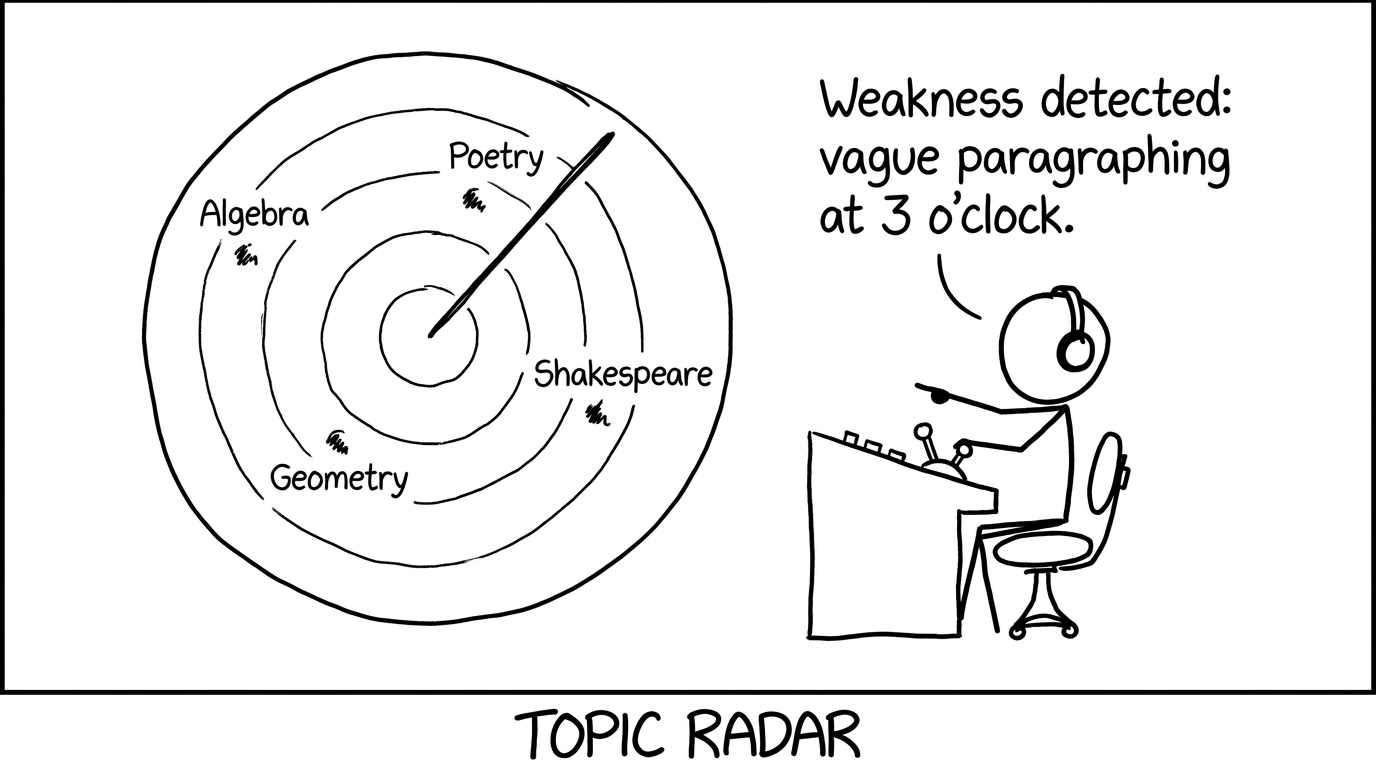 Topic radar screen with blips
Step three: use mark schemes like you use maths mark schemes
A GCSE maths mark scheme shows method marks, accuracy marks, and common slips. English mark schemes do the same thing, just with descriptors.
When you mark:
- Highlight where you actually meet the descriptor (not where you hoped you did).
- Circle any paragraph that lacks a clear “because” explanation.
- Underline any quote that is too long or too general.
Then write an “if I could redo this” line for each weakness. For example:
- “Next time I will choose 222 short quotations and zoom in on 111 word from each.”
- “Next time I will compare the poets’ methods not just their messages.”
This mirrors how you’d correct a maths solution: you don’t just note “wrong”, you note the step that went wrong.
To build that habit on the maths side of your GCSE revision, it’s worth using structured marking resources like Edexcel GCSE Maths Revision Guides and then applying the same discipline to English.
Step four: build a “weak topic list” you can actually revise
A weak topic list should be short, specific, and action-based.
Bad weak topic list:
- “Poetry”
- “Macbeth”
- “Structure”
Good weak topic list:
- “Poetry comparison: I summarise instead of analysing methods.”
- “Macbeth: I can’t recall quotations for ambition and guilt.”
- “Paragraphing: my topic sentences don’t answer the question.”
Now attach a revision action:
- Create a bank of 121212 quotations (themes + characters)
- Practise 333 introductions that directly mirror the question wording
- Do 222 timed comparison paragraphs using the same paragraph frame
If you like having everything centralised, YesGenie’s wider GCSE resource hub makes it easier to keep revision organised: Resources and Sitemap.
Step five: retest the same skill (proof you’re improving)
The quiet superpower of good GCSE revision is retesting. Not next day when it’s fresh -- a week later when it’s real.
Repeat one timed task. Mark it the same way. Then compare.
Worked example: measuring improvement
Week 1 score: 17/3017/3017/30.
Week 2 score: 22/3022/3022/30.
Marks gained:
22−17=5 22-17=5 22−17=5Percentage point increase:
(2230−1730)×100=530×100≈16.7% \left(\frac{22}{30}-\frac{17}{30}\right)\times 100 = \frac{5}{30}\times 100 \approx 16.7\% (3022−3017)×100=305×100≈16.7%That improvement usually comes from fixing one or two high-priority weaknesses, not from “doing more English”.
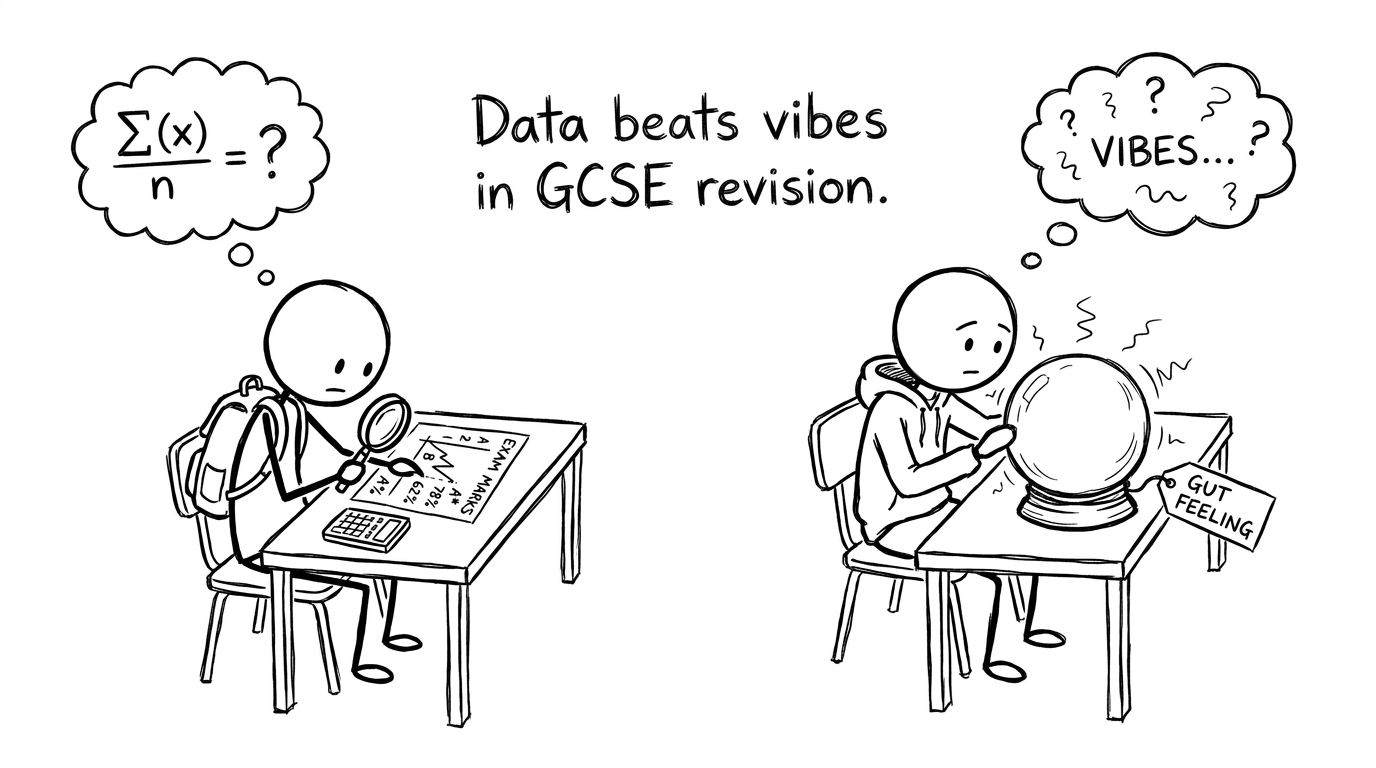 Data beats vibes comic
Bridging English Literature and maths revision (so you don’t burn out)
If you’re revising for GCSE maths and GCSE English Literature at the same time, your brain needs rhythm.
A practical weekly split many students sustain:
- 333 sessions maths (skills are highly procedural)
- 222 sessions English Literature (writing and recall)
- 111 mixed session: a short maths paper section + one English paragraph
For maths practice, lean on exam-board specific pages such as Edexcel GCSE Maths Revision, then keep your English work similarly exam-shaped: timed, marked, improved.
Common mistakes when finding weakest topics in GCSE English Literature
- Using confidence as your metric. Feeling confident often means you’re staying in familiar territory, not gaining marks.
- Calling entire texts a weakness. “Macbeth is my weakness” is too big to revise. The weakness is usually quotations, themes, or question focus.
- Not timing your practice. GCSE English Literature is partly an endurance test. Weaknesses appear when time is tight.
- Marking generously. If you wouldn’t award yourself method marks in maths without the method, don’t award yourself analysis marks without analysis.
- Fixing low-impact problems first. Neat handwriting matters, but it rarely moves your grade like better quotation choice or sharper analysis.
- Doing more, not better. Five essays without reflection can be worse than two essays with precise corrections and a retest.
FAQ
How do I find my weakest topics if I don’t have my teacher’s marks?
You can still find your weakest topics in GCSE English Literature by creating consistent self-marking. Start by writing one timed response and then marking it using the published assessment objectives for your exam board, even if you don’t have a precise mark scheme grid. The goal isn’t perfect accuracy; it’s repeatability, so you can compare your work over time. Look for patterns: do you keep missing the question focus, using vague quotations, or failing to analyse methods? Once you spot repeated patterns, those become your weakest topics. If possible, ask your teacher to sanity-check one marked piece so your self-marking calibrates to GCSE standards.
What if my weakest topic is “I can’t analyse quotes” rather than a specific text?
That’s actually a strong diagnosis, because it’s a transferable weakness across every GCSE text and poetry question. Treat “analysis” as a skill topic, like algebra in maths: you practise the method, not just the content. Pick a short quotation and force yourself to write three layers: what it means, how it’s written (method), and why that method matters for the character/theme. Then practise doing it under time pressure, because GCSE analysis has to be quick and clear. Keep an error log of the phrases you overuse (like “this shows”) and replace them with more precise explanation. Over a few weeks, you’ll find this weakness shrinks across every essay you write.
How many weak topics should I work on at once?
For GCSE revision, fewer is nearly always better. If you try to fix ten weak topics at once, you’ll do shallow revision and feel busy without moving marks. Choose two high-priority weaknesses (high frequency, high impact) and work on them for a week, then retest. Once you see improvement, swap one out and bring in the next weakness. This keeps your revision focused and reduces the stress of feeling like everything is urgent. It also mirrors effective maths revision: you don’t revise every topic every night, you target the ones costing you marks.
Do predicted papers help with identifying weak topics?
Predicted papers can help, but not because they “guess the exam” perfectly. They help because they are exam-shaped practice that exposes weak topics under realistic conditions. If a predicted paper repeatedly reveals that you lose marks on the same skills, that’s valuable evidence about your weakest topics. The key is what you do after: mark carefully, categorise the errors, and then do focused practice on that category. For maths, YesGenie makes this loop straightforward with resources like Edexcel GCSE Maths Predicted Papers. For English Literature, use the same philosophy: practise, mark, diagnose, and retest.
Closing: make weakness your strategy, not your secret
GCSE improvement is rarely about suddenly becoming “good at English”. It’s about removing the small leaks that drain marks, week after week, until your writing becomes more deliberate. When you learn to find your weakest topics in GCSE English Literature using evidence, you stop revising in circles. You start revising like someone who expects progress.
If you want the same structured loop for GCSE maths -- revision lessons, practice questions, mark schemes, past papers and predicted papers that make weaknesses obvious -- use YesGenie as your home base: GCSE Past Papers, Edexcel GCSE Maths Revision, and Edexcel GCSE Maths Past Papers. Then bring that same calm, data-led approach back to English Literature: one timed response, one honest marking, one weak topic fixed at a time.
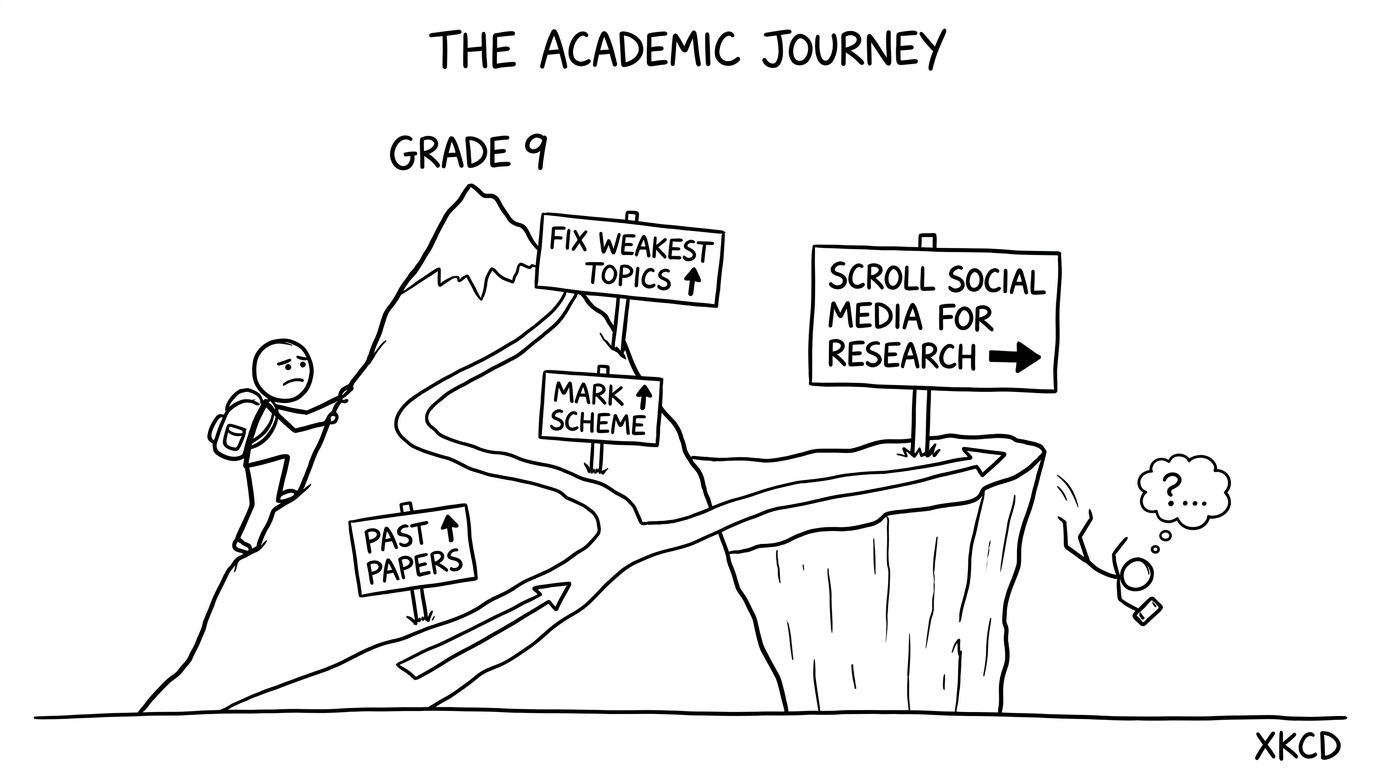 Climbing Grade 9 mountain