

GCSE Maths Night-Before Plan (No Panic, Better Marks)
GCSE night-before maths plan to avoid panic: a calm checklist, high-yield topics, worked examples, common mistakes, and YesGenie papers + videos.
The night before your GCSE Maths exam: the calm plan
The night before a GCSE Maths exam can feel like standing in front of a huge warehouse labelled “the specification” with one small torch and a fading phone battery. Your brain offers unhelpful deals: either panic-revise everything, or revise nothing and hope for the best. Neither works. A better night-before GCSE plan is smaller, calmer, and more tactical: you reduce decisions, practise a few high-frequency methods, and protect sleep like it’s part of revision (because it is).
This isn’t about cramming new topics. It’s about turning what you already know into marks tomorrow, whether you’re Foundation or Higher tier, and whether your board is Edexcel, AQA, OCR or Eduqas.
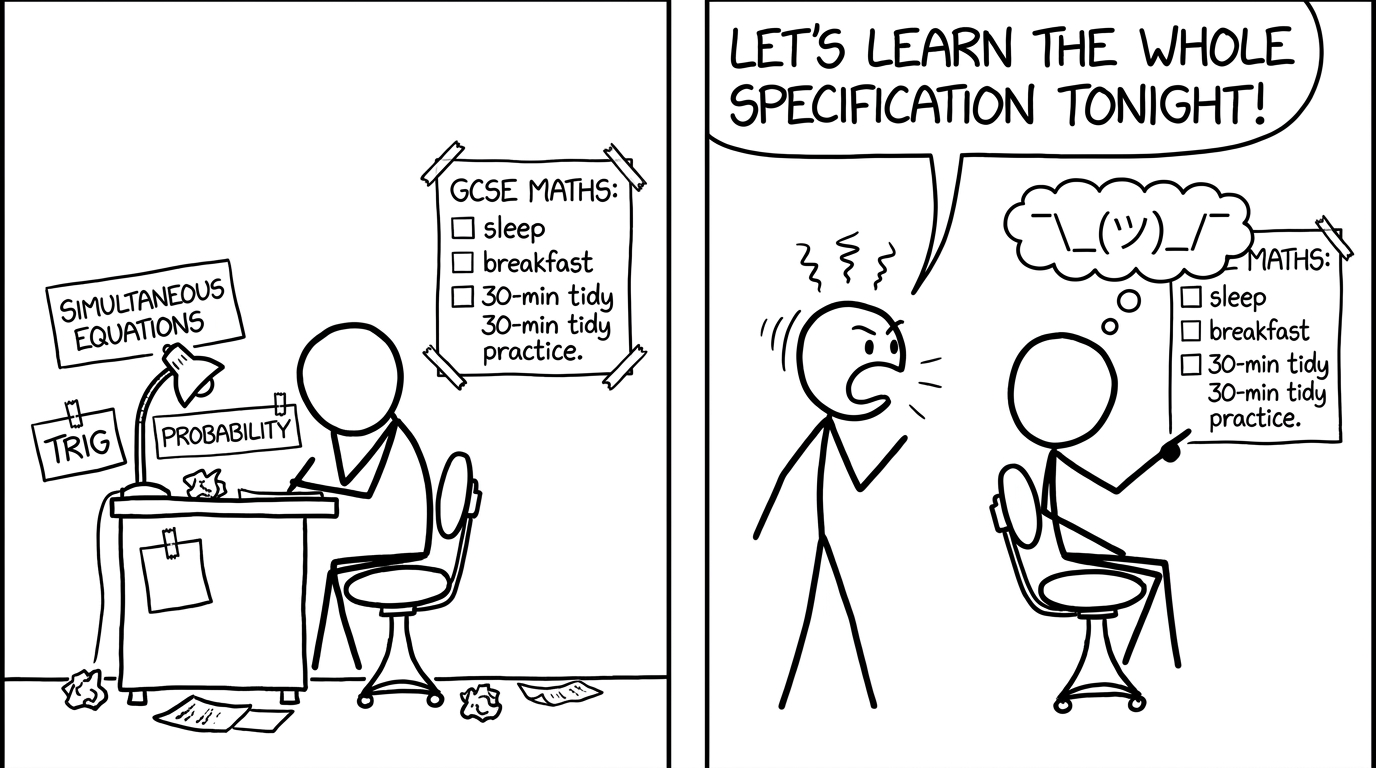 A calm checklist beats last-minute cramming
The night-before GCSE checklist (90 minutes, not 5 hours)
Keep it simple. You’re aiming for confidence, accuracy, and fewer unforced errors.
- Choose the right resources for your exam board (Edexcel/AQA/OCR/Eduqas).
- Do one short, exam-style set (not a whole paper unless you genuinely have time and energy).
- Fix your top three mistake patterns (the things you always drop marks on).
- Refresh key facts and formulas you actually use.
- Pack your kit (calculator, spare batteries, ruler, protractor, compasses, pens).
- Set a sleep time and stop when you reach it.
On YesGenie, this usually means: a board-specific page, a mini test or half paper, then targeted topic practice with solutions.
Useful starting points:
- GCSE Past papers
- Resources hub (mini tests, predicted papers, 45-minute papers)
- Edexcel GCSE Maths revision
- Edexcel GCSE Maths past papers
- Edexcel GCSE Maths predicted papers
- OCR GCSE Maths revision
Why “a little, well-chosen” beats “a lot, badly-chosen”
The night before GCSE Maths is not the time to pick ten topics you half-remember and try to relearn them from scratch. That’s how panic grows: your brain sees a messy list, can’t see progress, and starts sprinting.
A better approach is to pick a few methods that:
- show up often across GCSE papers,
- unlock multiple question types,
- and are easy to check.
Think of revision like packing for a trip. The goal isn’t to carry your entire wardrobe. It’s to pack the items you’ll actually wear tomorrow.
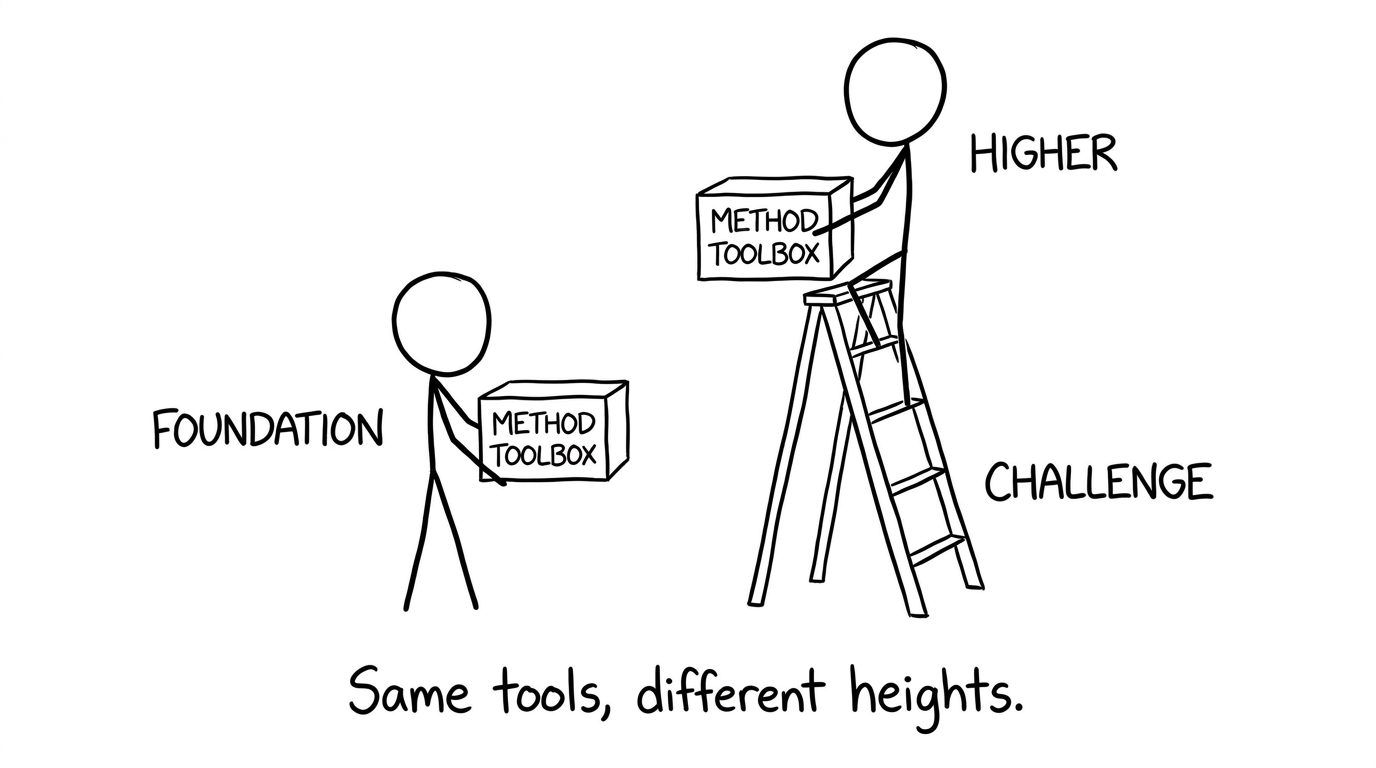 Same tools, different heights
The 3-part night-before GCSE plan (with timings)
Set up (10 minutes)
- Open the right board page (Edexcel/AQA/OCR/Eduqas). If you’re Edexcel, start with Edexcel GCSE Maths revision.
- Decide your tier (Foundation/Higher). Be honest: night-before revision should match the paper you’ll sit.
- Pick one small exam set:
- a mini test, or
- a 45-minute paper, or
- a section of a past paper.
If you know you spiral when you time yourself, don’t time it tonight. Accuracy first, speed later.
Focused exam practice (40 minutes)
Do an exam-style set, then mark it carefully. YesGenie’s past paper pages and video solutions are ideal for this.
- For Edexcel past paper practice: Edexcel GCSE Maths past papers
- If you learn best by seeing full solutions: Paper video solutions (example)
Fix and lock in (40 minutes)
Now choose three mistakes and fix them properly using topic practice and worked solutions.
If you have no idea what to pick, choose from the “classic mark-leaks” list:
- fractions/percentages,
- rearranging,
- solving equations,
- standard form,
- Pythagoras/trig,
- averages from tables,
- probability trees/conditional probability,
- iteration or algebraic fractions (Higher).
The key is not variety. The key is repetition with feedback.
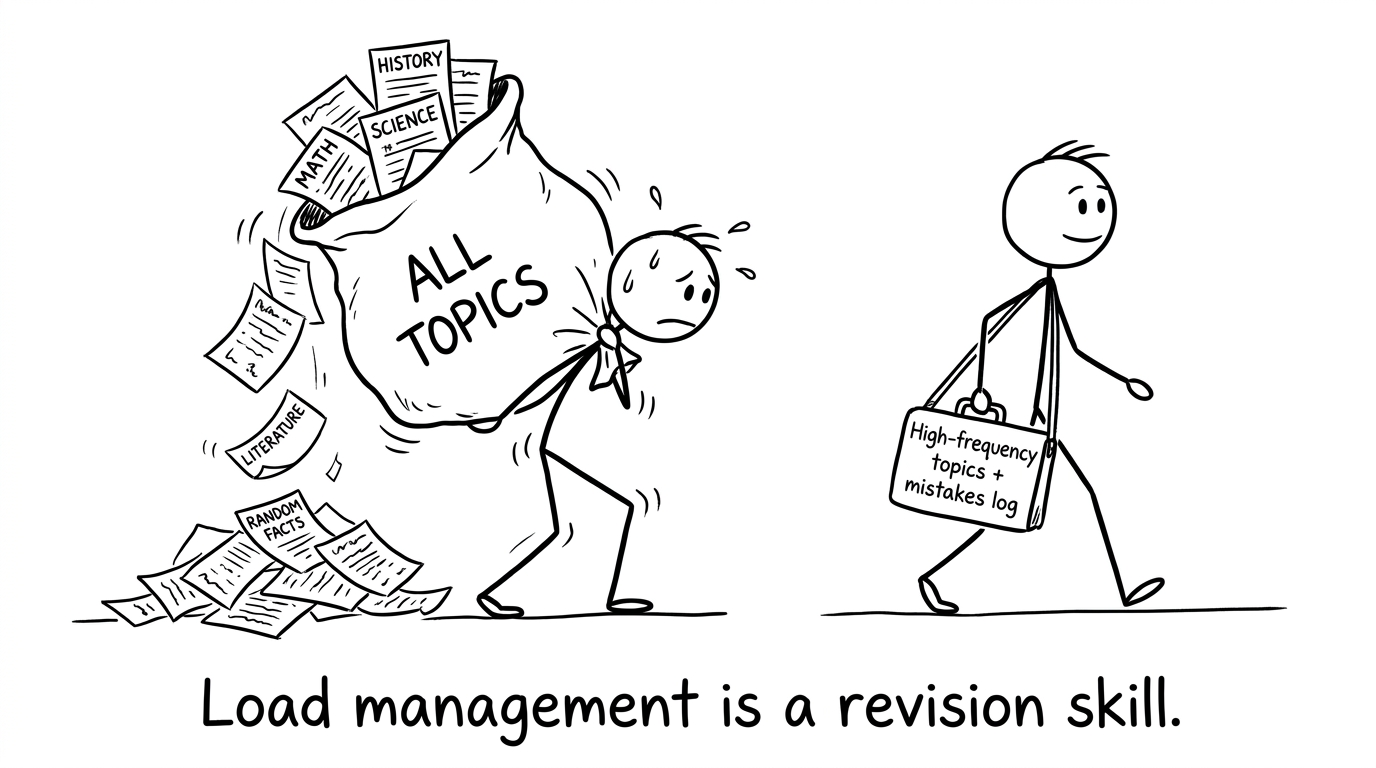 Load management is a revision skill
High-yield GCSE methods to refresh (with worked examples)
Below are three methods that turn up again and again in GCSE Maths. Don’t just read them. Work them through on paper once.
Rearranging and substitution (often 2-5 easy marks)
You’re given a formula, asked to make a different letter the subject, then substitute values.
Example: Make xxx the subject: y=3x−7y = 3x - 7y=3x−7. Then find xxx when y=11y=11y=11.
Rearrange:
y=3x−7y+7=3xx=y+73\begin{aligned} y &= 3x - 7\\ y + 7 &= 3x\\ x &= \frac{y+7}{3} \end{aligned}yy+7x=3x−7=3x=3y+7Substitute y=11y=11y=11:
x=11+73=183=6 x = \frac{11+7}{3} = \frac{18}{3} = 6x=311+7=318=6Night-before tip: write one line that proves you rearranged correctly (a quick substitute check). If x=6x=6x=6, then 3x−7=18−7=113x-7=18-7=113x−7=18−7=11. Good.
Standard form (quick accuracy wins)
Example: Calculate (3.2×105)×(4×10−3)(3.2 \times 10^5) \times (4 \times 10^{-3})(3.2×105)×(4×10−3) in standard form.
Multiply the numbers and add indices:
(3.2×4)×105+(−3)=12.8×10²(3.2 \times 4) \times 10^{5 + (-3)} = 12.8 \times 10^2(3.2×4)×105+(−3)=12.8×10²Now make the first number between 111 and 101010:
12.8×102=1.28×10312.8 \times 10^2 = 1.28 \times 10^312.8×102=1.28×10³So the answer is 1.28×1031.28 \times 10^31.28×10³.
Night-before tip: if you often slip with indices, write the index step explicitly: 5+(−3)=25 + (-3) = 25+(−3)=2.
Pythagoras and trigonometry (Foundation and Higher, different difficulty)
Example (Pythagoras): A right-angled triangle has legs 666 cm and 888 cm. Find the hypotenuse.
c2=62+82c2=36+64=100c=100=10\begin{aligned} c^2 &= 6^2 + 8^2 \\ c^2 &= 36 + 64 = 100 \\ c &= \sqrt{100} = 10 \end{aligned}c2c2c=62+82=36+64=100=100=10Example (trig): In a right-angled triangle, angle θ=35∘\theta = 35^\circθ=35∘ and the adjacent side is 121212 cm. Find the hypotenuse hhh.
Use cosθ=adjacenthypotenuse\cos\theta = \frac{\text{adjacent}}{\text{hypotenuse}}cosθ=hypotenuseadjacent:
cos35∘=12h\cos 35^\circ = \frac{12}{h}cos35∘=h12So:
h=12cos35∘ h = \frac{12}{\cos 35^\circ}h=cos35∘12A calculator gives cos35∘≈0.819152\cos 35^\circ \approx 0.819152cos35∘≈0.819152:
h≈120.819152≈14.65 h \approx \frac{12}{0.819152} \approx 14.65h≈0.81915212≈14.65So h≈14.7h \approx 14.7h≈14.7 cm (to 333 s.f.).
Night-before tip: write the trig ratio first (sin/cos/tan) before you touch the calculator. It prevents “button-mashing maths”.
A night-before GCSE paper strategy (what to do when you get stuck)
When you meet a hard question, your goal is not heroics. It’s marks.
- Write something: a formula, a diagram, a substitution, a rearrangement. Method marks are real.
- Use sensible values to check: if you got −200%-200\%−200% as a percentage decrease, pause.
- If it’s algebra, try a simpler version: if 2(3x−5)=172(3x-5)=172(3x−5)=17 feels messy, expand then solve.
A practical drill tonight: pick one tough question from a past paper, then watch the video solution once you’ve tried it.
Common mistakes that create night-before panic
These are the errors that make students feel like they “don’t get maths”, when it’s often just exam technique.
- Rounding too early in multi-step calculator questions. Keep full calculator values, round at the end.
- Forgetting to change the subject properly (especially when the letter is in a denominator). Write each rearrangement step.
- Using the wrong trig ratio or mixing opposite/adjacent. Draw and label the triangle every time.
- Sign errors when expanding brackets: −(3x−2)=−3x+2-(3x-2) = -3x+2−(3x−2)=−3x+2, not −3x−2-3x-2−3x−2.
- Not reading the final instruction (e.g. “give your answer in standard form”, “to 222 d.p.”, “show your method”).
- Skipping units and losing easy marks in compound measures.
If you do only one thing tonight: write a mini “mistakes log” with your top three, and how you’ll stop them tomorrow.
FAQ: night-before GCSE Maths revision
Should I do a full GCSE past paper the night before?
A full GCSE past paper can be useful, but only if it stays calm and controlled. If doing a full paper will push you past your sleep time, it’s usually not worth it. A better option is a shorter, exam-style set (like a mini test or a 45-minute section) so you still get realistic questions without the mental fatigue. The point of the night before is to strengthen recall and confidence, not to discover ten new weaknesses at 11pm. If you do attempt a full paper, mark it straight away and only fix a small number of errors, otherwise you’ll fall into endless review. Use YesGenie past papers so you’ve got mark schemes and support ready: GCSE Past papers.
What if I’m doing Higher tier and I feel behind?
Feeling behind in GCSE Higher Maths the night before usually means you’re comparing yourself to an imaginary student who’s mastered everything. Real Higher success is often about securing the “should get” marks, then picking up some of the harder ones. Tonight, focus on methods that travel across topics: rearranging, algebraic manipulation, accurate calculator work, and clear geometry/trig set-up. You don’t need to relearn the entire specification to improve your grade tomorrow. Choose one Higher topic you often drop marks on, practise a small set of exam questions, and watch a full worked solution when you’re stuck. This builds pattern recognition, which is what Higher questions reward. Start from your board page so you practise in the right style, for example Edexcel GCSE Maths revision.
Are GCSE predicted papers worth doing the night before?
GCSE predicted papers can be helpful as part of a balanced plan, but they should not replace solid practice on real past papers. Their main value is narrowing your focus and giving you fresh exam-style questions when you’ve already done a lot of the older papers. The night before, predicted papers work best in small pieces: try a cluster of questions, then mark and fix errors, rather than attempting everything at once. Treat predictions as a way to rehearse methods, not as a promise of what will appear. If a predicted question exposes a weakness, use that as your cue to do targeted topic practice with solutions. On YesGenie you can find predicted papers for boards like Edexcel here: Edexcel GCSE Maths predicted papers. And if you want a broader list of paper styles (mini tests, 45-minute papers), use the Resources hub.
How do I stop panicking during the GCSE exam itself?
Panic in a GCSE exam often comes from trying to solve everything immediately, as if the paper is one long emergency. A calmer strategy is to win the first ten minutes: pick questions you can answer, build momentum, and bank marks. When you hit a hard question, pause and switch to “method marks mode”: write down what you know, set up a diagram, state a formula, substitute carefully. Your breathing matters because your attention follows it; slow it down before you decide you’re stuck. Also, avoid repeatedly checking the clock, which can amplify anxiety and shrink your working memory. Finally, remind yourself that GCSE papers are designed so nobody finds every question easy -- your job is to collect marks, not to feel comfortable the whole time.
The final hour: sleep is part of GCSE revision
Here’s the uncomfortable truth: the most effective night-before GCSE move is often stopping earlier than your anxiety wants you to. Sleep protects accuracy, reading comprehension, and basic number sense. You can know a method perfectly and still lose marks if you’re too tired to apply it.
Do these instead of “one more topic”:
- Pack your kit and clothes.
- Set two alarms.
- Write your three reminders (e.g. “don’t round early”, “label triangle”, “show working”).
- Put your calculator in your bag now.
A calm GCSE call to action: use YesGenie as your plan
If you want the night before to feel structured, let YesGenie do the heavy lifting. Start with your exam board page, use GCSE past papers with mark schemes, and lean on video solutions when you need a method explained clearly. If you’re close to the exams and want focused practice, add predicted papers or mini tests from the resources hub. The goal is simple: fewer decisions, better practice, and a calmer you.
Open these and follow the checklist above:
- GCSE Past papers
- Resources hub (mini tests and more)
- Edexcel GCSE Maths revision
- Edexcel GCSE Maths past papers
- Edexcel GCSE Maths predicted papers
- OCR GCSE Maths revision
Tonight, keep it small and well-chosen. Tomorrow, you’ll sit your GCSE paper with a mind that’s steadier -- and that steadiness is often where the extra marks come from.