

GCSE Maths Revision When You’re Stuck at a Pass Grade
GCSE maths revision tips for students stuck at a pass grade. Use targeted practice, method marks, past papers and a simple plan to improve fast.
If you’re stuck at a pass grade in GCSE maths, it can feel like you’re doing a lot and moving very little. You revise. You re-watch a video. You do a few questions. Then a paper lands on your desk and the mark is almost the same as last time. The frustrating part is that a pass in GCSE maths (grade 444) is often only a handful of marks away from the next grade -- yet those marks can feel locked behind “hard topics”.
The truth is calmer than that: most students stuck at a pass grade don’t need more revision. They need different revision. The aim isn’t to become a different person by June. It’s to build a small set of reliable habits that win method marks, fix the same recurring mistakes, and turn weak topics into predictable routines.
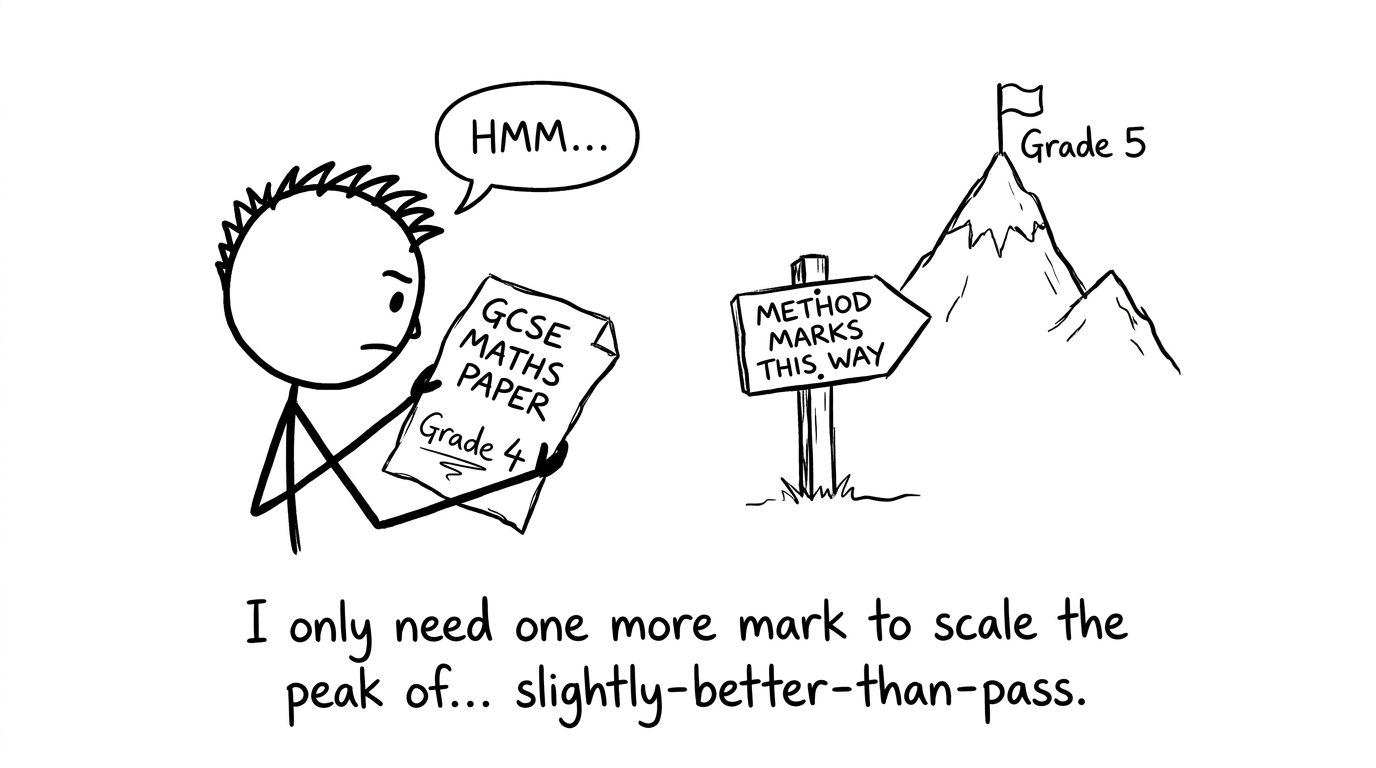 A student near the Grade 5 mountain
The simple checklist to move up from a pass in GCSE maths
Use this as your weekly GCSE maths revision checklist:
- Diagnose: Find your 5-10 weakest topics using real paper questions.
- Learn a method: One clear process per topic (not pages of notes).
- Practise for method marks: Show steps, even when you’re unsure.
- Repeat: Short, frequent practice beats rare marathon sessions.
- Prove it on papers: Build confidence with timed GCSE past papers and mini tests.
YesGenie is designed for exactly this loop: topic lessons and revision guides, then question bank practice, then papers with mark schemes. Start here: GCSE Past Papers and Resources (Mini Tests, Predicted Papers).
Why you get stuck at a pass grade in GCSE maths
Most pass-grade plateaus in GCSE maths come from one of these patterns:
You’re revising “comfort topics”
You practise the bits that feel safe (fractions, basic algebra, a few graphs), so revision feels productive. But the exam is a spread. AQA, Edexcel, OCR and Eduqas will all test the full specification, and the same 3-5 weak areas keep dragging your score back.
You’re doing passive revision
Reading solutions and highlighting notes feels like revision, but it doesn’t create retrieval strength. Your brain learns what things look like, not what to do.
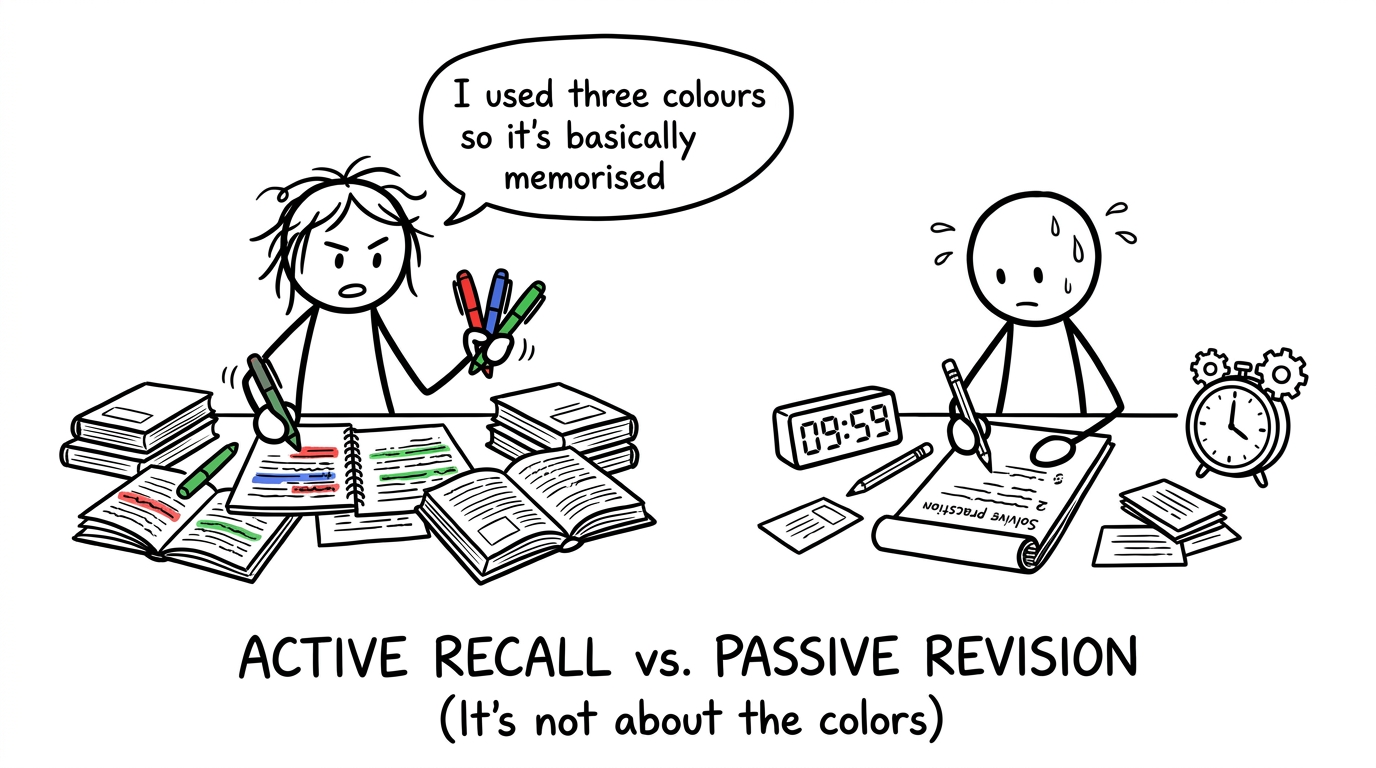 Active recall vs highlighting
You’re losing method marks
At pass grade, method marks are everything. Examiners reward correct steps, even when the final answer is wrong. If you do too much in your head, or write only an answer, you lose the “nearly there” marks.
Build a “mark-winning” topic shortlist (foundation or higher)
If you’re currently around a grade 333-444, the fastest route to improvement in GCSE maths is choosing a shortlist of topics that appear often and reward clear method.
A practical way to do this on YesGenie:
- Choose your board and tier and open: Edexcel GCSE Maths Past Papers.
- Do one paper open-book (yes, really) and circle every question you could not start.
- Turn those circles into your topic shortlist using the question bank or revision guides for your board, for example: Eduqas GCSE Maths Revision Guides or Eduqas GCSE Maths Question Bank.
Keep your list to 5-10 topics. Smaller is kinder, and it works.
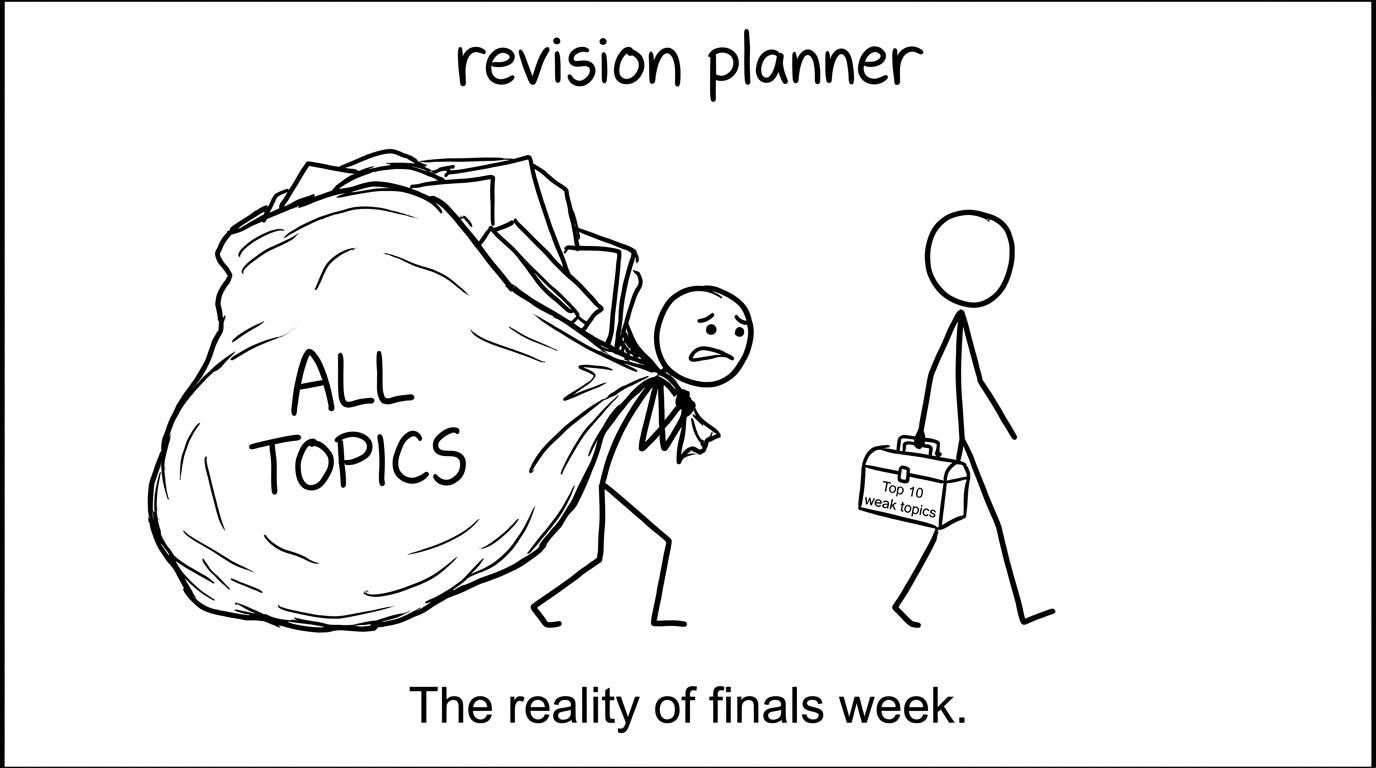 Carrying ALL TOPICS vs top weak topics
The method-marks mindset: write like you want credit
A lot of GCSE maths questions are designed so that the method is worth more than the answer. That’s good news when you’re stuck at a pass grade.
Two habits change everything:
- Always write an equation you’re solving.
- Always show at least one clear transformation (a rearrangement, substitution, factorisation, or a probability route).
Here are worked examples that show what “method marks” looks like.
Worked example: percentages (a pass-grade staple)
A jacket costs £484848 after a 20%20\%20% discount. What was the original price?
Let the original price be xxx.
A 20%20\%20% discount means you pay 80%80\%80% of the original price:
0.8x=48 0.8x = 48 0.8x=48Solve:
x=480.8=60 x = \frac{48}{0.8} = 60 x=0.848=60So the original price was £606060.
Why this helps your GCSE grade: even if you slip on the final division, the equation 0.8x=480.8x=480.8x=48 is a big method mark magnet. Practise these using the topic practice tools and then check your working against mark schemes on GCSE Past Papers.
Worked example: solving linear equations (easy marks, often dropped)
Solve 3x−7=203x - 7 = 203x−7=20.
Add 777 to both sides:
3x=27 3x = 27 3x=27Divide by 333:
x=9 x = 9 x=9If you’re stuck at a pass grade in GCSE maths, this kind of question is not “too easy to revise”. It’s exactly the kind of question you must answer correctly every time.
Worked example: best buy (structured reasoning, quick wins)
A 750 g750\text{ g}750 g bag of rice costs £2.102.102.10. A 1.2 kg1.2\text{ kg}1.2 kg bag costs £3.003.003.00. Which is better value?
Work in £ per kg.
First bag: 750 g=0.75 kg750\text{ g} = 0.75\text{ kg}750 g=0.75 kg.
Unit cost=2.100.75=2.80 (£ per kg) \text{Unit cost} = \frac{2.10}{0.75} = 2.80 \text{ (£ per kg)} Unit cost=0.752.10=2.80 (£ per kg)Second bag: 1.2 kg1.2\text{ kg}1.2 kg.
Unit cost=3.001.2=2.50 (£ per kg) \text{Unit cost} = \frac{3.00}{1.2} = 2.50 \text{ (£ per kg)} Unit cost=1.23.00=2.50 (£ per kg)So the 1.2 kg1.2\text{ kg}1.2 kg bag is better value.
If this topic is one you avoid, use a guided explanation like: Best Buy Questions (Revision Guide).
How to practise GCSE maths when you’re stuck: the 20-minute loop
When you’re stuck at a pass grade, long revision sessions often turn into tired guessing. Instead, use a repeatable loop:
Learn (5 minutes)
Use a short lesson or revision guide to get one method clearly in your head.
If you’re aiming for higher tier, you’ll also meet “step-up” topics later. But you still build them the same way: one method at a time.
Practise (10 minutes)
Do a small set of exam-style questions. Stop after each one and ask: could I start this again from scratch tomorrow?
A good resource for this is the YesGenie question bank, organised by topic and grade, for example: Changing the Subject of a Formula (Questions).
Mark and fix (5 minutes)
Don’t just tick and cross. Write a one-line “fix” like:
- “I forgot to convert 750 g750\text{ g}750 g to 0.75 kg0.75\text{ kg}0.75 kg.”
- “I divided by 0.20.20.2 instead of 0.80.80.8.”
- “I didn’t show an equation, so I lost method marks.”
Repeat the same topic tomorrow with different questions.
Use mini tests and 45-minute papers to build momentum
Full papers matter, but early on they can be too long to learn from. If you’re stuck at a pass grade in GCSE maths, you want lots of clean feedback.
Two ways YesGenie helps:
- Edexcel GCSE Maths Mini Tests for short bursts on key content.
- The wider hub at Resources (Mini Tests, Predicted Papers, 45-minute papers) when you want timed practice without the full length.
The goal is not to “prove yourself” in one sitting. It’s to train consistency.
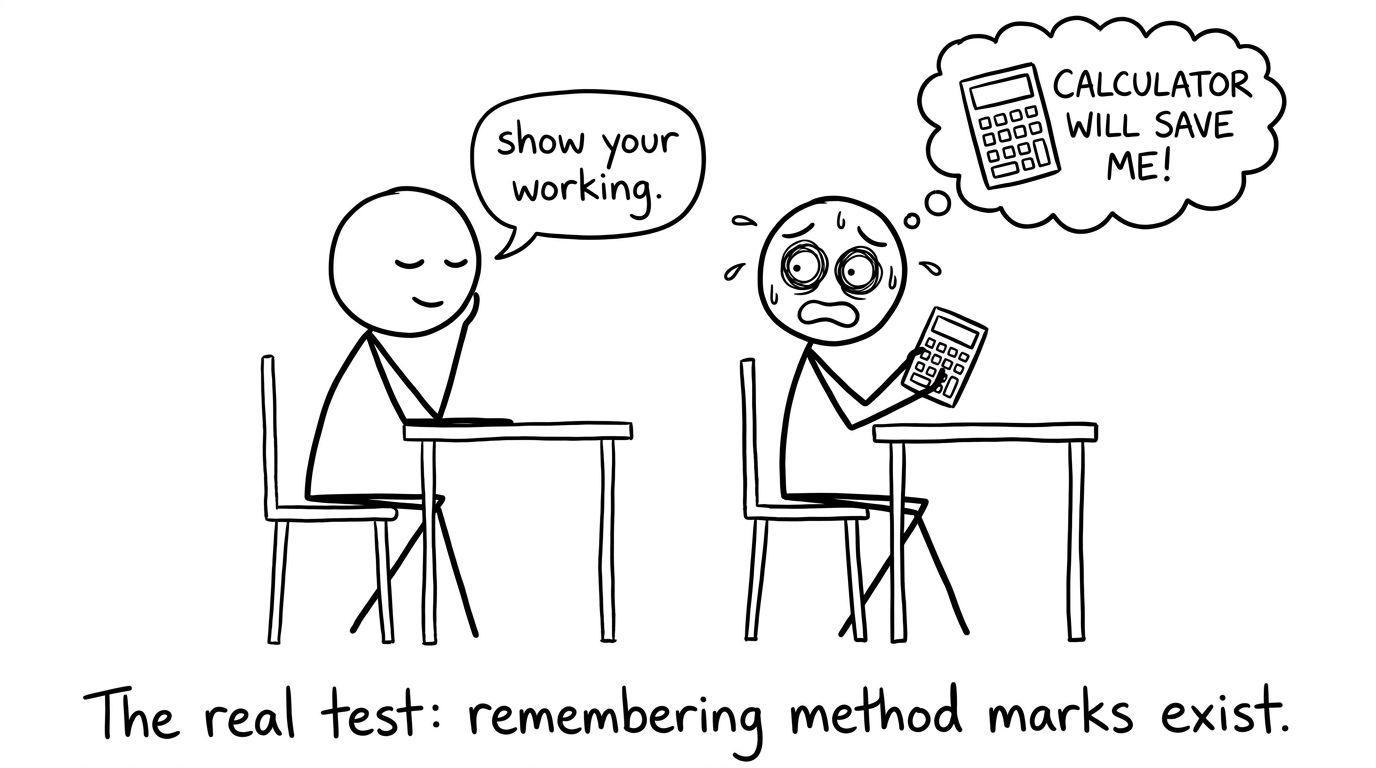 Exam hall: show your working
Common mistakes that keep GCSE students stuck at a pass grade
- Not writing enough working: you can’t earn method marks for thoughts.
- Rounding too early: keep full calculator values until the final line unless told otherwise.
- Mixing up percentage multipliers: decrease by 20%20\%20% means multiply by 0.80.80.8, not 0.20.20.2.
- Unit confusion: 750 g≠750 kg750\text{ g} \neq 750\text{ kg}750 g=750 kg, and 1.2 kg=1200 g1.2\text{ kg} = 1200\text{ g}1.2 kg=1200 g.
- Switching methods mid-question: choose one clear method and follow it through.
- Ignoring command words: “show that”, “prove”, “explain” require sentences and structure, not just a number.
If you’re moving into higher content, it helps to see what proof-style structure looks like: Proof (Revision Guide).
FAQ: revising GCSE maths when you’re stuck at a pass grade
How do I get from a grade 4 to a grade 5 in GCSE maths?
A grade jump in GCSE maths is usually less about learning brand-new topics and more about becoming reliable on the topics you already half-know. Start by doing one past paper (or a mini test) and identifying the questions you could not start confidently. Turn those into a shortlist of 5-10 topics, then practise them in short daily sessions using exam-style questions. The biggest win is method marks: write equations, show rearrangements, and always include units where needed. Once your shortlist feels more predictable, switch to timed practice using GCSE Past Papers and mark with the mark scheme. You’re aiming to reduce “blank space marks” first, then refine accuracy.
Should I revise differently for foundation tier versus higher tier GCSE?
Yes, but the core approach is the same: diagnose weaknesses, learn a method, and practise exam questions. For foundation tier GCSE maths, consistency on number, ratio, percentages, basic algebra, and standard geometry is what protects your grade. You want to make the common question types automatic so nerves don’t steal marks. For higher tier, you still need that foundation, but you also add a second layer: topics like algebraic fractions, quadratic methods, vectors and more demanding problem solving. The trap is trying to revise all of higher content at once, which often leads to shallow revision and repeated mistakes. Build from the topics that appear frequently and reward clear structure, and use mark schemes to see what working earns credit.
How many past papers should I do to improve my GCSE maths grade?
There isn’t a magic number, because the value of a GCSE past paper depends on what you do after it. One fully marked paper where you rewrite solutions and practise the weak topics again is worth more than three papers you never review properly. A sensible routine is one timed paper per week (or per fortnight early on), plus mini tests or topic sets in between. Use the mark scheme to spot patterns in your errors: is it algebra slips, unit conversions, rounding, or not showing steps? Then spend your next few sessions targeting those patterns with topic practice. YesGenie makes this easier because you can move from Edexcel GCSE Maths Past Papers straight into targeted practice and back again.
What if I panic in the exam and forget everything I revised?
Exam panic is common in GCSE maths, especially when you’ve been stuck at a pass grade and each paper feels like judgement. The best antidote is familiarity: timed practice in small doses so your brain learns that pressure is survivable. Train a “first pass” strategy: answer what you can quickly, mark the hard questions, and return once you’ve banked marks. Also train a writing habit: even if you’re unsure, write down an equation, a diagram, or a substitution, because method marks often come from the first two lines. When you revise, practise starting questions, not just finishing them, because the hardest moment is usually the first step. Over time, your confidence comes less from hope and more from proof: you’ve seen these structures before, and you’ve earned marks on them before.
Closing: the pass grade isn’t your ceiling, it’s your starting line
Being stuck at a pass grade in GCSE maths doesn’t mean you “can’t do maths”. It usually means your revision has been wide when it needed to be focused, and passive when it needed to be active. The change that moves the needle is small: pick your weakest topics, learn one clear method for each, practise short and often, and write working that earns method marks.
If you want a simple place to run that process, use YesGenie as your revision home base: start with GCSE Past Papers, add short timed practice from Edexcel GCSE Maths Mini Tests, and fill gaps with revision guides and question banks like Eduqas GCSE Maths Revision Guides. When exam season arrives, use Resources (Predicted Papers and more) to keep your practice sharp.
Keep going. In GCSE maths, the marks you need are often closer than they look -- and you can build them, one method at a time.