

GCSE Maths WJEC Revision: Stuck at a Pass Grade?
GCSE WJEC Maths revision tips for students stuck at a pass grade. Use YesGenie lessons, question banks, past papers and mark schemes to improve.
You know the feeling: you revise for GCSE Maths, you do “a bit of everything”, and your score refuses to move. Not failing -- but not safely passing either. For WJEC students, that pass-grade plateau can feel personal, like the exam has decided you’re “a grade 4 person” and that’s that.
It isn’t. What’s really happening is simpler: you’re spending time where it feels productive (reading, watching, highlighting) and not enough time where it changes marks (targeted practice, feedback, and fixing the same small set of errors). This post shows how to revise WJEC GCSE Maths when you’re stuck at a pass grade, using a method that’s calm, specific, and built to add marks quickly.
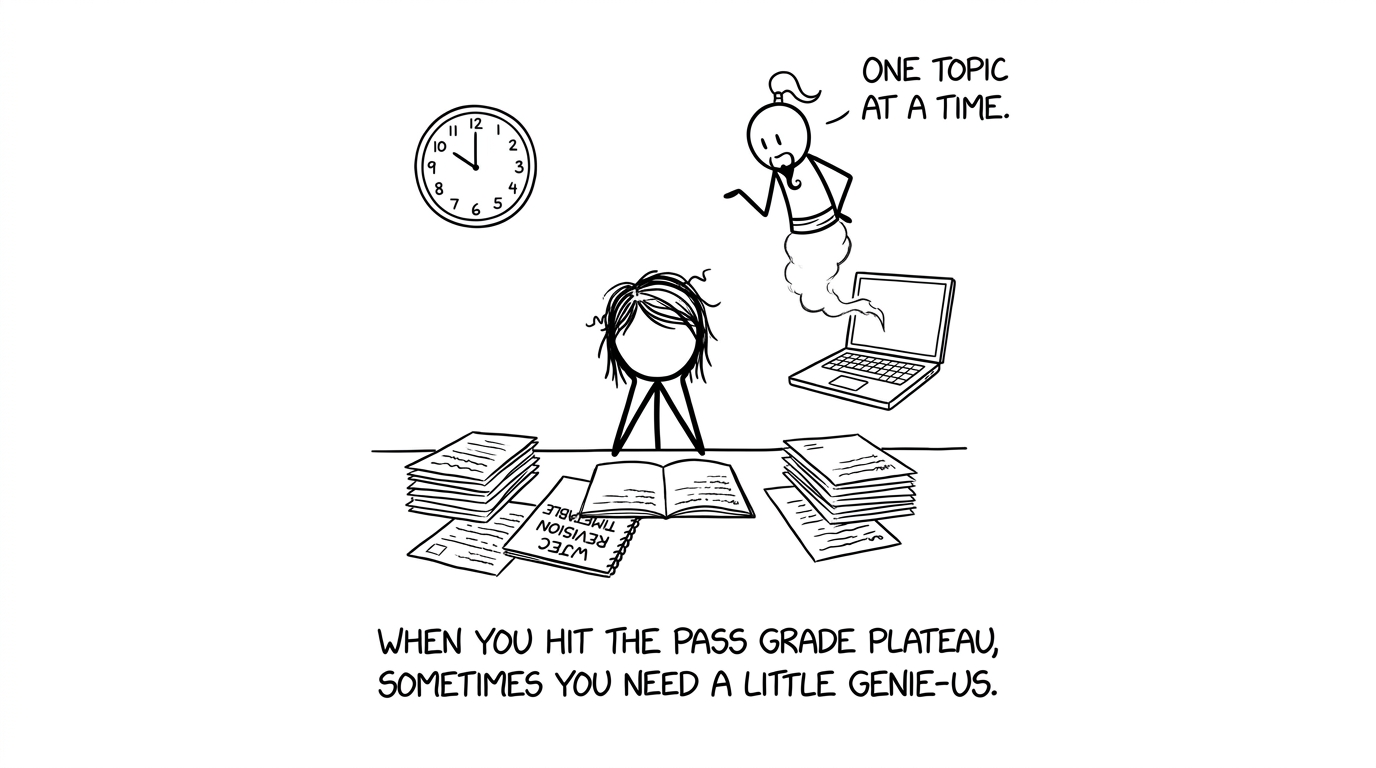 A student meets the revision genie
The pass-grade plan (WJEC-focused checklist)
If you’re aiming to move from “borderline” to a secure pass in GCSE Maths, you need a plan that prioritises marks, not comfort.
- Choose your exact pathway: WJEC foundation or higher tier (and commit).
- Use WJEC-specific practice first: papers, question banks, and mark schemes.
- Build a “next 10 marks” list (a short set of topics that come up often).
- Practise in exam style, then mark brutally and write a one-line fix.
- Repeat the same topics until your mistakes stop recurring.
YesGenie makes this easier because everything is organised by exam board. Start here:
Why you’re stuck at a pass grade (and why it’s not your fault)
Most students stuck at a pass grade are doing two things that feel like revision but don’t reliably change GCSE marks.
First: they revise too broadly. If you keep rotating through every topic, you never stay long enough to stop repeating the same errors. A pass grade is rarely blocked by “not knowing everything” -- it’s blocked by losing marks on a small set of frequent skills.
Second: they revise without feedback loops. In maths, you don’t improve because you “covered” a topic; you improve because you made a mistake, understood why, and then didn’t make it again.
That’s why your core resources should be practice questions, past papers, and mark schemes (plus short lessons when you’re genuinely stuck). YesGenie’s WJEC pages are built around that workflow:
Use WJEC materials, not generic worksheets
WJEC and Eduqas are closely related, but your safest bet for GCSE revision is still WJEC-tagged papers and practice. It’s not about “tricks”; it’s about familiar command words, layout, and the feel of multi-step questions.
Make these your defaults:
- WJEC past papers (timed, then marked): WJEC GCSE Maths Past Papers
- WJEC overview hub for lessons and practice: WJEC GCSE Maths Revision
- Grade targets and reality checks: WJEC GCSE Maths Grade Boundaries
A useful mindset shift: you are not “revising maths” in general. You are training for a very specific WJEC GCSE performance.
The “next 10 marks” method (what to revise first)
If you’re stuck at a pass grade, you don’t need a perfect topic list. You need a short list you can master.
Aim for 6 to 10 high-frequency, high-return areas typically seen around foundation-to-lower-higher difficulty:
- Fractions, decimals, percentages (including percentage change)
- Ratio and proportion
- Rearranging and solving linear equations
- Angles (lines, triangles, polygons)
- Area, perimeter, and circles
- Pythagoras and basic trigonometry (if higher tier)
- Straight line graphs and coordinates
- Averages and interpreting graphs
Then do this cycle:
- Do 10-20 exam-style questions on one topic.
- Mark with the mark scheme (or solutions).
- Write a one-line “fix” for each mistake.
- Re-do two similar questions immediately.
- Re-test the topic 48 hours later.
This is exactly the kind of workflow supported by YesGenie’s question banks, topic lessons, and solutions across boards. If you also want general short tests to build momentum, browse:
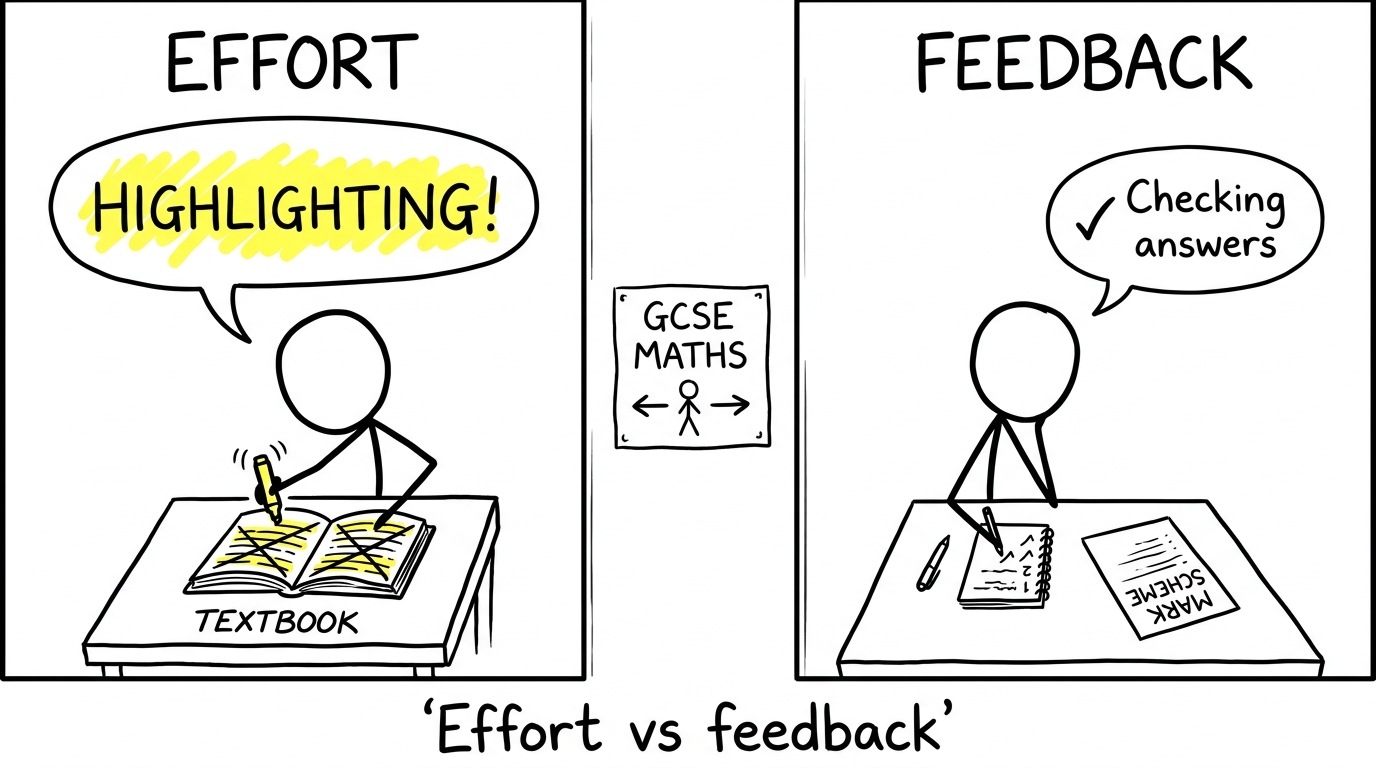 Effort vs feedback
Worked examples that often unlock pass-grade marks
These are the kinds of marks that quietly add up in GCSE Maths. They’re not glamorous. They’re reliable.
Example 1: Percentage change (a classic pass-grade separator)
A coat costs £80. It is reduced by 15%15\%15%. What is the new price?
Reduction is 15%15\%15% of £80:
15% of 80=0.15×80=12 15\% \text{ of } 80 = 0.15 \times 80 = 12 15% of 80=0.15×80=12New price:
80−12=68 80 - 12 = 68 80−12=68So the new price is £68.
A faster method (useful on calculator papers): multiply by the multiplier 0.850.850.85.
80×0.85=68 80 \times 0.85 = 68 80×0.85=68Example 2: Solve a linear equation without losing a sign
Solve 3(2x−5)=213(2x-5)=213(2x−5)=21.
Expand carefully:
6x−15=21 6x - 15 = 21 6x−15=21Add 15 to both sides:
6x=36 6x = 36 6x=36Divide by 6:
x=6 x = 6 x=6This is a typical GCSE “don’t panic” question: the marks are in the steps, not in doing it quickly.
Example 3: Pythagoras (higher tier but still very learnable)
A right-angled triangle has legs 6 cm6\text{ cm}6 cm and 8 cm8\text{ cm}8 cm. Find the hypotenuse.
Use a2+b2=c2a^2+b^2=c^2a2+b2=c2:
62+82=c2 6^2 + 8^2 = c^2 62+82=c2 36+64=c2 36 + 64 = c^2 36+64=c2 100=c2 100 = c^2 100=c2 c=100=10 c = \sqrt{100} = 10 c=100=10So the hypotenuse is 10 cm10\text{ cm}10 cm.
How to use past papers when you’re borderline
Past papers are intimidating when you’re stuck at a pass grade because they feel like judgement. Reframe them as diagnosis.
Here’s a WJEC-friendly routine that works:
- Start with one full paper untimed. You’re learning the exam language.
- Mark it the same day, while you still remember what you were thinking.
- Categorise each lost mark into one of three buckets:
- Knowledge (I didn’t know what to do)
- Process (I knew, but my method broke)
- Accuracy (I could do it, but I slipped)
- For every question in the first two buckets, go and do 5-10 targeted questions of that type before you attempt another paper.
Use:
And when you feel stuck emotionally, check grade boundaries to ground your target. A small improvement in raw marks can be the difference between “hopeful” and “secure” in GCSE Maths:
Common mistakes that keep students at a pass grade
These errors are common across WJEC, AQA, Edexcel, OCR, and Eduqas GCSE papers. Fixing just a few can move your grade quickly.
- Not showing method: even if the final answer is wrong, method marks are often available. Write the key step.
- Rounding too early: keep exact values (or at least keep decimals in your calculator) until the final line.
- Percentage confusion: mixing “percentage of” and “percentage change”. Learn multipliers like 1.21.21.2 for a 20%20\%20% increase and 0.80.80.8 for a 20%20\%20% decrease.
- Sign errors in algebra: especially when expanding brackets or moving terms across an equals sign.
- Units ignored: area in cm2\text{cm}^2cm2, volume in cm3\text{cm}^3cm3, speed in m/s\text{m/s}m/s or km/h\text{km/h}km/h. Dropping units loses easy marks.
- Misreading the tier: foundation questions often reward tidy, basic skills; higher questions often reward linking two skills. Revise accordingly.
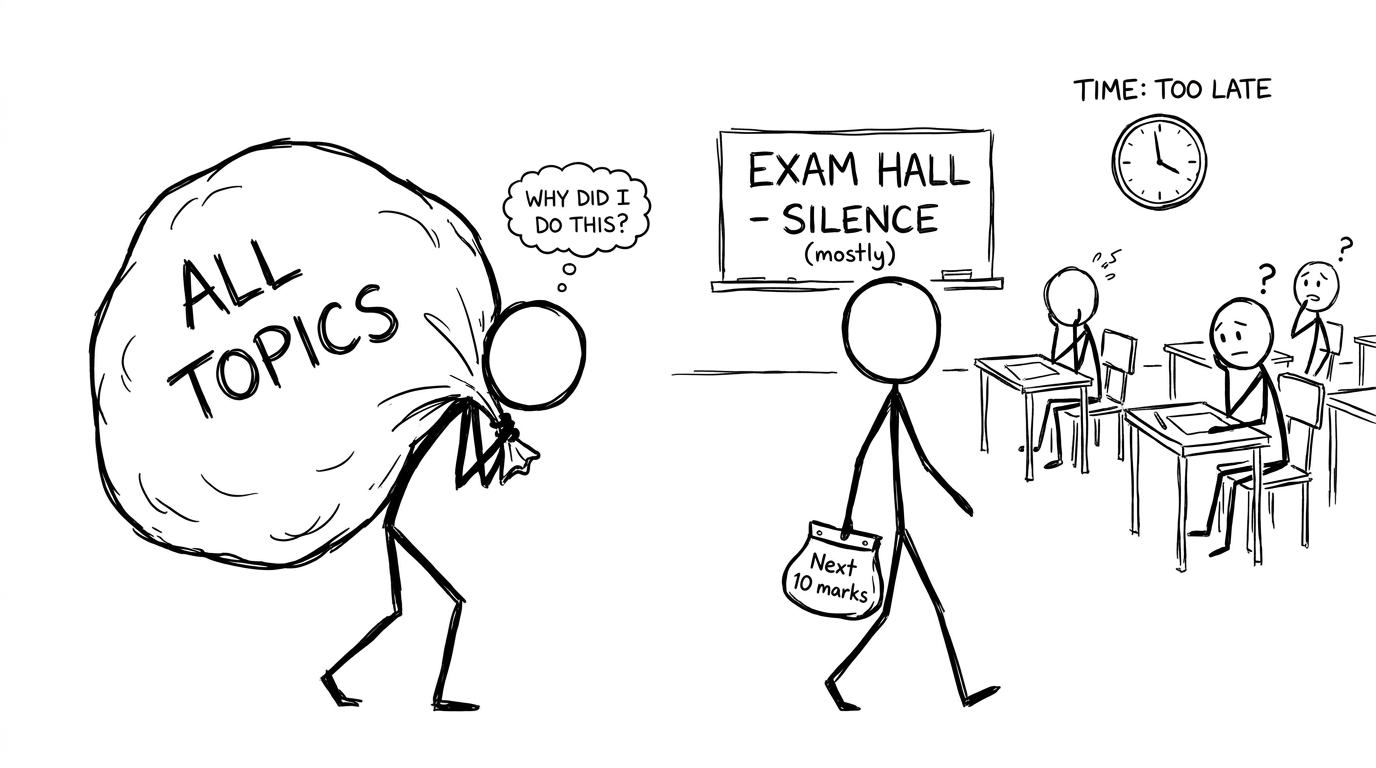 All topics vs next 10 marks
FAQ: WJEC GCSE Maths revision when you’re stuck at a pass
How many past papers should I do to pass WJEC GCSE Maths?
There isn’t a magic number, because doing a paper without learning from it is just a long worksheet. If you are stuck at a pass grade, you need enough GCSE past paper practice to reveal patterns in your mistakes. For most students, that means at least 3 to 6 papers per component type, but spread out with topic practice in between. The key is to repeat the cycle: attempt, mark, diagnose, then practise the exact weakness. If you can look back at two papers and see the same error happening, the next paper won’t fix it -- targeted questions will. Use WJEC GCSE Maths Past Papers alongside the lessons and practice on WJEC GCSE Maths Revision.
Should I revise foundation or higher if I’m currently at a grade 4?
This depends on your school’s entry decision and how stable your marks are under timed conditions. A grade 4 on higher tier can be fragile: one tough paper and you can drop below a pass, even if your topic knowledge feels decent. Foundation is often the more strategic route if your priority is a secure GCSE pass, because the content is narrower and the questions reward accuracy and fluency. Higher can still be right if you’re consistently scoring well above the grade 4 boundary and you want the chance at grades 5-9. The calm approach is to do two timed papers at each tier (if your school allows access) and compare not just totals, but how you lost marks. Use WJEC GCSE Maths Grade Boundaries to understand what “secure” looks like in raw marks, and then build your revision plan accordingly.
What should I do if I keep making careless mistakes in GCSE Maths?
“Careless” usually means “untrained under pressure”, not “lazy”. In GCSE Maths, accuracy is a skill you can practise, especially by building small habits that prevent slips. First, slow down at the start of a question: underline what is asked and write a brief plan like “find percentage, then subtract”. Second, use a one-line check that matches the topic: for example, after solving x=6x=6x=6, substitute back into the original equation to see if it works. Third, stop doing endless new questions and start redoing the ones you got wrong two days later; that spacing is what rewires the mistake. Finally, mark with a mark scheme and write the cause, not the symptom: “expanded incorrectly” is better than “silly mistake”, because it tells you what to fix. YesGenie is designed for this feedback loop: practise, check solutions, and revisit, using your WJEC hub and past papers.
Bringing it together: a simple weekly revision rhythm
If you want a pass-grade jump in GCSE Maths, your week should feel predictable:
- 2 topic sessions (45-60 minutes): one topic, exam-style questions, mark, fix.
- 1 mixed session (30-45 minutes): weak areas only.
- 1 past paper session (60-90 minutes): timed when you’re ready, then marked the same day.
Repeat for three weeks and you’ll usually feel something shift: not just confidence, but fewer repeated mistakes.
Conclusion: get unstuck by revising for marks
Being stuck at a pass grade in GCSE Maths is rarely about intelligence. It’s about method. WJEC students improve fastest when revision is board-specific, practice-led, and ruthlessly focused on the next few marks.
Make YesGenie your home base: use the WJEC GCSE Maths Revision page for lessons and practice, hammer WJEC GCSE Maths Past Papers with honest marking, and keep an eye on WJEC GCSE Maths Grade Boundaries so your target stays real. Then do what the exam rewards: practise, mark, fix, repeat.
Your pass isn’t hiding in “more revision”. It’s hiding in better revision -- the kind you can do, for free, on YesGenie.