

GCSE Revision: How Parents Can Help Without Nagging
GCSE revision support without nagging: practical parent tips, routines and maths examples. Use YesGenie lessons, past papers and predicted papers.
GCSE season has a particular sound: a zipper on a pencil case, a calculator sliding across a desk, and a sigh that means “I’m trying, I just don’t know where to start”. If you’re a parent, it’s tempting to fill the silence with reminders. If you’re a student, it can feel like being chased by a timetable. The aim of GCSE revision support isn’t to win a battle of willpower -- it’s to remove friction so the work can happen.
This post is about helping a student revise GCSE Chemistry without nagging, while also supporting what most UK students quietly worry about: GCSE maths. Because even when the subject is Chemistry, the confidence often breaks on the maths steps: rearranging equations, using standard form, calculating percentage yield, drawing graphs, handling units.
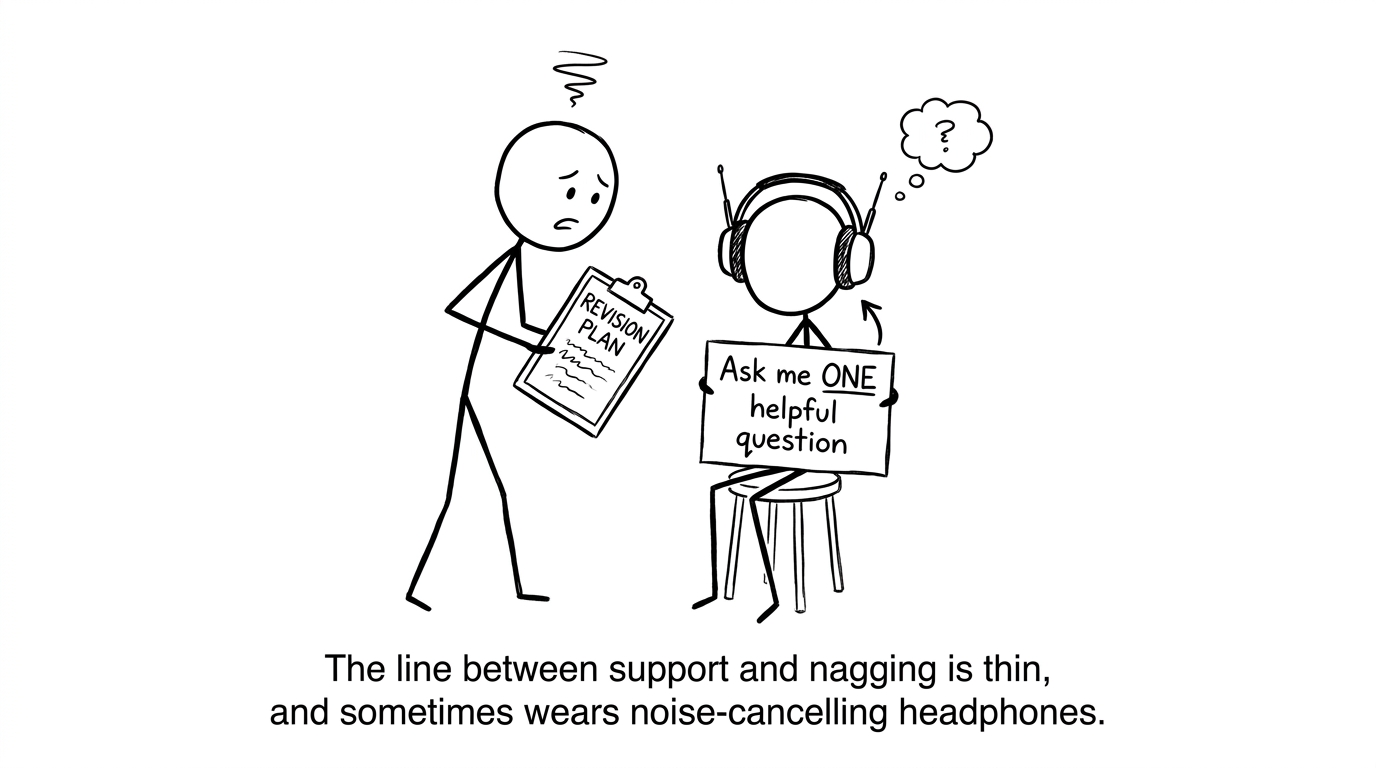 Parent hovering with a revision plan vs one helpful question
A no-nagging checklist that actually works for GCSE revision
If you only take one thing from this, take this: nagging is repeated instruction without new information. Support is changing the environment so the next good decision is easier.
Here’s a quick checklist parents can use to support GCSE revision without becoming the “revision police”:
- Agree a revision rhythm (same time, short blocks, predictable).
- Ask one helpful question instead of five anxious ones.
- Make resources frictionless: open tabs, printed papers, charged calculator.
- Focus on mark scheme practice, not just reading notes.
- Help them choose the next tiny task (10--20 minutes).
- Celebrate evidence of process: “You marked it and fixed it” beats “You revised loads”.
For maths practice that feeds straight into GCSE Chemistry marks, YesGenie is ideal because it’s built for short, focused wins: lessons, practice questions, mini tests, past papers, predicted papers, and video solutions.
Useful starting points:
- GCSE Maths Past Papers
- Edexcel GCSE Maths Predicted Papers
- Edexcel GCSE Maths Mini Tests
- Resources Hub (Predicted papers, mini tests and more)
- All GCSE Subjects on YesGenie
Why nagging fails (and what to do instead)
Nagging usually comes from love and fear in equal measure: love for the student and fear that time is slipping. But GCSE revision is mostly a behavioural problem, not an information problem. Students generally know they should revise; they struggle to start, to stick, or to feel that revision is working.
A better approach is to replace pressure with structure:
- Structure beats motivation. A student who revises at 5:10pm most days doesn’t need a motivational speech at 8:45pm.
- Autonomy beats control. If they choose the task, they’re more likely to finish it.
- Feedback beats volume. Marking and correcting one set of questions improves more than “three hours of notes”.
When Chemistry revision gets stuck, it’s often because a “simple calculation” doesn’t feel simple. That’s your cue to support the maths quietly, not to demand more Chemistry content.
The parent script: the “one question” rule
If you want to avoid nagging during GCSE revision, agree a single daily check-in question. One. Not a follow-up interrogation, not a second “just quickly”.
Good options include:
- “What’s the one thing you’re going to finish in the next 20 minutes?”
- “Do you want me to sit nearby, or would you rather be left alone?”
- “Should we do a past-paper question and mark it together?”
Notice what’s missing: judgement. You’re not asking whether they’ve revised “enough”. You’re helping them define the next concrete step.
If the student chooses a maths task, you can steer them towards YesGenie without making it a lecture:
- “Want to try a mini test and see what comes up?” -> Edexcel GCSE Maths Mini Tests
- “Let’s do one paper question, then mark it.” -> Edexcel GCSE Maths Past Papers
Build GCSE revision around tiny proof of progress
Students often avoid revision because it feels endless. So make it measurable.
Try this three-step loop (it works brilliantly for GCSE Chemistry and GCSE maths):
- Attempt one exam-style question set (10--20 minutes).
- Mark it with a mark scheme.
- Fix the mistakes and write one “next time I will…” line.
YesGenie makes this loop easier because it’s designed around practice and feedback: question banks, solutions, and exam resources.
If the student is doing Chemistry calculations, you can position maths as the tool that removes stress: “Let’s make the calculation bit automatic.”
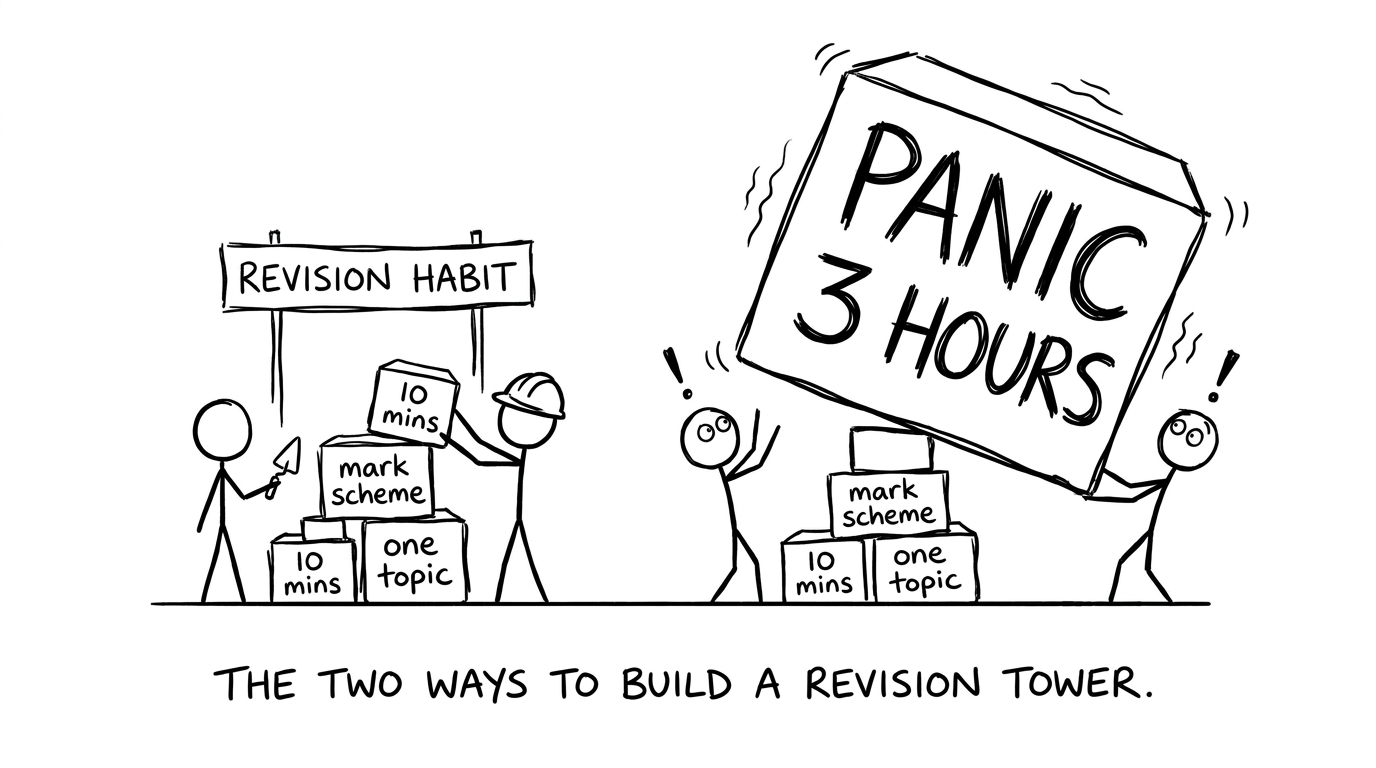 Building revision habits vs panic block
GCSE Chemistry maths: two worked examples (the calm way)
These aren’t Chemistry lessons. They’re the maths moves that repeatedly appear in GCSE Chemistry papers across AQA, Edexcel, OCR and Eduqas.
Rearranging an equation (needed for Chemistry formulas)
A common Chemistry relationship is density:
ρ=mV \rho = \frac{m}{V} ρ=VmIf a question gives ρ\rhoρ and VVV and asks for mmm, you rearrange.
Start with:
ρ=mV \rho = \frac{m}{V} ρ=VmMultiply both sides by VVV:
ρV=m \rho V = m ρV=mSo:
m=ρV m = \rho V m=ρVExample: If ρ=1.2 g/cm3\rho = 1.2\text{ g/cm}^3ρ=1.2 g/cm3 and V=50 cm3V = 50\text{ cm}^3V=50 cm3, then
m=1.2×50=60 g m = 1.2 \times 50 = 60\text{ g} m=1.2×50=60 gParent support tip: don’t say “You should know this”. Say: “Let’s do it slowly once, then you do the next one.” If they need more algebra confidence, build it with short targeted practice, like Simplifying Algebra (Edexcel GCSE Maths).
Percentage change (used in yield, concentration and error)
Students often lose GCSE marks by mixing up “percentage of” and “percentage change”. The core maths is stable.
Example: A reaction should produce 80 g80\text{ g}80 g, but actually produces 68 g68\text{ g}68 g. Percentage yield is:
percentage yield=actualtheoretical×100 \text{percentage yield} = \frac{\text{actual}}{\text{theoretical}} \times 100 percentage yield=theoreticalactual×100So:
percentage yield=6880×100=0.85×100=85% \text{percentage yield} = \frac{68}{80} \times 100 = 0.85 \times 100 = 85\% percentage yield=8068×100=0.85×100=85%Parent support tip: ask them to narrate the method: “What goes on top of the fraction, and why?” Talking through the structure reduces mistakes under pressure.
For more GCSE number confidence (fractions, decimals, percentages), point them towards a structured bank of practice via a GCSE maths board page like Eduqas GCSE Maths Question Bank.
Make the environment do the work (so you don’t have to)
The best no-nagging trick is to reduce the number of decisions required to begin GCSE revision.
Small changes that matter:
- Put the calculator, ruler, and paper in the same place every day.
- Keep one “default” tab open: a past paper or a mini test.
- Agree a “start ritual”: sit down, write today’s aim, start a 15-minute timer.
YesGenie helps here because students can go straight to what they need:
- When they need exam feel: GCSE Past Papers
- When they need targeted focus: Edexcel GCSE Maths Mini Tests
- When they need exam-style predictions: Edexcel GCSE Maths Predicted Papers
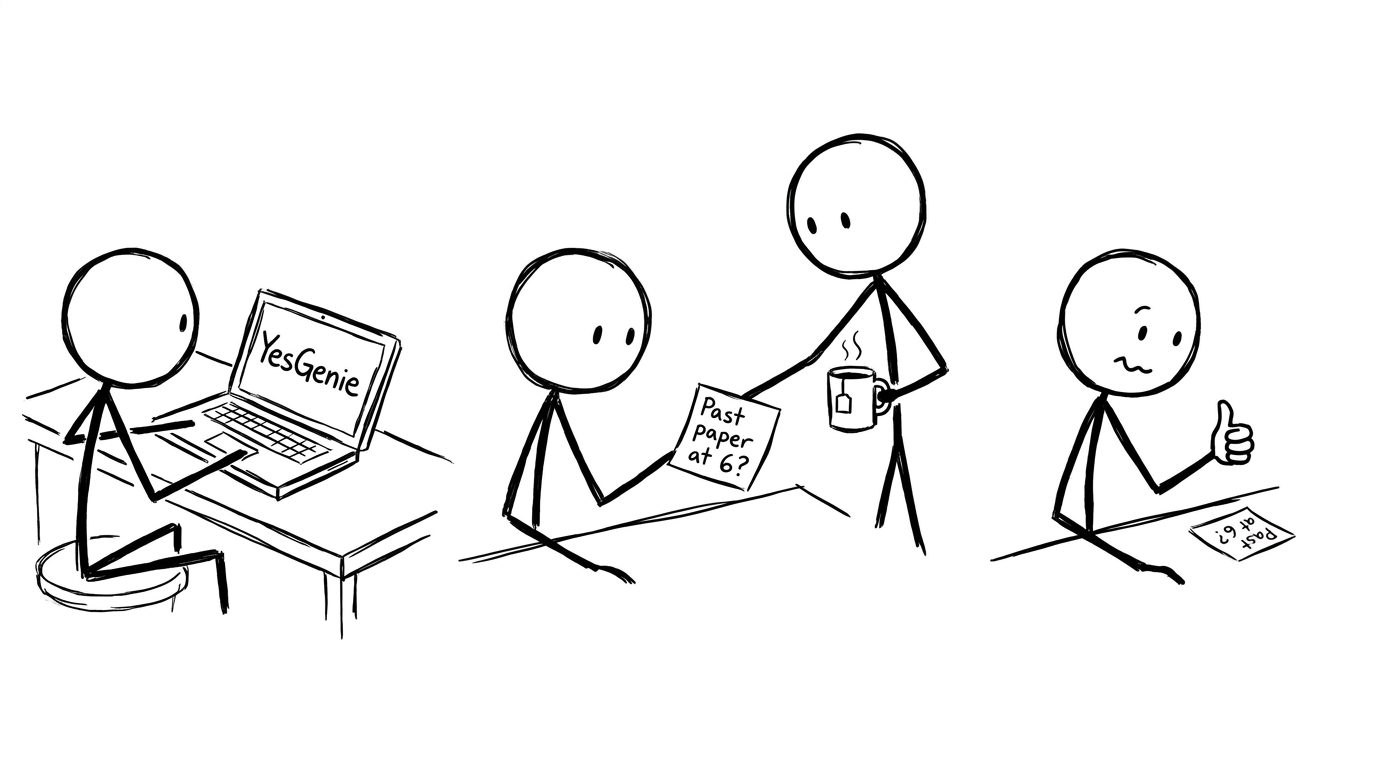 Quiet support with YesGenie on screen
Common mistakes parents make (even the good ones)
These are easy to slip into, especially when GCSE exams feel high-stakes.
- Confusing supervision with support. Sitting behind them monitoring the screen often increases stress and reduces effort.
- Asking “Have you revised?” instead of “What are you revising?” The first triggers defensiveness; the second triggers planning.
- Praising time instead of outcomes. “Three hours” can be passive; “marked, corrected, repeated” is active.
- Fixing the problem for them. If you complete the rearrangement or calculation, they lose the learning moment.
- Treating every low mood as laziness. GCSE revision fatigue is real. Sometimes the best move is food, a walk, then one small task.
- Pushing a perfect timetable. Consistency beats complexity. A sustainable routine wins.
FAQ: supporting GCSE revision without nagging
How can a parent help with GCSE Chemistry revision if they don’t know Chemistry?
You don’t need to know GCSE Chemistry content to be genuinely helpful. Most students don’t fail because they lacked information; they lose marks because they didn’t practise exam-style questions, didn’t check their answers, or panicked when the maths showed up. Your best role is to protect a routine and reduce friction: quiet space, predictable time, and one agreed check-in. You can also help them practise the “exam loop” of attempt, mark, fix, which builds confidence fast across AQA, Edexcel, OCR and Eduqas. When Chemistry calculations appear, you can support the maths method without teaching the science, by asking them to write the formula, substitute carefully, and check units. If they need extra maths practice, you can point them to a structured resource like YesGenie’s lessons, question banks, and GCSE Maths Past Papers.
What should parents say instead of “Have you revised today?”
That question is loaded, even when it’s kindly meant, because it implies there’s a “right” answer. A better approach is to ask a question that creates a next action and preserves autonomy. Try: “What’s the next small task you can finish in 20 minutes?” or “Do you want to do a mini test or a past-paper question?” This helps the student move from vague guilt to a specific plan, which is where GCSE revision actually begins. You can also ask: “What are you stuck on?” and then help them choose a resource, rather than trying to solve it verbally on the spot. If the student is unsure what to do, suggest a default: a mini test from YesGenie, because short tests lower the emotional barrier to starting. Over time, the student starts expecting the routine, and the question stops feeling like pressure.
How do we balance GCSE Chemistry with GCSE maths without arguments?
First, name the real issue kindly: most students don’t mind working, they mind feeling behind. If Chemistry revision triggers stress because of calculations, the student may avoid Chemistry entirely, then feel guilty, then avoid everything. The fix is to treat GCSE maths as a support subject that makes Chemistry easier, not as an extra burden. Agree on a split that respects energy: for example, one Chemistry task and one short maths task, both marked and corrected. Use clear boundaries: revision happens, but it ends at a sensible time, and rest is part of the plan. Choose resources that make switching easy: YesGenie’s mini tests for quick maths practice and predicted papers when exams get close. Finally, make the conversation about marks and methods, not morality; GCSE results improve faster when the home feels safe enough to try and fail on paper.
A calm ending: support the process, not the panic
The best GCSE revision support often looks small from the outside. A student opens a paper without being asked. They mark it. They fix two errors. They go to bed at a reasonable time. None of it is dramatic, but it compounds.
If you’re a parent, your job isn’t to be the voice in their head. It’s to build a home where GCSE effort can happen without constant friction. If you’re a student, remember that confidence is usually built from evidence: questions attempted, mark schemes checked, methods repeated.
YesGenie can be the shared tool that removes conflict: revision lessons when you need clarity, practice questions when you need reps, and exam resources when you need realism. Start with GCSE Past Papers, add Edexcel GCSE Maths Predicted Papers when exams are near, and keep momentum with Edexcel GCSE Maths Mini Tests. Pick one small task today -- and let that be enough to start.
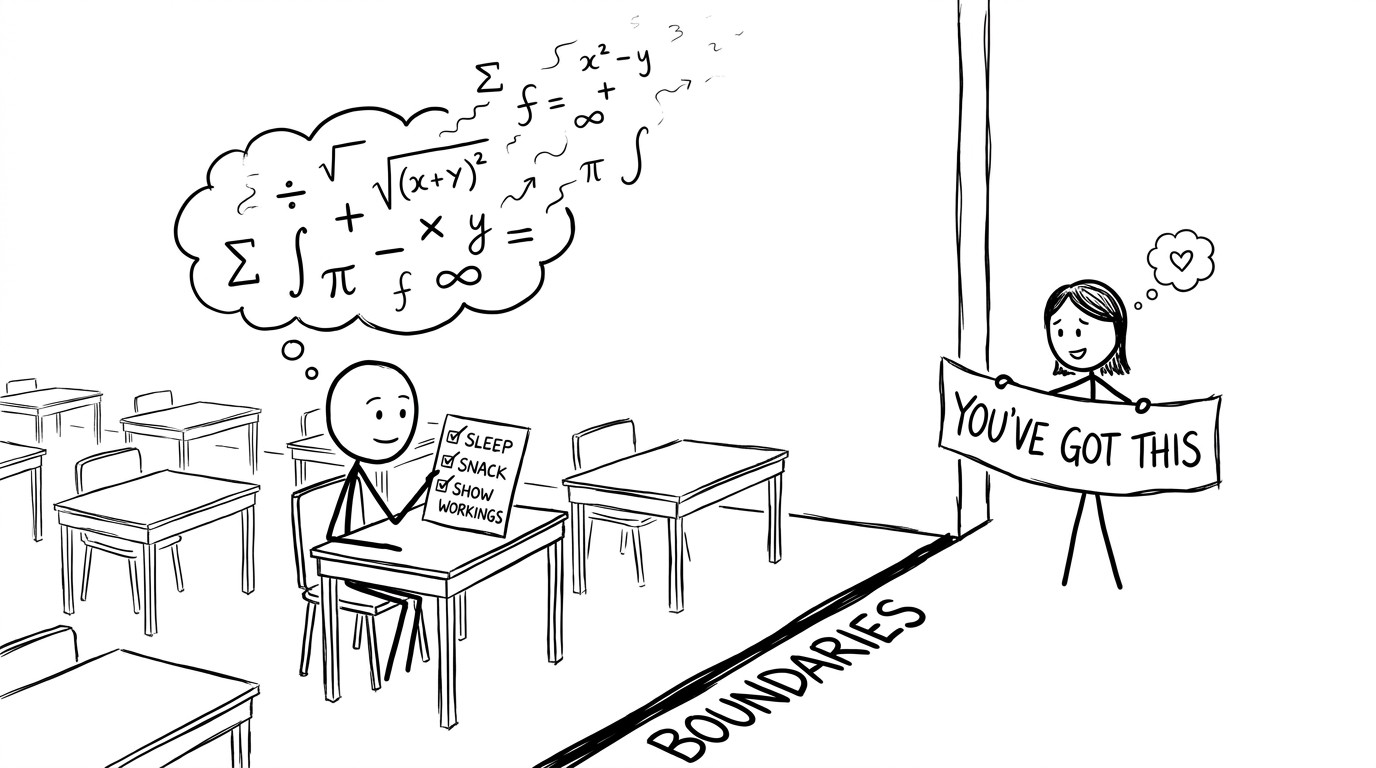 Exam calm checklist with boundaries