

GCSE: Turn Chemistry Notes Into Active Recall
GCSE revision: learn how to turn Chemistry notes into active recall with a simple workflow, plus maths-style examples, checklists and exam-ready routines.
A familiar GCSE trap: beautiful notes, shaky memory
GCSE revision often starts with good intentions: you rewrite Chemistry notes neatly, colour-code headings, and feel organised. Then you open a past paper and realise the facts don’t arrive on command. It’s not that you’re “bad at Chemistry” -- it’s that notes are usually storage, not retrieval. Marks come from what you can pull out of your head under timed pressure, not what you can recognise on a page.
Active recall is the simple shift: you turn notes into prompts, then practise answering them without looking. And here’s the part most students miss: the same mindset that improves GCSE Chemistry also improves GCSE maths. Maths rewards the ability to recall methods quickly, choose an approach, and execute accurately. So this post uses Chemistry as the example, but it’s written for students who want that calm, repeatable revision system across all subjects -- especially maths.
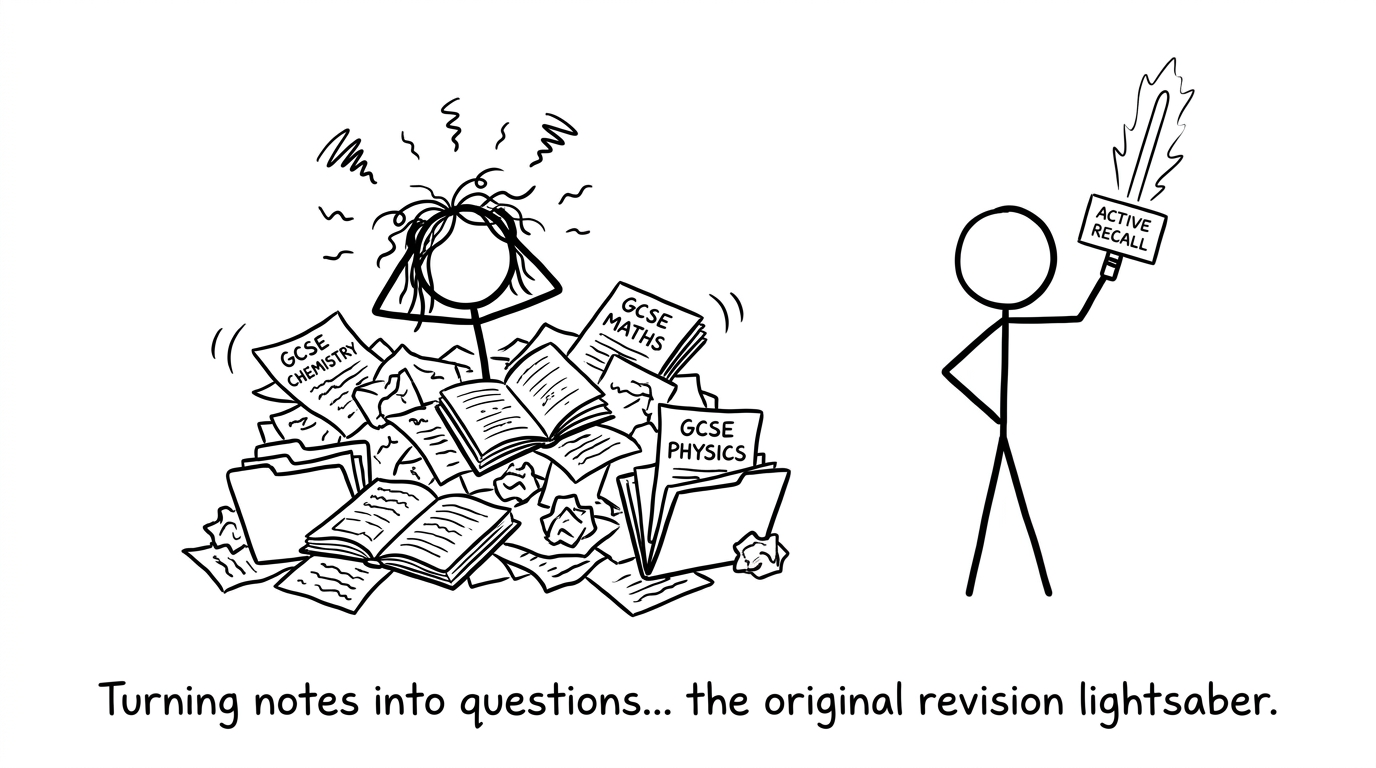 Stick figures with messy notes and a flashcard lightsaber
The active recall checklist (turn any notes into marks)
Use this as your “conversion” process from passive notes to active recall:
- Choose a small chunk (one lesson or one spec point).
- Write questions, not summaries (prompts you can answer from memory).
- Close the notes and answer in bullet points.
- Mark using the mark scheme style (add missing keywords, correct misconceptions).
- Log mistakes in a tiny “error bank” (1-2 lines per mistake).
- Spaced repetition: re-test after 1 day, 3 days, 7 days, then weekly.
- Add exam pressure: timed practice once recall is stable.
If you want this approach for maths straight away, pair it with YesGenie’s topic resources and papers: GCSE Predicted Papers and GCSE Past papers.
Why active recall beats re-reading (and why GCSE maths students should care)
Re-reading is comforting because the page does the work. Your brain gets the warm feeling of familiarity, which looks like confidence until you’re asked to perform. Active recall is uncomfortable in a useful way. The discomfort is information: it tells you what you can’t yet retrieve.
GCSE maths makes this obvious. If you “understand” simultaneous equations but cannot retrieve the elimination steps under time pressure, you lose marks. Chemistry behaves the same way with processes and definitions: bonding, rates, electrolysis, required practicals, and calculations.
So think of active recall as training the exam version of you. The quiet student who can still produce the right method when their mind goes blank for a second.
How to convert GCSE Chemistry notes into active recall prompts
Step 1: Split your notes into “exam-shaped” chunks
Take one double-page spread and divide it into:
- Definitions (short, mark-scheme friendly)
- Processes (steps in order)
- Comparisons (e.g. ionic vs covalent, exothermic vs endothermic)
- Calculations (methods, units, rearrangements)
- Required practicals (apparatus, variables, risks, conclusions)
Each category becomes a different style of active recall question.
Step 2: Use better question stems
Weak prompt: “Electrolysis notes”
Strong prompts:
- “Define electrolysis in one sentence suitable for a 2-mark GCSE question.”
- “State two observations at each electrode when electrolysing aqueous copper(II) sulfate with carbon electrodes.”
- “Explain why graphite is used as an electrode.”
Notice how these resemble mark schemes: specific, constrained, and answerable.
Step 3: Make your answers markable
When you answer from memory, write:
- Bullet points (not paragraphs)
- Keywords you expect in the mark scheme
- A simple diagram only if it adds information
Then check your notes and add what you missed in a different colour. That colour is not decoration -- it’s a record of the gap you just closed.
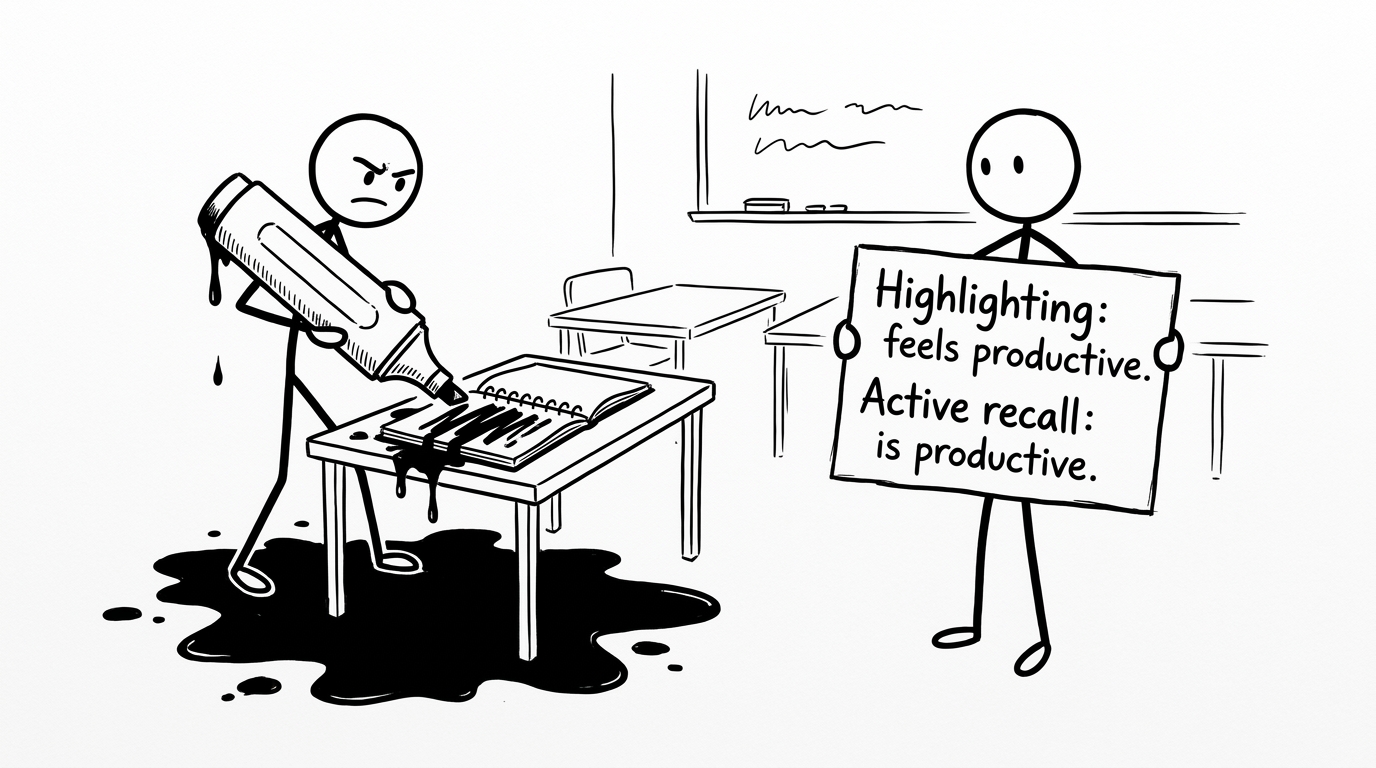 Stick figure highlighting everything vs active recall sign
Worked example: turning one Chemistry page into active recall (plus the maths mindset)
Let’s take a common GCSE topic: moles and reacting masses. You might have notes full of definitions and a worked example. Active recall means converting the page into 8-12 prompts.
Active recall prompts you’d create
- “What is the formula for moles?”
- “What are the units for relative atomic mass and molar mass?”
- “How do you find the mass of 0.250.250.25 moles of MgO\text{MgO}MgO?”
- “If you’re given a balanced equation, how do you use mole ratios?”
Answering one prompt (with full method)
Prompt: “Find the mass of 0.250.250.25 moles of MgO\text{MgO}MgO.”
- Find molar mass:
- Use m=n×Mrm = n \times M_rm=n×Mr:
That’s the Chemistry. But notice the maths skill underneath: substitution into a formula, unit awareness, and tidy arithmetic. This is exactly why GCSE maths revision improves when you adopt active recall: you stop “following along” and start producing methods.
For maths method recall, YesGenie’s board pages organise everything cleanly: Edexcel GCSE Maths Revision and OCR GCSE Maths Revision.
How to run active recall sessions (so it actually sticks)
The 12-minute loop
This is short enough to start even on tired days:
- 2 minutes: pick one micro-topic (e.g. “rates of reaction graphs”).
- 6 minutes: answer 6-10 prompts without notes.
- 3 minutes: check notes/mark scheme, correct in a different colour.
- 1 minute: write one “error bank” line: what I missed and the fix.
Repeat. Your brain starts to trust the process because it can see progress quickly.
Add “exam conditions” once recall is stable
After a few loops, move to timed practice. In maths, that’s best done with real papers and video solutions. Use:
- Edexcel GCSE Maths Past Papers
- Edexcel GCSE Maths Predicted Papers
- Example of a paper page with worked support: GCSE Edexcel Paper 2 (example page)
The pattern is the same across GCSE subjects: retrieve first, then check.
Making flashcards that don’t waste your time
Flashcards work when they are specific and mark-scheme aligned. They fail when they become mini-essays.
Chemistry flashcard rules
- One card = one idea.
- Use “why” and “how” cards, not just definitions.
- Include required practicals as process cards: variables, control, hazards, conclusions.
- For calculations, one card should be “method steps”, another should be a full example.
Maths-style flashcards (the transferable trick)
For GCSE maths, your best flashcards are “method triggers”:
- “When do I use Pythagoras?”
- “How do I rearrange y=3x−5y = 3x - 5y=3x−5 to make xxx the subject?”
Example recall card answer:
Given y=3x−5y = 3x - 5y=3x−5:
y+5=3x y + 5 = 3x y+5=3x x=y+53 x = \frac{y+5}{3} x=3y+5Even if this post is about GCSE Chemistry notes, the habit you’re building is the same one that raises maths grades.
Common mistakes when turning notes into active recall
- Keeping prompts too vague: “Revise bonding” is not a question. GCSE recall needs prompts like “State two properties of ionic compounds and explain why they occur.”
- Checking too quickly: if you look after ten seconds, you train panic. Give yourself time to think and attempt.
- Writing perfect model answers too soon: first, answer from memory. Then refine with mark-scheme wording.
- Ignoring calculations: many students convert only facts into prompts, but GCSE Chemistry marks often hinge on calculation method and units.
- No spacing: one intense evening feels productive, but recall fades. Spaced retrieval is where the gains compound.
- Not tracking errors: if you don’t keep an error bank, you repeat the same mistakes and call it “more revision”.
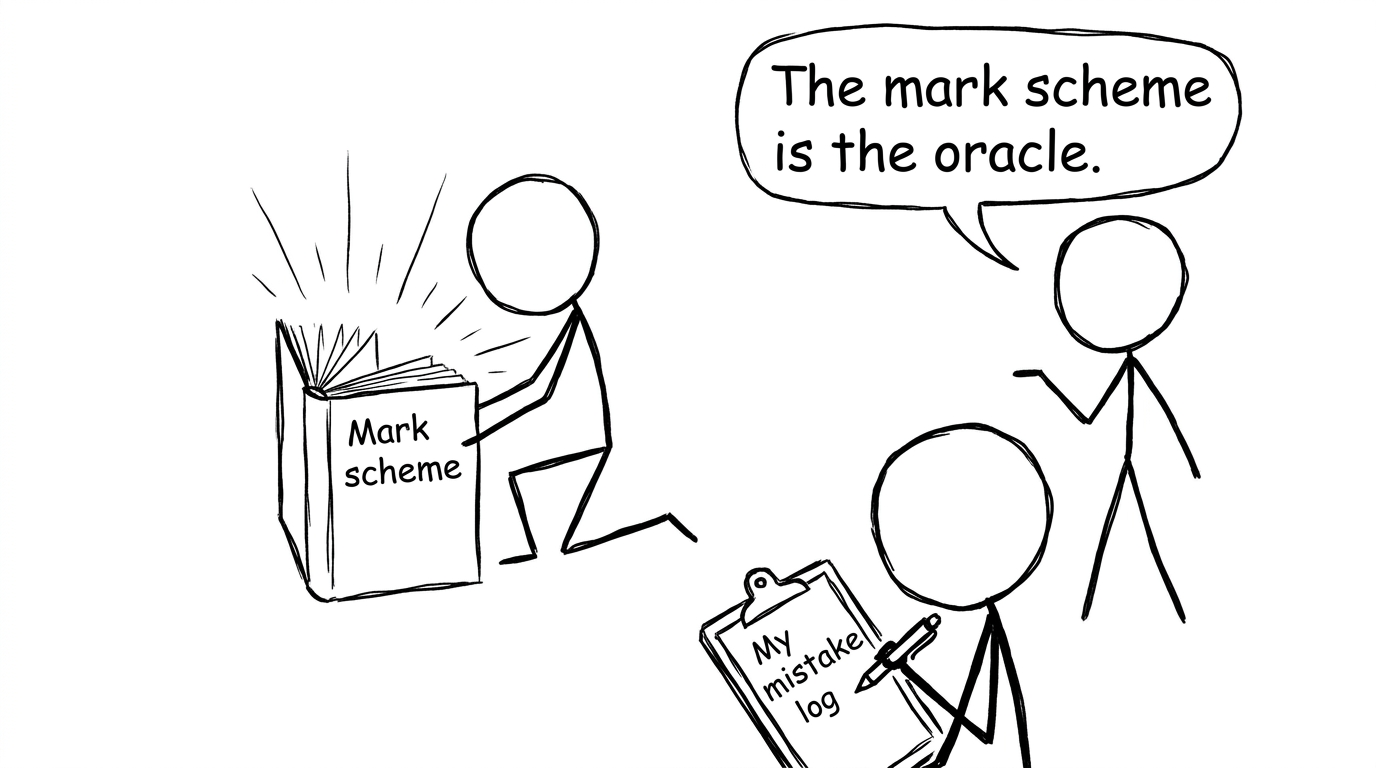 Stick figures with a glowing mark scheme treasure chest
FAQ
How many active recall questions should I make from one GCSE Chemistry topic?
Aim for fewer, better prompts. For a single GCSE lesson, 888 to 151515 strong questions is usually enough, because the real value is repeated retrieval over time. If you make 505050 questions in one sitting, you often end up with vague cards you never review. Start by covering definitions, one process, one comparison, and one calculation method. Then add prompts that target your mistakes, because those give the highest return on time. Over a few weeks, your deck grows in the right direction: shaped by what you forget, not by what looks neat in your folder.
I’m revising GCSE maths -- why should I care about active recall in Chemistry?
Because GCSE maths success is mostly retrieval under pressure: knowing which method to use and executing it accurately. Chemistry forces you to practise the same mental move, just with different content: definitions, steps, and calculations. When you learn to turn notes into active recall, you stop being a passive consumer of information and become someone who can produce answers on demand. That changes how you approach a maths topic too: you start asking “Can I do this without looking?” rather than “Do I recognise this example?” Pair the habit with timed practice on YesGenie, using GCSE Past papers and GCSE Predicted Papers, and you’ll feel the difference in speed and confidence.
Should I use past papers before I’ve finished making active recall cards?
Yes, but with a clear purpose. Use past-paper questions early to discover what exam boards actually reward: wording, working, and common traps. Then convert what you missed into new active recall prompts, so your revision deck evolves from real evidence. This is especially useful across AQA, Edexcel, OCR and Eduqas styles, where the topic is similar but the phrasing differs. For maths, this feedback loop is even more direct: the mark scheme teaches method, and your error bank tells you what to retrieve next time. If you’re doing Edexcel GCSE maths, keep it simple and consistent by working through Edexcel GCSE Maths Past Papers alongside the Edexcel GCSE Maths Revision topic structure.
How do I fit active recall around homework, mocks, and multiple subjects?
Think in loops, not marathons. A 121212-minute active recall loop is small enough to fit between tasks, and it keeps momentum when you don’t have a “perfect” two-hour window. Use a weekly plan: two short loops per day for content-heavy subjects, and one longer timed session for maths papers at the weekend. The key is consistency: recall today, again tomorrow, again next week. When mocks get close, reduce new cards and increase timed practice, because GCSE marks come from performance. YesGenie helps here because you can shift smoothly from learning to practising: revision content, then practice questions, then past papers and predicted papers, all in one place.
Closing: turn GCSE notes into something that answers back
Notes are quiet. They sit there politely, waiting for you to look at them. Exams aren’t polite. GCSE questions ask you to retrieve, decide, and write something precise while the clock keeps moving.
So turn your GCSE Chemistry notes into active recall prompts, practise them on a schedule, and let mistakes guide what you do next. Then carry the same approach into GCSE maths: retrieve methods, check with mark schemes, and repeat until it becomes automatic. When you’re ready to add exam pressure, build your routine around YesGenie’s free resources -- Edexcel GCSE Maths Revision, OCR GCSE Maths Revision, Edexcel GCSE Maths Past Papers, and Edexcel GCSE Maths Predicted Papers.
If you want the simplest next step: pick one topic tonight, write ten active recall prompts, and test yourself before you sleep. GCSE progress often starts that quietly -- one honest attempt at retrieval, repeated until it sticks.