
GCSE: Use AQA Past Papers Properly (Maths Student Plan)
GCSE revision: learn how to use AQA past papers properly with a simple routine, smart marking, and maths-style tracking to boost your grades fast.
GCSE revision can feel oddly repetitive: you do an AQA GCSE Chemistry past paper, you mark it, you promise yourself you’ll “learn it”, and then you move on. A week later, the same mistake appears again, like it never left. The paper wasn’t the problem. The way you used it was.
If you revise maths, you already know the uncomfortable truth: progress comes from feedback loops. In maths, you don’t just “do questions” -- you analyse methods, spot patterns in errors, and practise the exact skill until it becomes automatic. You can use AQA GCSE Chemistry past papers the same way, and the difference is immediate.
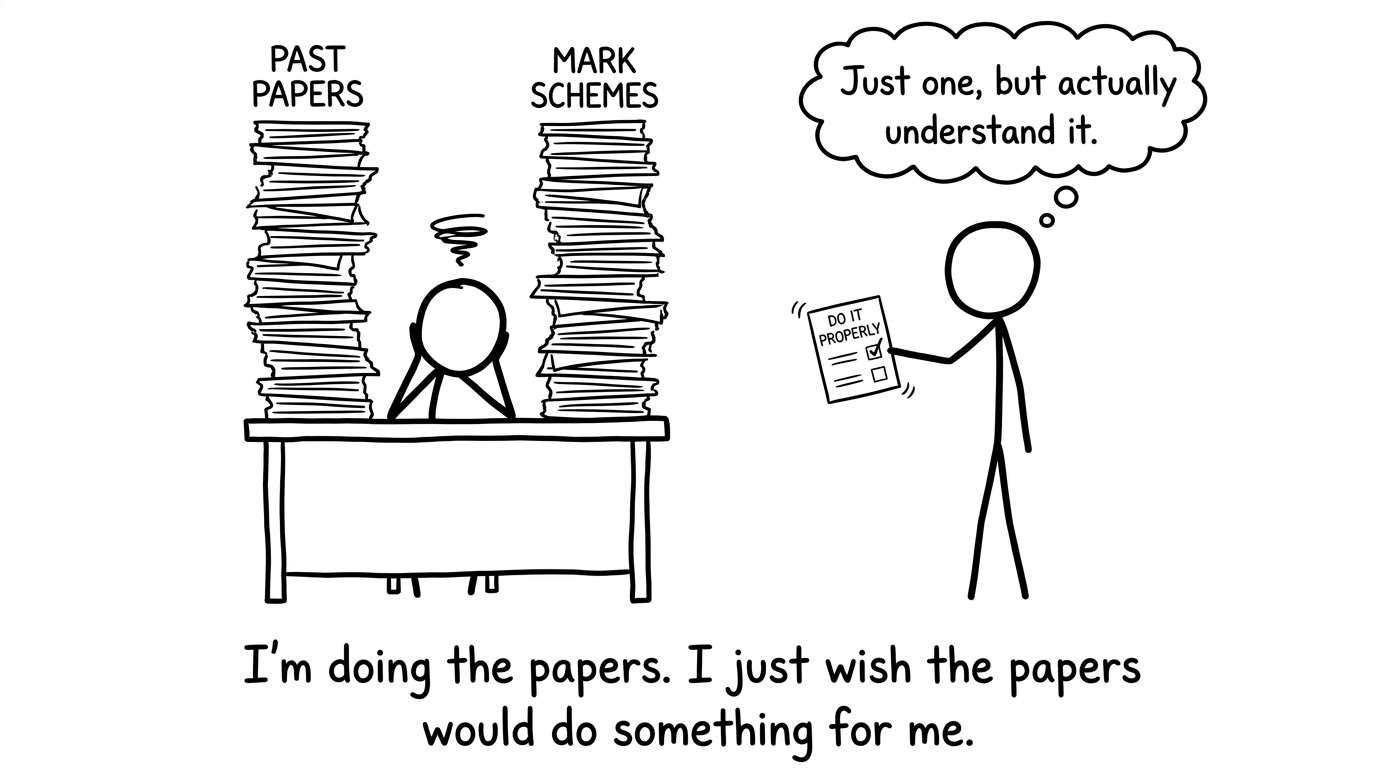 A student facing a mountain of past papers and a tiny checklist
AQA past papers, used properly: the maths student checklist
Here’s the routine that stops past papers becoming a comfort blanket and turns them into a results machine (for GCSE grades 9-1).
- Pick the right paper (AQA Trilogy/Separate, higher/foundation, paper 1/paper 2).
- Sit it in two modes: learning mode first, then exam mode.
- Mark with the mark scheme like you’d check a worked solution in maths.
- Convert every lost mark into a micro-skill to practise.
- Track mistakes by type (not by topic name).
- Re-attempt the same questions after 484848 hours and again after 777 days.
Alongside Chemistry revision, keep your maths sharp with YesGenie’s free exam resources: GCSE Past papers, Resources hub, and topic-by-topic practice via AQA GCSE Maths Lessons.
Choose the right AQA GCSE Chemistry past paper (so the data is real)
AQA Chemistry has paper 1 and paper 2, and many students accidentally mix specifications: Combined Science: Trilogy vs Separate Sciences, higher vs foundation, and different years.
If you’re a maths student, treat paper choice like choosing the right set of exam-style questions. If the paper doesn’t match your course, the “feedback” is noisy. Your score won’t mean much, and your revision plan will drift.
A simple rule:
- If you’re targeting grade 7-9, sit higher-tier style questions early, but don’t rush to full timed papers.
- If you’re targeting grade 4-6, build accuracy first, then add time pressure.
On YesGenie you can keep your maths exam practice organised by board and tier too, for example: Edexcel GCSE Maths Past Papers and Eduqas GCSE Maths Revision.
Two modes that change everything: learning mode then exam mode
Most students only use past papers in one mode: panic mode. Timer on, adrenaline up, and then a deflated marking session where the mark scheme feels like judgement.
A better approach is the two-mode system.
Learning mode (first attempt)
- No timer.
- Use your notes when you genuinely need them.
- Write down why you used a step.
This is exactly how you’d learn a new maths method: you wouldn’t time your first attempt at completing the square, you’d build the method.
Exam mode (second attempt)
- Full timing.
- No notes.
- Strict answer-only discipline when the question demands it.
That second attempt is where confidence becomes real.
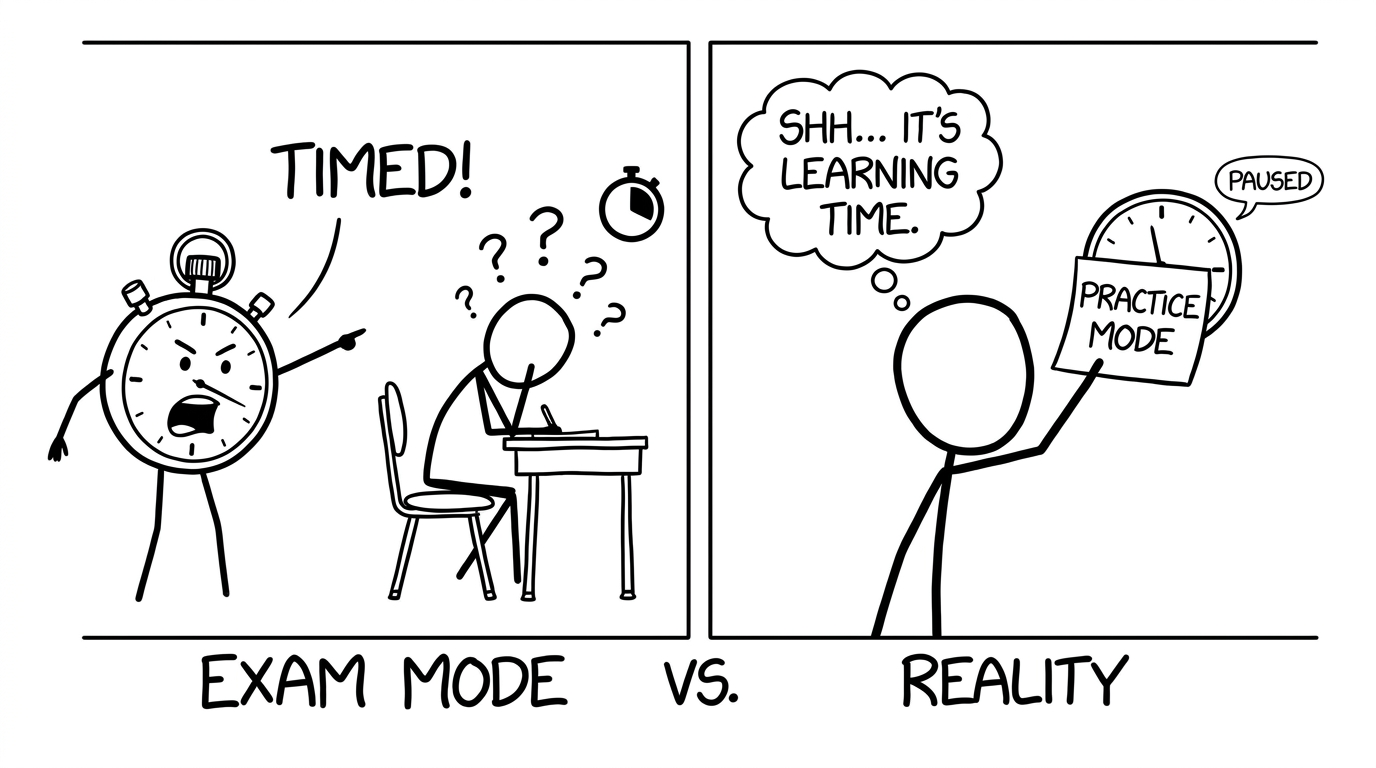 A stopwatch shouting “TIMED!” while a sticky note says “practice mode”
Mark like a mathematician: marks are clues, not scores
In GCSE maths, you learn quickly that you can lose marks even when your “idea” was right: rounding, units, misread scales, weak algebra. AQA GCSE Chemistry is the same. A mark scheme isn’t just answers -- it’s a map of what counts.
When you mark, sort every lost mark into one of these buckets:
- Knowledge gap (you didn’t know the fact)
- Process gap (you knew it, but couldn’t apply the steps)
- Communication gap (you had it, but didn’t write the key word/units)
- Exam-technique gap (you misread, missed a command word, ran out of time)
That classification matters because the fix is different each time.
To keep your maths marking equally sharp, use worked solutions and videos: a good example of this style is YesGenie’s Paper 1 - Video Solutions.
Worked example: using maths to audit a Chemistry calculation question
AQA GCSE Chemistry calculation questions often reward method marks, just like GCSE maths. Here’s how to review one properly.
Imagine a question where you calculate percentage yield:
- Actual yield: 9.6 g9.6\text{ g}9.6 g
- Theoretical yield: 12.0 g12.0\text{ g}12.0 g
The percentage yield is
percentage yield=actualtheoretical×100 \text{percentage yield}=\frac{\text{actual}}{\text{theoretical}}\times 100 percentage yield=theoreticalactual×100Substitute:
percentage yield=9.612.0×100 \text{percentage yield}=\frac{9.6}{12.0}\times 100 percentage yield=12.09.6×100Compute:
9.612.0=0.8 \frac{9.6}{12.0}=0.8 12.09.6=0.8So
0.8×100=80 0.8\times 100=80 0.8×100=80Final answer: 80%80\%80%.
Now the past-paper part: if you lost marks here, don’t just rewrite the correct answer. Identify the failure mode.
- If you wrote 12.09.6×100\frac{12.0}{9.6}\times 1009.612.0×100, that’s a process gap (formula structure).
- If you got 0.080.080.08 instead of 0.80.80.8, that’s a calculator/process gap (place value).
- If you missed the %\%%, it’s a communication gap (units/symbols).
Then you build a mini drill: do 555 percentage calculations (yield, concentration, percentage by mass) across different topics. This is how maths students move fast: same skill, different context.
For pure maths calculation fluency, YesGenie’s question sets are designed exactly for this kind of drilling. Start from a bank and build consistency: Eduqas GCSE Maths Question Bank.
The mistake log that actually improves GCSE grades
Most “mistake logs” are lists. Lists don’t change behaviour. Patterns do.
Create a simple table (paper, question, mark lost, mistake type, fix, re-attempt date). Then add one more column: what would have stopped this?
Examples:
- “I forgot the test for gases” -- fix: make 101010 flashcards, then re-attempt a 6-mark question.
- “I didn’t state ‘increase temperature increases rate’ with collision theory” -- fix: learn the sentence stems.
- “I didn’t convert cm3\text{cm}^3cm3 to dm3\text{dm}^3dm3” -- fix: do a conversions mini set.
Even though this is Chemistry, that last one is maths at heart. Units are where marks quietly disappear.
If you want structured practice habits in maths, YesGenie’s wider resource system helps you rotate between lessons, practice questions, and exam papers: Resources and Other Resources.
Common mistakes students make with AQA GCSE Chemistry past papers
- Doing too many papers too early: You get lots of scores and very little learning. In GCSE maths, 101010 untargeted papers can be worse than 222 carefully reviewed ones.
- Marking like it’s binary: Chemistry marks are often for method, key words, and reasoning. If you only check the final answer, you miss the real lesson.
- Ignoring command words: “Explain” and “describe” are not the same, and AQA rewards precision.
- Not re-attempting: A past paper only pays you back when you return to the questions you got wrong.
- Letting time pressure hide gaps: If you always work timed, you can’t tell whether you’re slow because you’re under-practised, or because you don’t understand.
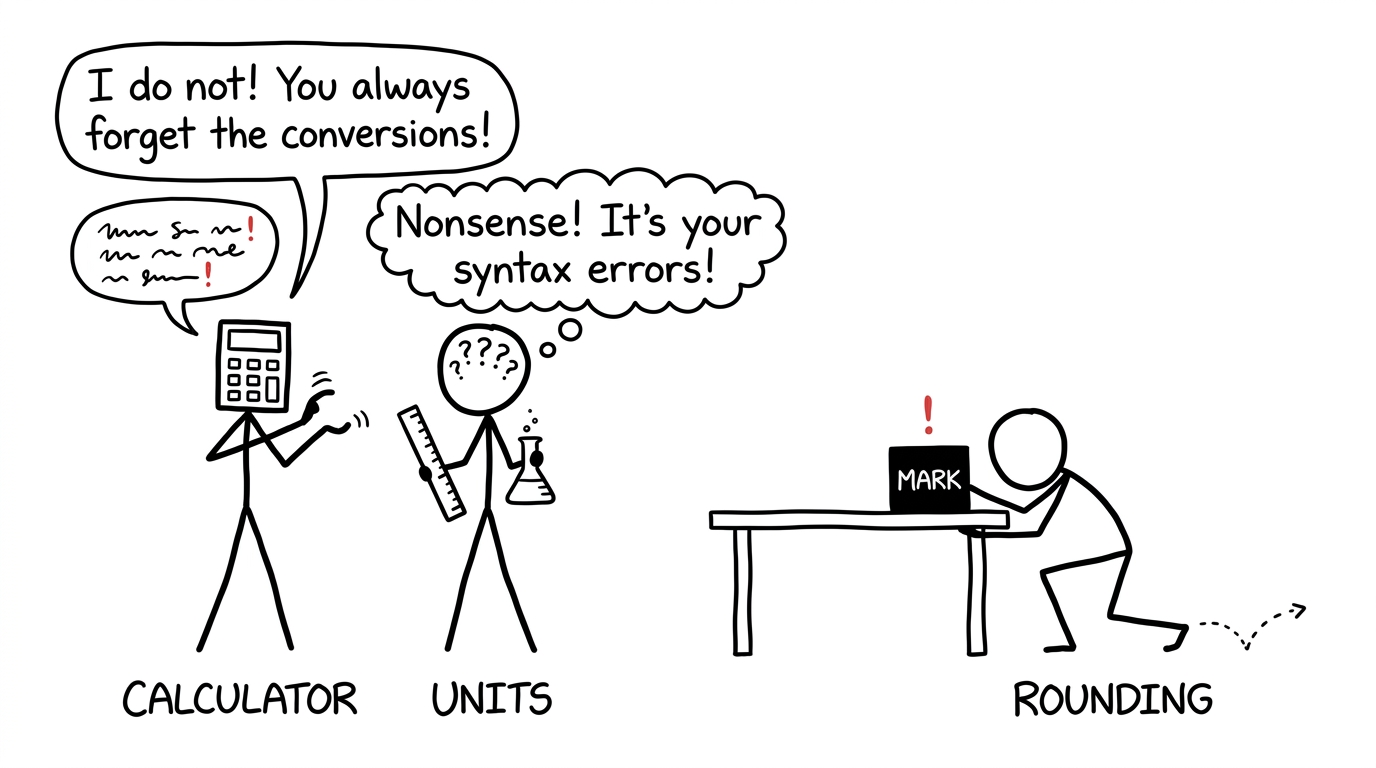 Stick figures arguing: Calculator vs Units, while Rounding steals a mark
How maths revision makes Chemistry past papers easier
Chemistry has a reputation for “content”, but GCSE success is often about handling information under pressure. Maths revision trains that.
- You learn to show working clearly (useful for method marks).
- You learn to check reasonableness (e.g. if your percentage is >100%>100\%>100%, something is wrong).
- You learn to handle ratios, graphs, rearranging formulae, and units without panic.
So if you’re revising both, don’t compartmentalise. AQA GCSE Chemistry past papers can be your exam technique training, and GCSE maths can be your accuracy training.
If you need a clean, topic-by-topic route through maths while you do science papers, keep a single home base: AQA GCSE Maths Lessons.
FAQ: using AQA GCSE Chemistry past papers properly
How many AQA GCSE Chemistry past papers should I do for GCSE revision?
Enough to expose your patterns, not so many that you stop learning from them. For most students, 333 to 666 full AQA GCSE Chemistry past papers per paper (paper 1 and paper 2) is a strong amount if you properly review and re-attempt mistakes. The real time commitment isn’t sitting the paper, it’s the 454545 to 909090 minutes after, when you turn lost marks into targeted practice. If you do a paper and don’t create a fix list, you’ve mostly practised being disappointed. A better approach is to do fewer papers but cycle back: first attempt (learning mode), second attempt (exam mode), then a final re-attempt of only the questions you missed. This method is very similar to GCSE maths revision where repeating the same skill, correctly, is what raises grades.
Should I do past papers timed from the start?
Not at the start, because timing can hide the reason you’re struggling. In early GCSE revision, sit parts of an AQA GCSE Chemistry past paper in learning mode so you can build correct method and language. Once you can consistently earn method marks, then add the timer and practise the exam rhythm. Think of it like maths: you don’t time your first attempts at simultaneous equations; you learn the steps, then build speed. Timed practice is essential, but it’s the second layer, not the foundation. If you’re running out of time, diagnose whether it’s reading speed, decision-making, or weak recall causing you to hesitate. Then your timed papers become training, not punishment.
What do I do if I keep losing marks on “explain” questions?
Treat explanations like a method, not like free-writing. First, use the mark scheme to identify the exact phrases AQA rewards (for example, ideas like “more frequent collisions” or “greater kinetic energy” when explaining rate). Then write a short “sentence stem” you can reuse, and practise applying it to different contexts. You can even mark your own explanation like a maths proof: do you have the key cause, the mechanism, and the outcome? After that, re-attempt the same question 484848 hours later without looking, and compare your answer to the mark scheme again. Over time you’ll build a bank of reliable explanation structures, which is exactly how students improve in GCSE maths on show-that or reasoning questions. The goal isn’t originality, it’s clarity under exam pressure.
Bringing it all together (and keeping your GCSE momentum)
AQA GCSE Chemistry past papers work when you stop treating them like a scoreboard and start treating them like a mirror. They show you what you think you know, what you can do under pressure, and what you can communicate for marks. The maths-student advantage is that you already understand the loop: attempt, mark, diagnose, practise, re-attempt.
If you want that same loop for your GCSE maths revision, YesGenie is built for it: free revision lessons, practice questions, mark schemes, video solutions, and exam-style papers in one place. Start with GCSE Past papers, use the Resources hub to plan your weekly routine, and keep your core maths skills strong through AQA GCSE Maths Lessons. Your GCSE grades don’t change when you do more papers -- they change when you learn more from each one.