

GCSE WJEC Biology Exam Week Checklist (Simple Guide)
GCSE WJEC Biology exam week checklist: a simple plan for calm, effective revision, plus maths time blocks, past papers and common mistakes.
You can feel it in the week before a GCSE exam. Your bag is heavier, your sleep is lighter, and every subject suddenly starts negotiating for your attention like a noisy group chat. WJEC Biology wants flashcards. Maths wants practice papers. English wants quotations. And you just want a plan that makes the week feel possible.
This is that plan: a simple GCSE WJEC Biology exam week checklist, written for students who are revising multiple subjects and need something realistic. Because even if Biology is tomorrow, your maths still matters too -- and you can protect it with small, high-quality blocks.
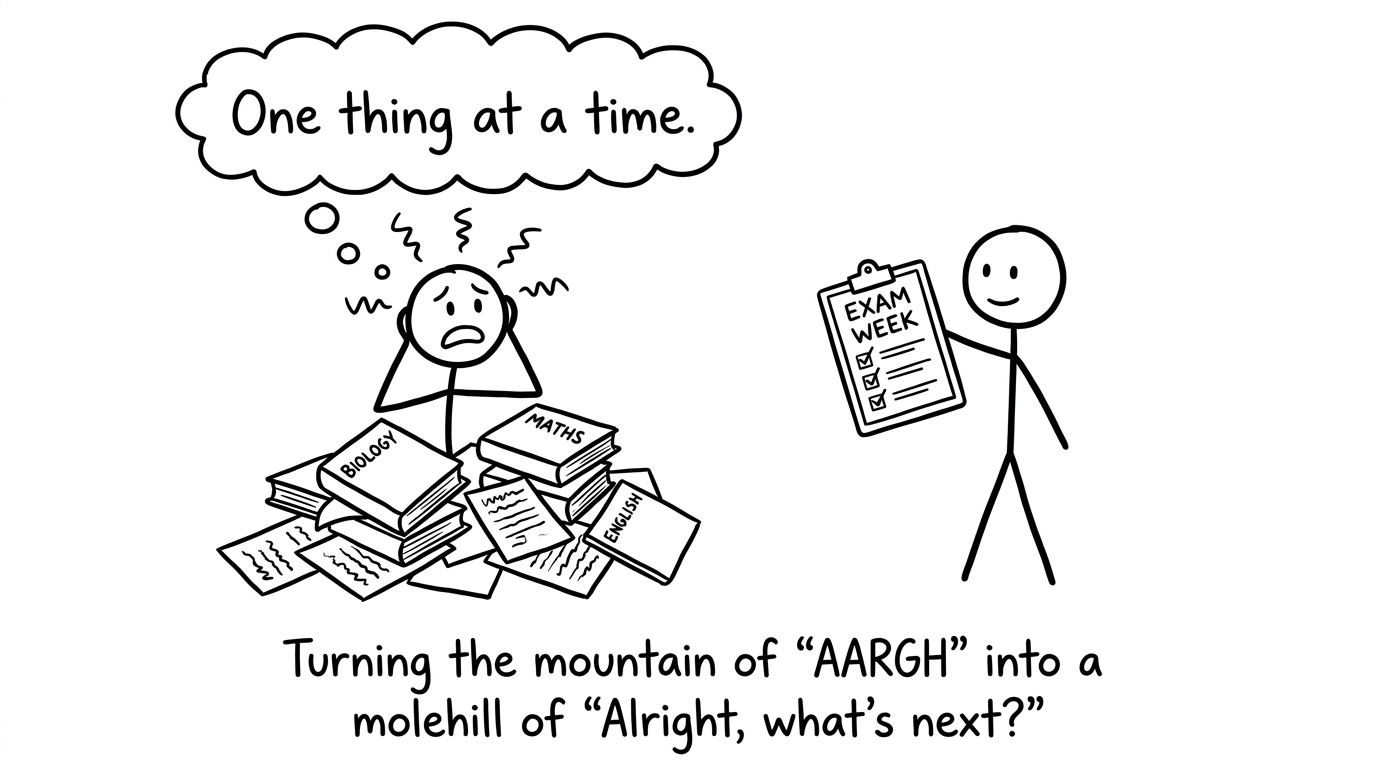 A simple checklist beats panic
The simple exam-week checklist (print this mentally)
Use this checklist for each day of exam week. It keeps your WJEC Biology moving forward without letting your GCSE maths drift.
- Pick one Biology focus (a topic, not “everything”).
- Do one active recall task (closed-book).
- Do one exam-style task (timed, then mark it).
- Fix three specific mistakes (write them down).
- Keep a small maths block (20--40 minutes) to stop rust.
- Prepare your kit and timings the night before.
If you want ready-made maths blocks, YesGenie is built for this exact week: quick lessons, mini tests, past papers, predicted papers, and video solutions.
Useful starting points:
- GCSE Maths Revision
- Edexcel GCSE Maths Lessons
- Edexcel GCSE Maths Revision Guides
- Edexcel GCSE Maths Mini Tests
- Edexcel GCSE Maths Predicted Papers
- GCSE Past Papers (All Subjects)
- GCSE Mini Tests (Browse)
- Resources Hub
What “WJEC exam week revision” should feel like
A lot of students try to revise in a mood. They wait to feel motivated, then do a long session, then crash. Exam week doesn’t reward that pattern.
Exam week rewards repeatable. Short sessions you can finish even when you feel tired. Clear tasks you can mark. Small wins you can stack.
For WJEC Biology, that usually means: definitions, processes, required practicals, and exam command words. For GCSE maths, it means: keeping methods warm (so you don’t waste marks remembering how to start).
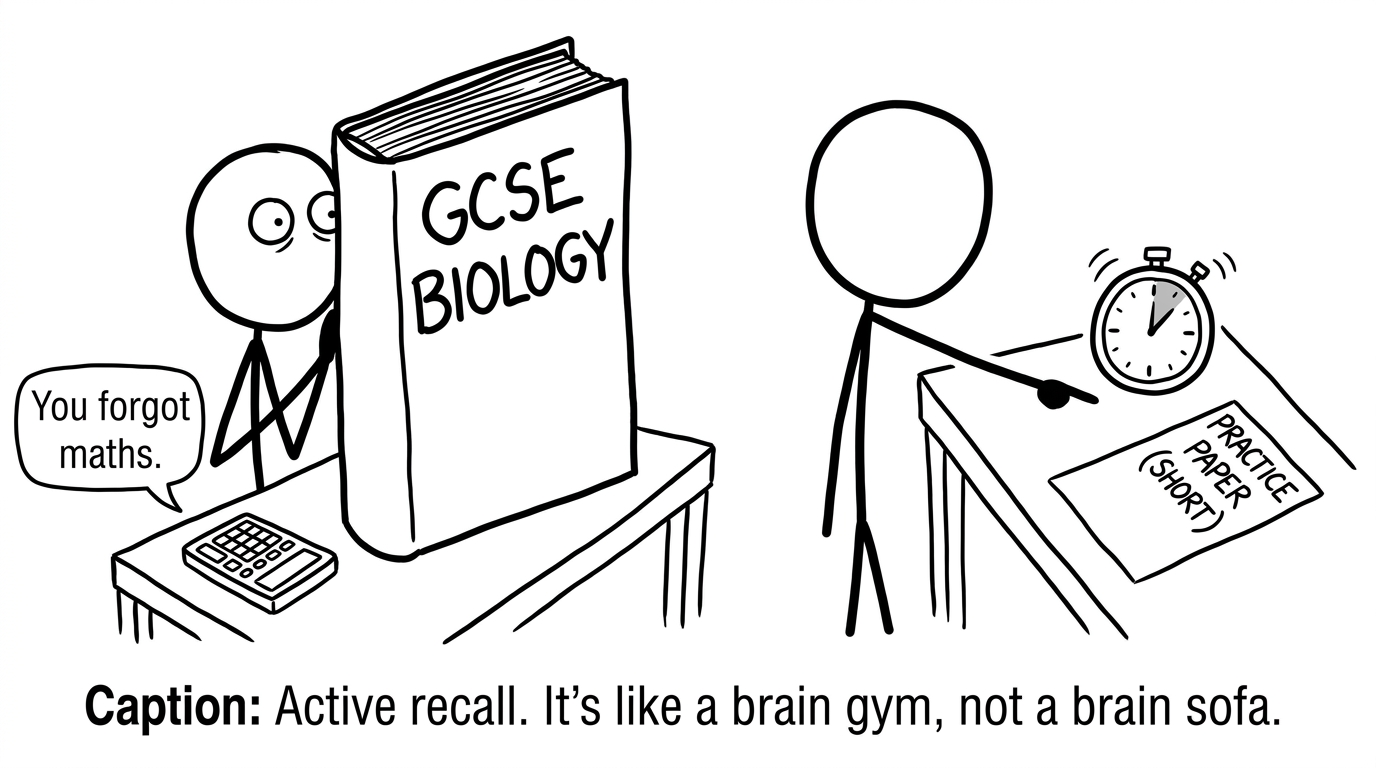 Active recall beats staring at notes
Your WJEC Biology daily routine (30--90 minutes)
Choose one Biology “anchor”
Pick a chunk you can actually finish. Examples:
- Cells and microscopy
- Enzymes
- Gas exchange
- Digestion
- Ecosystems
Write the anchor at the top of a page. If your brain drifts, you come back to that one line.
Do one active recall set (closed-book)
Closed-book is the point. You are training retrieval, not recognition.
Try one of these:
- Write a definition list from memory, then correct it.
- Draw and label a process (e.g. digestion pathway), then annotate what you missed.
- Explain a practical method in bullet points, then compare to your notes.
Do one exam-style task (timed)
Set a timer and answer like it’s real. Then mark it.
Even if you don’t have WJEC Biology on YesGenie yet, you can still use the same exam-week method using the platform’s structure: timed work, then mark schemes, then targeted fixes.
On the maths side, YesGenie makes this easy with:
Fix three mistakes properly
Don’t just “note” mistakes. Convert them into rules you can apply.
Example mistake-fix format:
- Mistake: “I describe diffusion but forget it’s net movement.”
- Fix: “Use the phrase ‘net movement from high to low concentration’.”
That habit -- turning feedback into a rule -- is the same skill that lifts GCSE maths grades.
Protecting your maths during Biology exam week
Here’s the uncomfortable truth: most grade drops in GCSE maths during exam season aren’t from forgetting everything. They’re from losing fluency. You stop practising, methods go cold, and you burn time in the paper trying to remember what to do.
Your solution is a small daily block: 20--40 minutes. Not a full “maths day”. Just maintenance.
The 3-part maths maintenance block
Use this structure on YesGenie:
- 8 minutes: one short lesson recap (pick the exact topic).
- 12 minutes: a mini test or a small set of exam questions.
- 10 minutes: mark and write one improvement note.
Good places to pull this from:
Worked example: build a realistic exam-week timetable
Students often ask, “How much revision should I do?” The more useful question is, “How much can I repeat daily without breaking?”
Suppose you have:
- 555 days until your WJEC Biology exam
- 909090 minutes per day available on average
- You want to keep GCSE maths ticking over
A realistic split might be:
- Biology: 606060 minutes/day
- Maths: 303030 minutes/day
Total study time across the week:
5×90=450 minutes 5 \times 90 = 450 \text{ minutes} 5×90=450 minutesBiology total:
5×60=300 minutes 5 \times 60 = 300 \text{ minutes} 5×60=300 minutesMaths total:
5×30=150 minutes 5 \times 30 = 150 \text{ minutes} 5×30=150 minutesThat’s not “everything”. But it’s consistent, mark-heavy, and calm. And consistency is what most GCSE students are missing in exam week.
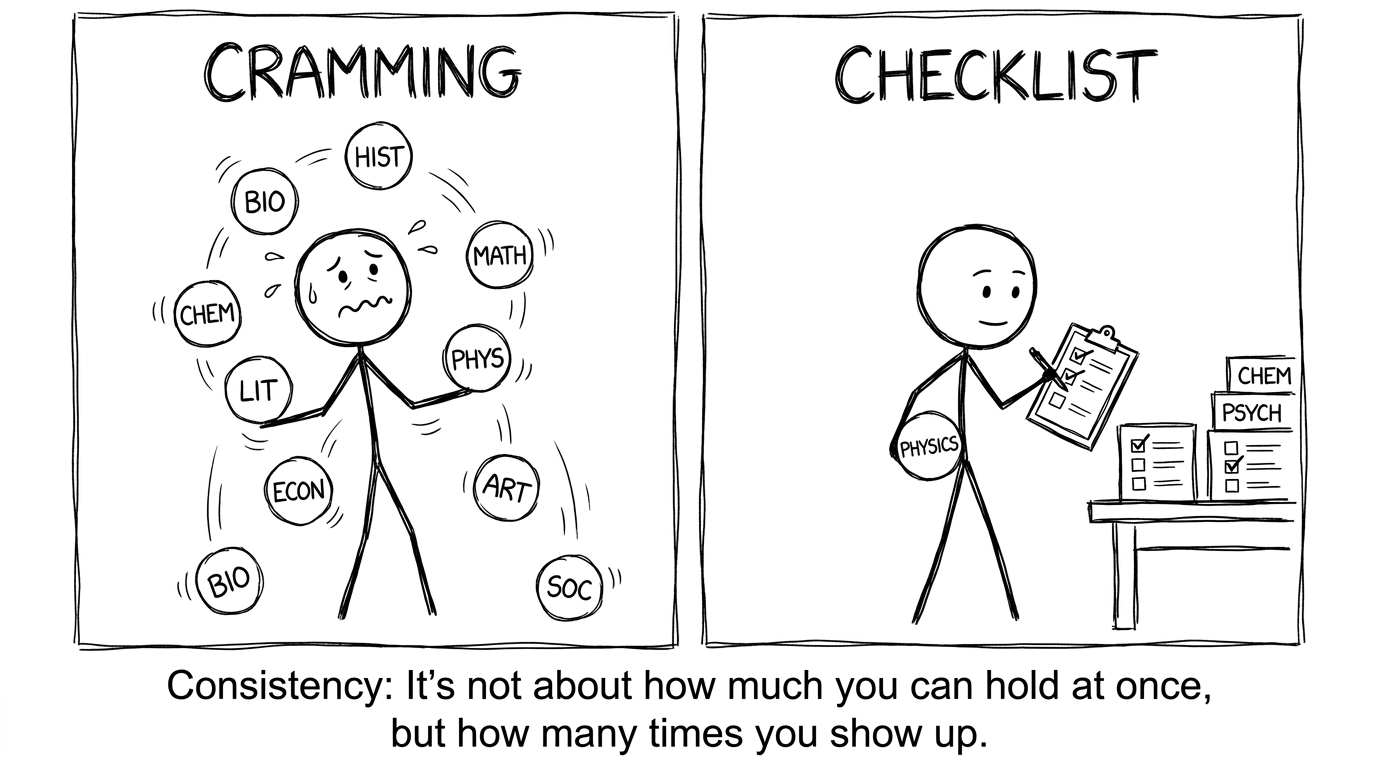 Cramming vs checklist
Exam technique crossover: what Biology can borrow from maths
Maths revision trains a certain honesty: either the answer works or it doesn’t. WJEC Biology rewards that same discipline when you treat it like a mark scheme game.
Use command words like operators
In maths, “solve” means do a method. In Biology, command words tell you the depth:
- State: one fact.
- Describe: what happens.
- Explain: why it happens (link cause to effect).
- Evaluate: judgement with evidence.
A good exam-week habit is to underline the command word before you answer. It’s a small step that protects marks.
Show steps, even in Biology
Biology isn’t algebra, but markers still reward structured thinking.
Instead of one long paragraph, try:
- Point
- Evidence
- Link back to the question
It’s the Biology version of showing working.
A maths mini-refresh you can do any day (with one worked method)
When time is tight in GCSE exam week, pick one high-frequency skill and rehearse it cleanly.
One reliable choice is percentages, because it appears everywhere (science required practical analysis, data questions, and maths papers).
Worked example: percentage change (quick and accurate)
A value increases from 484848 to 606060. Find the percentage increase.
Change:
60−48=12 60 - 48 = 12 60−48=12Percentage change:
1248×100=14×100=25% \frac{12}{48} \times 100 = \frac{1}{4} \times 100 = 25\% 4812×100=41×100=25%Two exam-week reminders:
- Always divide by the original value.
- Write the final answer with a percentage sign.
If this topic is shaky, do a focused recap using a YesGenie lesson sequence and then practise:
Common mistakes (and how to stop losing easy marks)
Exam week isn’t usually where you learn brand new content. It’s where you stop donating marks.
Common WJEC Biology exam-week mistakes
- Passive rereading and calling it revision. If it’s open-book and comfortable, it’s probably not training recall.
- Ignoring required practicals until the last minute. These questions are predictable in style and easy to structure.
- Not using the language of the specification (key terms like “net movement”, “limiting factor”, “diffusion gradient”).
- Writing everything you know rather than answering the question asked. Marks are specific.
Common GCSE maths exam-week mistakes
- Dropping maths completely because another exam feels urgent, then losing fluency.
- Not checking signs and units under pressure.
- Doing papers without marking properly, so the same mistakes repeat.
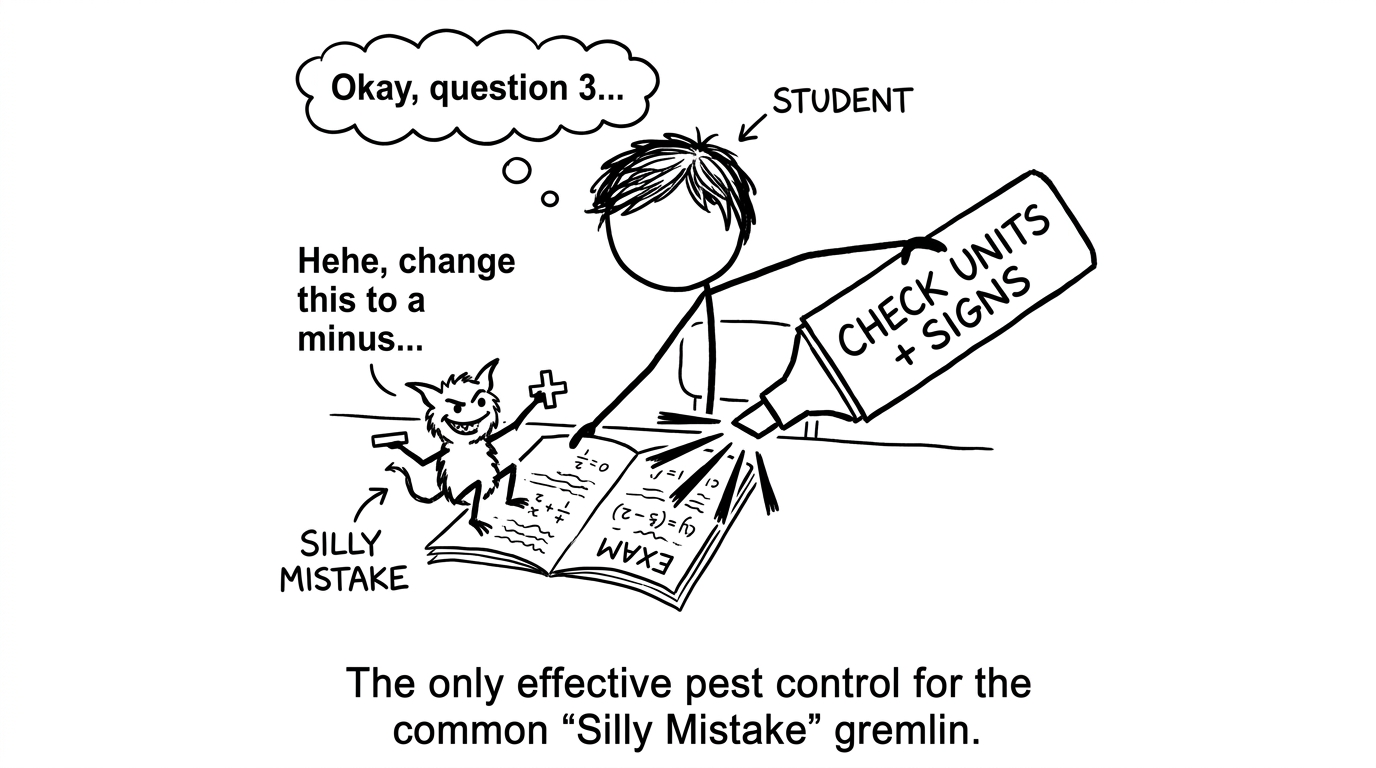 The silly mistake gremlin
A simple fix is to keep a “mistake log” of just five lines. Update it daily. If you use YesGenie papers and mini tests, your log gets very specific, very quickly.
FAQ
How should I revise for WJEC Biology during GCSE exam week if I’m also doing maths?
Treat exam week like a logistics problem, not a motivation problem. Decide in advance what “enough” looks like each day: one Biology anchor topic, one active recall task, and one timed exam-style task. Then protect a short GCSE maths block so methods don’t go cold, even if it’s only 202020 minutes. The key is that both subjects get touched regularly, because forgetting is often about gaps rather than ability. If you have a day with two exams, lower the target and still do something small, because consistency matters more than heroic sessions. Finally, mark what you do and write one improvement note, because feedback is the fastest form of revision.
Are predicted papers actually useful for GCSE maths in exam week?
They can be useful if you treat them as practice for decision-making under time pressure, not as a promise of what will appear. A predicted paper helps you rehearse pacing, calculator habits, and how you respond when a question looks unfamiliar. The real value comes after: marking carefully, categorising mistakes, and then doing a targeted lesson or revision guide to fix the weak spot. On YesGenie, that loop is straightforward because you can move from a paper to topic practice quickly. Predicted papers also reduce the “blank page” feeling when you sit down to revise, which matters in GCSE exam week when your brain is already busy. Use them alongside past papers and mini tests, not instead of them.
What’s the best way to mark my work so I actually improve before my GCSE exams?
Marking is where most of your progress is hiding, but only if you do it actively. First, don’t just tick answers -- write the correct method in your own words, especially for maths, and the key term you missed for Biology. Second, label each error type: “forgot”, “misread”, “method”, or “careless”. That classification tells you what to do next: relearn, slow down, practise more, or add a checking habit. Third, reattempt the question a day later, because immediate correction can be an illusion of learning. On YesGenie, use mark schemes and video solutions to see why the method works, not just what the answer is. Over a week, this approach turns GCSE revision into a set of corrected behaviours, which is exactly what exam performance is.
A calm ending: the week is not a verdict
A GCSE exam week can feel like it’s trying to measure your entire personality in a single morning. It isn’t. It’s measuring what you can recall and apply under time limits. That’s why a checklist works: it turns a big fear into small actions.
If you want your maths blocks to be simple, focused, and properly marked, make YesGenie your home base: start with GCSE Maths Revision, keep momentum with Edexcel GCSE Maths Mini Tests, and sharpen exam technique using GCSE Past Papers and Edexcel GCSE Maths Predicted Papers. Keep your mistake log tight, practise a little every day, and let the plan carry you when motivation doesn’t.
That’s how you walk into a GCSE exam week feeling less like you’re chasing time -- and more like you’re using it.