

GCSE: How WJEC Students Use Mark Schemes to Improve
GCSE mark schemes can boost WJEC Maths grades fast. Learn how to read method marks, fix errors, and revise smarter with YesGenie.
If you have ever finished a WJEC Maths paper, checked the answers, and thought, “I was basically there… so why did I lose so many marks?”, you are not alone. For many GCSE students, the jump from knowing maths to scoring marks feels unfair. But it is not random. The mark scheme is the examiner’s language, and once you learn to read it, your GCSE revision becomes calmer, more targeted, and surprisingly more predictable.
A mark scheme is not just a list of answers. It is a map of how marks are awarded: where working matters, where accuracy matters, and where exam technique quietly decides your grade. For WJEC students especially, using mark schemes well can turn “nearly” into “nailed it”.
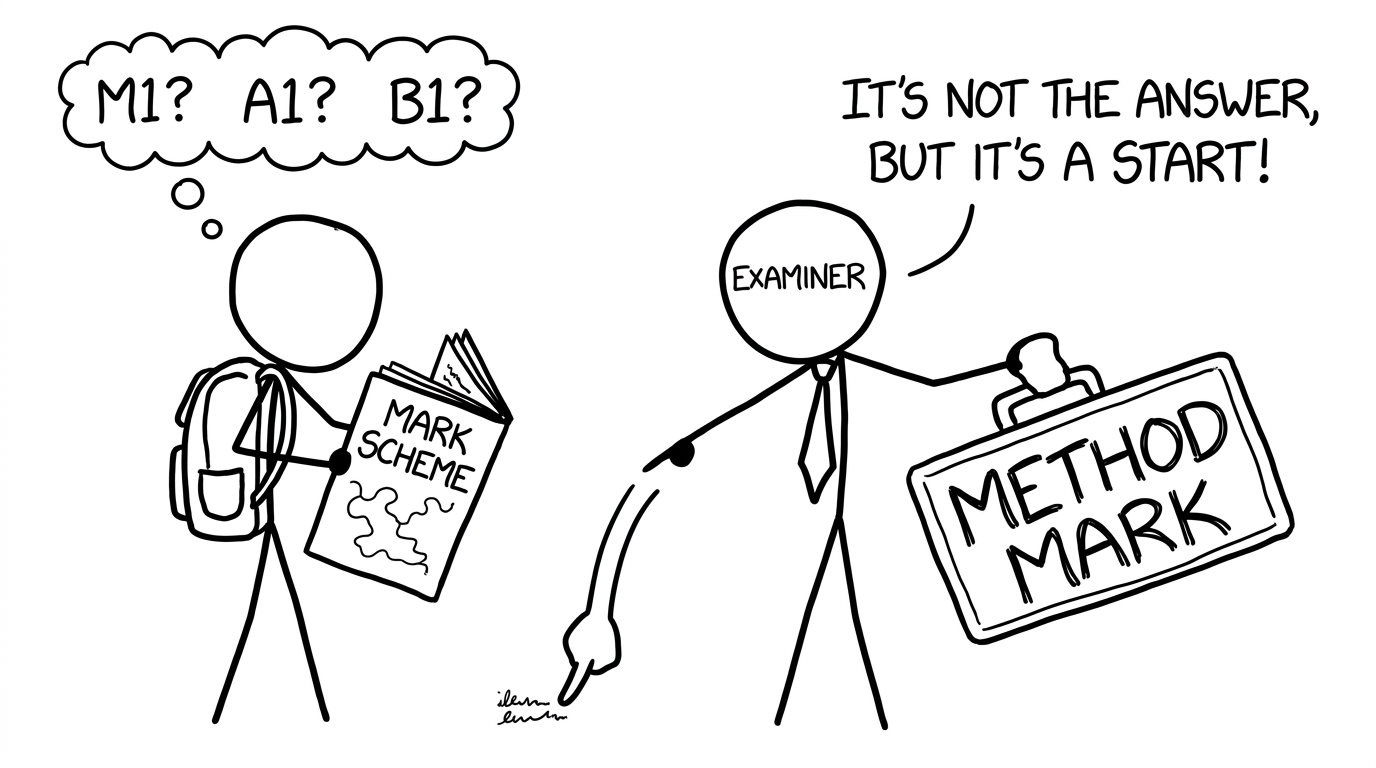 A student treating a mark scheme like a treasure map
A quick checklist for using a mark scheme properly
Before we get into examples, here is the simple routine that makes mark schemes useful (and stops them becoming a demotivating answer-sheet).
- Do the question under timed conditions first (even if it is just 10-15 minutes).
- Mark in three colours: correct, partially correct, incorrect.
- For every dropped mark, write why you lost it (method, accuracy, communication, rounding, units).
- Re-do the question one day later without looking.
- Log the topic and error type, then practise that exact weakness.
You can do all of this using WJEC resources on YesGenie, including WJEC GCSE Maths Revision, WJEC GCSE Maths Past Papers, and the wider GCSE Maths Revision area.
What WJEC mark schemes are really telling you
When students say “I understand it, but I lose marks”, what they usually mean is: I did not show the thing the mark scheme needed to see. Mark schemes reward evidence.
Most GCSE mark schemes use a few common mark types:
- BBB marks: independent marks, often for a correct statement or value.
- MMM marks: method marks for a correct approach (even if you make an arithmetic slip later).
- AAA marks: accuracy marks, usually dependent on earning the method mark first.
- ft (follow through): you can still score later marks using your earlier wrong value, as long as the method remains correct.
- cao (correct answer only): no working required or credited -- you either have it or you do not.
This matters because it changes how you revise. If you are losing AAA marks, you need accuracy and checking. If you are losing MMM marks, you need structure and method. If you are losing communication marks (often hidden inside the wording), you need habits like writing units and concluding statements.
The GCSE habit that changes everything: mark for methods, not answers
A GCSE student often marks like this:
- “My final answer does not match. So the whole thing is wrong.”
An examiner marks like this:
- “Did they earn the method mark? Did they set up the correct equation? Did they substitute correctly? Did they communicate a conclusion?”
So when you use a mark scheme, you are training yourself to think like an examiner. It is a skill, not a personality trait.
To practise on real questions, use GCSE Past Papers alongside mark schemes. If you want smaller, topic-focused practice between papers, use the Eduqas GCSE Maths Question Bank (the skills overlap heavily across UK GCSE boards, even when the paper style differs).
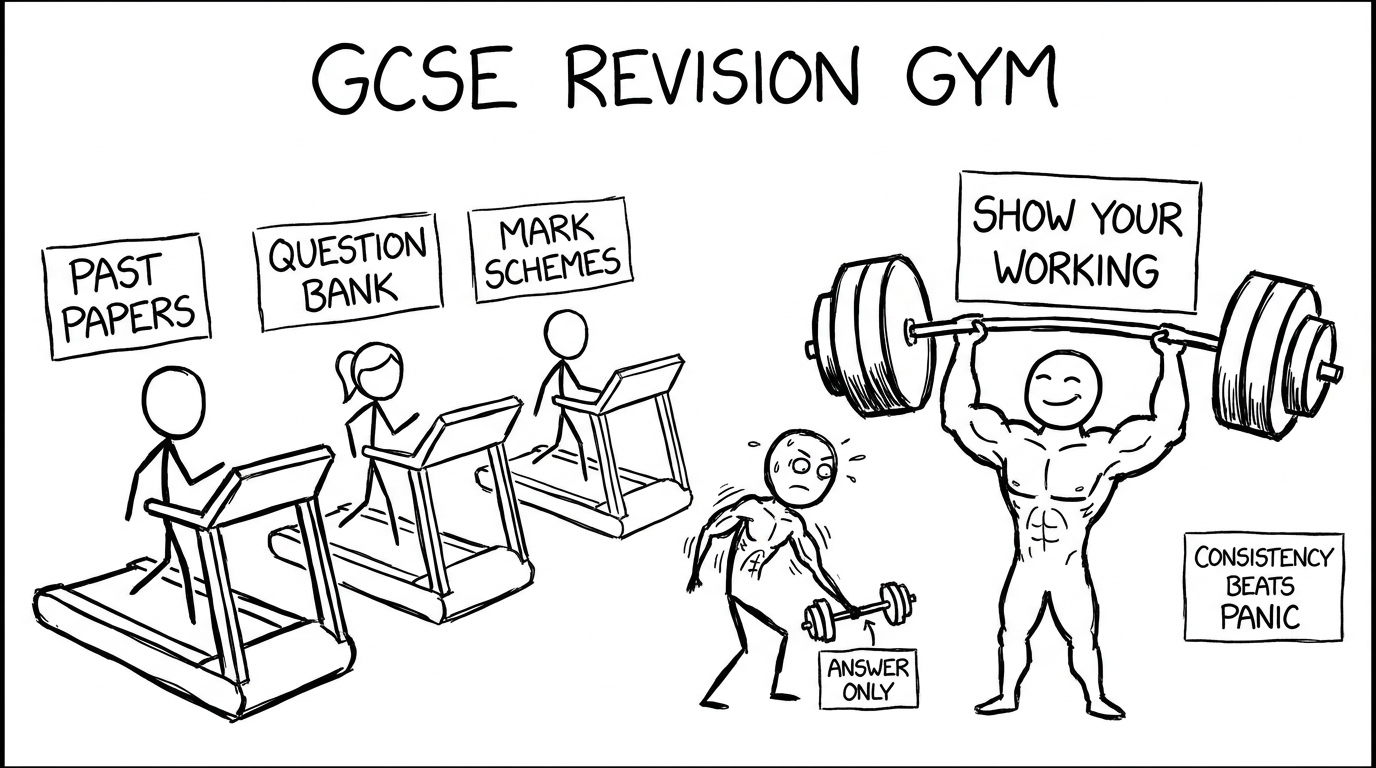 Revision gym parody with mark schemes as equipment
Worked example: turning one lost mark into two gained marks
Imagine a typical GCSE algebra rearrangement.
Question: Make xxx the subject of 3x+5=263x + 5 = 263x+5=26.
A student writes:
3x=26−5=20 3x = 26 - 5 = 20 3x=26−5=20 x=20 x = 20 x=20Final answer is wrong, but notice the first line is good. A mark scheme for a multi-mark rearrangement often awards:
- M1M1M1 for correctly subtracting 555 from both sides.
- A1A1A1 for dividing by 333 to get the correct value.
Let’s do it properly:
3x+5=26 3x + 5 = 26 3x+5=26 3x=26−5=21 3x = 26 - 5 = 21 3x=26−5=21 x=213=7 x = \frac{21}{3} = 7 x=321=7How mark schemes help you improve: you can see you were not “bad at algebra” -- you made one arithmetic slip that destroyed the accuracy mark. Your next step is not more random algebra. It is a checking habit: after 26−526-526−5, pause and verify.
A practical GCSE rule: whenever you do a basic operation inside a longer method, treat it like a mini checkpoint.
Worked example: follow-through marks (ft) -- why you should keep going
Many GCSE students stop once they think they have gone wrong. But mark schemes often reward correct structure even with a wrong earlier value.
Question: A rectangle has length 121212 cm and width xxx cm. Its area is 84 cm284\text{ cm}^284 cm2. Find xxx.
Correct method:
Area=12x \text{Area} = 12x Area=12x 12x=84 12x = 84 12x=84 x=8412=7 x = \frac{84}{12} = 7 x=1284=7Suppose you accidentally write 12x=8212x=8212x=82, then do:
x=8212=416 x = \frac{82}{12} = \frac{41}{6} x=1282=641A typical mark scheme might award:
- M1M1M1 for setting up 12x=8412x=8412x=84.
- A1A1A1 for x=7x=7x=7.
If you set up 12x=8212x=8212x=82 you probably lose that M1M1M1 (because the equation is wrong). But in more complex problems, you can still earn later marks via ft if the mark scheme allows it. The lesson is simple: keep going, and write clearly. A visible method is a markable method.
If algebra is a consistent weakness, build it from the basics using YesGenie revision lessons and guides, for example the topic lists within Edexcel GCSE Maths Revision Guides (the methods are GCSE-wide even if you are taking WJEC).
How to “translate” a mark scheme into revision actions
A mark scheme is only powerful if you turn it into a plan. Here is a translation table you can use during GCSE revision:
When you lost method marks (MMM)
You likely:
- started with the wrong equation,
- used the wrong formula,
- skipped a key transformation,
- or did not show your working.
Revision action: watch a solution, then write a three-line template for that question type. Practise until you can reproduce the structure without prompts.
When you lost accuracy marks (AAA)
You likely:
- made an arithmetic slip,
- rounded too early,
- wrote the final answer incorrectly (units, form).
Revision action: practise with deliberate checking. On calculator questions, re-enter the calculation a second way. On non-calculator, estimate to see if your answer is sensible.
When you lost “communication” marks
You likely:
- missed units,
- gave an incomplete conclusion,
- did not state the final answer clearly.
Revision action: add two habits: always write units, and always write a final statement like “So x=7x=7x=7.” when asked to “find” or “calculate”.
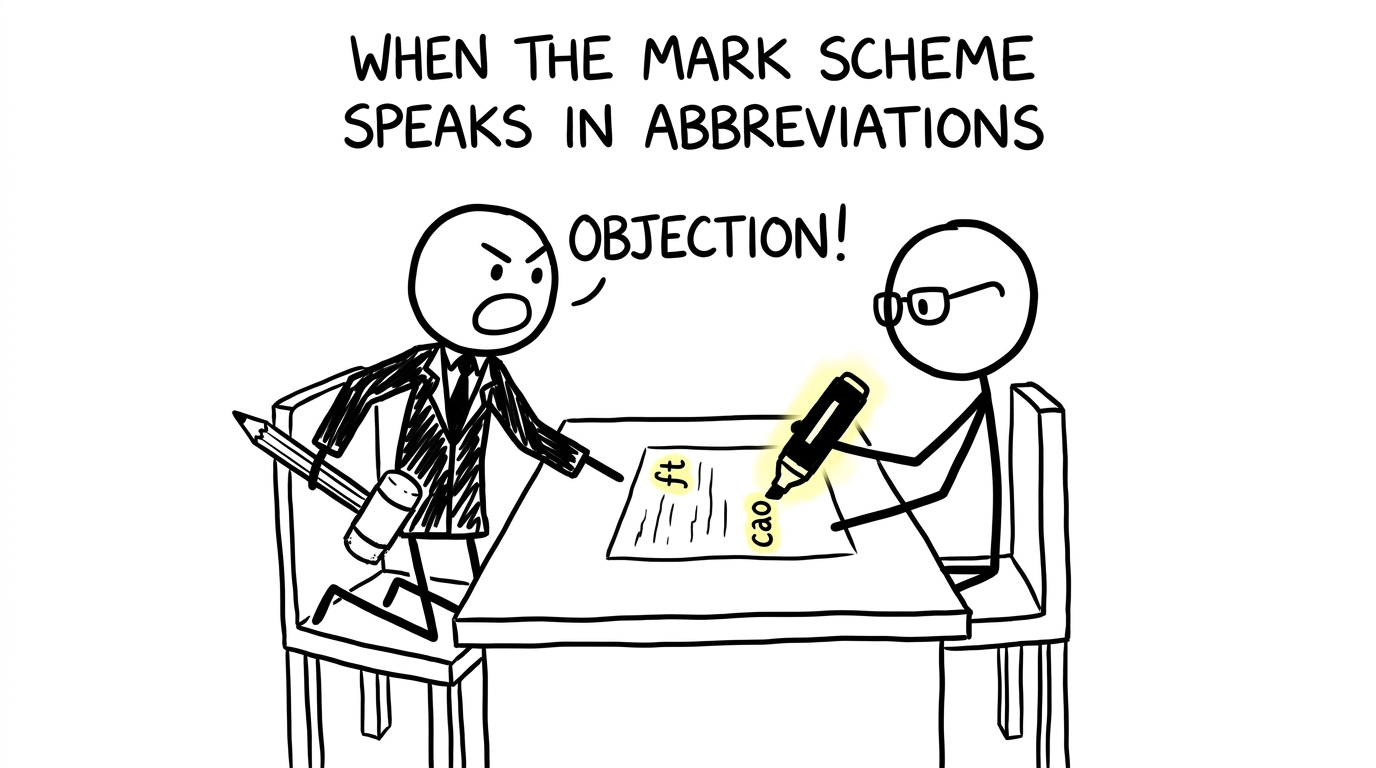 Arguing with the mark scheme in a courtroom
A WJEC-focused workflow using YesGenie
WJEC papers are split into non-calculator and calculator components, so your mark scheme work should reflect that. Here is a realistic weekly cycle that fits GCSE life.
- Choose one paper from WJEC GCSE Maths Past Papers.
- Do it in timed conditions (even if you do half a paper at a time).
- Mark it with the official mark scheme.
- Categorise every lost mark into: method, accuracy, or communication.
- Pick two topics to fix, not ten.
- Use topic practice from question banks and revision guides, then re-do the same paper section one week later.
If you like organising your revision in one place, explore the wider Resources section to combine past papers, mini tests, and focused practice.
Common mistakes when using mark schemes (and how to avoid them)
- Reading the mark scheme before attempting the question. This feels efficient but kills exam skill. Attempt first, always.
- Only checking the final answer line. You miss the point: GCSE marks are often in the method.
- Copying the mark scheme working without understanding it. That produces neat notes but no retrieval strength.
- Ignoring “ft” opportunities. Even if you think you are wrong, keep going and show structure.
- Not learning from recurring patterns. If the same error happens three times (rounding, sign errors, units), it is now a system problem, not a one-off.
- Doing more papers without fixing weaknesses. Past papers without feedback become repetition, not progress.
FAQ
How do mark schemes help me improve my GCSE grade if I keep getting questions wrong?
Mark schemes show you where you are losing marks, not just that you are losing them. In GCSE Maths, many questions are worth multiple marks, and you can often earn method marks even if your final answer is wrong. Once you start spotting whether you lost an MMM mark or an AAA mark, your revision becomes more precise. For example, losing accuracy marks suggests you need checking and careful arithmetic, while losing method marks suggests you need to re-learn the structure of the topic. Mark schemes also reveal what examiners accept as “or equivalent”, which matters when your method is valid but looks different. Over time, you stop revising “everything” and start fixing the few habits that are actually costing you grades.
Should I use mark schemes differently for WJEC non-calculator and calculator papers?
Yes, because the papers reward slightly different habits even though the GCSE content overlaps. On non-calculator papers, mark schemes often reward clean number sense: exact fractions, tidy algebra, and sensible arithmetic without rounding. This means you should use the mark scheme to check not only the method, but also the form of your answer, such as leaving values like 213\frac{21}{3}321 simplified to 777. On calculator papers, mark schemes often reveal when rounding is expected and when it is not, so you can practise keeping full precision until the final step. The best approach is to mark each paper and create two error lists: one for calculator issues (rounding, calculator entry mistakes) and one for non-calculator issues (basic arithmetic, fraction handling). When you practise, match your practice to the paper type so your improvements transfer directly to the exam.
What if my working is different from the mark scheme -- will I lose marks in GCSE Maths?
Not automatically, and this is one of the most comforting things mark schemes can teach you. GCSE mark schemes usually include “oe” (or equivalent) because there are often multiple valid methods. If your approach is mathematically correct and logically shown, examiners can award the same method and accuracy marks. The risk comes when your method is correct but your working is too unclear to be credited, especially on multi-mark questions. That is why writing one clear equation or one clear transformation per line is such a strong habit. When you revise with mark schemes, look for the milestones that earn marks, then make sure your alternative method still hits those milestones visibly. Over time you develop a style of working that is both yours and examiner-friendly.
Closing thoughts: let the mark scheme coach you
Most GCSE students do not need a new brain; they need a better feedback loop. The mark scheme is that loop. It tells you what counts, what is ignored, what must be shown, and what earns marks even when you wobble.
If you are revising for WJEC, build your routine around doing a little less, but marking a lot better. Start with WJEC GCSE Maths Revision and WJEC GCSE Maths Past Papers, then use the mark schemes to turn mistakes into a shortlist of topics to practise. Top it up with targeted practice from the wider GCSE Maths Revision area, and keep your momentum with the extra Resources like mini tests and predicted-paper style practice.
The goal is not to “do loads of GCSE papers”. The goal is to do fewer papers, learn more from each one, and walk into the exam knowing exactly how marks are won.
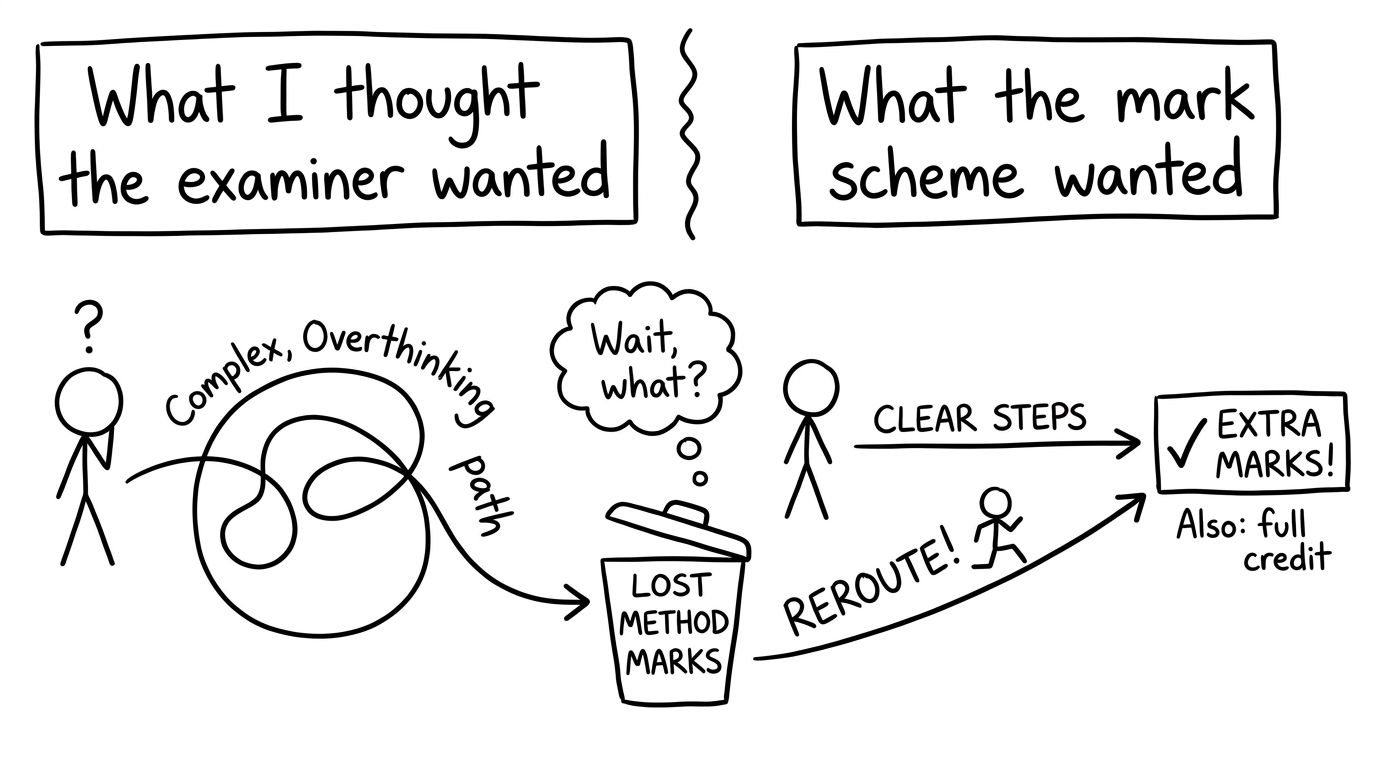 Flowchart of misunderstanding vs mark-scheme clarity