

GCSE WJEC Maths: the night-before plan that avoids panic
GCSE WJEC night-before plan for Maths: a calm checklist, quick wins, worked methods and exam-day routine using YesGenie past papers and lessons.
If you are reading this the night before a GCSE Maths paper, you are probably not looking for motivation. You are looking for certainty. Not the fake kind ("I’ll just cram everything"), but the steady kind: a plan you can follow when your brain is loud and your time is small.
This GCSE WJEC guide is a night-before routine designed to reduce panic, protect sleep, and still add marks. It is not a miracle. It is a set of small, sensible choices that stop you from spending the evening in a spiral.
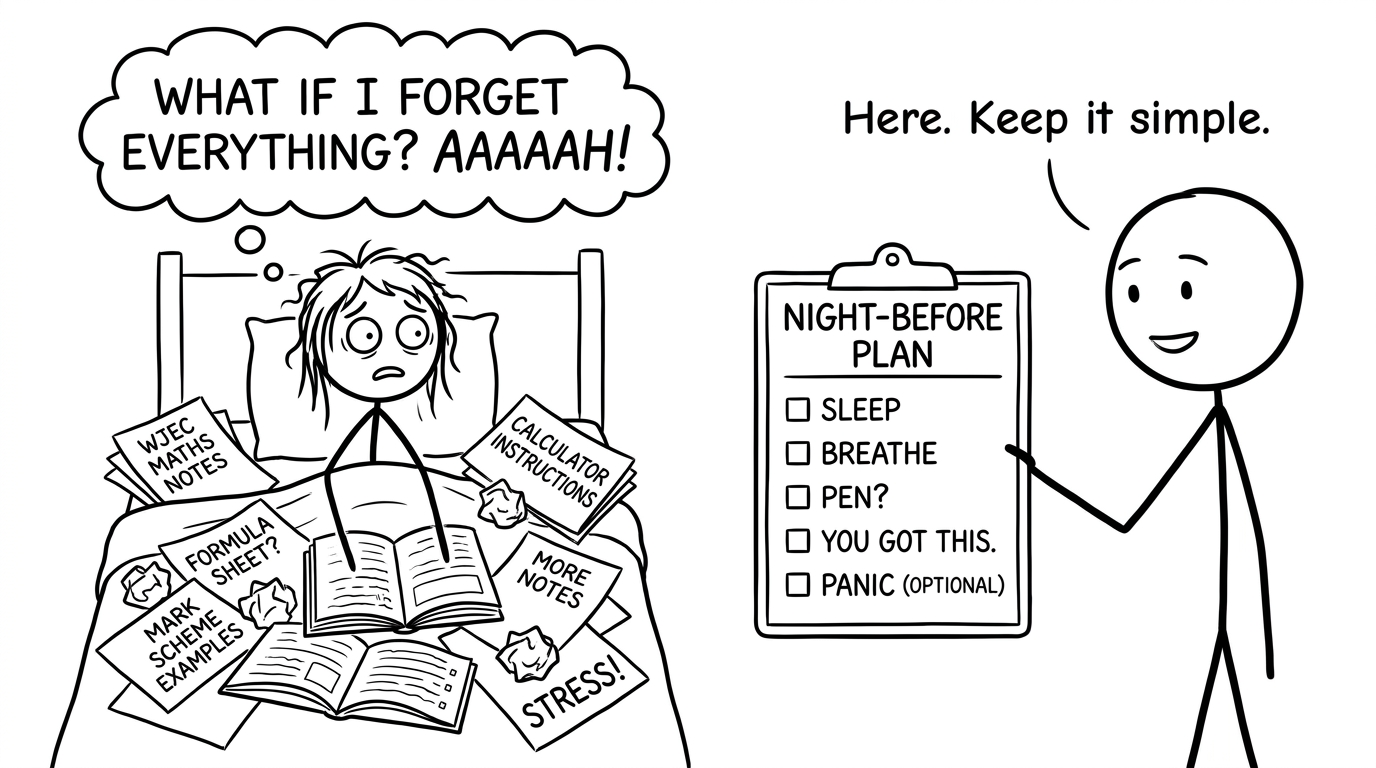 Student uses a calm night-before checklist
The night-before GCSE checklist (WJEC-friendly)
Keep it simple. Your goal tonight is confidence and recall, not new learning.
- Choose your tier: foundation or higher (be honest, not hopeful).
- Do one short, timed paper section (or a mini test) to wake up exam mode.
- Review 6--10 “high-frequency” methods (not whole topics).
- Practise showing working for method marks.
- Pack your kit and set your morning routine.
- Stop heavy revision early enough to sleep.
Useful starting points on YesGenie:
- WJEC GCSE Maths Revision
- WJEC GCSE Maths Past Papers
- GCSE Past Papers (all boards)
- Resources (Predicted Papers, Mini Tests, Short Tests)
- Other Resources (self-assessment sheets and formulae)
Why panic happens the night before GCSE Maths
Panic usually isn’t caused by the hardest topics. It’s caused by uncertainty.
A student opens a revision checklist and sees 80 items. The mind does a quick calculation: I can’t do all of that, so it tries a different tactic: do nothing properly, but do it loudly. That is what doom-scrolling through random videos feels like. Movement without progress.
A better night-before strategy for GCSE Maths is to trade breadth for precision: a small set of methods you can execute cleanly, under time pressure, with working that earns marks even when the final answer doesn’t arrive.
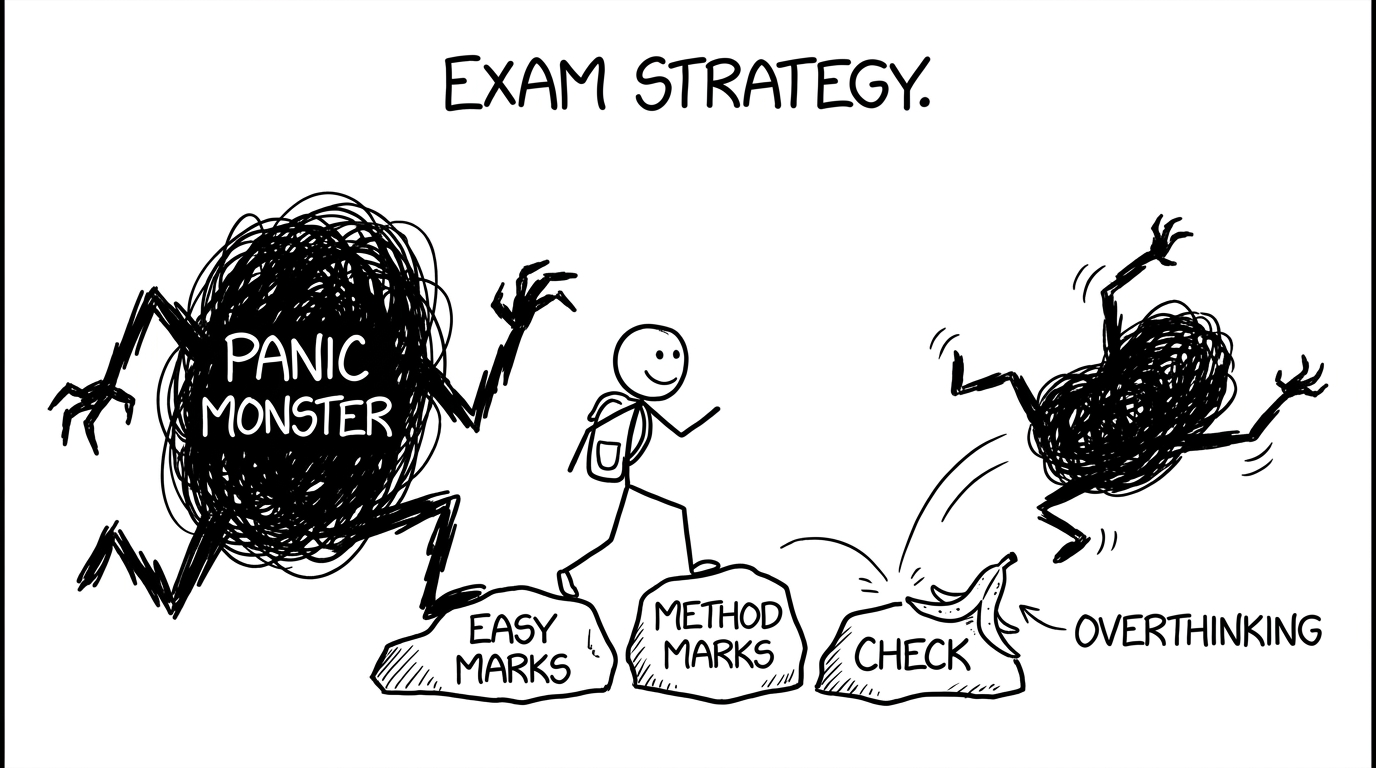 Panic monster slips on 'overthinking'
Your 90-minute GCSE night-before plan (with WJEC focus)
Get the paper shape into your head
WJEC GCSE Maths is typically split into non-calculator and calculator components, and your tier matters. Tonight, spend five minutes looking at one recent paper (not the whole thing) so your brain stops treating tomorrow as unknown.
Use:
Choose one component that matches tomorrow’s paper type (calculator or non-calculator). Your aim: familiarity.
Do one short timed burst (not a full paper)
Set a timer for 202020 minutes.
- Pick one section of a past paper.
- Attempt it like the real exam: no pausing, no checking notes.
- Then mark it quickly.
This is where YesGenie is quietly powerful: you are never stuck guessing what the examiner wanted because the papers come with mark schemes.
If you struggle to face a paper tonight, use shorter resources:
Mark like the examiner: hunt method marks
The best night-before habit for GCSE Maths is not “learn more”. It is “write more clearly”. WJEC (like AQA, Edexcel, OCR, Eduqas) awards method marks for correct steps even if the final number is wrong.
So when you mark, ask:
- Did I write the key equation?
- Did I substitute values correctly?
- Did I show the rearranging step?
If not, rewrite your solution as if you are teaching it.
Refresh 6--10 methods you can bank marks on
Pick methods that appear constantly across GCSE specifications: fractions/percentages, linear equations, angles, Pythagoras, trigonometry basics, ratios, and graphs.
On YesGenie, use revision guides because they compress a topic into what actually gets examined:
Worked examples (quick wins for GCSE marks)
These are the kinds of questions that reward calm method, especially when you are tired.
Fractions of an amount (foundation and higher)
Question: Find 35\frac{3}{5}53 of 120120120.
Method: Divide by the denominator, then multiply by the numerator.
120÷5=24 120 \div 5 = 24 120÷5=24 24×3=72 24 \times 3 = 72 24×3=72So 35\frac{3}{5}53 of 120120120 is 727272.
Night-before reminder: if you do the first division correctly, you have a strong chance of method marks even if you slip later.
Percentage change (common on calculator papers)
Question: A price increases from £808080 to £929292. Find the percentage increase.
Method: Change =92−80=12=92-80=12=92−80=12. Percentage increase is
1280×100=15 \frac{12}{80}\times 100 = 15 8012×100=15So the increase is 15%15\%15%.
A small writing habit that earns GCSE marks: always write the fraction changeoriginal\frac{\text{change}}{\text{original}}originalchange before you calculate.
Rearranging and solving a linear equation
Question: Solve 3x−7=203x-7=203x−7=20.
3x=27 3x = 27 3x=27 x=9 x = 9 x=9Night-before reminder: it is worth writing the line 3x=273x=273x=27. Even if you make a final slip, the method is visible.
Pythagoras (non-calculator friendly when numbers are nice)
Question: A right-angled triangle has legs 666 cm and 888 cm. Find the hypotenuse.
c2=62+82=36+64=100 c^2 = 6^2 + 8^2 = 36 + 64 = 100 c2=62+82=36+64=100 c=100=10 c = \sqrt{100} = 10 c=100=10So the hypotenuse is 101010 cm.
A quiet truth about GCSE Maths: many “hard” questions are just two easy methods joined together. Tonight, you are sharpening the joins.
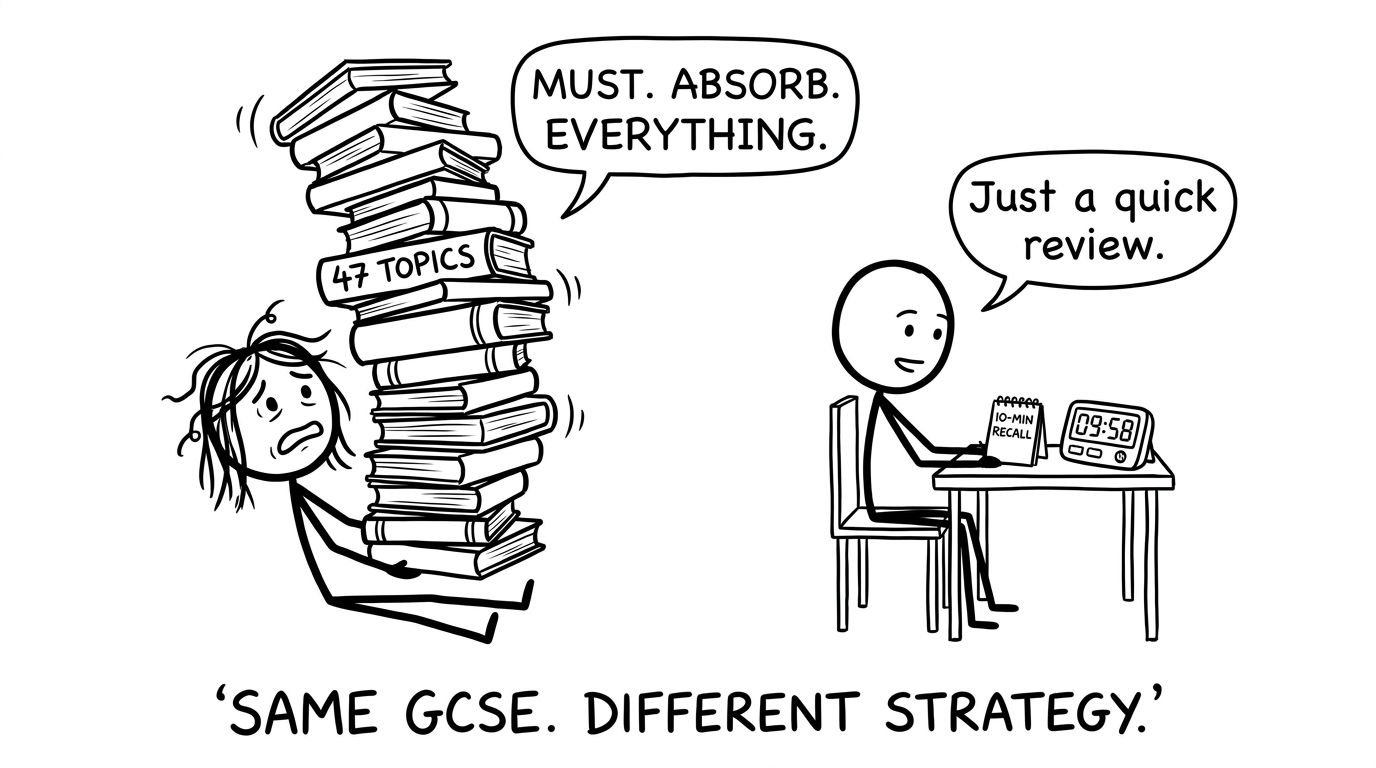 Two strategies: cramming vs 10-minute recall
The 30-minute calm-down block (the part most students skip)
After your timed burst and method refresh, do something that looks like it is not revision but wins marks tomorrow:
- Write a micro checklist of what you will do in the first 5 minutes of the paper: read instructions, check calculator mode (if relevant), scan for starter questions, circle any multi-part questions.
- Pack your equipment: two pens, pencil, ruler, eraser, protractor (if you use one), calculator, spare batteries if you have them.
- Decide your pacing: if a question is stuck after 909090 seconds, move on and return.
This block matters because it lowers cognitive load. Your brain is not trying to remember logistics while solving simultaneous equations.
Common mistakes that cost GCSE marks (especially when tired)
- Doing everything in your head. Examiners cannot award method marks for invisible work. Write the equation, then the substitution, then the calculation.
- Mixing up “of” and “off”. “30%30\%30% of £505050” is 0.3×500.3\times 500.3×50. “30%30\%30% off £505050” is 50−0.3×5050-0.3\times 5050−0.3×50.
- Rounding too early. Keep full calculator values until the end, then round once.
- Forgetting units. WJEC mark schemes often expect cm2^22, cm3^33, m/s, etc. Put them on the final line.
- Using the wrong angle fact. For example, in parallel lines, write the reason (“alternate angles”, “corresponding angles”) so you do not second-guess yourself.
- Not reading the last word. “Estimate”, “write as a fraction”, “give your answer to 222 d.p.” changes the whole mark scheme.
FAQ: night-before GCSE Maths (WJEC and beyond)
Should I do a full GCSE past paper the night before?
A full GCSE paper the night before can help if it calms you, but it can also backfire if it steals sleep. The better choice is usually a short timed section plus careful marking, because that recreates exam pressure without exhausting you. If you do attempt a full paper, stop early enough that you can review mistakes calmly rather than chasing a score. Use your marking to learn the examiner’s habits: what gets method marks, what is “accuracy only”, and what wording they expect. On YesGenie, you can pick a recent WJEC paper and mark it with the official scheme, which reduces the uncertainty that causes panic. If you finish and feel worse, that is a sign you should shorten the session next time, not that you are “bad at maths”.
What if I can’t remember anything during GCSE revision tonight?
That feeling is more common than you think, and it often means you are tired rather than unprepared. Memory retrieval works better in short bursts, so switch to 101010 minute cycles: read one method, cover it, then reproduce it on paper from memory. Choose topics that appear constantly, like fractions of an amount, percentage change, linear equations, and Pythagoras, because a small improvement there converts directly into marks. When you get stuck, look at one worked example and rewrite it in your own words, focusing on the first line of the method. YesGenie revision guides are helpful here because they show the core steps without the noise. Finally, remind yourself that tomorrow’s paper contains starter questions designed to let you settle -- you do not need to “remember everything” to do well at GCSE Maths.
How do I avoid silly mistakes in the GCSE exam when I feel panicked?
The simplest anti-panic technique is to slow down your writing, not your thinking. Write one line per step, even if you could do it mentally, because the structure reduces errors and protects method marks. For calculator questions, do a quick reasonableness check: if you worked out 15%15\%15% off £808080 and got £929292, something has flipped. Use a “two-pass” approach: first pass for easy marks, second pass for harder questions, and a final pass for checking. Checking means redoing one small part, like substituting back into an equation, not staring at the page hoping it feels correct. Practising one timed section tonight and marking it properly trains this rhythm far better than rereading notes. This is why using GCSE past papers on YesGenie is such a reliable night-before move.
Is this night-before plan still useful if I’m also doing A Level Maths?
Yes, because the skill you are practising is not the content -- it is exam execution under pressure. A Level students often panic because they expect themselves to be “above” GCSE mistakes, but tired brains still misread questions and skip steps. The habit of writing clear algebra, labelling units, and checking answers scales up to differentiation, integration, and proof. Also, if you are supporting a younger sibling or tutoring, revisiting GCSE methods can actually sharpen your A Level fluency. The night-before plan is a reminder that performance is built from small repeatable routines, not last-minute heroics. Even at A Level, past papers and mark schemes are the fastest feedback loop, just as they are at GCSE.
A final GCSE night-before script (so you can stop thinking)
- Open WJEC GCSE Maths Past Papers and choose the right tier.
- Do 202020 minutes timed.
- Mark it and rewrite any missed methods clearly.
- Refresh 6--10 key methods using WJEC GCSE Maths Revision and a couple of revision guides.
- Pack your kit, set your alarm, and stop.
 Student enters exam hall with 'show your working' sidekick
Conclusion: a calm GCSE is a higher-scoring GCSE
The night before GCSE Maths is not the time to become a different student. It is the time to become a steadier version of the one you already are: someone who can collect easy marks, show working for method marks, and keep moving.
YesGenie is built for this exact moment: free revision lessons, clear revision guides, practice questions, and GCSE past papers with mark schemes, all organised by exam board including WJEC. If you want the simplest next step, go to WJEC GCSE Maths Revision, pick tomorrow’s paper type, and follow the plan above. Then close the laptop and sleep -- because the best night-before revision is the kind that leaves you able to think in the morning.