

Using OCR GCSE Maths Past Papers Properly
GCSE revision: learn how to use OCR GCSE Maths past papers properly with timing, analysis and mark schemes so you improve fast and score higher.
GCSE maths revision has a strange trap: you can do loads of OCR past papers, feel busy, and still not move your grade. It happens when past papers become a ritual (print, attempt, mark, sigh) instead of a feedback machine. The point of OCR GCSE Maths past papers isn’t to “see questions” -- it’s to learn exactly how OCR rewards method, where your marks leak away, and which topics need targeted practice. Used properly, each GCSE paper becomes a map: it tells you what to practise next and how to do it.
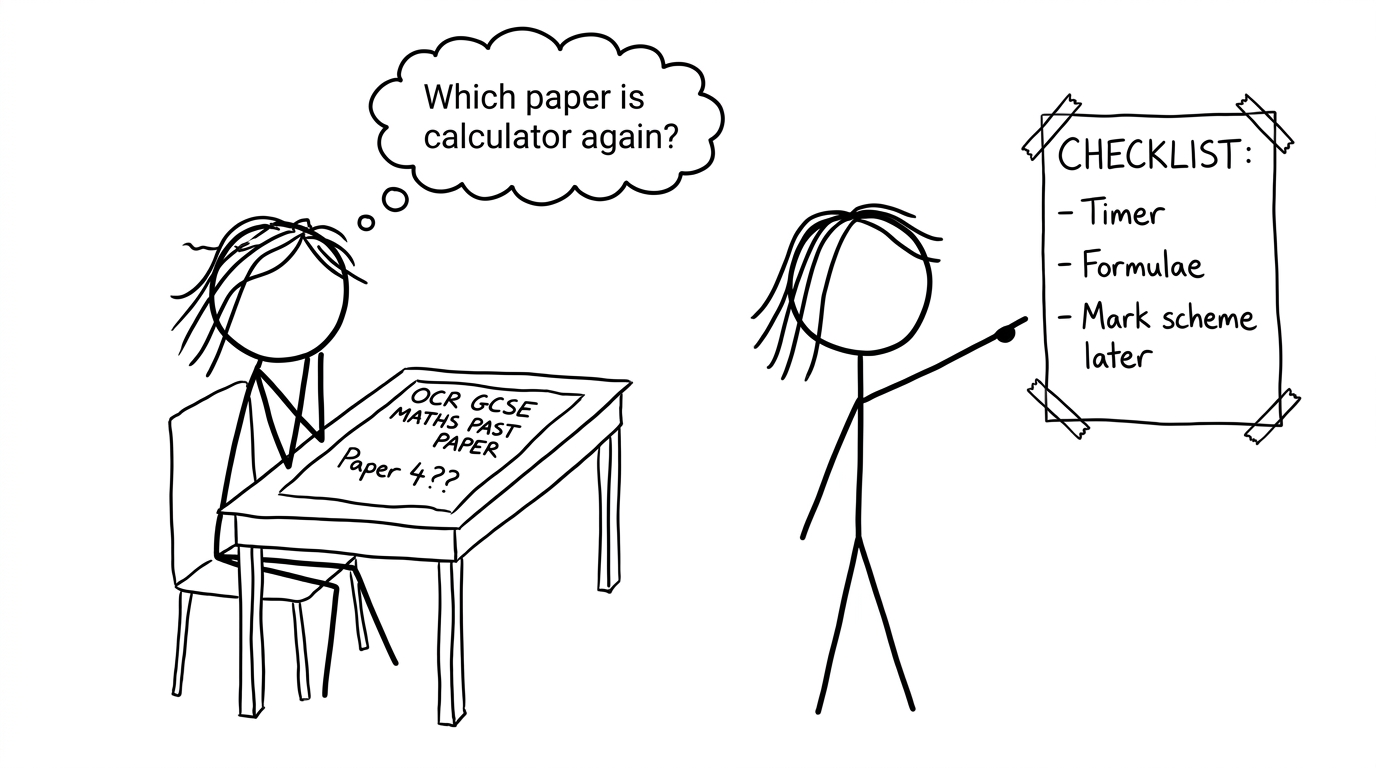 A stressed student vs a helpful checklist
The short checklist (save this before you start)
Use this as your OCR GCSE routine:
- Choose the right paper (foundation or higher, correct series) from GCSE Maths OCR.
- Sit it like a real GCSE: silence, timer, no pausing.
- First mark quickly for a raw score.
- Then re-mark slowly for method marks using the mark scheme.
- Log mistakes by topic (not by question number).
- Fix the weakest topics using lessons, revision guides, and topic questions.
- Re-attempt the same paper two weeks later to prove the improvement.
If you do those seven steps, OCR GCSE Maths past papers stop being stressful and start being useful.
Start with the right OCR GCSE paper (and the right goal)
Before you answer a single question, decide what “properly” means for you.
Match the paper to your tier and your next grade
OCR GCSE Maths has foundation and higher tiers. A foundation student aiming for a grade 555 needs a different strategy from a higher student pushing from grade 777 to 999. Past papers are most powerful when they sit just outside your comfort zone: hard enough to expose gaps, not so hard that everything collapses.
On YesGenie, begin from the OCR board hub: GCSE Maths OCR. From there you can move into the past paper area and topic resources without bouncing between tabs.
Use one paper for timing, another for diagnosis
In GCSE revision, students often try to do “as many papers as possible”. A better pattern is:
- Paper A (timed): build exam stamina and pacing.
- Paper B (untimed, slow): build accuracy, method, and understanding.
Both count as using OCR GCSE Maths past papers properly, but they teach different skills.
Sit OCR GCSE Maths past papers like the real exam
The biggest performance jump often comes from conditions, not content. Under pressure, students stop writing steps, misread the question, or rush a basic calculation. So make pressure normal.
Your exam conditions script
- Set a timer.
- Clear your desk.
- Use the right tools (calculator only when allowed).
- If you’re stuck, mark the question and move on.
After the paper, write one sentence: “What did I do when I panicked?” That sentence becomes your next improvement goal.
 Stopwatch vs calculator duel
Marking properly: the mark scheme is the lesson
Most GCSE students mark OCR papers like this: check answers, count marks, feel good or bad. That’s not marking -- it’s scoring.
Proper marking has two passes:
First pass: score it fast
- Tick correct final answers.
- Add up the marks.
- Circle any question where you guessed.
This tells you your current performance.
Second pass: hunt method marks
OCR GCSE mark schemes (like AQA, Edexcel and Eduqas) often reward method. That means you can be “wrong” and still be close to full marks if your working is strong. So your second pass is about this question:
“Where could I have earned marks even without the final answer?”
Write down what the mark scheme wanted to see: an equation, a substitution, a correct rearrangement, a diagram, a unit, or a clear statement.
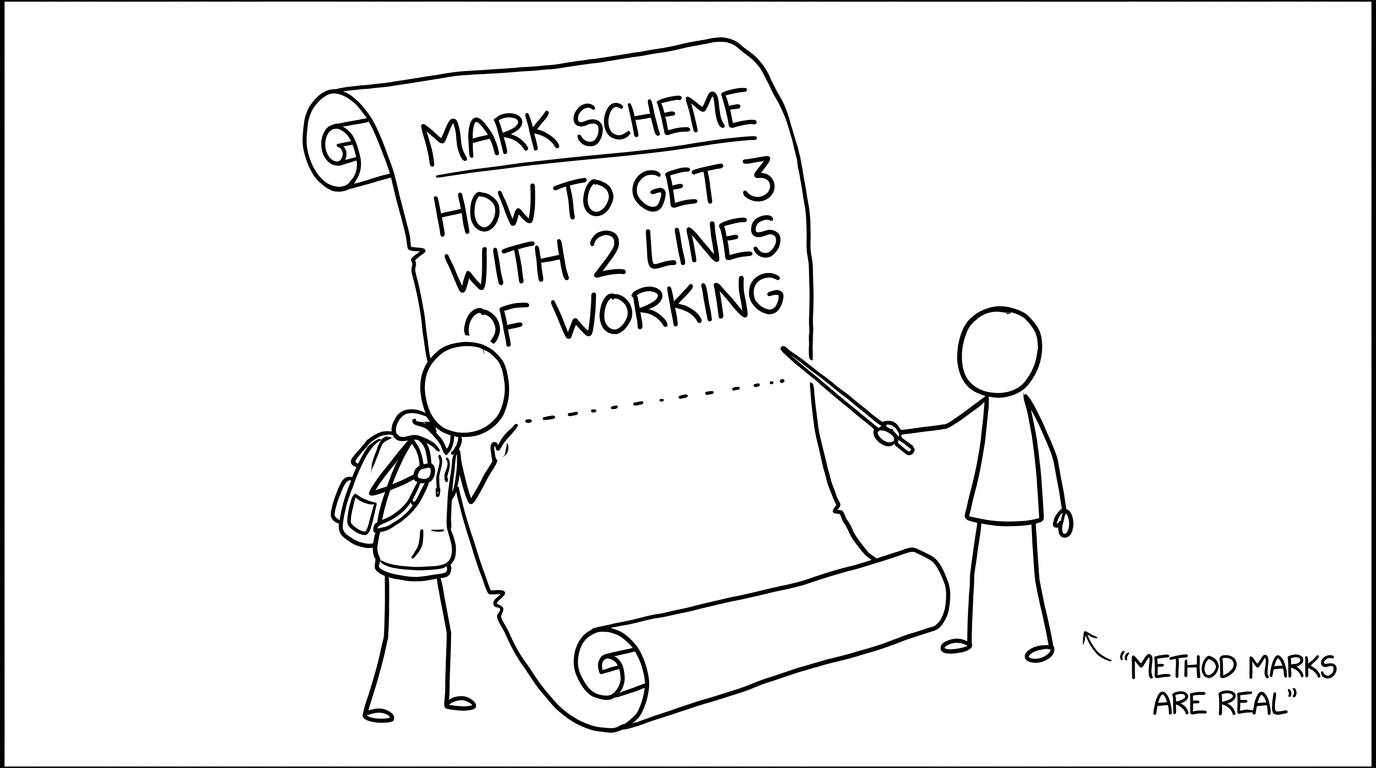 Mark scheme as treasure map
Worked example: method marks on a linear equation
Suppose an OCR GCSE question is worth 333 marks:
Solve 3(2x−5)=4x+73(2x-5)=4x+73(2x−5)=4x+7.
A strong method solution is:
3(2x−5)=4x+7 3(2x-5)=4x+7 3(2x−5)=4x+7 6x−15=4x+7 6x-15=4x+7 6x−15=4x+7 2x−15=7 2x-15=7 2x−15=7 2x=22 2x=22 2x=22 x=11 x=11 x=11Even if a student slips at the final step, the mark scheme often allows method marks for expanding and rearranging correctly. When you mark, don’t just note “I got x=10x=10x=10”. Note where your method first stopped matching the scheme.
Turn every OCR GCSE paper into a topic hit list
A past paper is a mix of topics. Your job is to split it back into topics, because revision happens by topic.
After marking, create a simple log with three columns:
- Topic (e.g. probability, bounds, ratio, graphs)
- Error type (forgot method, accuracy, misread, ran out of time)
- Next action (a YesGenie lesson, revision guide, question bank set)
To target common OCR GCSE areas, these YesGenie pages are useful anchors:
- Probability (OCR) revision guide
- Bounds revision guide
- Best buy questions revision guide
- Coordinates revision guide
- Writing a ratio as a fraction or linear function
You’re not just collecting links -- you’re turning the OCR GCSE paper into a personal specification.
Worked example: bounds (a classic GCSE mark-dropper)
A length lll is given as l=8.2l=8.2l=8.2 cm correct to the nearest 0.10.10.1 cm. Find the lower and upper bounds.
Nearest 0.10.10.1 means half a step is 0.050.050.05.
So:
8.15≤l<8.25 8.15 \le l < 8.25 8.15≤l<8.25Students often write 8.2±0.18.2 \pm 0.18.2±0.1 (too wide), or forget the strict inequality on the upper bound. When you use OCR GCSE Maths past papers properly, you don’t just correct the interval -- you write the rule: “half the rounding unit”. Then you go and practise bounds questions until it’s automatic.
Fixing weaknesses: use YesGenie resources between papers
Past papers are the diagnostic scan. The real improvement happens between scans.
A simple cycle:
- Do one OCR GCSE paper.
- Identify the top two topics losing the most marks.
- Spend 333--444 days on those topics using:
- revision lessons and revision guides,
- topic question banks and solutions,
- mini tests for speed,
- and then return to another past paper.
If you want a central place to branch out into different formats (predicted papers, mini tests, short papers), use Resources and Other resources.
You can also use the broader hub of GCSE Past papers if you’re comparing OCR with Edexcel or AQA practice for extra variety while keeping GCSE difficulty consistent.
How to review errors without wasting time
A lot of GCSE revision fails in the review stage. Students re-do the whole question, or copy the mark scheme, or highlight everything. None of those guarantee you can do it next week.
The fastest review method is:
- Write a one-line diagnosis: “I expanded incorrectly” or “I didn’t form an equation”.
- Write a one-line fix: “Always expand before collecting like terms” or “Let the unknown be xxx and translate words into algebra”.
- Do two similar questions from the question bank or topic booklet.
That final step matters. Understanding feels like progress, but only correct repetition becomes marks.
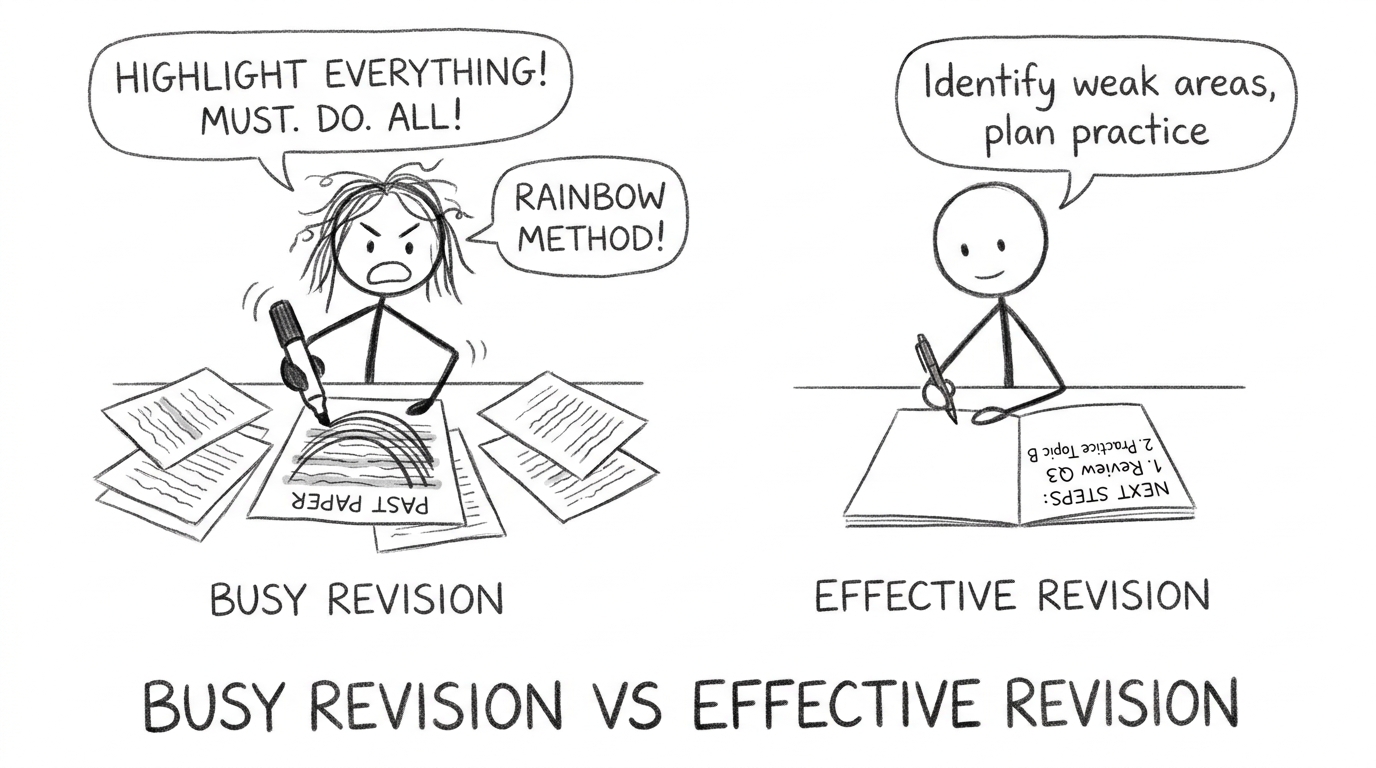 Busy revision vs effective revision
Worked example: ratio into a fraction
A class has boys:girls in the ratio 3:53:53:5. What fraction of the class are girls?
Total parts =3+5=8=3+5=8=3+5=8.
Girls are 555 parts, so the fraction is:
58 \frac{5}{8} 85In GCSE papers, students sometimes write 53\frac{5}{3}35 (they treat the ratio like a fraction) or 55\frac{5}{5}55 (they forget total parts). Your review note should be: “fraction is part over total parts”. Then practise with mixed ratio questions, including “not” and multi-step problems.
Common mistakes when using OCR GCSE Maths past papers
- Doing papers back-to-back with no gap analysis. This creates familiarity, not skill. GCSE improvement comes from fixing specific topics.
- Marking only the final answer. OCR mark schemes reward method. If you don’t learn what earns marks, you won’t write it under pressure.
- Not reattempting. The second attempt is where you prove the learning. Without it, you’re guessing whether revision worked.
- Ignoring timing data. Write down where you ran out of time. Many GCSE students lose marks simply by spending too long early on.
- Practising the wrong tier. Foundation students doing higher papers (or vice versa) get distorted feedback and often lose confidence.
- Treating a weak topic as “a paper problem”. If probability keeps coming up, it’s a probability problem. Use the topic pages and practise properly.
FAQ
How many OCR GCSE Maths past papers should I do?
There isn’t a magical number of OCR GCSE Maths past papers, because the value comes from the review cycle, not the count. If you do five papers but never fix the repeated topics, you’ll feel busy and still plateau. A better plan is to do fewer papers, but reattempt them after targeted practice, because that proves learning and builds confidence. For most students, 111 timed paper per week plus 111 slow paper (or a half paper) can be enough when the review is rigorous. Closer to exams, you can increase frequency, but only if you still have time to correct weaknesses. YesGenie makes this easier because you can move from a past paper straight into revision lessons, topic question banks, and solutions on the same site.
Should I use the mark scheme straight away or try corrections first?
For GCSE revision, do a short “correction attempt” before reading the mark scheme in detail. First, circle the questions you dropped marks on and give yourself 555--101010 minutes to rework them using your notes or memory. This reveals whether the error was a one-off slip or a genuine gap in method. After that, use the mark scheme to learn exactly what OCR would award, including method marks and acceptable forms. Then write a short note about what you needed to show, not just what the answer was. Finally, practise two similar questions so the fix sticks. That sequence stops the mark scheme becoming a crutch and turns it into a teacher.
I’m an A Level student helping a younger sibling with GCSE past papers -- what’s the best approach?
As an A Level student, your instinct may be to solve everything quickly in your head, but GCSE success often depends on writing clear steps that match the mark scheme. When you support someone with OCR GCSE Maths past papers, focus on structure: show the setup, show the transformation, show the final statement with units where needed. Encourage them to narrate the decision-making: “This is a ratio, so I’ll add parts” or “This is bounds, so I’ll halve the rounding unit”. Also help them build a topic-based error log, because GCSE gaps are usually clustered (fractions, algebra, graphs, probability), and clusters respond well to short, targeted practice. Use YesGenie revision guides to refresh the exact GCSE method, because it’s sometimes taught differently to the way you’d naturally do it at A Level. Over time, the goal is that they can replicate the method under timed conditions without you.
What if I keep getting the same OCR GCSE topics wrong even after practice?
When the same GCSE topic repeats, the problem is usually not effort -- it’s feedback quality. Check whether you’re practising questions that are too similar, because that can create pattern-spotting rather than understanding. Go back to the revision guide and make sure you can explain the method in one or two sentences, then do mixed questions that force you to choose the method. Also check whether your mistakes are actually accuracy issues (sign errors, arithmetic, calculator input) rather than concept issues, because the fix is different. If timing causes the mistakes, practise the topic with a strict time limit so your brain learns to work under pressure. Finally, reattempt the original past-paper question after a week, because retrieval after a gap is what makes the learning durable. This is where YesGenie’s topic resources, mini tests, and full past papers work well together: you can practise, test, and then validate on the real OCR GCSE style.
Closing: make OCR GCSE past papers work for you
Using OCR GCSE Maths past papers properly is less about grinding through paper after paper, and more about building a loop: attempt, mark for method, log by topic, practise the weak spots, then reattempt. That loop is what turns time into marks.
If you want the simplest next step, start at GCSE Maths OCR, choose a past paper, and commit to the two-pass marking routine. Then use YesGenie revision lessons, revision guides, practice questions, and solutions to fix the exact topics your GCSE paper exposed. When you’re ready, layer in predicted papers and mini tests from Resources to sharpen exam readiness. Do that consistently, and your OCR GCSE past papers stop being a judgement -- they become your plan.