

Revise GCSE Maths (Edexcel) Without Wasting Time
GCSE maths revision for Edexcel students: stop wasting time, target weak topics, use past papers, predicted papers and mark schemes to gain marks fast.
There’s a moment most Edexcel students recognise. You sit down to do GCSE maths revision, open ten tabs, scroll past a hundred resources, and somehow an hour disappears without a single mark earned. It’s not laziness. It’s friction. Revision feels like pushing a heavy door when you’re not sure which room you even need to be in.
This post is about making revision lighter by making it sharper. Not more effort -- better aim. If you’re revising for Edexcel GCSE Maths (foundation or higher tier), the goal isn’t to “cover everything”. The goal is to turn time into marks using the specification, past papers, predicted papers, and a method that stops you drifting.
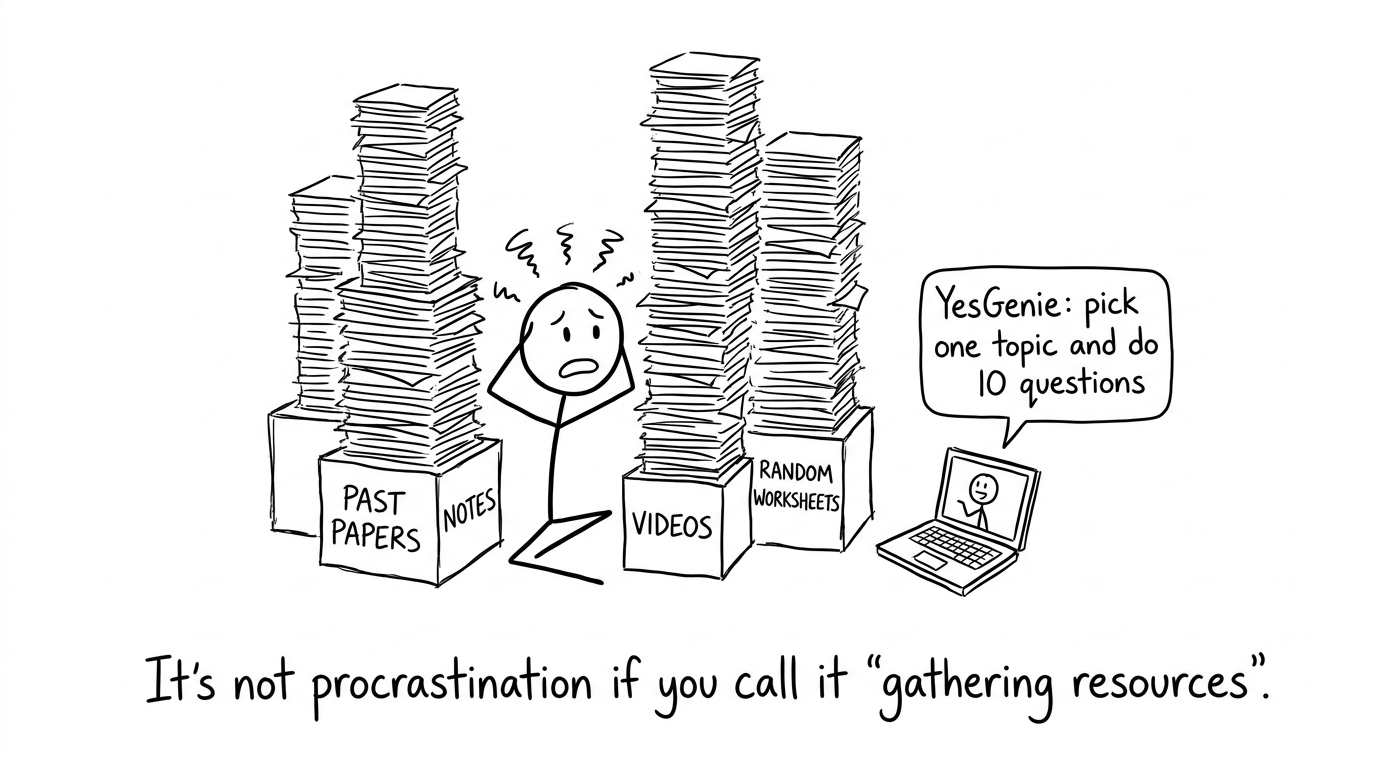 A student drowning in resources while a laptop suggests one topic and ten questions
The no-waste GCSE revision checklist (Edexcel)
Use this as your default loop. It’s simple enough to repeat daily and strict enough to keep you honest.
- Pick one topic (not a whole paper).
- Learn the method quickly (lesson or revision guide).
- Do exam-style questions immediately.
- Mark with a mark scheme.
- Write a one-line fix for every mistake.
- Re-test the same skill within 48 hours.
For Edexcel GCSE Maths, YesGenie makes this loop easy because the resources live together: lessons, topic questions, past papers, predicted papers, mini tests, and video solutions.
Useful starting points:
- Edexcel GCSE Maths Revision Hub
- Edexcel GCSE Maths Past Papers
- Edexcel GCSE Maths Predicted Papers
- GCSE Past Papers (all boards)
- Resources (mini tests, 45 minute tests, predicted papers)
- Other Resources (self-assessment sheets, formulae)
Why GCSE maths revision wastes time (and what to do instead)
Time gets wasted in Edexcel GCSE revision for three predictable reasons.
You revise what feels familiar
It’s comforting to redo a topic you can already do. It’s also a quiet way of avoiding your weak areas. Marks, however, don’t care what feels comfortable.
Fix: keep a “marks leak” list. After every practice session, add the exact skill you missed (for example: “rearranging with fractions” rather than “algebra”). Your next session starts with that list.
You confuse recognising with knowing
Reading a worked solution gives the feeling of understanding, but the exam asks you to produce the method under time pressure.
Fix: switch from passive revision to active recall: look away, write the steps, then check.
You do full papers too early
Full papers are brilliant -- but only once you have a base. Early on, they can turn into 90 minutes of guessing, which creates stress rather than skill.
Fix: build accuracy topic-by-topic first, then use Edexcel papers to practise timing and exam technique.
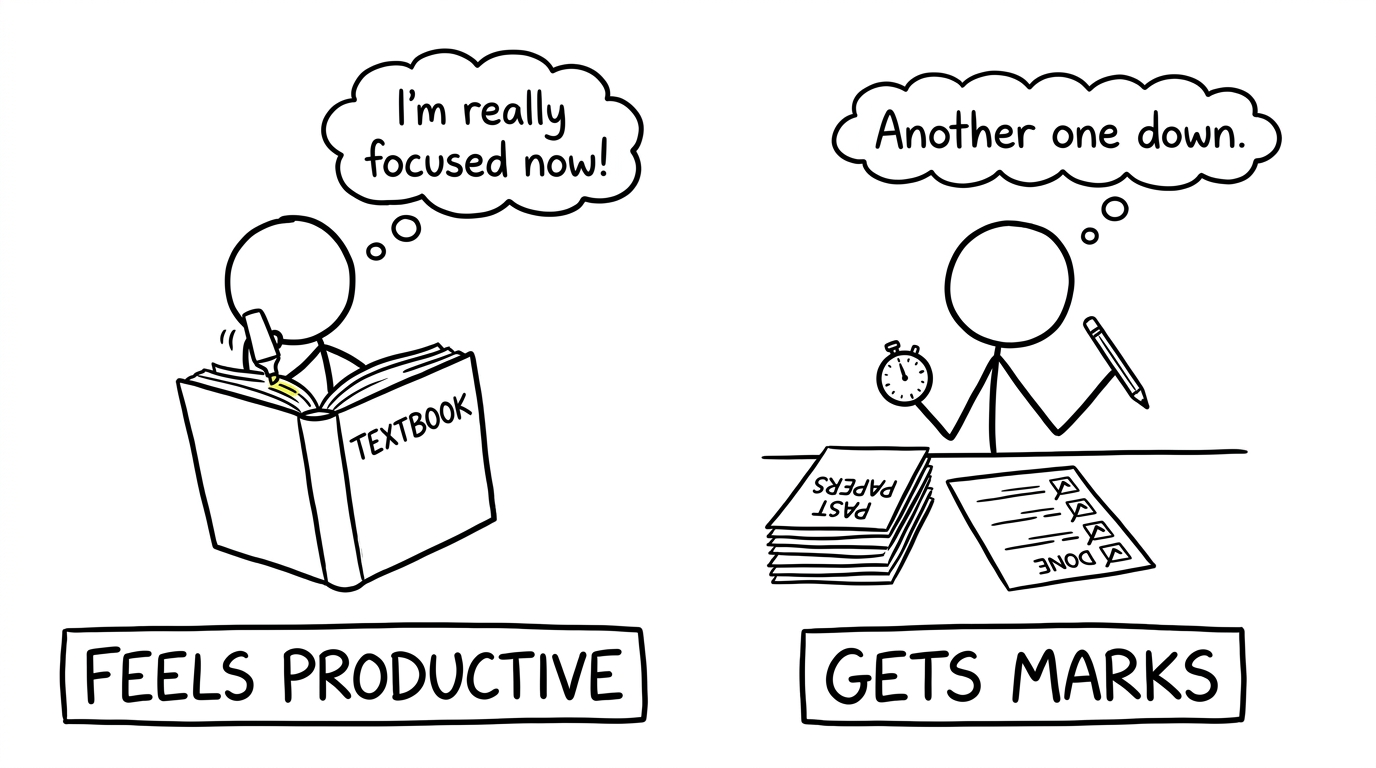 Feels productive vs gets marks: highlighting vs past paper practice
A smarter GCSE plan for Edexcel: topic first, papers second
Think of Edexcel GCSE Maths revision like building a wall. Past papers are the weather test. Topic practice is laying bricks.
Phase 1: Build the brickwork (topic practice)
Spend most of your time on high-frequency, high-leverage skills:
- algebra manipulation (collecting like terms, expanding, factorising)
- rearranging formulae
- ratio, proportion, and percentage change
- graphs and gradients
- area/volume and standard form
On YesGenie, start from the Edexcel GCSE Maths Revision Hub and choose a topic lesson, then move straight to exam-style questions.
Phase 2: Weather test (past papers and predicted papers)
Once you’re consistently accurate on topics, use:
- Edexcel GCSE Maths Past Papers for realism
- Edexcel GCSE Maths Predicted Papers to sharpen focus near exams
Predicted papers are most useful when they follow topic work. They’re not magic. They’re a spotlight.
Worked examples: three methods that win GCSE marks fast
These are the kinds of skills that show up everywhere in Edexcel GCSE Maths. The aim is to practise the method until it’s boring.
Rearranging a formula (algebra you can trust)
Make xxx the subject of:
y=3x−5 y = 3x - 5 y=3x−5Add 555 to both sides:
y+5=3x y + 5 = 3x y+5=3xDivide both sides by 333:
x=y+53 x = \frac{y+5}{3} x=3y+5Why it matters for GCSE: Edexcel loves rearranging because it tests accuracy under pressure. One sign error can lose multiple marks.
Percentage change (the difference between “I knew it” and full marks)
An item costs £80 and increases by 15%15\%15%. Find the new price.
Convert 15%15\%15% to a multiplier: 1.151.151.15.
New price:
80×1.15=92 80 \times 1.15 = 92 80×1.15=92So the new price is £92.
Extension that saves time in GCSE papers: A decrease of 15%15\%15% would use multiplier 0.850.850.85.
Solving a quadratic by factorising
Solve:
x2+7x+12=0 x^2 + 7x + 12 = 0 x2+7x+12=0Find two numbers that multiply to 121212 and add to 777: 333 and 444.
Factorise:
x2+7x+12=(x+3)(x+4) x^2 + 7x + 12 = (x+3)(x+4) x2+7x+12=(x+3)(x+4)Set each bracket to zero:
x+3=0⇒x=−3 x+3=0 \Rightarrow x=-3 x+3=0⇒x=−3 x+4=0⇒x=−4 x+4=0 \Rightarrow x=-4 x+4=0⇒x=−4So the solutions are x=−3x=-3x=−3 and x=−4x=-4x=−4.
Why it matters for Edexcel GCSE: it’s usually a clean, high-value question where method marks are available even if you slip at the end.
How to use mark schemes without fooling yourself
Mark schemes are not just for scoring. They’re a map of what Edexcel rewards.
- If the mark scheme shows an intermediate line, it often means a method mark is available there.
- If your answer is wrong, check whether your method was right. You might be one sign error away from full marks next time.
- Write a one-line correction in your own words, like: “When finding gradient, use ΔyΔx\frac{\Delta y}{\Delta x}ΔxΔy, not ΔxΔy\frac{\Delta x}{\Delta y}ΔyΔx.”
When you practise papers from Edexcel GCSE Maths Past Papers, make the marking part of the session, not a separate task you “might do later”. That’s how you stop repeating the same mistake.
Common mistakes that waste GCSE revision time
These are small errors with large consequences in Edexcel GCSE Maths.
- Not writing enough working. In GCSE mark schemes, correct method often earns marks even if the final answer is wrong.
- Mixing up exact and decimal answers. If the question expects an exact value (like π\piπ or a surd), don’t round unless asked.
- Forgetting to answer the question. You solve for xxx, but the question wanted 2x+12x+12x+1. Always re-read the final line.
- Rounding too early. Keep full calculator values until the end, then round once.
- Angle facts half-remembered. If you’re not sure, revisit the topic lesson rather than guessing in a paper.
- Calculator dependence. Paper 1 non-calculator rewards number sense. Use short, regular practice, not a last-minute panic.
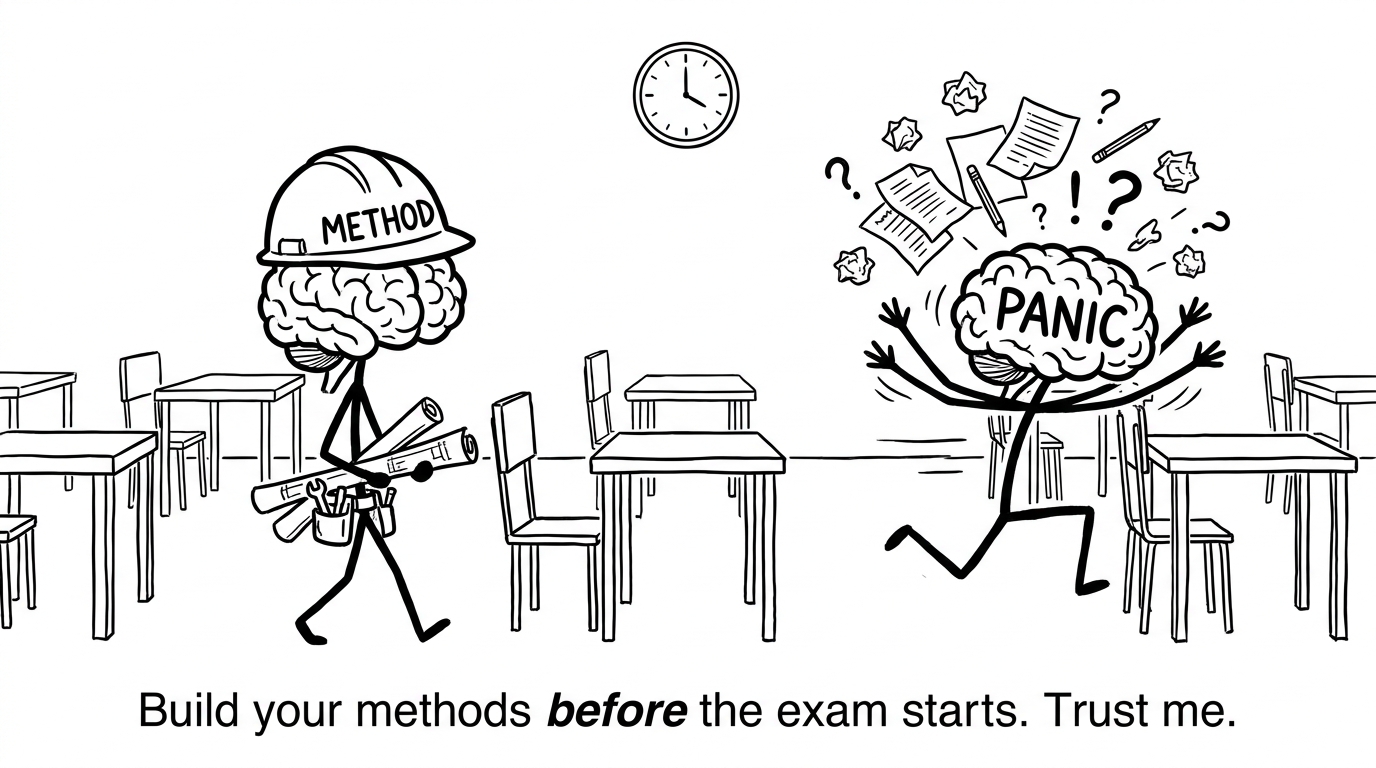 Two brains in an exam hall: “Method” calm, “Panic” chaotic
Edexcel GCSE timing: practise like you’ll sit it
Edexcel GCSE Maths comes in three papers. Usually, Paper 1 is non-calculator; Papers 2 and 3 are calculator (check your year’s information). The mistake is revising “topics” but never practising the switching cost of an exam: moving from algebra to geometry to statistics with no warm-up.
A simple routine:
- Once a week, do a timed half-paper or mini test from the Resources section.
- On other days, do focused topic practice.
- In the final weeks, alternate between Edexcel GCSE Maths Predicted Papers and your marks leak list.
This way, your GCSE revision stays targeted while still building exam stamina.
FAQ
How many hours should I revise for GCSE Maths each week for Edexcel?
It depends on your starting point, but the bigger factor is quality per hour, not the raw number. Many students do long sessions that are mostly reading, rewriting notes, or watching videos without attempting questions, and that time doesn’t convert into GCSE marks. A more reliable approach is shorter sessions where you attempt exam-style questions, then mark them carefully. If you’re in Year 11, a common rhythm is 333 to 555 focused sessions a week, each 303030 to 606060 minutes, plus one longer timed paper session. If you’re aiming for grades 888-999, you’ll usually need more frequent exposure to harder multi-step questions and proof-style reasoning. Use YesGenie to keep sessions tight: lesson or revision guide for the method, then immediate practice, then mark scheme and video solutions.
Should I use predicted papers or past papers first for Edexcel GCSE?
Past papers are the most authentic mirror of the Edexcel style, so they matter for exam technique and timing. But if you start with full past papers too soon, you can spend most of your time discovering weaknesses rather than fixing them. Predicted papers are best when you already have a topic foundation and want a focused final stretch, not when you’re still building basics. A sensible sequence is topic work first, then a few past papers to learn the feel of the exam, then predicted papers nearer the real dates to tighten coverage. When you do a paper, don’t just score it and move on: analyse it, add mistakes to your marks leak list, and revisit those topics. On YesGenie you can move smoothly between Edexcel GCSE Maths Past Papers and Edexcel GCSE Maths Predicted Papers so the loop stays fast.
I’m good at maths but my GCSE marks don’t show it. What should I change?
This is common, especially for higher tier students who can do the maths but lose marks on communication and structure. Edexcel mark schemes reward clear method, correct units, sensible rounding, and answering the question that was actually asked. Start treating working as part of the answer: write the line that earns the method mark, not just the final result. Next, practise under mild time pressure so you learn to keep accuracy when you’re moving quickly between topics. Then focus on your “near-miss” errors: sign slips, wrong substitution, rounding early, or copying numbers incorrectly, because these are the fastest marks to recover. Finally, use video solutions to compare your approach to a clean exam-method approach, and copy the structure, not just the result. YesGenie’s paper practice and mark schemes help you turn “I understand it” into “I can score it in a GCSE exam”.
Bringing it together: a GCSE revision routine that earns marks
If Edexcel GCSE maths revision has felt messy, it’s usually because you’ve been trying to revise everything at once. The calmer strategy is to make every session answer one question: “What will I do differently in the next paper because of this hour?”
Use YesGenie as your home base: start from the Edexcel GCSE Maths Revision Hub, build skills with lessons and practice questions, then pressure-test them with Edexcel GCSE Maths Past Papers and sharpen your final preparation with Edexcel GCSE Maths Predicted Papers. Keep a marks leak list, mark properly, and re-test quickly.
Do that consistently, and you stop “revising GCSE maths” in the vague sense. You start collecting marks on purpose.