

Stop Forgetting GCSE Maths (OCR): A Simple System
GCSE OCR maths revision made simple: stop forgetting topics using spaced practice, mixed questions, past papers and YesGenie resources to boost marks.
If you’re an OCR student revising for GCSE Maths, forgetting can feel personal. You do a topic on Monday, feel fine on Tuesday, then by Friday it’s like the method never existed. It’s not laziness, and it’s not a sign you “just aren’t a maths person”. It’s a predictable result of how memory works when revision stays too tidy: one topic at a time, one worksheet at a time, and then you move on.
The good news is that OCR GCSE Maths rewards students who can retrieve methods under pressure, not students who once understood them in a calm bedroom. So the fix isn’t more highlighting or longer sessions. The fix is a small system: spaced recall, mixed practice, and exam-style checking.
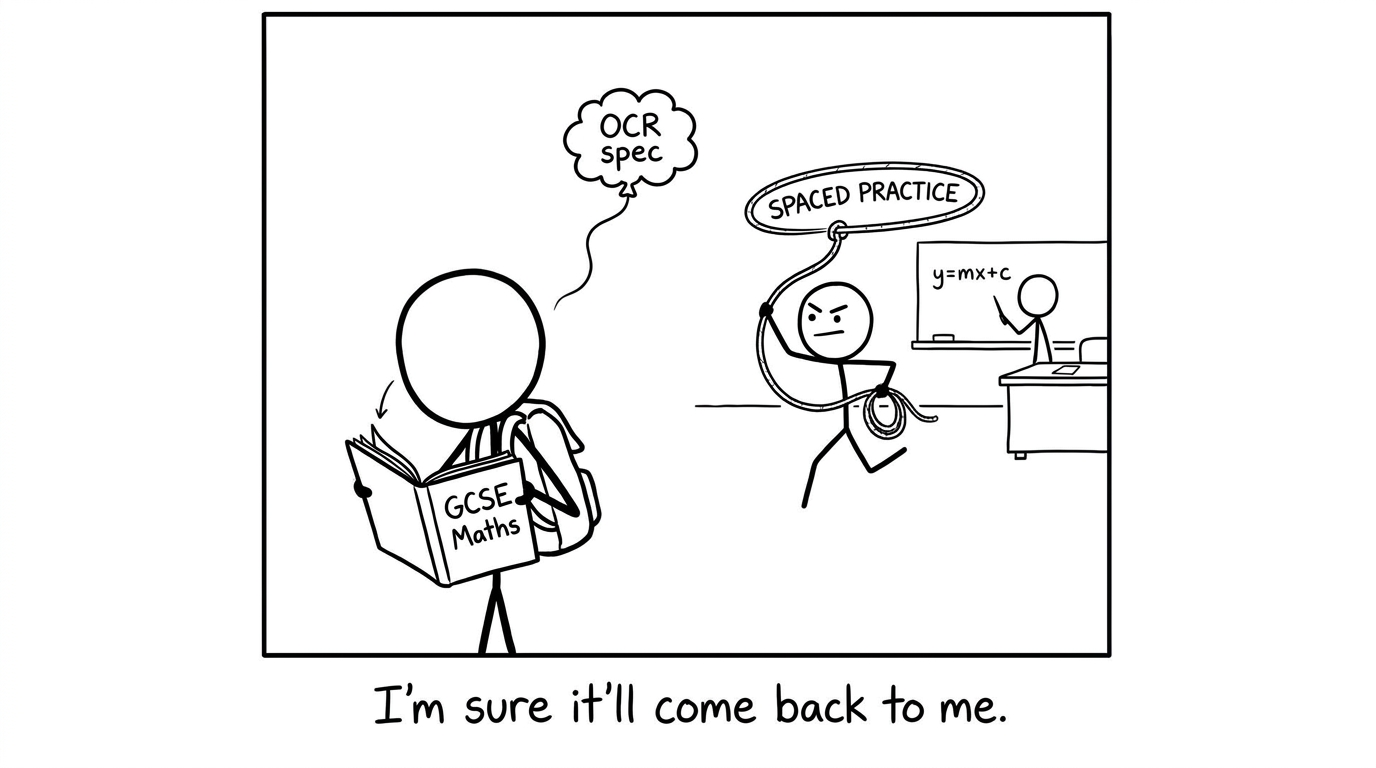 A stick figure chases the OCR spec balloon with spaced practice
The forgetting problem (and why OCR GCSE makes it obvious)
OCR papers are full of “looks familiar but not identical” questions: fractions inside algebra, ratio in context, geometry with a twist, probability wrapped in words. If your revision has been mostly recognition (seeing worked solutions and thinking “yeah, I get it”), the exam exposes the gap.
Forgetting happens fastest when:
- You practise a topic once, then don’t touch it for weeks.
- You only do questions that match the example you just saw.
- You don’t check against a mark scheme, so mistakes become habits.
That’s why students often feel confident in revision but lose marks in the GCSE itself.
A quick checklist to stop forgetting GCSE content
Use this as your baseline for OCR GCSE Maths revision:
- Spaced practice: return to a topic multiple times across weeks.
- Active recall: start sessions by trying questions before looking at notes.
- Interleaving: mix topics in one session, like real GCSE papers.
- Exam feedback loop: mark, reflect, redo, then re-test later.
- Small, consistent sessions: 20-40 minutes beats one long panic.
YesGenie is built for this style of revision: topic lessons, question banks, flashcards, mini tests, and past papers in one place.
Start with the OCR GCSE hub (your “home base”)
Your system needs one reliable place to organise everything. For OCR students, start here: OCR GCSE Maths Revision.
From that hub you can:
- Learn methods again using lessons and revision guides.
- Switch straight into exam-style practice.
- Use flashcards for quick active recall.
This matters because forgetting often comes from friction: if finding the “right” questions takes longer than doing them, you stop returning to topics.
The method that actually sticks: spaced recall + mixed GCSE questions
Spaced recall means you intentionally bring a topic back just as it starts to fade. Mixed practice (interleaving) means you stop your brain relying on the chapter title to tell it what to do.
A simple weekly pattern for OCR GCSE Maths:
- Day 1: Learn/relearn a topic (lesson + a few guided questions).
- Day 2: Do a small set of exam questions on it.
- Day 5: Do a mixed set where that topic appears alongside others.
- Next week: Re-test using a mini test or short paper segment.
On YesGenie, mix these tools:
- Use topic notes and examples from the revision guides (for clarity).
- Use flashcards to force recall: Fractions, Decimals and Percentages Flashcards (OCR).
- Use exam-style questions from the question banks (to stop “example copying”).
Worked example: fractions of an amount (a classic GCSE memory trap)
A lot of OCR GCSE mistakes come from rushing the “divide then multiply” structure.
Example: Find 35\frac{3}{5}53 of £60.
Method (always the same): divide by the denominator, multiply by the numerator.
35 of 60=60÷5×3=12×3=36 \frac{3}{5}\text{ of }60 = 60 \div 5 \times 3 = 12 \times 3 = 36 53 of 60=60÷5×3=12×3=36So the answer is £36.
Now make it stick: two days later, do one more question of the same type without notes. A week later, do it again in a mixed set with algebra and ratio. That repeated retrieval is what stops forgetting in GCSE Maths.
For supporting notes and more examples, use a revision guide like Fractions, Decimals and Percentages Revision Guide (the method is the same across boards, so the worked structure still helps).
Worked example: ratio that turns into algebra (OCR loves this feel)
OCR questions often start with ratio language and end with an equation.
Example: The ratio a:ba:ba:b is 2:52:52:5 and a+b=56a+b=56a+b=56. Find aaa and bbb.
Let the common multiplier be kkk.
a=2k,b=5k a=2k, \quad b=5k a=2k,b=5kThen:
a+b=2k+5k=7k=56⇒k=8 a+b=2k+5k=7k=56 \Rightarrow k=8 a+b=2k+5k=7k=56⇒k=8So:
a=2×8=16,b=5×8=40 a=2\times 8=16, \quad b=5\times 8=40 a=2×8=16,b=5×8=40This is an ideal spaced-recall topic because students remember the idea, but forget the clean structure (2k2k2k, 5k5k5k, add, solve). Build it into your weekly OCR GCSE rotation.
For more ratio-to-algebra style practice, see: Writing a Ratio as a Fraction or Linear Function (OCR Revision Guide).
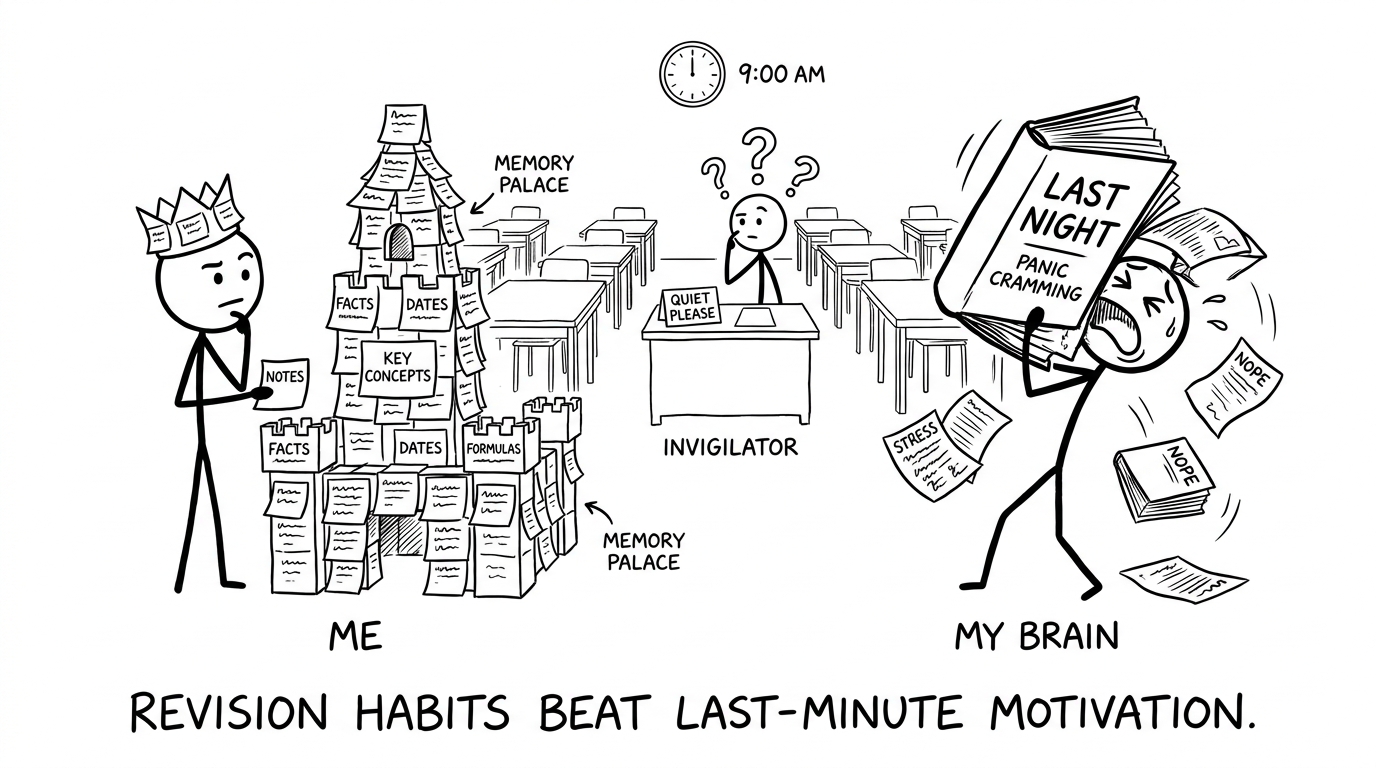 Two students: calm spaced practice vs last-night cramming
How to use past papers without “wasting” them
Many students avoid past papers because they feel too hard, or they save them for later. But OCR GCSE Maths papers are most useful when they become a feedback tool, not a judgement.
Use this process:
- Attempt a section timed (even 20-30 minutes).
- Mark it carefully.
- Write a one-line reason for each lost mark (e.g. “expanded wrongly”, “forgot to simplify”, “used area formula not circumference”).
- Redo the exact questions you missed 48 hours later.
- Re-test the same topic a week later using different questions.
To find papers and keep it board-specific, start at: GCSE Past Papers and your OCR hub: OCR GCSE Maths Revision.
Build retrieval into your day (without adding hours)
A memory-friendly GCSE routine is usually short and slightly uncomfortable:
- 5 minutes: flashcards on yesterday’s topics (active recall).
- 20 minutes: mixed exam questions (interleaving).
- 5 minutes: correct, reflect, and log what to redo.
If you want a menu of short, focused resources, use: Resources on YesGenie.
A good rule: if you always feel comfortable, you’re probably revising in a way that doesn’t transfer to GCSE exam pressure.
Common mistakes that cause GCSE forgetting (and lost marks)
These patterns are responsible for a lot of “I knew this last week” moments in OCR GCSE Maths:
- Only re-reading notes: recognition isn’t retrieval. You need to answer questions cold.
- Doing topics in blocks: it feels productive, but your brain learns the cue “this is a fractions worksheet” rather than the method.
- Not using the mark scheme language: in GCSE, method marks matter. If your working is unclear, you lose marks even with the right idea.
- Ignoring small arithmetic errors: a wrong ÷\div÷ or sign error becomes a repeated habit unless you correct it deliberately.
- Not revisiting mistakes: the quickest route to improvement is redoing your own errors after a gap (48 hours, then a week).
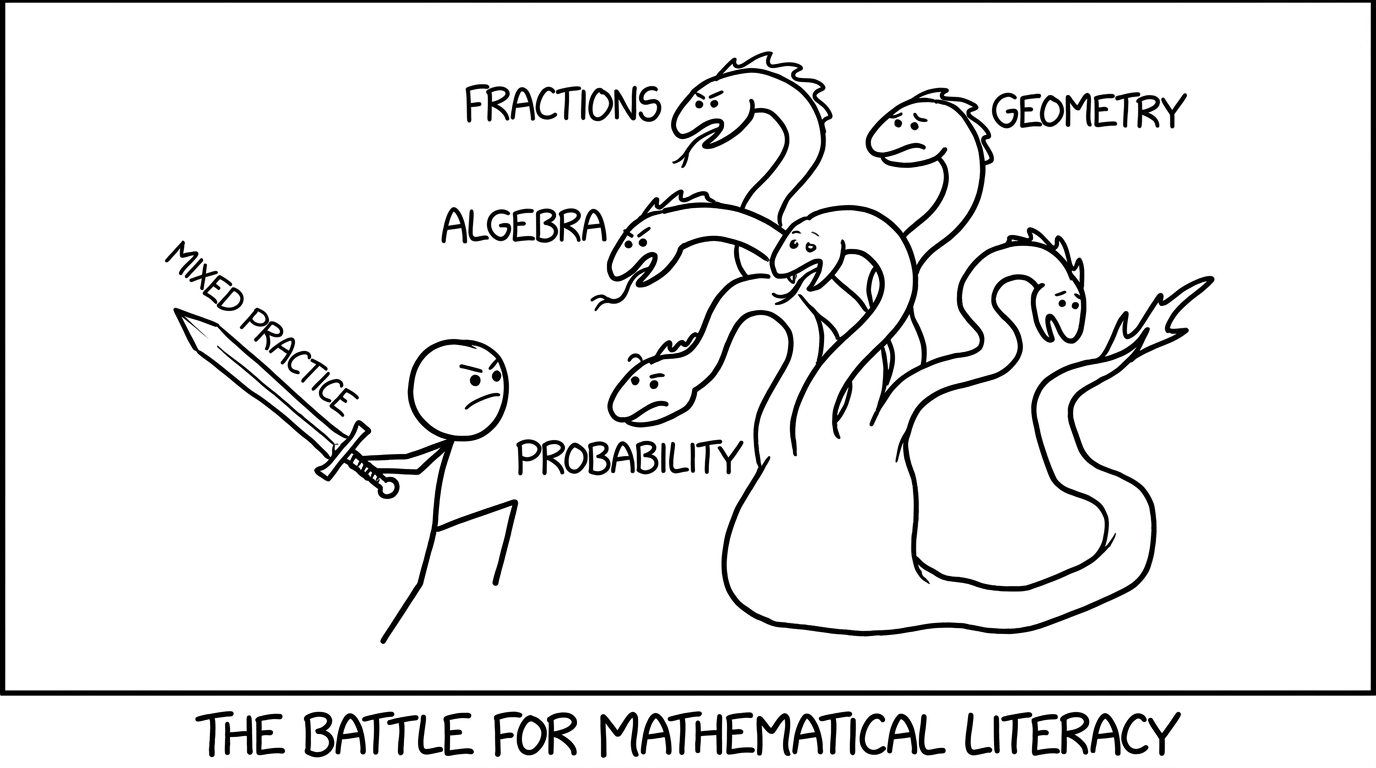 A hydra labelled fractions/algebra/geometry defeated by mixed practice
FAQ
How can I stop forgetting GCSE Maths formulas and methods?
Forgetting GCSE Maths formulas is usually a retrieval problem, not an understanding problem. You might understand the formula when you see it, but the exam asks you to recall it under time pressure and apply it in context. The fix is to practise bringing it to mind rather than re-reading it: write the formula from memory, then use it in one exam-style question. Space this out so you return to it after 2 days, then 5-7 days, then again two weeks later. That spacing is where memory strengthens, because you’re re-building the pathway each time it tries to fade. On YesGenie, combine revision guides (to keep the method clean) with flashcards and then exam questions so the formula becomes something you can use, not just something you can recognise.
I’m OCR for GCSE Maths. Do I need OCR-specific practice to stop forgetting?
OCR-specific practice helps because the style of question phrasing and topic balance becomes familiar, which reduces cognitive load in the GCSE exam. That said, forgetting is mostly about how you revise: active recall, spaced practice, and mixed questions matter more than the logo on the paper. A strong approach is to learn the method using a clear revision guide, then lock it in using OCR exam questions and papers so the application matches your specification. If you always practise in neat topic blocks, you will still forget even if every worksheet is OCR branded. Use the OCR hub as your home base, then return to weak topics repeatedly across weeks. The best sign you’re improving is not that revision feels easier, but that you can still do the method after a gap.
What should I do when I get a GCSE question wrong but I don’t know why?
First, treat it like data: a wrong answer is a clue to what your brain is doing under pressure in GCSE conditions. Re-attempt the question without looking at the solution, but force yourself to write down the plan in words (e.g. “make a common denominator”, “let the ratio be 2k:5k2k:5k2k:5k”, “rearrange then substitute”). Then check the worked solution or mark scheme and compare your plan to theirs, line by line, until you can name the exact moment you diverged. Next, write a short correction note that you can re-test later, not a full page of rewriting. Finally, schedule two re-tests: one in 48 hours (same skill, different question) and one a week later (mixed set). This is how mistakes stop repeating, and how you stop “forgetting” the same topic every fortnight.
Bringing it together: a GCSE system you can trust
OCR GCSE Maths doesn’t reward the student who revised the longest. It rewards the student who can retrieve methods, choose the right tool, and show clear working when it matters.
Build your system around repeated retrieval:
- Start from the OCR GCSE Maths Revision hub.
- Use lessons and revision guides to rebuild foundations quickly.
- Use flashcards and mixed practice to stop forgetting.
- Use GCSE Past Papers to train exam decisions.
- Use the wider YesGenie Resources when you need mini tests, predicted papers, or short focused practice.
If you want a calmer run-up to the GCSE exams, make forgetting part of the plan: revisit topics before they disappear. Then let YesGenie do what it’s built for -- free revision lessons, practice questions with solutions, past papers, predicted papers, and mark-scheme-ready methods that turn effort into marks.